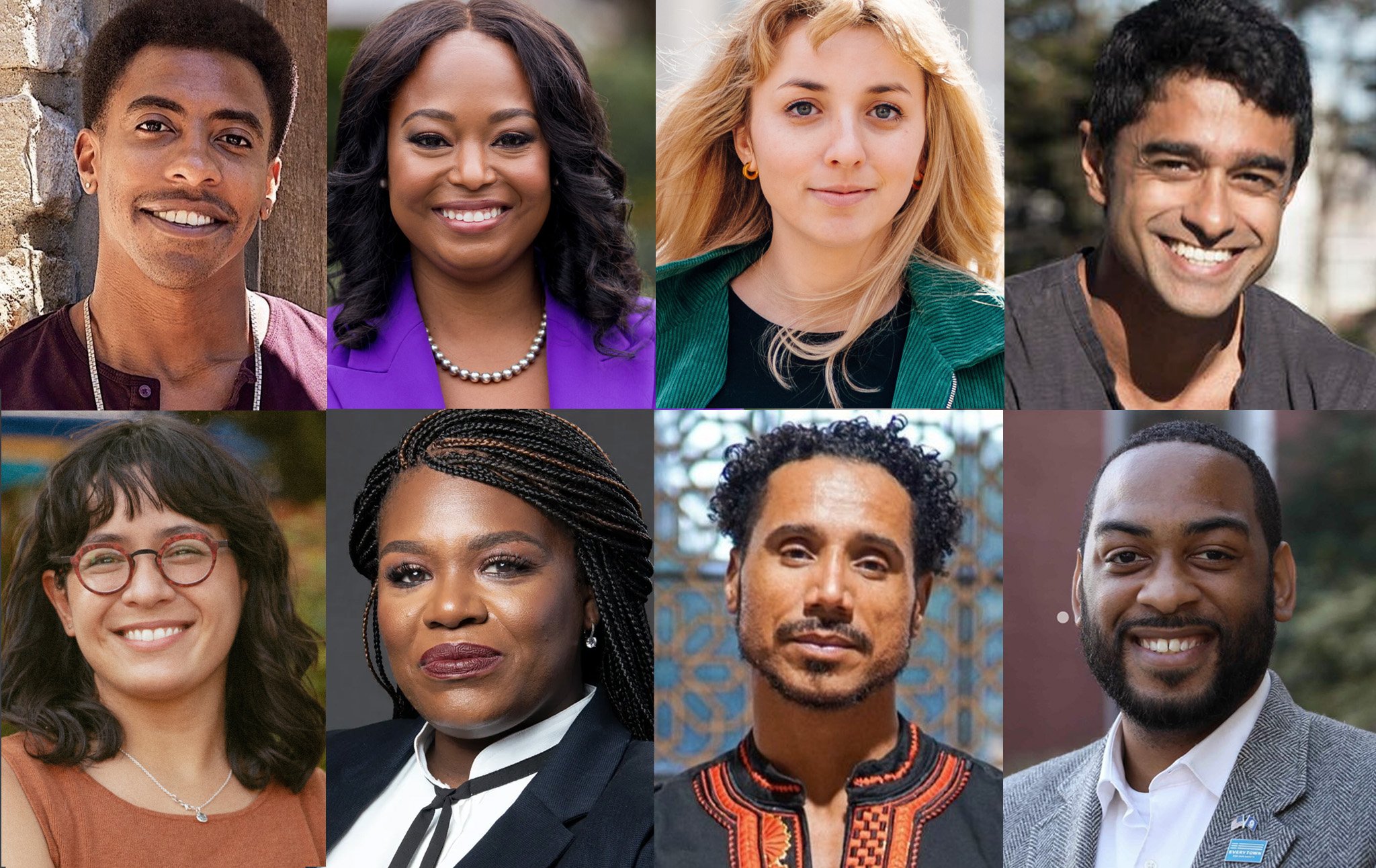
Election Day is coming up, and there’s an opportunity for socialists, labor candidates, and the Medicare for All movement to make historic gains.
We’re now two months into 2026, roughly a quarter of the way through Donald Trump’s second presidency, and things have been grim. Overseas, Trump’s government has attacked Venezuela and kidnapped its head of state, killing at least 83 people in the process. Trump is now threatening Colombia, Cuba, Mexico, Iran, Greenland, and Nigeria with the same kind of aggression, and that’s the short list. At home, ICE troops have murdered Renee Good and Alex Pretti in the street, and they’ve killed at least six people in nightmarish detention centers across the country. Measles is spreading everywhere, thanks largely to the anti-vaccine propaganda of people like Robert F. Kennedy, Jr, and the literacy rate continues to slide downward, while the economy and the environment are consumed by AI data centers. The state of the union, frankly, is a train wreck. Or it would be, if we had any decent trains to begin with.
The good news, though, is that the political pushback has already begun—and not just against Trump, but against the standard-issue, corporate-friendly Democrats who enable him. In a New York Times panel this week, 13 Democratic voters described their party and its leadership with words like “spineless,” “paralyzed,” “afraid,” and “incompetent.” When asked what kind of candidate they would like to see running for office, all 13 said a progressive; none said a moderate. Their total consensus is striking, but after a full year of watching Hakeem Jeffries and Chuck Schumer flop around like landed trout while Trump does whatever he wants, it shouldn’t be surprising. Clearly, there is a real appetite in this country for politicians with a strong left-wing vision—and as the 2026 midterms approach, the Left is ready to deliver them.
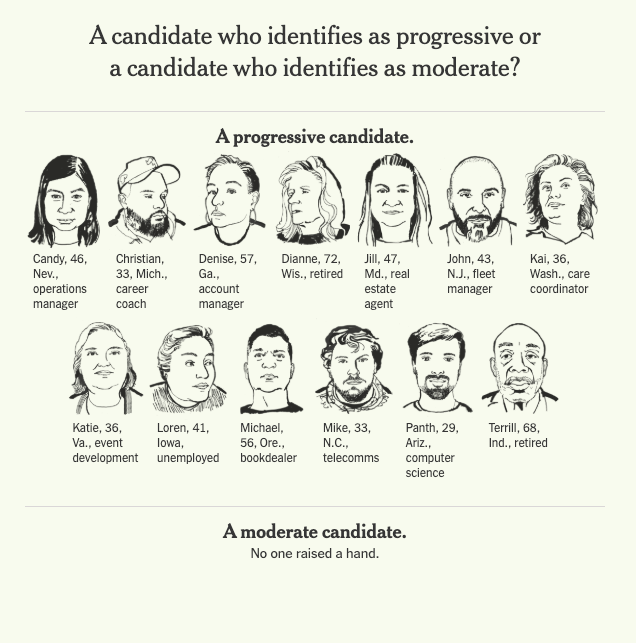
The people just aren’t buying centrism anymore. (Graphic: New York Times)
Already, the first sparks have been struck. We started off the year with the inaugurations of Katie Wilson in Seattle and Zohran Mamdani in New York City, both democratic socialist mayors with ambitious agendas to reshape their cities. In the weeks since, we’ve also seen dramatic victories for progressive legislators. First Taylor Rehmet, a labor organizer from the International Association of Machinists and Aerospace Workers (IAM), scored a startling win in the Texas state senate, beating a Trump-endorsed candidate in a district Trump won by 17 points in 2024. Then, days later, Analilia Mejia won the primary for New Jersey’s 11th congressional district, after receiving endorsements from both Bernie Sanders and Alexandria Ocasio-Cortez. And when we look down the track to November, it looks increasingly possible that these two wins are only the beginning.
The Senate
For starters, take the Senate, where the Republicans currently have a 53-47 majority. For Democrats to take it back, they need to flip four seats and defend their current ones—and in that effort, there are several leftists, Medicare for All activists, and labor candidates with a shot.
In Kentucky, Charles Booker is currently the frontrunner in the Democratic primary, running on a platform of “Medicare for All, Universal Basic Income, Reparations, and Universal Childcare,” along with “refusing to fund genocides and an ever growing military industrial complex.” Here at Current Affairs, we profiled Booker when he ran in the previous Senate cycle, which saw him narrowly lose to Amy McGrath in 2020. McGrath is running again, but just like the New York Times panelists, it seems Kentucky voters are reconsidering the wisdom of centrism. And with Mitch McConnell retiring to his ghoul crypt, a Democrat may even have a chance in the general election this time.
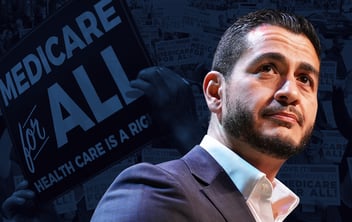
Meanwhile in Michigan, Emerson polling from the end of January found that the primary was “wide open.” Right now state Senator Mallory McMorrow is in the lead with 22 percent, but Medicare for All advocate Dr. Abdul El-Sayed isn’t far behind at 16 percent, and with 38 percent of voters still undecided, he’s still very much in the running. For full disclosure, El-Sayed is a friend of the magazine; we’ve profiled him when he ran for governor in 2018, interviewed him about the Senate race last summer, and if elected, he’d be the first U.S. senator who’s written a Current Affairs article. But that doesn’t mean we aren’t disappointed in some of his choices, like telling the Daily Wire he’s “not a socialist” in a recent interview. (Abdul, what on Earth are you thinking?)
Over in Nebraska, independent union leader Dan Osborn is taking another crack at the Senate, having narrowly failed to defeat Republican incumbent Senator Deb Fischer in 2024. His opponent this time around is Senator Pete Ricketts, and Ricketts is vulnerable—partly because the Trump administration’s decision to quadruple beef imports from Javier Milei’s Argentina has angered a lot of farmers, and partly because Ricketts has defended the Tyson company’s decision to abruptly close a meatpacking plant that employed 3,200 of his constituents in Lexington. Right now, the Omaha Herald reports that he and Osborn are in a dead tie.
In Delaware, there’s Christopher Beardsley, a Peace Corps veteran who backs Medicare for All and condemns the genocide in Gaza, but has gotten bizarrely little press attention as he challenges incumbent Senator Chris Coons. (You might remember Coons as the legislator who was repeatedly yelled at on a train by Grayzone reporter Aaron Maté, after Coons refused to call for a ceasefire in Gaza in late 2023.) And in Maine, Graham Platner has somehow weathered the controversy over his Nazi tattoo, which you really might have expected to finish him, and now has a commanding lead in his primary, beating Governor Janet Mills by as much as 15 points in some polls. Like Osborn, Platner would face a weakened opponent in the general, as a recent Morning Consult poll shows only 2 in 5 Maine voters approve of incumbent Senator Susan Collins.
But there are more parties in this country than the Democrats and Republicans, and some of them are getting active. After focusing mostly on presidential races in recent years, the Party for Socialism and Liberation is fielding two candidates for the Senate: Greg Levy, a military veteran and community organizer running to replace Senator Jon Husted in Ohio, and Joe Tache, who calls capitalism itself a “national emergency” and is running against Senator Ed Markey in Massachusetts. Because of the structural issues with funding and ballot access that face any third-party candidate in America, they each have a particularly hard fight ahead of them—but at the same time, having options on the ballot further left than “Democrat” is valuable in itself.

The House
Turning to the House of Representatives, the Democrats have an easier task here: just add four seats to their current 214, and they’ve got a majority. And in the House, as you might expect, there’s an even bigger range of left-wing candidates. Some of them are fairly well-known. In Illinois, Kat Abughazaleh got a big publicity boost after being physically assaulted by ICE at a protest last September, then hit with criminal charges for supposedly assaulting them. Saikat Chakrabarti made headlines for challenging Nancy Pelosi in California’s 11th district, before Pelosi announced her retirement last November, leaving an open field. And in Missouri, former Representative Cori Bush is launching a comeback campaign, after losing her seat to heavy AIPAC spending in 2024. With the reputation of AIPAC significantly dimmed these days, it’s now a whole different landscape for her.
In New York, Representative Ritchie Torres has annoyed so many people that he has three progressive challengers: former mayoral candidate Michael Blake, who says that “Torres cares more about Bibi than he does about the Bronx,” DSA organizer Dalourny Nemourin, and a PSL candidate, schoolteacher Andre Easton. If anything, the multiplicity of options in that race may be a problem, allowing Torres to split the progressive vote—and a lot may depend on a Zohran Mamdani endorsement, if he decides to give one.
Only a few weeks into his tenure as New York City’s mayor, Mamdani has already become a powerful player in his state’s congressional politics. Inspired by his mayoral win, a whole new crop of democratic socialists are running across New York state, but Mamdani is picking and choosing which to endorse. Controversially, he discouraged Chi Ossé from running in NY-8, although incumbent Representative Hakeem Jeffries still has a challenger: Vance Bostic, an outsider candidate who says he’s been “a carnie, a waiter, a line cook, and a food-truck hustler” before getting into politics. Of all the candidates in 2026, Bostic is probably the longest of long shots, but still, you have to give him credit for making the attempt.
Meanwhile, Mamdani has endorsed Claire Valdez, formerly a DSA state assembly member like himself, to run in neighboring NY-7, where she’d be replacing the retiring Representative Nydia Velázquez. But at the time of writing, it’s reportedly an “open question” whether he’ll do the same for Darializa Avila Chevalier, another DSA candidate who’s challenging Representative Adriano Espaillat in NY-13. As Meagan Day writes for Jacobin, Espaillat is heavily funded by both AIPAC and the real estate industry, so whether Chevalier can take him down will be a major test of DSA’s political muscles.
There are other candidates for the House, though, who haven’t gotten nearly enough media attention—either because of the ongoing decimation of local journalism, or for ideological reasons. One of the most notable is Kshama Sawant, who’s running as an independent socialist for Washington’s 9th district. Unlike a lot of third-party candidates, Sawant actually has a track record of getting things done in government, having served three terms on the Seattle city council and successfully fought for a $17 minimum wage, so she at least deserves to be discussed seriously. There’s also Iziah Thompson, a socialist housing advocate running to replace Representative Bonnie Watson Coleman after her retirement in New Jersey’s 12th district. Thompson’s platform includes “a nationwide public housing program, implementing Medicare for All, supporting the Green New Deal, abolishing Immigration and Customs Enforcement (ICE), embargoing arms shipments to Israel, and banning congressional stock trading,” which ticks a lot of policy boxes.
The more you research, the more candidates you find. In Missouri, another DSA member named Hartzell Gray is running for the 4th congressional district. He’s a tenant organizer and Kansas City radio host, and has angered the pro-Israel website Canary Mission by calling Benjamin Netanyahu “the blood-soaked butcher of Gaza,” among other pro-Palestine statements. In New Jersey, a former Bernie Sanders delegate named John Hsu, who also wants to “end the genocide in Gaza,” is making a second attempt to unseat Representative Frank Pallone1 after failing in 2024.
The Green Party has two notable House candidates of its own, both U.S. military veterans who were horrified and disillusioned by the Gaza genocide: Greg Stoker and Anthony Aguilar. Aguilar is running in North Carolina, and was a key whistleblower in the case of the fraudulent “Gaza Humanitarian Foundation.” Meanwhile, Stoker is running in Texas’ 31st district, and one of his opponents is Valentina Gomez, the extremist Republican candidate who likes to film herself burning the Quran with a flamethrower. So voters there are in for an interesting year.
Even in deep-red Utah, there’s 26-year-old Luis Villarreal, another democratic socialist who says abolishing ICE is “the moderate position.” He’s running for a district in Salt Lake City that didn’t exist until the map of Utah was redrawn by a judge last November—though Bernie Sanders has instead endorsed state senator Nate Blouin, another Medicare for All candidate, for that seat, so left-wing Utahns have options.
The Justice Democrats PAC has just released its own slate of 12 House candidates who are primarying incumbent Democrats, too:
- Mai Vang (CA-07)
- Angela Gonzales-Torres (CA-34)
- Melat Kiros (CO-01)
- Junaid Ahmed (IL-08)
- Kat Abughazaleh (IL-09)
- Donavan McKinney (MI-13)
- Cori Bush (MO-01)
- Nida Allam (NC-04)
- Claire Valdez (NY-07)
- Darializa Avila Chevalier (NY-13)
- Justin J. Pearson (TN-09)
- Rev. Frederick Haynes III (TX-30)
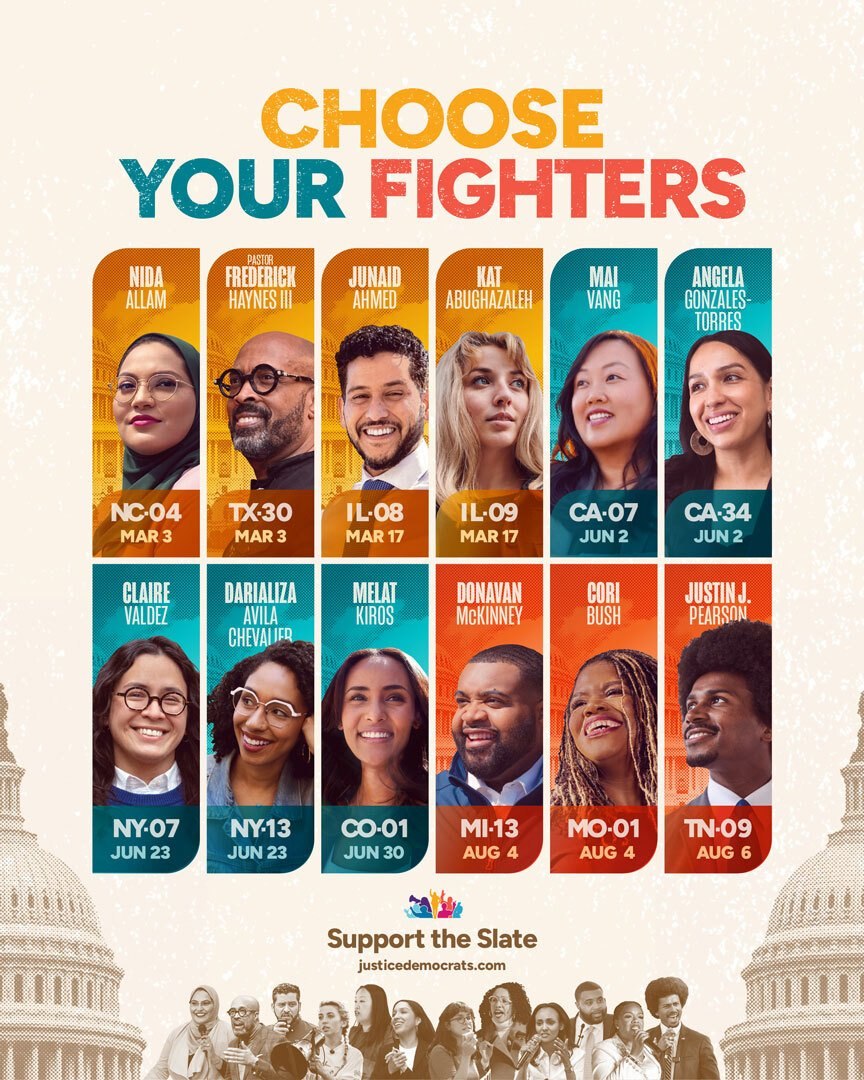
Graphic: Justice Democrats
Now, this list has some odd omissions—in particular, Saikat Chakrabarti, who actually helped found the Justice Democrats in 2017—but it makes interesting reading. Nearly every candidate on the slate lists Medicare for All on their policy pages, including Angela Gonzales-Torres in California, who has one of the strongest statements (“no premiums, no copays, no exclusions based on income.”) The only question mark is Rev. Frederick Douglass Haynes III, who’s running for Jasmine Crockett’s current seat in Texas and says he supports “affordable” healthcare, but not that the state should provide it. (In a January speech, Haynes said he does support Medicare for All, but again said people should have “affordable” care, which is not quite the same as “no premiums, no copays.”)
To his credit, though, Hayes does say ICE should be abolished, calling the agency a “terrorist group.” In fact, every candidate on the Justice Democrats slate has called for ICE to go, either on their websites or in speeches and social media posts. And, strikingly, all 12 candidates say Israel’s war crimes in Gaza constitute genocide, something even Bernie Sanders took forever to admit, and which Gavin Newsom still won’t say. But that can be a little tricky, because their responses to that genocide aren’t all the same. Some have particularly strong stances, like Darializa Avila Chevalier, whose “Babies, Not Bombs” policy plank promises to “stop all funding to the Israeli government” and instead use the money to house homeless children. Similarly, Melat Kiros and Junaid Ahmed say we should end “all military aid to Israel.” “All” is an excellent word; it leaves no room for ambiguity. But others, like Gonzales-Thomas, make a point of saying that they will support Rep. Delia Ramirez’ Block the Bombs Act—which, while it would definitely be better than the status quo, blocks only certain kinds of weapons to Israel, while allowing others through. It’s an important distinction.
By themselves, if the majority of the Justice Democrats win their races, they’ll double their voting bloc overnight—currently, they have just nine representatives. But when you tally up all the House candidates we’ve seen so far, we’re looking at more than 20 potential U.S. representatives from either the Bernie Sanders wing of the Democrats, the Green Party, or the wider labor and socialist movements. That’s a bloc rivaling the size of the GOP’s so-called Freedom Caucus, and they forced a Speaker of the House out in 2023. There’s no reason the Left couldn’t wield the same kind of power, given enough numbers.

Mayors and City Councils
Just as important, though, has been the resurgence of interest in socialism at the municipal level after Mamdani and Wilson’s wins. There’s now a democratic socialist candidate for mayor of Washington, D.C. too: Janeese Lewis George, a city council member who announced her candidacy shortly after Mamdani’s victory. Similar to New York, D.C. has a “Fair Elections Program” that matches small-dollar donations with public funds at a ratio of 5 to 1, but only if the candidates agree not to accept corporate donations. It’s a highly sensible system, which more places ought to adopt, and may give Lewis George a chance even without deep-pocketed supporters, just as it did for Mamdani. According to the Washington Post, she raised more than $110,000 from 1,500 donors on Day One, for an average of about $73 per donor.
In Los Angeles, they’ve got two socialist candidates vying for the mayorship. Rae Huang announced her candidacy first, on November 15 of last year, with a campaign focusing mainly on the cost of housing; she’s both a single mother and a Presbyterian minister, who cites Dr. Martin Luther King Jr. as a key influence. More recently, Nithya Raman, a member of the LA city council, has also thrown her glove down to challenge incumbent Mayor Karen Bass. They’ve got the same problem Torres’ challengers have in New York: if either of them want to win, they’ll have to work out which of them should step aside, or Bass may well be able to split the difference and hang onto power.
D.C. and LA are both well-known progressive hotspots, but socialists are popping up in more unexpected places, too. In Providence, Rhode Island, David Morales is challenging incumbent Mayor Brett Smiley, despite a serious gap in their funding: roughly $130,000 raised for Morales as of late 2025, versus more than $1 million for Smiley. So far, the race has involved a lot of talking about snow, with Morales slamming the incumbent for dumping the excess in South Providence, a practice he calls “environmental racism.” Responding to reporting in Current Affairs, Morales has also hit Smiley for attending a conference in New Orleans where various mayors, including Eric Adams, discussed criminalizing pro-Palestinian protest. And in the grand tradition of Jesse “the Body” Ventura, he has a side gig as a professional wrestler.
Up in Ann Arbor, Michigan, there’s another would-be socialist mayor: Yousef Rabhi, a DSA member and commissioner of Washtenaw County. He’s campaigning hard against the privatization of things like garbage collection and the electric grid, saying that “Any time you privatize a service, you lose control, you lose quality, you lose workers’ rights because it’s not union.” If he wins, Rabhi may also get backup from Dave Zeglen, another democratic socialist who’s running for Ann Arbor’s city council, calling for “rent control and a massive expansion of social housing.”
In fact, several of the cities with socialist mayoral hopefuls also have socialists aiming for city council. In New York City, Lindsey Boylan has turned from her crusade against the loathsome Andrew Cuomo to a campaign of her own; if she gets in, the DSA’s base of power on the council will grow again. In Los Angeles, there’s Estuardo Mazariegos and Faizah Malik, both endorsed by the local DSA. They’d be joining incumbents Eunisses Hernandez and Hugo Soto-Martinez on the 15-member council, forming a sizable voting bloc. In Washington, D.C. there’s Aparna Raj, a housing organizer known for organizing the “Stomp Out Slumlords” campaign to coordinate rent strikes and tenant unions.
Even the Communist Party USA is making moves. Last year, the party earned fuming-mad headlines from the New York Post when they got two city council members elected: Daniel Carson in Bangor, Maine and Hannah Shvets in Ithaca, New York. (With its typical sleazeball condescension, the Post called Shvets a “tankie tyke,” a reference to her relative youth at age 20.) Carson ran as an independent, Shvets as a Democrat, but both have become some of the only elected communists in the United States since the 1940s. And in an email exchange, a representative of the Party confirmed to me that more candidates are on the way in the near future.
Kentucky, somewhat surprisingly, also has its insurgent leftists. In Lexington, there’s Herbert Lynn, a man with an impressive handlebar mustache who’s running for an at-large seat on the city council; he wants to build a homeless shelter and a public power utility, among other useful things. And over in Louisville, they have two DSA candidates: Andrea Parr and Aprile Hearn are running to represent districts 9 and 5 respectively, both on similar platforms that emphasize bringing down housing costs. So the red rose may yet grow in the Bluegrass State.
State Legislatures
The Louisville DSA is also fielding a candidate for the state House of Representatives: Robert LeVertis Bell, a public school teacher and community organizer who previously campaigned for Bernie Sanders. He’s one of a wave of candidates aiming for seats in state legislatures across the nation. There’s Tyler Cavey in Nevada, another socialist schoolteacher who says that private schools and charter schools shouldn’t exist. In Maryland, Raaheela Ahmed is running for the state Senate, while Gabriel Acevero is up for reelection to the House of Delegates, both endorsed by their regional DSA. But once again, it’s New York that has the really expansive roster.
New York’s state assembly races have been a battleground for a while, with Hakeem Jeffries personally intervening to stop DSA candidates wherever he can. This year, one of Jeffries’ personal nemeses is back for a rematch: Eon Huntley, who Jeffries and incumbent Assembly Member Stefani Zinerman were able to fend off by just 6 points back in 2024. But there’s also Aber Kawas, a Palestinian American civil rights activist running under the DSA banner in Queens; Conrad Blackburn, a public defender and labor leader in Harlem; David Orkin, an immigrant rights lawyer who’s gunning for one of Eric Adams’ closest allies, incumbent Jenifer Rajkumar; and Christian Celeste Tate, who’s focusing on housing prices and eviction protections in Brooklyn. If Jeffries tries to stop all of those candidates and keep centrist incumbents in, he’s going to have his hands full.
Governors
Finally, leftists are beginning to take aim at state-level executive offices, too. In California, where Governor Gavin “Gruesome” Newsom’s reign will soon be drawing to a close, a few different candidates are hoping to take the state in a more firmly progressive, less Silicon Valley-friendly direction. There’s Katie Porter, a former U.S. representative who backs both the Green New Deal and Medicare for All—a stark contrast to Newsom, who once promised to implement universal healthcare at the state level in California, but later reneged on it. But the Green Party has also entered the ring with Butch Ware, their most recent nominee for vice president in 2024, who cites Malcolm X and Kwame Ture as his political heroes and has an ambitious plan for state-owned social housing modelled after Vienna, Austria. And they’re not the only ones: a socialist candidate named Ramsey Robinson is also running with the Peace and Freedom Party, which was born out of the anti-Vietnam War movement in the 1960s, on an anti-war platform and a full jobs guarantee. Because California has a nonpartisan “jungle” primary system, third parties have more of a chance than usual, because the top two vote-getters regardless of party proceed to the general election—so it could be two Democrats, or even a Democrat and a Green or a PFP member, who ultimately face off. Right now all of the above are trailing behind Eric Swalwell, a Democrat with roughly Newsom’s politics but less competence. But with 21 percent of voters still undecided, the race is just getting started.
In Georgia, Ruwa Romman—the Palestinian American member of her state’s legislature who Kamala Harris stupidly denied a speaking slot at the 2024 DNC—has announced her own campaign for governor. She’s added a moratorium on data centers to her platform, a smart move in a political climate where more and more people are wary of the expensive, pollution-belching facilities. And in Wisconsin, there’s Francisca Hong, who was recently interviewed in Jacobin about her campaign. She’s another DSA candidate, who’s aiming to reclaim the tradition of the “sewer socialists” who governed Milwaukee for a few decades in the early 20th century, and earned the somewhat grimy nickname because they made the sanitation services work smoothly. There’s been a resurgence in Wisconsin socialism in the last few years, starting when two DSA members took seats in the state assembly in 2023 and formed a caucus, and at least one poll shows Hong leading her race—though that’s only with 6 percent, since 81 percent of voters are still undecided, so it’s a bit too early to really tell.

This is not a comprehensive list. Undoubtedly, I’ve missed candidates, especially those running at the state and municipal level. Nor is it a list of endorsements. All of these politicians have flaws, some of them serious. Katie Porter, for instance, has earned a reputation as a “mean boss” who shouts at her staffers. Nithya Raman has been censured by the Los Angeles DSA for pursuing the endorsement of Democrats for Israel, a liberal Zionist group, despite the Gaza genocide. Butch Ware has said some transphobic bullshit. Dan Osborn says that although he supports a return to Roe v. Wade, he is “personally” anti-abortion. As for Graham Platner, his bizarre past—first an anti-war protester, then a volunteer for the invasion of Iraq, then a crisis of conscience, then back to mercenary work in Afghanistan as recently as 2018—means I’ll never fully trust him, no matter how good he seems to be on foreign policy these days. Similarly, Chakrabarti’s personal wealth and ties to Silicon Valley make me twitchy. El-Sayed, as we’ve seen, has disavowed socialism to Ben Shapiro’s media outlet. Others just don’t have very extensive track records to judge them on.
But it’s not about any one candidate. It’s about all of them together, and what they mean for the future of the U.S. Left. It’s been more than a decade since Bernie Sanders burst onto the national scene in 2015, which means Americans have had plenty of time to get used to leftists—and every day on their news feeds, they see evidence that the Left’s views on critical issues like oligarchy, war, and militarized policing are the correct ones. Clearly, they’re starting to take note, and electing people like Zohran Mamdani. Sanders may yet prove to be a 21st-century Barry Goldwater figure, in the sense that he never becomes president himself, but lays the groundwork for many who come after him with greater success.
Now, this new wave of upstart leftists is coming at the perfect time. Apart from the anomaly of 2022, where the Supreme Court’s Dobbs decision drove lots of liberals to the polls, it’s a rule of thumb in American politics that the incumbent president’s party loses seats in the midterms. It makes sense: things are going wrong, voters want someone to punish, and the incumbent party is there to catch the blame. But for Donald Trump and the GOP, the 2026 midterms are looking unusually rough. According to a recent YouGov poll, Trump is now less popular than spiders and only slightly above wasps and roaches with Americans. According to the New Republic, Democrats are now favored with voters who care primarily about “the cost of living,” something that hasn’t happened since the last days of the George W. Bush administration. But it matters what kind of Democrats get in. If they’re centrists like Hakeem Jeffries or Joe Manchin, it won’t matter much, because they won’t do much. If they’re leftists, it’s a whole different story.
Donald Trump and the GOP know all this, better than anyone. They see the poll numbers. It’s why they’re already trying to undermine the midterm elections themselves, with Arizona Republicans trying to put ICE agents at the polling places and Trump himself going on long rants about supposed voter fraud. They see what’s coming, and are trying to throw roadblocks in the way. But they’re not the only ones. The centrist Democrats and their wealthy backers, who unfortunately still exist, have their own propaganda effort going. They’re starting all kinds of think tanks with names like “the Searchlight Institute” or “Next American Era” to try to police the bounds of Democratic politics, keep things nice and corporate-friendly, and stifle any hint of socialism. They’re running blogs like “the Argument” and events like “WelcomeFest” to launder and promote the ideas those tanks think up. Tech companies like Meta are burning tens of millions of dollars to swing races their way, and so is the pro-Israel lobby. They’re terrified of the exact same thing Trump is: the rise of a strong working-class Left.
They should be. Maybe it’s recency bias talking, but I can’t ever remember seeing this many socialists running for public office—not even in 2020, at the height of Bernie Sanders’ last campaign, when Current Affairs last published a guide like this. And when we look one step further, the results in 2026 will lay the table for 2028. If candidates like Abdul El-Sayed or Graham Platner can win in places like Michigan and Maine, it will demolish the idea that a “Berniecrat” approach only works in already-progressive enclaves like New York City, reshaping the whole idea of “electability.” If people like Kshama Sawant and Dan Osborn prevail, it will put a major dent in the idea that only Democrats and Republicans matter. And if leftists rack up 10 or 15 seats in the House and Senate, it will dramatically expand the bench of potential candidates for future races—including the presidency. Currently, there is no obvious leftist candidate for the biggest office of all. But the person to fill those shoes may be on a ballot somewhere in America, right now.
Special thanks to John Ross for research and advice on this article!
1: Not to be confused with Frank Stallone

%20(1).jpg?width=352&name=Parrots_by_a_nest_in_the_Green-Wood_Cemetery_gate_(61841)%20(1).jpg)