The California representative talks Epstein, taxing billionaires, and Donald Trump’s war crimes.
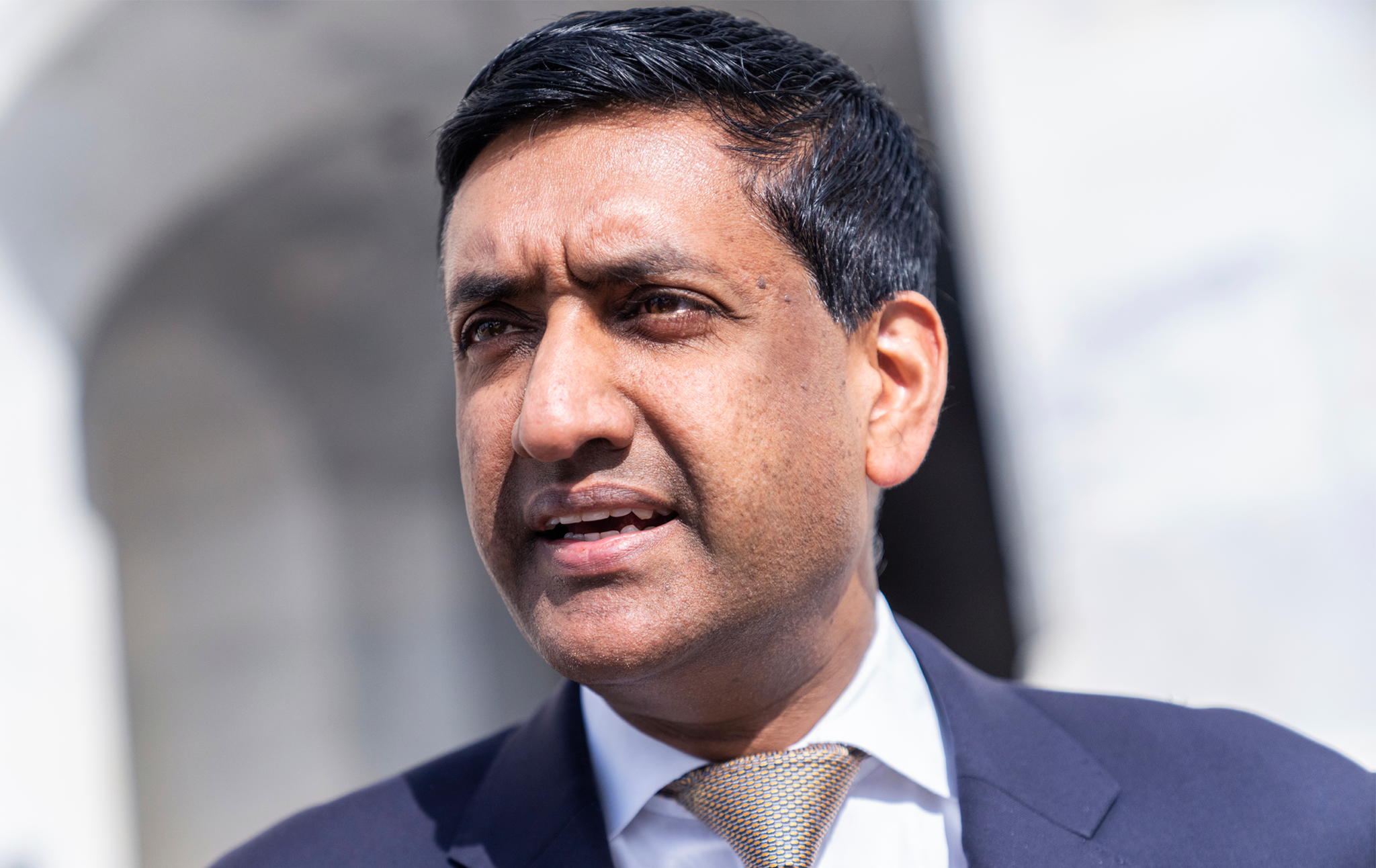
Ro Khanna is the U.S. representative for California’s 17th Congressional district, more commonly known as “Silicon Valley.” He was a co-chair of Bernie Sanders’ presidential campaign in 2020, and there’s been speculation he may run for president himself in 2028. He joined Current Affairs associate editor Alex Skopic to discuss his bipartisan efforts to release the Epstein files, a “new FDR moment” for the Democratic Party, and the dangerous state of U.S. foreign policy under Donald Trump.
Alex Skopic
I wanted to get in touch and talk to you, because you are all over the news right now with a few different situations. There’s the situation where you and Representative Thomas Massie have been at the forefront of trying to get the Epstein files released to the public. There’s the situation in California with progressive taxation, and trying to bring more of a fair economic order out there. And then there’s all kinds of foreign policy. There’s Venezuela, China—you were recently appointed to the House Select Committee on China. But I want to start with Epstein here. Now, you and Representative Massie passed a law late last year requiring the Justice Department to release all of the files it has on Jeffrey Epstein and his possible co-conspirators, minus very minor redactions. It’s now more than a month later. It’s now late January, and that clearly has not happened. Why do you think that is?
Ro Khanna
First of all, the Epstein class needs to go. This is about elite accountability. For too long, the rich and powerful have had one set of rules in this country, while ordinary Americans have had another set of rules. And here you have a case where rich and powerful men visited Epstein’s island, raped or sex trafficked underage girls, often from working-class families, and suffered no consequences. The most powerful people in America, for decades, got away with the most heinous crimes, and we had not isolated cases, but over 1,200 survivors. That’s why I say it’s going to be a moral reckoning when everything is released. And this is one of the greatest scandals in American history.
The Epstein Transparency Act we passed is the single biggest modern effort to hold the elites accountable. It was an uphill effort, but Massie and I managed to get it through a Republican House with a discharge petition. We managed to get 70 Republicans willing to defy the president of the United States, to the point that the president was forced to sign a Democratic bill. It’s the most consequential Democratic bill that the president signed in 2025, and we got it through the Senate unanimously. Now, why has there still been resistance? Because there are a lot of rich and powerful people whose reputations will be destroyed and could face prosecution when this comes out.
And so there are a lot of forces that we’re fighting against. We already know through some of the documents that have come out, more than have ever been released before, that Maria [Farmer] was telling the truth about having gone to the FBI in 1996, and having been ignored. She sounded the alarm about Epstein decades ago, and no one did anything. The FBI sat on it, even though Epstein was committing these crimes. They sat on it because of Epstein’s connections to politicians and rich people, and Maria was called a liar for decades. It’s only when these files came out that she was vindicated.
And we know that Donald Trump lied about being on Epstein’s plane throughout the campaign, because documents have come out showing that he was on the plane. We know that there were co-conspirators, that this was not just Maxwell and Epstein, because documents have already come out showing that there were co-conspirators, but there are many more documents that we need. We’re working with survivors’ lawyers right now. We’re in contact with the Department of Justice. They are being consulted, and we are confident that there are going to be more documents released this month from talking to those survivors’ lawyers. We are also pursuing legal action with survivors in the Southern District of New York, and Massie and I are contemplating impeachment where we believe we have the Republican votes. So we are going to fight until these files are released. We’re going to fight until this Epstein class is held accountable.

Skopic
I know you’ve mentioned in a few recent interviews that if there is more of a delay and there is more obstruction, you would consider impeachment proceedings against Attorney General Bondi in particular. What is the threshold for you that would cause that to be necessary? And how close are we to that threshold?
Khanna
She’s already violating the law. I think impeachment is already justified. It’s more a matter of making sure we have the Republican votes because we want it to succeed. I mean, it would be an unprecedented action to have a Republican House impeach a Republican attorney general, but we are in the process of talking to about 20 Republicans currently, and believe that there is a increasing frustration with Representative Bondi. People like Representative [Anna Paulina] Luna are expressing this publicly. So I am quite confident we will be able to get the coalition.
Skopic
And you mentioned also that you’ve been in talks with the lawyers for the survivors; you mentioned at one point in an interview that if there are inappropriate redactions, you will know about it, because the lawyers know the names of some of the people who are implicated. Have you also been able to learn specific names? Are you aware of them?
Khanna
I’ve been told categories of people—a powerful banker, a powerful finance individual, a powerful politician—through survivors’ lawyers. But the names are all mentioned in the 302 forms. These are the survivors’ statements to the FBI agents. These are the witness interviews they did where the survivors’ lawyers were present, and so they know the names, and that’s why we’re pushing for the release of these 302 forms. That has the information that the American people want. They want to know who are the other rich and powerful men who raped underage girls from working-class families? That information is in the FBI 302 forms. So far we have not seen any of those forms, that’s the most important thing to be released.
Skopic
Based on everything you’ve seen and heard, do you believe it’s likely that Donald Trump is guilty of crimes, whether sex crimes or related to obstruction of justice and the cover-up?
Khanna
I don’t speculate. I’ve been very careful to keep this factual; what I want is the release of all the files. I have refused to speculate about any particular individual, because that would not be what the survivors want. I’ve been very careful to make statements based solely on fact and keep this about their wishes, which is to see all the files released and then to see people prosecuted based on what is in the files,
Skopic
And with the current situation as it stands today, how likely do you think success is there?
Khanna
I believe we will get a lot of the files out, but ultimately it will take a Democratic president on Day One to release all of them in 2029. But until then, we will get files out. But I’ll tell you why this matters, and why this should be a top priority for everyone who cares about public service and progressive politics. We have a crisis of trust right now in this country. We do not have a belief that government actually is for the people. We believe that government has been co-opted by the rich and powerful. If you’re like me and believe in a new economic Bill of Rights, if you believe we need Medicare for All, and $10 a day child care, and a living wage, and free public college, and 1,000 new trade schools, you have to have people believe in government. And until there is a restoration of trust, a bold FDR-like agenda is hard to implement, and so to me, the Epstein files being released and the elite being shamed and held accountable is an essential step to the restoration of trust in our government, to a sense that the elites don’t get a different set of rules in America. And that is why I will be fighting as a top priority in 2026 for these files to be released. And that is why I believe it should be a top priority of the next Democratic president to release these files.
Skopic
On that subject of economic democracy, and of a new Bill of Rights, another policy that you’ve been in the news for a lot recently has been this tax out in California, they call it the Billionaire Tax Act. It’s the 5 percent tax on the assets of everybody with more than a billion dollars. And you’ve faced a real, intense backlash for that policy from Silicon Valley. I think with the exception of Jensen Huang, the CEO of Nvidia, virtually every CEO out there is against you on this. Were you surprised by the amount of backlash?
Khanna
I was, because I was simply saying that to whom much has been given, a little is expected. In some senses, I took inspiration from FDR, who was a traitor to his class. And I celebrate entrepreneurs. I’ve always celebrated builders. I’ve celebrated people who have built extraordinary companies, and hyperscalers, and new innovations that have led to advances in communication and knowledge and medical science. But I do not believe that this country can have $18 trillion in my district, one-third of the nation’s wealth, and see people without healthcare, see people without education in California because of the one ugly bill that Trump passed. Two and a half million people are going to lose health care. 200,000 health care workers, nurses, home care workers are going to be laid off. 600,000 people on the exchange are going to lose their health care. So we need to do something about this at a time where we’re building unprecedented wealth.
I talked to [economist] Emmanuel Saez, who drafted part of the bill, and he said that billionaires’ wealth over the last three years has gone up 140 percent in California, and the real return for billionaires over the last 15 years is 7.5 percent. So asking the ultra-wealthy to pay what amounts to a percent a year, to make sure people have health care and education, is something that I believe is part of a new tech social contract. We need to make sure that the AI revolution benefits not just a few billionaires, but all of us. Now, I want to make clear that those provisions don’t go after illiquid stock, and I want to make sure that you know you’re not taxing founders’ voting rights, and these are technical issues that can be resolved. But the broader theme is that we cannot have unprecedented wealth in this country just in the hands of a few. We need to have everyone in America have a stake in it. That doesn’t mean that I don’t celebrate individual initiative or free enterprise or building things, but it means that the benefits of all of this—which come from a foundation of human knowledge, especially when you’re dealing with AI, and come from government investments, from NSF and ImageNet and in Stanford and Berkeley and UCSF, and in national security—that the benefits have to accrue to every Californian and every American.
Skopic
And this is what I wanted to ask about, really. Because the tax you’ve tried to put in place, and that the SEIU labor union out there has tried to put in place, is really rather modest. It’s 5 percent. As you say, you’re not aiming to go after the voting shares. And yet, even that minor—to these wealthy billionaires, minor—setback for them has prompted this furious backlash. I mean, they are now trying to find a primary challenger to you and drum you out of Congress just for saying this. So what does that say to you about the likelihood that this tech elite will voluntarily go along with sharing the wealth?
Khanna
Well, I don’t think anyone has ever voluntarily paid tax or been part of a social contract. You need people who are willing to stand up to the powerful on behalf of workers, and on behalf of the middle class. That’s what FDR did. That’s why he was called a traitor to his class. That’s what Lyndon Johnson did in developing the Black South. That’s what Bernie Sanders did, whose campaign I supported in 2016 and co-chaired in 2020. And that’s what I’m doing in taking on AIPAC, and taking on defense contractors, and taking on the Epstein class, and taking on billionaires in my own district. And of course, it’s done with a great risk politically. But why are you in politics if you’re not going to be fighting for principle? To me, we’re past an age of platitudes. The country really wants to see a new FDR moment in the realignment post-Trump. And if we don’t have that, if we just go with the cookie-cutter Democrat again, a Clintonite like Gavin Newsom, we basically are going to see an even more ferocious right-wing populism come back in 2030 or 2032. I believe that the only way to truly defeat Trumpism is to have an FDR-like realignment in 2026 and 2028.
Skopic
And I think all that’s very correct. But at the same time, you are careful to say that you are not—unlike Bernie Sanders, and unlike Zohran Mamdani—you’re not a socialist. You say you’re a progressive...
Khanna
I call myself a progressive capitalist, like FDR. FDR said he was going to save capitalism from itself. He didn’t have any problem with free enterprise. He celebrated free enterprise, and he celebrated initiative and hard work, but he had a problem with a capitalistic system that benefited the connected and the privileged, and that did not give ordinary Americans the chance to live up to their potential. So his view of a stakeholder capitalism, a moral capitalism, an economic democracy of capitalism, has always been my view.
Skopic
And you’ve also said, in a 2019 interview, that you disagree with people who say that billionaires shouldn’t exist. Is that still your position?
Khanna
Yes. I have no problem with billionaires existing in terms of building wealth. I just think they should pay 1 percent a year, or a modest amount, to make sure everyone has healthcare and education. If Elon Musk is going to become a trillionaire because of the grants that he has been given by Tesla and by SpaceX, then are we going to make sure that he’s going to pay something so that people have health care and education in California, around the country? And we also can’t have an unholy alliance between wealth and power. In other words, there has to be the abolishment of Super PACs, because there are two problems to extraordinary wealth in this country. One is if they’re not paying something, paying a tax on those extraordinary returns that allow every American to have basic healthcare and child care and education and housing. But the second is if they’re using that wealth to distort the democratic process, as they’re clearly trying to do with me, and did with putting Trump in, which is to say, using that money to try to buy political office. And so my problem is with the Citizens United decision that allowed these super PACs, and Summer Lee and I have a bill to ban Super PACs, to say you can’t give a Super PAC more money than you can give a candidate.
Skopic
And I think that would definitely help. But what do you say to the socialist argument that, just by having billionaires, the sort of gravitational pull of that money and the power it allows you to buy, you can never truly have a democracy with billionaires in it?
Khanna
Well, I think you could, if you severed the the relationship between billionaires, Super PAC money, and political office. I think you could if you had progressive taxation, and made sure everyone had Medicare for All healthcare as a human right, $10 a day childcare, free public college, trade schools, so that you were giving every American the chance to contribute and flourish. I mean, even Rawlsian political philosophy says that it’s fine for people to build wealth as long as it’s helping the least well-off. And so to me, liberal democracy works as long as you do not have a corrupting influence of wealth in the political sphere, and if you have a strong social investment in people’s health and education.
Now, in today’s practical terms, the billionaires have way too much power, and so what we need to look at is who in the Democrat Party doesn’t just mouth platitudes, but is actually willing to stand up, at some personal cost and sacrifice, to an elite class. And in my case, I’ve done it in three very specific cases, the Epstein class, taking them on, where[...] there were a number of people in my district and Silicon Valley who were part of the Epstein class. So obviously that’s earned me ire. The AIPAC class, I mean, obviously they’re spending against me as we speak. And the billionaire class in my own district, because I said that they should pay higher tax. And I believe that that politicians are going to have to be willing to show that ultimately, they’re on the side of the movement and not the side of the donor class, and that is the fundamental fight within the Democratic Party in 2026 and ’28.
Skopic
So basically, for you, you see it as a case of—whether it’s AIPAC, whether it’s the Epstein people—you see it as a case of bad actors within capitalism, and it hasn’t challenged the legitimacy of capitalism itself?
Khanna
Well, I think that there is amoral capitalism, an unfettered capitalism that does not have the proper guard rails, that does not have the proper rules, that is a system which is rigged, that needs massive reformation. But I don’t reject a free enterprise system that works, that rewards hard work and initiative. I reject a free market system that rewards power, privilege and those with connections.
Skopic
So we can’t expect DSA member Ro Khanna any time soon?
Khanna
No, we can expect a modern FDR-like moment.

Skopic
Okay, fair enough. I know we’re running out of time. I want to quickly move on to foreign policy, and another thing that’s happened recently is that you are, to your credit, one of the members of Congress who has come out and said explicitly that Israel is committing genocide in Gaza. You even, I believe, co-sponsored one of Rep. Rashida Tlaib’s resolutions to that effect.
Khanna
Yes, I was one of 21 members who co-sponsored her resolution, and my co-sponsoring the resolution is what led AIPAC to start spending against me in my district.
Skopic
Now, I wanted to ask you about one of your contemporaries in California, Governor Gavin Newsom. He recently did an interview with Ben Shapiro—I don’t know if you’ve seen it—where Shapiro challenged him on this issue of the Gaza genocide. He said that civilian deaths in Gaza don’t mean genocide. And Newsom said, quote, “I agree with you,” and a little later, “I do not agree with that notion” [of genocide]. Now, what do you make of this difference between yourself and Mr. Newsom, and what is effectively genocide denial coming from someone who’s been talked about as a front-running presidential candidate?
Khanna
He doesn’t want to offend the AIPAC donors. He doesn’t want to offend the donor class. And that explains his position on going to give Netanyahu a blank check right after October 7, on not being willing to ever call out the funding we were giving, and not willing to call out that clearly it was a genocide, and then not willing to challenge the billionaire class on tax policy.
Skopic
And you also had a controversy recently, about this vote to send $3.3 billion in “security assistance” to Israel, and also to defund UNRWA, the United Nations Relief and Works Agency.
Khanna
I’d like a chance to explain that. I have voted consistently for UNRWA funding, and I have, even during the height of the war, I was supporting UNRWA, and supported funding UNRWA. I have voted consistently for funding the ICJ and ICC. Of course, I believe that Israel committed genocide, and have cited the ICJ and the UN findings as critical. And I have voted against the Israel funding of $14 billion during the war, and voted against the military sales, which is the $3.3 billion. I co-sponsored Delia Ramirez’s Block the Bombs Act, which is basically no military sales to Israel.
So the vote for the State Department authorization, which I voted for for 10 years, is usually a foreign aid bill. It’s a bill that has $5 billion for PEPFAR that this administration wants to cut, which is the AIDS program in Africa. It had $5 billion for emergency disaster relief, that is basically aiding when there’s tsunamis and earthquakes around the world, our global commitment, and it had $10 billion for diplomatic personnel around the world. So the A New Policy foundation, the think tank, which is very progressive on Gaza, said that they aren’t even scoring the bill because it had so many positive things about foreign aid, and I had individually voted against those provisions related to Gaza. And, you know, one can make a good argument that you should reject the entirety of the foreign aid because of those Israel provisions. But my view was, I’d already voted against those provisions. Now we had a defense bill that just had a vote yesterday where I voted no, which also had military sales to Israel. In that case, I’m against an $850 billion defense budget.
Skopic
Well, about that specific vote, I wanted to ask you about an exchange you had on social media with a reporter, Jasper Nathaniel. You began by saying, “the Republicans snuck these provisions into a bill about funding for the UN”—
Khanna
They did.
Skopic
And then Nathaniel asks, “can you clarify what you mean?” And “did you not know they were in there?” You say, “I genuinely did not.”
Khanna
They traditionally don’t put those things in the State Department authorization bill. So the context of it was that the State Department bill, I knew it had the HIV funding. I knew it had the funding for Africa, for all of the diplomatic things. I didn’t know, they added last-minute, some of these poison pills into the bill, which I’d already voted against. Now, I still think there’s a lot in that bill that was important, which is why the Progressive Caucus can take a position on it, which is why a lot of the think tanks can take a position on it, that have been for Gaza policy. But what happened is AIPAC took a victory lap off having put these poison pills in the bill.
Skopic
Well, I guess what a lot of people want to know is, how does it happen that you don’t have either a staffer read the bill, or even one of these automated assistants read the bill, and find out that those are in there before making the vote?
Khanna
We do, usually. In this case, they were late, snuck in, and even if you were to—I mean, it’s still a very difficult vote. Because are you really going to say you don’t want Africa funding and UN funding? And, you know, I and a lot of the groups think that’s the reason—sometimes we rely on a lot of the human rights groups, and Progressive Caucus, but none of them flagged this, because they understood that you’d be voting against a lot of aid to Africa, you’d be voting against the AIDS bill, AIDS funding, you’d be voting against humanitarian assistance.
Skopic
So, to you, it was basically unavoidable in that situation?
Khanna
Well, no. I mean, I think there’s some people who, in good conscience, said, I can’t vote with these poison pills in there. I think you could. It’s a difficult vote. But I don’t think this is in any way a litmus test on Gaza policy. I think people should look at a lot of the votes, or sponsorships of bills, which are clean votes that are related to Gaza, as opposed to a bill which has so many complexities in it, where they’ve added poison pills into it.
Skopic
I also want to talk about this issue of offensive versus defensive weapons. And your line last year was, I believe you told Drop Site News, you have voted consistently against offensive weapons, but you support defensive weapons like the Iron Dome. Is that still your position there?
Khanna
My position is the same exact one as Bernie Sanders’s, which is I oppose military sales to Israel, but I support Iron Dome funding, which is used to help Israel keep safe—not simply from Gaza, but from Iran’s strikes and other strikes. And that has always been my position through the war. It’s the same exact position as Sanders or Delia Ramirez’s Block the Bombs Act, it’s the same view.
Skopic
And the objection I’ve seen there, which I wonder what you think about, is that even if you are sending weapons that are designated as “defensive,” that frees up other money and other weapons that will then be offensive. And you know, we are talking about a genocidal state. UN experts have said that.
Khanna
Like I said, I’m not for military sales. But I am for anything that will save lives, and I view the Iron Dome as saving lives. And that position is consistent with where Delia Ramirez and Bernie Sanders are, who have authored the no-military-sales amendments in the Senate and the bill in the House.
Skopic
But the analogy I’ve seen people use there is, if someone is carrying out a mass shooting, it’s acceptable to give them body armor, so long as you don’t give them bullets? I mean, is that how this works?
Khanna
Well, I distinguish between the government of Israel and the people of Israel. I mean, I don’t want the people of Israel to be killed because their government is engaged in committing genocide in Gaza.
Skopic
Well, there are quite a few people who disagree there, but I respect that that’s your position. And lastly, I just want to talk about China. You were recently made the ranking member on the House Select Committee on China.
Khanna
Yes.
Skopic
And I want to ask how you’re thinking about China currently, because there’s a lot of talk in Congress—mainly on the Republican side, but also a lot of Democrats who feel that we are in a huge competition with China, who feel we are almost in a new Cold War.
Khanna
I reject the Cold War. I just was in China, in one of the first [delegations] to China since 2019, we hadn’t had one since COVID in the House, and I was part of it intentionally. And we talked about peaceful coexistence and seeing how we rebalance the economy. We lost too much of our industrial base to China. I’m interested in building the industrial base in this country when it comes to the computer and electronic manufacturing. We should never have lost that. We shouldn’t have lost some of the machine tools. We shouldn’t have lost some of the robotics and steel. And we should have more industry in America, and they have an over-indexed export manufacturing sector and an under-indexed service and financial sector. So we must rebalance our economies, but I’m for figuring out peaceful coexistence.
Skopic
Well, good. That’s actually encouraging to hear, because you look at a lot of the actual measurable metrics that affect people’s lives, and in a lot of them, the Chinese model, they are clearly doing better. I mean, in education, we’re 31st in global rankings. China is 13th.
Khanna
China has 18 percent youth unemployment. Their young people are extremely dissatisfied.
Skopic
There’s that. But also 90 percent of Chinese people own their own homes; in the US it’s only 65 percent. On energy, China produces 32 percent of green energy worldwide, the U.S. only 11 percent. So what I’m wondering is, in terms of rejecting that Cold War approach, are there even areas where we can learn from what China is doing and copy them where they’ve had success?
Khanna
I mean, they’ve got 18 percent youth unemployment, they have huge constraints on human rights. They have no concern when truck drivers get displaced by AI, or workers get displaced by AI, and they’ve got an authoritarian regime that violates human rights. I would look to other places. You know, I’m not just [saying] America can’t learn, but I would look to Canada when it comes to some of the issues on prescription drugs and child care, $10 a day child care. I would look to Singapore when it comes to models of how we have renewable energy or industrial policy, but I certainly don’t look to China as a governing model.
Skopic
Not even on energy?
Khanna
Well, I think I would look to Singapore. I look to other places where we can have strong renewable energy focus, but they have a state authoritarian system that I don’t agree with.

Skopic
I mean, that makes sense. I appreciate that you have to be careful about saying, I admire this or that about China. And I think the last thing I want to ask here is, you and Bernie Sanders are two of the only people in congressional history who have successfully passed a War Powers Resolution, back in 2019. Saudi Arabia was waging its bombing campaign against Yemen.
Khanna
We helped stop the war, because Trump voluntarily suspended the refueling after we passed the War Powers Resolution.
Skopic
Yes, and that was a big success, historic. But we’re now in a situation with this second Trump administration where he’s really ramped up aggression against other countries. He’s kidnapped Maduro from Venezuela. He’s threatened Mexico. He’s threatened Cuba, threatened Greenland. And even worse, he has shown himself perfectly willing to ignore Congress, even ignore the Supreme Court. To what extent do you think that you and the rest of Congress will be able to stop him if he decides to, say, invade Mexico or Cuba or Greenland? How worried are you?
Khanna
Well, we need to build a coalition like we had with the Epstein Transparency Act or with Yemen to do that, and I’m working on that. We’ve had Don Bacon come out and say he would vote to impeach on Greenland. We need about 20 Republicans. Michael Turner, who’s on the Armed Services Committee, has said similarly. Don Bacon and I went to meet President Sheinbaum in the summer, specifically to establish a bipartisan relationship with Mexico. We need to build that coalition with about 20 Republicans to prevent it. The reason we haven’t been able to prevent it in Venezuela is, you know, from yesterday, we just lost the vote. We only could get two Republicans on Venezuela, but I think we can get far more on Greenland and on Mexico and on Cuba.
Skopic
Well, I certainly hope so. And the last thing I want to ask here is, we’ve seen Donald Trump commit what are pretty unambiguously war crimes. So we’ve seen the blowing up of the Venezuelan boats, with no evidence whatsoever that they were drug dealers, like he claimed. And we see that internationally, the International Criminal Court has a warrant out for Vladimir Putin for his crimes in Ukraine, and for Netanyahu for his crimes in Gaza. Do you think Donald Trump should also stand trial for what he’s done?
Khanna
Well, I believe there needs to be accountability for everyone in the Trump administration, starting with domestically. On the ICE agents who have violated the law, the people who are violating the law on Epstein, the people who violated the law with DOGE and eliminated agencies without any congressional authorization, the people who committed the crimes of shooting boats with civilians on them, fishermen on them, and all of the crimes that have been committed. I don’t think that we should just, in the next administration, move past it like we failed to prosecute those who committed war crimes in Iraq, like we failed to prosecute the bankers who committed crimes in the Great Recession. I think there has to be accountability for everyone who was involved in committing crimes.
Skopic
But specifically on war crimes, do you think Trump, Hegseth, or Marco Rubio should one day be tried in the Hague?
Khanna
I believe the next administration should have accountability and go wherever the law leads. And that should be, of course, the purview of the Attorney General, but there should be a clear directive that there needs to be accountability, and that they need to be held accountable to domestic and international law.