Donald Trump's overthrow of Nicolás Maduro sets a terrible precedent that severely erodes international sovereignty. Can other countries depose any leader they accuse of a crime?
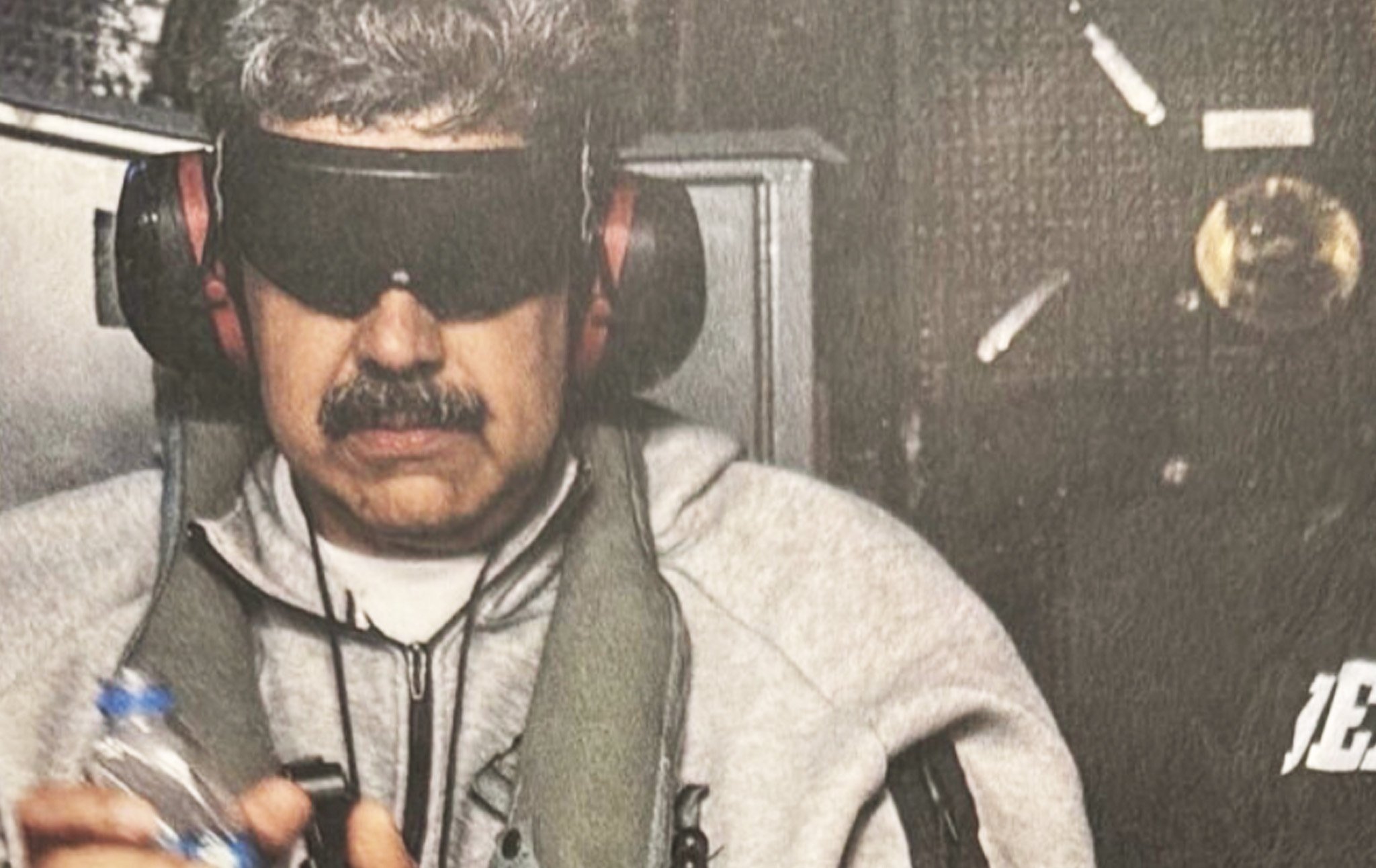
The United States has overthrown the president of Venezuela, in violation of the United Nations Charter and the U.S. Constitution. Early on the morning of January 3, President Donald Trump sent U.S. special forces to kidnap the country’s president, Nicolás Maduro, blindfolding and handcuffing him, then bringing him to the U.S. to stand trial on four criminal counts (“narco-terrorism,” conspiracy to import cocaine, and two counts of “possession of machineguns and dangerous devices”).
The coup in Venezuela is illegitimate and illegal. Invading a sovereign country violates the UN Charter’s prohibition on the use of force except in self-defense against an armed attack. (Venezuela has not attacked the U.S., and claiming that importing drugs is violence is like claiming that importing unlicensed beer is violence). The Constitution also vests the power to make war in Congress, and it is plainly an act of war to invade a country and kidnap its head of state. It is also not even clear why U.S. courts can claim jurisdiction over Nicolás Maduro for acts like “possessing machineguns” committed in Venezuela. There is certainly a precedent for kidnapping foreign heads of state to try them in U.S. courts (George H.W. Bush did the same thing to Panama’s Manuel Noriega, an act that was condemned by the United Nations General Assembly and the European Parliament as a blatant violation of international law). The hypocrisy of this supposed anti-war, anti-regime change president is galling, but the fact is that what’s happening in Venezuela is not far outside the range of usual presidential malfeasance, and militarism and aggression have long been tolerated or outright supported by both parties. But the fact that something similar has been done before does not make the act any more legitimate.
It’s not clear why U.S. courts should be able to claim jurisdiction for acts committed by Venezuelans in Venezuela, or for that matter Panamanians in Panama. After all, if this principle is applied consistently, do other countries have the same right to apply global jurisdiction for their domestic laws? What would stop Venezuela from indicting and kidnapping Trump for violating Venezuelan law? If Vladimir Putin had accused Volodomyr Zelenskyy of violating Russia’s domestic laws, would he have been legitimately allowed to depose him? If anyone else acted according to the standard the Trump administration is adopting, we would see it as an obvious violation of the principle of sovereignty, which is why it’s absurd that JD Vance responded to accusations of illegality by pointing out that Maduro has been accused of violating U.S. laws (like possession of guns that are banned in the U.S.)

It’s hard to overstate the danger of the precedent that’s been set here. Trump has just sent a message to the world that, if any head of state acts in a way the U.S. disapproves of, the U.S. may unilaterally attack and kidnap that head of state, provided it can come up with a “crime” to accuse them of in a U.S. court. In other words, no country is actually sovereign. Nations gets to keep their governments only as long as the U.S. says so. Under those circumstances, it’s difficult to see why any country would trust the United States to negotiate with it in good faith, or to honor any agreement it makes. (Remember, Maduro was attempting to open talks with Trump on the issue of drug trafficking right up until the moment of his abduction.) If accusing a head of state of a crime is enough to justify removing them from power, the pretense of going after “crime” becomes a license for the U.S. to own the world and decide who gets to stay in power and who does not.
It is therefore crucially important for there to be a united, loud condemnation of Trump’s actions, because he has not just deposed Maduro, but asserted the radical principle that the U.S. president can launch coups at will against any government that the U.S. president deems to have violated a U.S. law. Unfortunately, plenty of people who should know better have actually been praising Trump for this blatant criminal act. Pennsylvania senator John Fetterman was in full “America, Fuck Yeah” mode, tweeting “I maintain that we have the STRONGEST and MOST LETHAL military in the world—today proves that even more.” (It’s creepy that so many American officials boast of the “lethality” of the American military, as if its job is not to achieve strategic objectives but simply to kill a lot of people.) Democratic House Leader Hakeem Jeffries celebrated Maduro’s removal but raised questions about whether Trump followed the correct procedure. In fact, many liberals bear responsibility for failing to forcefully oppose military action against Venezuela while Trump was threatening it. The New York Times ran multiple op-eds calling for regime change. After the coup, the editorial board of the Bezos-owned Washington Post immediately ran an editorial heralding “justice in Venezuela.” Naturally, U.S. media coverage described the “capture” rather than “kidnapping” of Maduro, and questions of international law were mostly absent.
Of course, Democrats in Congress have been dropping the ball on foreign policy for a long time now. Nowhere was this more obvious than in the confirmation process that placed Marco Rubio at the head of the State Department this past February. Rubio was unanimously confirmed by senators in both parties, including all 47 of the Democrats in Congress’s upper chamber—even progressives like Bernie Sanders and Elizabeth Warren voted for him. But as Bryce Greene wrote for Current Affairs at the time, it was always obvious that Rubio was a dangerous warmonger who had ambitions to attack and destabilize Latin America in particular. In 2021, he all but threatened Maduro’s life, posting a picture of Libyan president Muammar Qaddafi’s corpse along with a message about “the willingness of many nations to support stronger multilateral actions to dislodge” what he called the “Maduro crime family.” But Democrats allowed him to sail through unchallenged, and now he’s realized his long-held ambition to take Maduro out. This past year also saw the rollout of the disastrous “TACO Trump” slogan, for “Trump Always Chickens Out,” which Senator Chuck Schumer used to criticize Trump for not being aggressive enough against designated enemies like Iran. He should have been careful what he wished for, because Trump definitely isn’t “chickening out” now.
It was left to New York City mayor Zohran Mamdani and Senator Bernie Sanders to issue the most forceful condemnations of this latest attack, with Mamdani correctly calling the coup an “act of war” and Sanders saying that Trump “does NOT have the right to unilaterally take this country to war, even against a corrupt and brutal dictator like Maduro.” This is the kind of response we should have seen from European leaders, many of whom actually celebrated Trump’s coup, including Keir Starmer of the UK, Emmanuel Macron of France, and Ursula von der Leyen, president of the European Commission. These countries, supposedly committed to international law, should have been leading the charge for the international community to condemn this illegitimate act of imperialist aggression. Of course, many leaders in Latin America were much less supportive of this 21st century assertion of the Monroe Doctrine (the view that the United States of America is entitled to dominate the entire Western hemisphere, which Trump calls the “Donroe Doctrine”). The governments of Brazil, Colombia, Chile, Mexico, Cuba, and Nicaragua all condemned Trump’s actions. Right-wing leaders like Javier Milei of Argentina and indicted war criminal Benjamin Netanyahu of Israel were predictably supportive.
The striking thing about the Trump administration’s propaganda effort surrounding this attack is just how threadbare it all is. They barely seem to be trying to convince anyone that war on Venezuela is justified or necessary; perhaps they don’t think they need to. Like with the earlier airstrikes on Venezuelan boats, there has been little or nothing in the way of actual evidence connecting Maduro with drug trafficking or “narco-terrorism.” No details on the alleged shipments of drugs, no proof that Maduro ordered or condoned them. Like with the alleged Iraqi WMDs in the early 2000s, we are expected to just take the government’s word for it, trusting that Trump and his associates have intelligence we aren’t privy to. Yet the United States’ government’s own drug enforcement agencies report that Venezuela does not produce fentanyl in any significant amount. Some cocaine does come through the country (around 250 tons a year, by a 2020 estimate), but it mainly originates in Colombia. If the goal were to stop the flow of drugs, attacking a middleman rather than the source wouldn’t make sense. Similarly, the idea that the U.S. overthrew Maduro because he was an “illegitimate leader” responsible for “stealing an election” in 2024—which the Washington Post asserted—doesn’t hold up to scrutiny, since the U.S. is still allied with outright dictatorships like the Gulf monarchies.
Instead, it’s just transparently about oil. Unlike the Bush administration in 2003, the Trump administration has been remarkably open about the fact that a core objective of deposing the Venezuelan government is seizing the country’s oil for U.S. oil companies. “We are going to be taking out a tremendous amount of wealth out of the ground,” Trump said, as “reimbursement for the damages caused us by that country.” Having promised fossil fuel executives during his campaign that if they gave him money, he would deliver for them (an outright corrupt quid-pro-quo), Trump is now handing them access to the world’s largest oil reserve. “We’ll be selling large amounts of oil to other countries,” Trump declared, promising that the U.S. will now run the country. (Trump and vice president JD Vance both claimed that Venezuelan oil is, in fact, U.S. oil already, because it was “stolen” by Venezuela when it nationalized its oil industry in the 1970s. In other words, Venezuela stole its own oil.)
That honesty about motives may be unprecedented, but the action is not. The U.S. has been undermining and overthrowing Central and South American governments it does not like for many decades, from Guatemala to Chile to Grenada (plus the many decades of attempting to oust the Cuban government). As always, we should be careful not to think of Trump as too much of an aberration. The operative principle of U.S. foreign policy has been that we own the world and do not have to follow the rules we expect others to follow. Trump just makes his imperialist commitments more obvious and doesn’t bother to coat them in idealistic rhetoric. He wants more oil for his buddies to profit from, Venezuela has it, therefore the U.S. should invade Venezuela and take the oil. Trump’s view is that the only things that matter are (1) whether he wants to do something and (2) whether anyone will stop him. If nobody will stop him, he doesn’t see why he shouldn’t simply take whatever he wants. Unfortunately, if Trump’s operative principle is “if it feels good, do it,” the Democrats’ modus operandi is “don’t make waves.” We’re likely to see a few press releases expressing “concern” and hope for a “stable transition,” and that’s about it.
In fact, Trump is already making not-so-veiled threats to attack other countries. “Something’s going to have to be done with Mexico,” he said during an interview with Fox and Friends on Saturday, claiming that President Claudia Sheinbaum has lost control of the country to drug cartels. In the same interview, he appeared to take aim at President Gustavo Petro of Colombia as well, saying that “He’s making cocaine[...] They’re sending it into the United States, so he does have to watch his ass.” Likewise, Trump says that “I think Cuba is going to be something we’ll end up talking about, because Cuba is a failing nation right now.” If he’s allowed to get away with toppling the Venezuelan government, you can bet that one of these countries—or all three of them—will be next. “We have to do it again. We can do it again, too. Nobody can stop us,” Trump told Fox News.
That’s why it’s so important for there to be a forceful effort to rein Trump in. Democrats in the House should bring articles of impeachment against him. If we condemn Putin for trying to depose governments that fall outside of his “sphere of influence,” how can we tolerate a president who does the same? Why should any government around the world not just invade countries when it wants their assets? Trump’s actions will take us into a dangerous, lawless world where countries feel no need to even pretend to care about one another’s sovereignty or rights. That’s why he must be held to account for this criminal aggression.

%20(1).jpg?width=352&name=Parrots_by_a_nest_in_the_Green-Wood_Cemetery_gate_(61841)%20(1).jpg)