Abby Martin on the Battle to Save the Planet from "Earth's Greatest Enemy"
The fearless journalist behind The Empire Files discusses her ground-breaking new film on the global military empire, and how she channels anger into action.
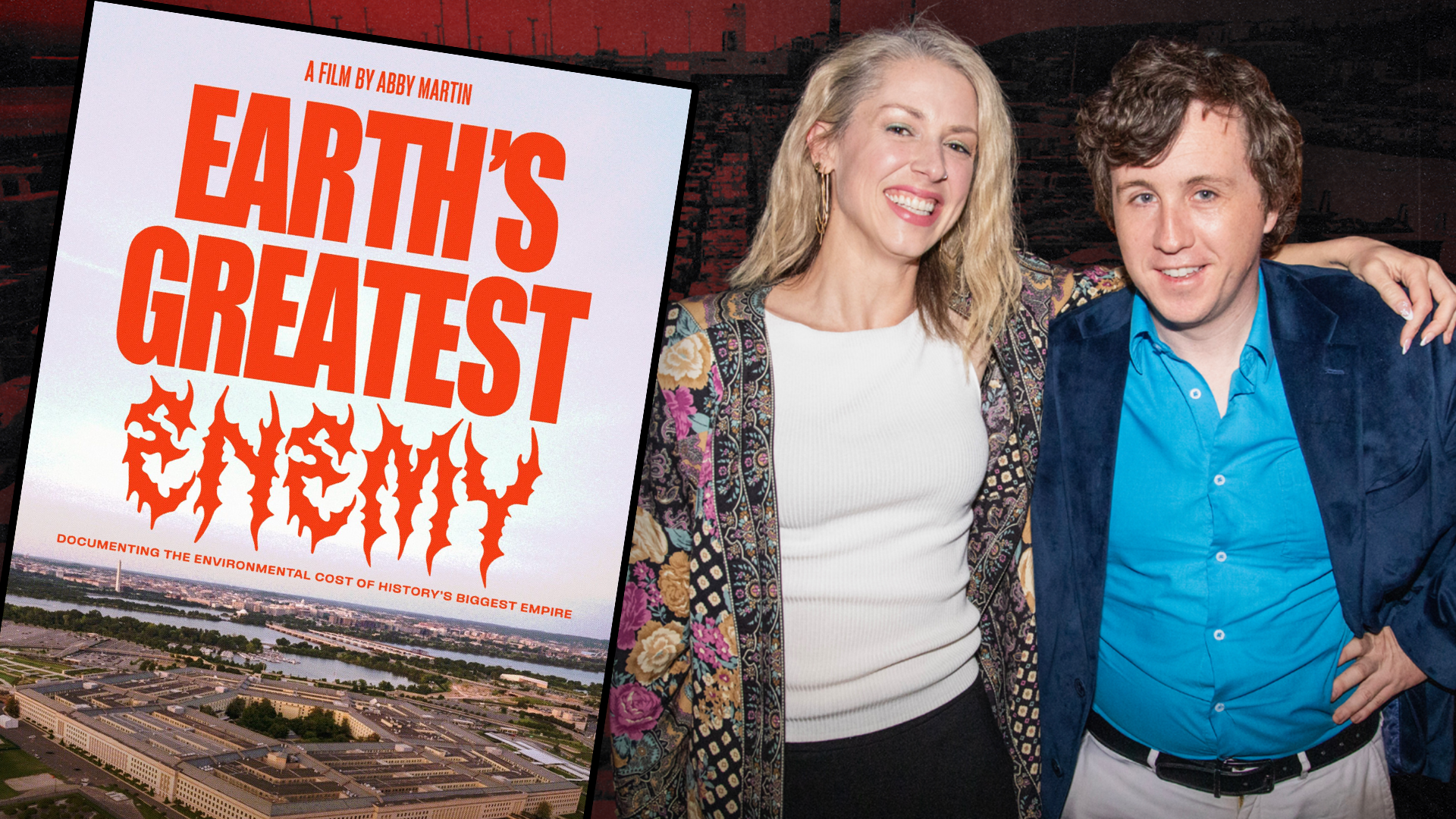
Abby Martin is an investigative journalist and filmmaker who has dedicated her entire career to speaking truth to power, taking audiences to the high rises of Wall Street, the rubble of the Gaza Strip, and everywhere in between. Martin's latest documentary, co-directed with her husband Mike Prysner, is her most ambitious yet—and exposes the ultimate force responsible for our generation's most pressing emergency.
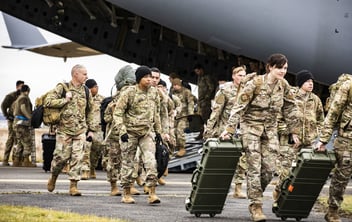
Earth's Greatest Enemy is a tour-de-force of filmmaking that thoroughly explores how the U.S. military is destroying the planet. The film travels from Camp Lejeune in North Carolina, where hundreds of infants were poisoned by military pollution, to the oceans of Okinawa, Japan, where local activists are begging Americans to leave their waters alone. Martin speaks to former members of the military, who recall being instructed to dump plastic waste off the side of naval ships, and confronts the U.S. politicians who allow this carnage to continue. She sat down with Current Affairs to discuss the purpose of the film, and how she hopes it will inspire audiences to act.
(Earth's Greatest Enemy is currently premiering in select theaters across the country. You can help organize a screening in your hometown at the following link.)
Nathan J. Robinson
This film is a very difficult thing to get through. It's a remarkable piece of work. You've worked on this for five years along with your co-director, Mike Prysner. And your director of photography and editor are fantastic, too.
Abby Martin
Thank you so much. Yes, that's Taylor Gill.
Robinson
Yes, just the editing on this thing. If you try and describe this film in a simple way, you would say that it's a film about the effects of the US military on the environment and the destructive climate consequences of US military action. But I feel like that massively oversimplifies what you're doing in this film. You're almost instead trying to explain, to show people, how the forces of destruction in our world today work. And so while it looks like a film about the climate consequences of the US military, it's more than that. So how do you explain what you're trying to convey with this film?
Martin
It's a really interesting angle to look at it as kind of the holistic approach of our filmmaking, which is trying to tell the entire story, the totality of these existential crises that no one really wants to face. But I feel like it's about time that we synthesized these things that have been floating in the periphery for so long—that the US military is the world's largest institutional polluter. But when we went into that, Nathan, we realized that is just on paper: the oil purchases every day. And so to extrapolate that out and continue to explain how much it is, it becomes completely unquantifiable.
So what we intended to do was really make an educational film about the machinery and machinations of US imperialism as a system and how it actually enforces this fossil fuel infrastructure at the barrel of a nuclear-armed gun, subjugating the planet and impeding any sort of ingenuity or creativity out of that system.
Robinson
We can break down specifically some of the ways in which US military action contributes to the destruction of the planet. And you do. Directly, here is the burning of oil. There is pollution. You try and sort of tally up all the different ways in which this destruction occurs. Maybe you could break down for us some of the basics as you try to sort of get to grips with the climate and human consequences of US imperialism.
Martin
Absolutely. There have been several waves, obviously, of military buildup and expansion of the US military over the last several generations. And so every time there are those military buildups, there's a new wave of contamination on every single one of these bases, using US troops as lab rats in these kinds of experimental exercises where you're testing Agent Orange and nuclear tests.
So you can look at the legacy contamination, which still continues to kill people every day. You compound that with the current wave of military buildup in places like Guam, Okinawa, and the Mariana Islands. All of this—the just complete national security exemption from testing open-air detonation in these indigenous lands, the desecration of these lands. And then you look at the complete lack of accountability of any sort of cleanup or remediation efforts—all the Superfund sites across the US. And these are just across the US. Imagine the impunity when we're looking at the 800 to 1,000 military bases around the world.
So we entered into it wanting to just prove that thesis, that the US military was the world's largest institutional polluter. But when we unpacked it, we realized the life cycle emissions. You're taking rare earth minerals from the Congo. The maintenance and arsenal of a military empire—how do you quantify that? It becomes completely insane. And then you look at the actual application of the machinery, which is war itself. So that alone is really kind of unquantifiable. But then you couple in the maintenance of the arsenal, the chemical dumping of just maintaining these engines to be mission-ready, the B-52s, and the Bradley Fighting Vehicles. All these things—an unparalleled size, of course, when you look at the next five greatest powers on earth, and they're just sitting there, mission-ready, dumping every single day and contaminating our water supplies.
And none of this needs to happen. None of it's necessary. There are safe alternatives for all of this, but they just choose to have a callous disregard for the environment and human life.
Robinson
What did you say in the film? The miles per gallon on one of those vehicles?
Martin
0.75 miles per gallon for the Bradley fighting vehicle, and then after the billions invested in hybridization, it's 0.9.
Robinson
One of the very striking things that comes across is how futile any of our individual efforts to reduce our emissions to live sustainable lifestyles are when you put them next to that—none of us can, even altogether, make up for even a fraction of the destructive effect of even the US military just sustaining itself in the absence of an ongoing war.
Martin
Exactly. And I think that's the really zoomed-out bird's-eye view of the film. It's that, yes, you can look and classify all the different facets of contamination that are ongoing, that are continuous, throughout the past. But what you really are looking at, Nathan, is a system that is enforcing a fossil fuel infrastructure and necessitates the expansion. So the continuous extraction and pillaging and plundering of every last drop of oil, natural earth minerals, and everything that we're seeing, especially in the Arctic, is used to justify continuous growth and expansion of the military. It's a self-feeding cycle of all of this.
But to your point about collective action, I'm a militant composter. Ask my husband, I don't get a fucking scrap of food past me, but I also understand that alone is not going to make a dent as long as we are allowing this institutional force to grow unabated.
Robinson
Well, you mentioned unabated growth, and I think that one of the important ways in which your film reframes people's understanding is that you do go in thinking that you're going to learn that the military is, as you say, an institutional polluter. But I came away thinking of it rather differently—not just that this is an institution that pollutes and needs to be cleaned up, but that this institution is a kind of cancer on the earth. It operates in kind of the same way as cancer. There's this endless drive for self-replication and growth, destroying anything in its wake. And you show that wherever the US military goes, everything it touches is kind of destroyed. Everything is poisoned. Even the soldiers themselves end up poisoned. It almost comes across in your film like this toxic organism that threatens to envelop the earth.
Martin
Absolutely. And at the end, we have this animation done by this really wonderful friend, Aaron Dunbar, who basically shows that and anthropomorphizes this idea and shows it, quite literally, consuming the earth. And that is what it is. It is a monster that will continue to feed on every last vestige of human and animal life.
It's collective insanity, Nathan. Every year we see António Guterres at the UN say, "We're digging our own graves." And it's like, yes, we are, but there's no ingenuity or creativity outside this system. I've talked to climate scientists who are like, I've never even heard of this information, because it's never presented to us that we even have an option outside of capitalism.
Robinson
Yes. One of the striking recurring images in the film is the kind of barrenness at the end—this organism, as I say, kind of eats everything in its path. You show the destruction in the Middle East. You have the footage swooping over Gaza. But you also show the deaths of ocean mammals and coral reefs. And of soldiers. It almost comes across that we've built this institution that pushes us towards collective suicide, and it's a very bizarre institution to have built that nobody within it quite understands or even knows how to justify.
Martin
Right, and that's a really fascinating part of the film: actually approaching the people who are compartmentalized in the system, the high military brass, top generals. You see the glitch in the matrix as they're talking to me when I say, "Is this worth it? Is the wanton destruction of all this marine life worth RIMPAC?" And they're just like, "I don't know if it is. I don't know if it is." And I'm like, "Whoa, wait, you just said it right there." But then they're like, "We have to train, we have to get the oil, we have to get the minerals." It's a hive mind, and just like a for-profit corporation, if someone disagrees, they're out of the board the next day because it is just a machine that's essentially operating on its own.
Robinson
You mentioned RIMPAC there. You might want to explain what that is.
Martin
Yes, the RIMPAC: Rim of the Pacific. They're the largest war games in the world that are held under the orders of the US, and they incorporate 14 different countries. I think that was the last RIMPAC. And it's just insane, widespread destruction over the Pacific Ocean on the shores of Hawaii, using high-frequency sonar that travels 300 miles underground. And what's so fascinating about this is just this full-frontal assault on the world's oceans with no news, really, no investigation on what this is doing to the life in the ocean, which is really essential for life on Earth. It's just this complete, I don't know, misdirection.
I remember watching The Cove when I was 13 years old and writing letters to the Japanese government about their whaling program because I was so horrified. And now I'm looking back on it, and I just think it seems like a really intentional kind of misdirection, an obfuscation of what the hell my own government is doing in my name. Why don't I know this stuff as an American citizen?
Robinson
Watching the RIMPAC section of the film really did drive home the strangeness, the absurdity of it all, because these are war games. These are big games, but they're with live fire, and they're preparing for...what war? What is coming that they're preparing for? What is this even all about? What are you doing? And it's all of this human effort, all of these resources burned. You go through the staggering numbers of marine mammals killed by the Navy with permission, and you're just left going, What are you doing? What is all this?
Martin
Exactly. It is the most short-sighted collective insanity, and it continues to ratchet up in terms of how ridiculous and cartoonish it really is when you look at the scale and scope. I think the most kind of startling part, even for me, is seeing how vast the arsenal is, how cartoonish it is, and how unnecessary it is. Who is this all for? What is it for? It's literally to line the coffers of a few billionaires and defense contractor CEOs. When you say, "What is it all for?" some people may say, "Well, we need to defend ourselves, so we need this massive military arsenal."
The thing is, it's completely counterintuitive and pointless. Not only is it parasitically, vampiristically sucking every last resource, every last drop of our blood, sweat, and tears, and we can't afford bread, gas, housing, or health care, and all going to line the pockets of these people, but it also is just like you said. Every single one of the best and brightest engineers, the people who need to be working on solutions, cooperating, and collaborating, are working on how to kill people more efficiently, and for what?
Robinson
The military is inherently an institution whose job is destruction. Its job is to kill and destroy or to threaten to destroy. That's the sole purpose of a military. And you asked one of the military brass—I can't remember who—about the Arctic: why do we need this talk on Arctic supremacy, dominating the Arctic? Why do we need to dominate the Arctic? He's like, "I don't think we need to dominate the Arctic. Did I say that?" And you're like, "That's the title of the talk! That's why we're here. What is this all about?"
Martin
It's like the compartmentalization, the self-rationalization, of their own insanity, of how insane it is. And, yes, you saw him just being like, "Talk to AFA. I didn't make up the name of that." And it's like, you are the NORAD Commander. And you see him in the panel just saying, "Come and experiment. This is an open invitation for corporations all over the world to come and experiment in the Arctic." Who's giving you the right to do that? You don't own the Arctic.
Robinson
This is going to sound funny, but watching the film, I have a comment is, —which is, I think, in a certain way, you underestimate the full costs and the full level of destruction. And the reason for that is: in the film, you go through the direct climate consequences and all the pollution. You go through some of the indirect ones, so everything that goes into building this stuff and everything that goes into rebuilding after a war. But I've been writing a lot about security dilemmas and the way that US foreign policy causes other countries to adopt more adversarial positions towards us.
That is to say, we ring China with bases, and then we enter into an arms race with China, and China responds by building up its nuclear armed forces. We respond by building up ours. So it strikes me that another consequence, which is not even discussed in the film but is very real, is that the Chinese military arsenal, which is presumably also wasteful and destructive—as arms races escalate, as powers around the world rush to arm themselves on both sides of the great power conflict—there's a whole other level of waste and destruction.
Martin
Absolutely, you wanted me to make the film longer? Wanted me to give me more work?
Robinson
Yes, I want a section about the Chinese military and how that's also our fault!
Martin
That's true. I'll wear that shirt around that says "the US military is the world's largest polluter" and I've actually had one person come up to me and say, "That's China." And I'm like, let's sit down and talk about this. Because if we're really just looking at the manufacturing, the emissions of China, they've absorbed all of our manufacturing. If you look at the cumulative emissions of how we even got to this point, it's really unparalleled. And to your point, the great power competition.
Yes, of course, we wouldn't be looking at the buildup of the nuclear arsenal of Russia and China and also the withdrawing of these treaties that were really important with Russia without the posturing, the belligerence and arrogance, and the continuous war drive of the US against these countries and military buildup in the Red China Sea, just basically saying it's a threat to us if China has a ship in the Red China Sea. We were saying earlier about the counterintuitive nature of all of this. When someone says we need this military to defend ourselves, you could argue it's waning US hegemony. It actually impedes our control around the world. But it doesn't even matter at the end of the day, because it's not even about strategy, winning, or even maintaining imperialism. It's so short-sighted. It really is "you're a hammer, and every problem is a nail." Because you could look at the whole losses of the War on Terror, and people are like, well, we lost the war—we've lost every war in the last 50 years. That's not even the point. The point is just literally profit.
Robinson
I did come away with the phrase "suicide machine" in my head. You're building this thing that, in the long run, serves nobody. Some of the most powerful parts of your film are looking at the effects on soldiers themselves, the way that the military destroys those who serve in it. In fact, in our review, Karissa Halstrom said that she was most struck by the opening scene of your film. Maybe you could describe it. Since it's the opening, it's perhaps not too much of a spoiler.
Martin
Yes. Living in LA for so long, there's that dichotomy of having the ultra-rich with just abject poverty and homelessness surrounding you, and especially Veterans Row in Brentwood, one of the most affluent neighborhoods in LA. It's a bunch of veterans living right outside the VA hospital displaying the flags because they're given them from the VA to display.
Robinson
Well, how nice of them.
Martin
Yes, isn't that nice? Maybe they could drape them as a blanket during the cold nights in LA. So we met one of these young men named Lavon, who was an Iraq War veteran. I'm aging myself—not young. I guess he's around my age, around 40, if he served. But what was so startling, Nathan, is that he told us, as he was playing this beautiful song on a piano in his tent, that he was in an Army commercial. He was actually in an Army commercial. I could not believe it. And then we found it. I found the commercial, and it struck me. It just was like a gut punch, because I was like, I remember that.
Robinson
I saw the commercial. As soon as you played it, I realized that I had seen that commercial years ago. And in it, he's there, a young man. They go, "Have you ever flown as fast as a helicopter?" He goes, "Oh yes, in my last job." And they show it. I remember that ad. The thesis of the commercial is: the Army makes men. And then you catch up with the guy, which no one has thought to do, and it turns out he's living in a tent on Veterans Row.
Martin
Yes, he's living in a tent in Veterans Row. And it really just encapsulates what Tomas Young, the paralyzed Iraq War veteran, wrote in that letter to Dick Cheney, just saying, "We are the human detritus. You have done this to us. We are an entire generation laid waste because of the consequences of the War on Terror." And that's how we wanted to open. This is what happens after your churn, after you're just used as cannon fodder by the ruling class: you're put out in the streets and you're left to die. And that's really the encapsulation of the whole movie. Levan represents the Iraqi children poisoned with depleted uranium. It's the children playing in the rubble in Gaza, trying to make a life for themselves. It's my child at home living in Portland, Oregon. There are no borders to this global empire's pollution.
Robinson
I would mention one more detail of that sequence with Lavon that really drives home the tragedy of the story. While he's playing the piano, he says, "I play it as much as I can because I'm losing the feeling in my hands, and I won't be able to play." So it's not just that he's living in a tent. His life force, his ability to create something beautiful, has been slowly taken away from him. You see that and realize, how much longer is he even going to be able to do this?
Martin
And then they take it away from him. As we watch, they destroy the encampment. And so it was just such a powerful scene, because it's like it doesn't really have a direct correlation to environmental pollution, but at the same time, it really does, because it just shows everything's laid to waste. They will not preserve anything.
Robinson
Before we move on to the part about resistance, which I think is incredibly important—because we are describing a very bleak and dystopian and overwhelming picture, and people should know that when they watch the film, you do profile people who resist—I want to still dwell, just for a moment, on the people who are part of this system. Because it is extraordinary, the access that you get in this film. You go to trade shows for weapons companies. You go to the climate conference, and you manage to ask questions.
There's the great sequence where Nancy Pelosi is like, I think I'd like to take a question from a woman. And then she picks you. Oops! Because you immediately start asking a very tough question. Can you talk a little bit about the mentality? Karissa, in her review, mentions the banality of evil, or she talks about the stupidity of evil. All the people who are part of this kind of know what they're part of but don't know it. And then you ask them a direct question, and then there's all this cognitive dissonance. It happens over and over.
Martin
Yes, and I was particularly shocked by (former Washington Gov.) Jay Inslee, who literally ran on climate change. I don't remember anything else about his platform. And he couldn't even answer a simple question. In fact, he said the military is the solution for some of these things. And you just kept getting that over and over again. The only person who really addressed it correctly was AOC. And it really is the bare minimum. Do you want military emissions to be exempt or not? And you have all these people who are supposedly these leaders on climate solutions, and they cannot answer a basic question.
But speaking as someone who understands just how corrupted corporate media is and how much these journalists work as appendages to the military-industrial complex, one interesting thing about the RIMPAC worship is I get access in these areas because the military is also comprised of kind of dumb people who don't Google me.
Robinson
That is evident, actually, in the film. It did come into my head multiple times. Did you Google Abby before you let her into this room?
Martin
And so I'm on this massive aircraft carrier in the middle of the Pacific Ocean, and I thought that I'd be surrounded by real reporters who are beating down the hatches just trying to get answers from the Secretary of the Navy, and instead, I'm surrounded by Air Force Defense One reporters who literally exist to bolster the military-industrial complex. They are there to essentially just revel in the latest weapon systems. They were trying to ice me out before I even got in the room. And it was a stark realization, even though I know how this works, to see how many there are actively participating in that system where they just exist to just be a part of the military machinery as reporters. It's really fascinating.
Robinson
Yes. We've sort of laid out what you show in the film: how we've built this vast machinery of death and destruction; the way in which it's buried from view, so we don't see it, we don't talk about it; what it does to the people within it, from pollution poisoning people to emissions creating devastating environmental and human consequences; and the interests that it serves—we have laid some of that out. It's interesting.
People might be surprised that your children are in the film. Your family is in it. You made the film with your husband, Mike Prysner. You focus a lot on what's going to happen for this next generation and who's doing something about this. And it struck me that, perhaps, because you have children, you can't leave with a pessimistic perspective. You have to think about the question, what do we do? Because I have kids, they're going to grow up, they're going to live lives, and we have to find a way for them to live decent lives.
Martin
Yes, I always have been driven by not just rage and anger. Of course, I used to be a lot more angry outwardly, but I've become so incredibly motivated and inspired by all the people that I continue to meet around the world, especially those that are living under the boot of US imperialism, that don't have the capacity to really change head-on like American citizens do, living in the imperial core. And so I'm actually incredibly inspired at this moment, having met the elders in Okinawa who've spent 20 years slow-walking, doing shifts to do civil disobedience, just to slow down the Henoko-based construction. We do this for them. We do this because we have to.
And certainly, once I had children, I tripled down on my efforts, because I'm absolutely not going to let these parasitic vampires win without a fight, and I'm not going to be on my deathbed just saying I didn't do everything that I possibly could to give you a habitable future, even though it's insurmountable odds. We have to, we have to. And it is beautiful. And everyone that I've met—I met my husband in the movement, and I met all of my friends and loved ones in this movement to try to build a better world collectively. So that's my best advice: for people to get involved.
Robinson
The Okinawans are very striking. In fact, you profile a number of different groups of people who are resisting in different ways, from the Atlanta forest defenders to Native Hawaiians, but the Okinawans really stuck with me. Because here you have, first off, the full absurdity of the system, that is to say, the United States military building this base in Japan, taking over a huge piece of the island of Okinawa, and destroying this pristine landscape with all these endangered species for nothing. And then you have all the people who live there, these ordinary people who are going out in little tiny canoes every day to try and save their island from us.
Martin
Yes. And then you have the Japanese military acting as just the warriors for the US to protect this absurd project that is so counterintuitive to anything at all. I spoke to the governor, Denny Tamaki, and he was just like, "This is so stupid." He actually says in the film, "You're sacrificing nature for this obsolete idea that makes no sense," and he actually reiterates that he has no power over the US military. He's the highest elected body in Okinawa, and he cannot stop this base construction, even though he was elected because he opposed any new construction of US bases.
Robinson
Yes, you speak to one Okinawan in the film, who goes, "Please leave. Can you just please leave? Why are you here? What are you doing, taking over this huge piece of our island and destroying it? This is our home. It's not your home."
And what's striking is you think, well, most Americans don't even know we're there! When you say, "Please leave," they go, "What are you talking about?" And so one of the remarkable features of this system that "we" have built is that we, most Americans, have no idea about what we are part of—this thing that we are part of.
Martin
Yes. It's all externalized. Every consequence—until recently, for a lot of people, seeing the militarization of ICE and the increasing repression here at home. But for a long, long time, Nathan, the vast majority of Americans have been completely removed from any sort of consequence of this military empire and how it subjugates the planet.
And for example, my dad, who was drafted in Vietnam, saw the movie and just said, "What...? Why are we there?" He said, "We're still there?!" It's like, surprise! We're still there because of this old colonial holdover of this antiquated Status of Forces Agreement that just allows us to still treat these people as slaves to the system. They're being repressed by both Japan and the US, and they're stuck in between. It's absolutely horrific.
Robinson
And there have been huge protests against it for decades. The Okinawans overwhelmingly want us to leave. Americans, I assume, if they were polled, if they had any understanding of this, would probably support us leaving. And yet, it is an issue that is never discussed. It just doesn't enter the consciousness. I don't know when the last time any reference to Okinawa was made, even though it's such a live controversy on the island of Okinawa. It's totally absent from US discourse.
Martin
That's how I actually became radicalized, not just from the Iraq War propaganda, but from reading Blowback by Chalmers Johnson, a CIA guy who turned anti-imperialist because he went to Okinawa and said, "This is wrong. This is horrific." He detailed the crimes, the atrocities, the rape, the drunk driving, the murders, and just complete impunity for these soldiers being shipped back to the US. And I was just so horrified. I wanted to tell that story 20 years later and to be around the elders doing that work. That's what we do this for, Nathan. We do it for them. We do it for everyone who's fighting that we need to amplify and give voices to.
Robinson
Now last night at the screening you said that when we're talking about the hopeful aspect of this, you have seen over the past half decade that people are, in fact, beginning to wake up. You say in the film the power we're up against is not absolute. It has weaknesses. We can get in its way. We can disrupt it. And in fact, you show examples of small victories.
But you talked last night about how you made a film about Gaza in 2019. Nobody was talking about Gaza. The situation even before the genocide in Gaza was horrendous. Now, however, there is a vastly greater awareness. And one of the encouraging things that you were saying is that you have seen people are beginning to understand what you are trying to convey in the film about how this system works.
Martin
And that has exploded. Ten years ago, even just bringing up socialism was taboo. As you know, Nathan, it's been a very long slog of trying to get these ideas to be fundamental to our understanding of how these systems work. Basically, I've seen Palestine become a nonissue to the issue, to the crux of humanity's collective liberation—people understanding how our collective freedom is intrinsically tied to Gaza, to Palestine, and having it all fold together. It's something that I've never seen, and I continue to be absolutely thrilled by people from all walks of life in a multigenerational class struggle against the ruling class.
Robinson
One of the things I so appreciate about the film is that I feel like to act, we first have to understand; we have to have a deep understanding of what it is. You take feelings that people might have: feelings of discontent, or something is wrong, or there's something kind of dystopian, or there's something that doesn't feel quite right, something false. When I watch one of those Army commercials, something feels like propaganda, but I'm not sure what it is. And you help us understand, what are the parts of this system? How does it work? And as you say, we have to act, but in order to act, we really have to know what it is we're dealing with. So what are we dealing with here?
Martin
Well, exactly. This is why Current Affairs is so important. This is why I do my work at Empire Files. We try to create an understanding and educate through mass education through independent media because we understand the power and the potency of a message like this. The richest men in the world are trying to consolidate every form of information and narrow the field down to just reinforce a false, inverted reality. And that's why they're amplifying all of this trash online, and it's becoming so difficult to wade through.
But to your point, this is why Trump was successful in his first and second terms. He seized on that distrust. He seized on that disaffected collective consciousness that we are being lied to, that we can't trust the government and what they're telling us. There's this bipartisan consensus of just endless war and destruction and the cannibalization of the working class and our material conditions, and people know that, but the Democrats didn't have any sort of vehicle to capture that. So you had Trump, legacy media, fake news, the Bannon strategy folding everyone into that right-wing sphere. That's where we come in. Someone like me and Mike, who spent five years putting together a real investigative report of good information, sitting someone down and giving them 20 different entry points and saying, You're so inundated with propaganda, sit down and just take it in, and sit with real news.
Robinson
And I think what people will hopefully come away with after they watch your film is the ability to interpret the additional facts that they find in the world and other news items. So, for example, in the paper just this morning, I read two news items. One was that Vanguard Investments has been forced to enter a settlement with some red states because they supposedly pushed oil companies that they were invested in to adopt green energy. The red states sued and said they can only pursue profit. You can't pursue green energy. And they've conceded they will never do anything on climate again. They will only pursue profit. They will only pursue the destruction of the planet because anything else violates the principles of capitalism.
And then I saw another news item: bird populations in the United States are not only declining but declining faster, especially in areas with intensive agriculture. The overall drop in bird population is much larger than anticipated before. So what people see is these little, tiny, disconnected fragments of news that sort of flow at them, and what you help them do with this film is take that and put it into a constellation, give it meaning, and help them understand how all this fits into one picture.
Martin
Yes, because people are completely paralyzed. Understandably so. Our brains are not meant to take in information like this. We're not meant to learn about every horrible thing happening on the planet within five seconds without any context or feeling of agency about why this is happening and how it's happening. And so again, going back to that holistic understanding of why the structure creates situations like this, why the system is at fault, and the onus is not on us—that's the problem. For the longest time, our struggles have been superficialized and sold back to us under neoliberalism, and it's so hollow and bankrupt, and people are realizing that and realizing we cannot change this alone.
We have to come into it with some sort of collective agency and action. The truth for me is it's invigorating and it's empowering. I want to see with very clear eyes what we are looking at, and I think that is the first step, because as things get worse, people are becoming more detached. I see fewer people talking about climate change and becoming more radicalized in conspiratorial frameworks and detached from just a consensus reality. And so I want to get us back to that groundwork of what we know to be true. These truths should be self-evident. This is true. We live in a military empire. None of this serves us. We have more in common than we do with Elon Musk and Donald Trump. Immigrants and trans people are not why we can't afford eggs and gas.
Robinson
To return sort of to where I started talking about the film, I do want to emphasize to people who are thinking about seeing the film that if you think this is a film about the environmental consequences of US military bases, that is a very narrow way of framing what this is. This is really a film about helping us understand how the world works and what the central problem of our time is and suggesting some ways in which we might deal with, resist, and build a livable future. So that's why I hope everyone watches Earth's Greatest Enemy.
Martin
Thank you so much, Nathan. The thing is, we have a chance. This is our moment to seize, and it really takes mass education, because that is what they're terrified of. They're terrified of us being awake and working together. So let's do it.
Robinson
And so if people want to watch your film, they've heard us have our conversation, and they now think, "I'm ready. I think I can take it."
Martin
Buckle up.
Robinson
Yes. What do they do?
Martin
Okay, they go to earthsgreatestenemy.com. We are trying to go on an exclusive director's tour to get people in the room with each other so we can kind of unpack the trauma and what these monsters have done to us and the planet with the love and solidarity of community organizations. And then hopefully, in May, it'll be up on streaming so that we can let this baby fly and change the world. Let's do it.
Robinson
Abby Martin, congratulations. We know this film took half a decade of your life, and it really shows in the film. The number of places that you go, the number of people that you talk to, all the incredible footage that you've got in there that nobody's ever seen before. There is stuff in there that will really open your eyes, and I do hope that every single person who listens to this does find a way to see Earth's Greatest Enemy. So thank you so much for joining us here at Current Affairs.
Martin
Thank you so much. It was a great honor to be here.
Transcript edited by Patrick Farnsworth.


%20(crop).jpg?width=352&name=wile-e-coyote%20(resize)%20(crop).jpg)