Rania Khalek is a Lebanese-American journalist based in Beirut and the host of Dispatches on BreakThrough News. She returned to Current Affairs to give Digital Editor John Ross an update on Lebanon, where Israel has continued bombing, occupying territory, issuing displacement orders, and demolishing villages during what is being called a “ceasefire.”
John Ross
Last time you spoke with Current Affairs, you warned that Israel was openly threatening to turn southern Lebanon into the next Gaza, and since then, we’ve seen continued Israeli strikes during what’s being called a ceasefire, in addition to mass displacement, entire villages being blown up, and journalists and medics being targeted, as well as a so-called “Yellow Line” or buffer zone, where people may just never be allowed to return. And since you’re based in Lebanon, I was hoping that you could just walk us through what the so-called “ceasefire” has actually looked like on the ground.
Rania Khalek
Yes. So this ceasefire has been in effect since April 17, I believe, and was imposed unilaterally by Donald Trump a week after the ceasefire went into effect between the Iranians and the Americans. And I just quickly want to point out that the initial Iranian-American ceasefire was supposed to include Lebanon. That’s what the Iranians were under the impression of. That’s what the Pakistanis thought would be the case. That’s apparently what the Americans had agreed to. But as soon as that ceasefire went into effect, it was the next day that Israel dropped 160 bombs on Lebanon in 10 minutes, killing almost 400 people, if not more—in 10 minutes—to try to obstruct Lebanon’s ability to be a part of that ceasefire, in addition to trying to really collapse the Iranian-American ceasefire. Then things got much more vicious after that day, April 8. It was called Black Wednesday.
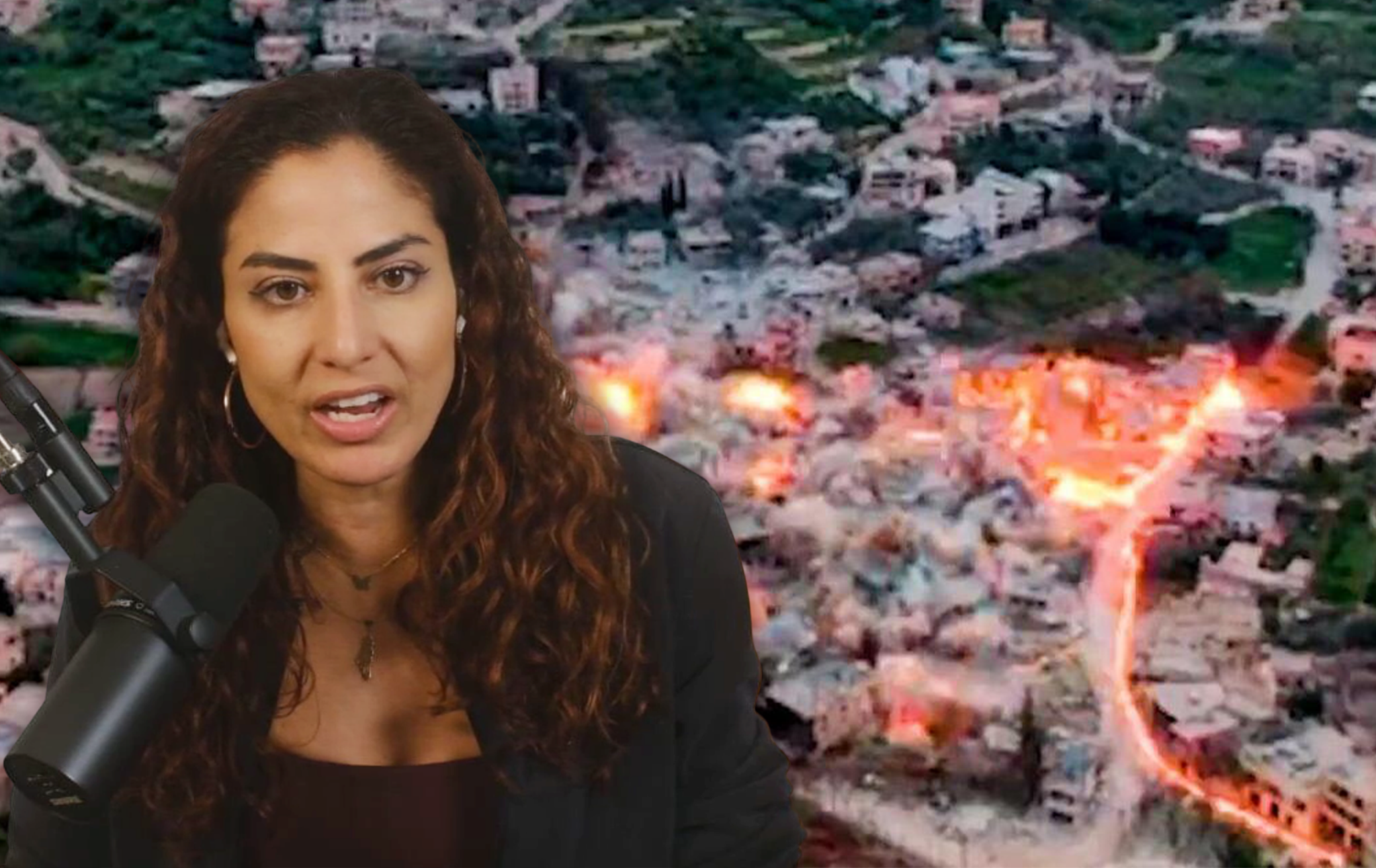
Then Trump imposes this ceasefire on Lebanon. Everybody felt a little bit of relief. Because over a million Lebanese had been displaced from the south and from the south suburbs of Beirut, a lot of people went back to their homes to check on their houses, but a lot of them have been displaced again since then because the bombing hasn’t stopped in southern Lebanon. As you mentioned when I was on last, I talked about Israel’s stated plans to turn parts of southern Lebanon into Khan Yunis, into Rafa, into Gaza. And we’ve seen what the Israelis did in Gaza, and that’s exactly what they’ve done. They have refused to withdraw from the areas they invaded in the south. They continue to occupy villages, and they’re carrying out these controlled detonations of entire villages. Almost 40 Lebanese villages have been largely damaged or entirely destroyed, Gaza-style, because of this. And this is going on during the ceasefire.
Since March 2, when this war escalated, the Israelis have destroyed 50,000 Lebanese housing units. That has continued throughout the ceasefire. That’s 50,000 homes people don’t have anymore, and they’re doing it on purpose. That’s their policy so people don’t return. They want to create a buffer zone, or dead zone, across southern Lebanon so that people don’t return, similar to what they’ve done in Gaza, where they have this yellow line, this imaginary line they’ve placed on the map, where they destroy everything beyond that yellow line to create this dead zone between the Israelis and the people they’re trying to eliminate. So that’s what they’ve done in southern Lebanon. They’ve continued to kill people. They’ve killed almost, I think, 400 people—something like 380 people is the last number I saw during the ceasefire. That’s crazy. Hundreds of people are killed during a ceasefire every day. It’s like 20 people yesterday—I think it was 17. They continue to bomb Civil Defense workers as they’re trying to rescue people from the rubble across southern Lebanon.
Every morning, I wake up and see notifications from the Israeli military spokespeople in Arabic that people need to evacuate their villages. We call them “forced displacement orders.” That’s still going on. And then yesterday, the one thing that’s been in place since the “ceasefire” went into effect—and I put “ceasefire” in huge quotes here—is there’s been a kind of ceasefire on Beirut, I guess you could say, but that was actually broken yesterday. For the first time since this fake ceasefire went into effect, Israel bombed the southern suburbs of Beirut. And in fact, what’s interesting about this bombing that they carried out is, the Israelis said that they did it in coordination with the Americans, as in they called up Donald Trump—Netanyahu called up Donald Trump—and they coordinated this bombing yesterday in the southern suburbs of Beirut. And so now that actually kind of makes the Americans directly involved in a war on Lebanon that, as far as I know, the American public and the representatives in Congress have not authorized. So it really brings a kind of new level of American involvement to this war. But yes, the situation on the ground here is absolutely horrific.

Ross
Yes, and of course, it also begs the question: how can the United States possibly be a neutral partner in peace negotiations when they’re actively participating in the bombings? But I just wanted to linger on something you were talking about before, on what is being lost when these villages in South Lebanon are being destroyed. I remember a little over a decade ago, for example, when ISIS was destroying cultural and religious sites in Syria. Of course, there was rightly a lot of horror in the United States in outlets like the Atlantic about the attempt to just wipe out history and civilization. But when Israel destroys entire villages in Lebanon, it often gets framed or described in this language of security or military infrastructure. It’s like, “Oh, this was just a Hezbollah stronghold. We just had to blow up this entire village.” Can you talk about what Israel is destroying beyond the physical buildings themselves and also what it does to people psychologically when they’re displaced, told there’s a ceasefire, try to go home, and then realize there’s nothing to go back to, or they’re being driven out all over again?
Khalek
Yes. Okay, so these are villages that have been around for generations, for hundreds and hundreds of years, and in some cases, a thousand years. These villages have so much history. A lot of attention has been given to Israel desecrating religious symbols of Christianity in the south, because while Lebanon, or the Middle East in general, is largely portrayed as this Islamic place—it is majority Muslim—there are historic Christian communities. In fact, the original Christian communities, or the ancestors of the original Christians of this region, exist across Palestine, Lebanon, and Syria, with so many old churches and religious sites. Israeli soldiers have been desecrating those sites in places like Debel, for example, a village in southern Lebanon that’s majority Christian. And that’s been provoking a lot of outrage because Israel has portrayed itself as protecting Judeo-Christian culture, or so they say, against the Islamic hordes.
And so there’s a kind of acceptance in the West of the routine destruction of mosques, whether in Gaza or in South Lebanon, and the routine killing of Muslims in Lebanon—specifically Shia Muslims, because that’s who makes up the base of Hezbollah’s community. Shias in Lebanon make up the majority of the south. But all that’s to say there are sites and statues that have been destroyed. There are sites that are believed to be the burial sites of Christian saints that have been destroyed by the Israelis. Several churches, since 2024 when there was the first big war between the Israelis and Lebanon, have been destroyed, especially this time around. Because there are Israeli soldiers marauding across the south, they’ve also photographed themselves desecrating both Muslim and Christian symbols, but then having to apologize for desecrating the Christian symbols because it upsets Christians in the West—as it should, by the way. But what that demonstrates to me, and should demonstrate to everyone, is that Israel is a Jewish settler colony committed to Zionism, which is Jewish settler colonialism in this region. It’s Jewish supremacy. And basically, anybody who’s not Jewish, whether Christian or some variation of Muslim, is somebody who’s considered killable and needs to be ethnically cleansed to make room for Greater Israel, or for security, depending on what kind of Israeli you’re talking to.
So it doesn’t matter in Lebanon if you’re Christian, Shia, Sunni, or Druze. The problem is that you’re Lebanese, that you’re Arab, and that you’re not Jewish. The same goes for Palestine, by the way. We see the Israelis invading a Christian village, Taybeh, in the West Bank that keeps getting a lot of attention, destroying homes and desecrating their symbols. It is because they obviously hate Islam and Christianity because, again, this is a settler colonial movement, but it’s just the mere fact of destroying the indigenous people, their symbols, and their historic sites on the land. So when we talk about what’s being destroyed in South Lebanon, you’re talking about hundreds and hundreds, and in some cases, a thousand years of history of people who’ve been on this land, of houses that have been passed down generation after generation, of state infrastructure like bridges and municipal buildings, and of water sanitation infrastructure. You may have seen what they destroyed.
Actually, in the same Christian village of Debel, there was video footage of the Israelis destroying solar panels. Lebanon has very, very poor state electricity, so a lot of villages outside the city are dependent on solar panels to get electricity. And so destroying those solar panels is essentially making a village unlivable. You’re destroying the electricity infrastructure of that village. So these are people’s lives too. I want people to really consider the fact that these are homes just like your home, wherever you live across the U.S.: it has your photographs of your family and your dining room and your childhood bedroom. I’ll use my village as an example. The village I come from, which is not in the south but is in the mountains of Lebanon—I’ve had generation after generation of ancestors who’ve lived in that village, and all the memories and all the houses that have been built on top. And so when you destroy a home like that, you’re destroying something with hundreds of years of history, usually. So that’s what people are losing here. They’re losing their land as well. The Israelis are poisoning the land. They’re dropping white phosphorus that’s actually destroying the ability for agricultural land to be able to grow and have vegetation on it. And the thing about the south is it is the kind of agricultural heartland of Lebanon. It’s where we grow a lot of our food. There are olive trees. Israelis, famously, kind of seem to hate olive trees, which is bizarre for people that claim to be indigenous to so badly hate the indigenous trees of the land. But they want to make sure, literally, that you cannot grow food, that the soil is dirty, and that your home can never be livable again. And that’s what they’re doing, and it’s just absolutely horrific.
Ross
Yes, 100 percent. You would think that people who are indigenous to the land wouldn’t be trying to destroy it.
But shifting gears a little bit, the last time you spoke with Current Affairs, you gave a really helpful history of Hezbollah, which I would encourage people to check out. But this time I wanted to ask about how the internal Lebanese debate has evolved over the last month. Drop Site News reported on April 27 that Hezbollah security general Sheik Naim Qassem rejected direct negotiations with Israel, reaffirmed that the group will not give up weapons in defense, and criticized the Lebanese Government, accusing it of abandoning Lebanon’s rights. Qassem also said that any solution must be based on five conditions: ending Israeli attacks, Israel’s withdrawal, the release of detainees, the return of displaced residents, and reconstruction. And to me, all of that sounds pretty reasonable. So how should Americans understand the real fault lines in Lebanon right now? Is it simply pro-Hezbollah versus anti-Hezbollah? Or do you think it’s more fundamentally a divide between people who see Israel as this existential colonial threat to Lebanon and people who think that Lebanon can somehow survive by accommodating Israel?
Khalek
I think it’s definitely the latter because, of course, there’s the pro-Hezbollah and anti-Hezbollah camp, but that actually becomes murkier when war is happening—when Lebanon’s actually under attack. And a lot of the people who maybe don’t like Hezbollah politically, internally in the country, recognize that Lebanon does not have an army that is capable of protecting Lebanon. It’s intentionally incapable of protecting Lebanon because it depends on the Americans for its weapons, and the Americans, by law, have to preserve Israel’s military edge and are like their military base in the region. So they’re never going to allow any other force across the region, especially one that borders Israel, to have the ability to confront or challenge the Israelis. So the Lebanese army is very weak. It has very basic weapons, and it’s just not capable of protecting the country from an aggressor as bad as the Israelis. And that’s why Hezbollah exists.
That’s why Hezbollah has always existed. It stepped in to defend Lebanon in the ’80s, which I know I explained last month on the show, but it’s worth reemphasizing. In the 1980s, when Israel invaded Lebanon and occupied the south for 18 years after its invasion, that’s where Hezbollah came into being. It was people of the south that organized themselves militarily to confront a colonial occupier, and they were given weapons and allied with the Iranians. So they have this whole ideology behind them, but at the core of their ideology, even more than the role that religion plays—although it does play a huge role for Hezbollah—is being people who are being occupied and trying to get their land and homes back. And that situation existed back then too. The Lebanese state was fractured and weak, and there were elements in Lebanon who, exactly like you said, have an accommodationist approach to the Israelis, or they’re actually in collaboration with the Israelis because they agree with them. And so it’s like those people versus the people of the south, and the people of the south were left on their own to deal with it, and so they dealt with it with armed resistance. And that’s what’s happening now as well.
Anybody in the country you know who is from the south—not everyone, but typically because they’re geographically and materially forced into this situation—is more likely to support armed resistance than, perhaps, people who aren’t from the south. That said, there are a couple of camps that exist in the rest of the country, outside the south, that see all of Lebanon as their country. They see Israel’s trampling on the land of the south and trying to steal it as an affront to Lebanese sovereignty. A lot of people feel that way, whether they’re from the south or not, and therefore, because the army cannot defend Lebanon, even if they don’t like Hezbollah politically internally in the country, they see those soldiers on the ground as brave, patriotic heroes who are fighting for the territorial integrity of Lebanon as a country.
There’s another camp of people—I wouldn’t say they’re collaborators with Israel or that they love Zionism, but I think that there’s a lot of media in this country that’s funded by oligarchs who are close to the Gulf states or close to the Americans, and they feed this narrative that basically, resistance is futile, you can’t fight the Israelis, and resistance to the Israelis is the reason we have a thousand other problems in Lebanon. It’s all because of resistance. And if the Lebanese just stopped resisting Israel, we could be like Dubai, or we could be like Jordan, or we could be like Egypt. I’m not really sure why you’d want to be like any of those countries, but they are seen in a bit of a positive light in that respect—maybe because they have better electricity, I don’t know. But all that’s to say there is this kind of exhaustion, because Lebanon has been a very difficult place to live for the last 10 years with the port blast and the economic collapse and on and on and on. There’s this kind of despair and this idea that what’s the point in fighting them? We just need to make a peace agreement already.
I don’t think that’s the majority view. And if you look at polling—there was a recent poll done by a reputable institute. I can’t remember the exact name of it, but it showed that 89 percent of Lebanese are against peace with Israel in this current climate. So that’s a vast majority of the country that’s against peace with Israel for all kinds of different reasons, I’m sure, but I think the number one reason would be because they’re destroying our country right now. And then there’s a small segment of Lebanon, though it’s not insignificant, that is Zionist. They believe in a Jewish state, just like they believe Lebanon should be like a Christian state, I guess, or they want business deals. They think, “Just get this out of the way; let Israel have its Zionism, and we can do business with them and make a ton of money.” This really does exist in Lebanon, and it’s unfortunate. Again, it’s a very minority opinion, but it’s an opinion held by people with a lot of money, and because of that, they’re able to fund media that promotes this narrative. And they are close to the Trump administration, so they have sway and kind of convince people in the Trump administration that, no, this is exactly what Lebanon wants, actually, and we can totally defeat Hezbollah and let Netanyahu and Israel keep bombing and destroying Hezbollah, because the Lebanese state is too weak to do it.
So I would say that’s where it splits. And the thing is, democratically speaking, if we care about democracy, if we care about what the majority of people want, the majority of people, not just in Lebanon but across the region, hate Israel. That’s why this region is full of monarchies and police states that are backed by the U.S. to try to suppress the democratic will of the people when it comes to U.S. imperialism and Israel, which basically represents that. Lebanon is still a democracy. It’s not a police state—not yet, at least—and it’s not a monarchy. And the people who hate Israel the most in Lebanon have the most weapons. So Lebanon will be a very difficult country, so even if you have some photo op that Trump orchestrates between the Lebanese president and the Israeli prime minister, on the ground, you are not going to have peace with Israel.
Ross
And another thing I find striking is that after the pager attacks last year that you mentioned and the assassination of Nasrallah, a lot of Western coverage made it seem as if Hezbollah had been permanently crippled. Oh, and by the way, if there’s anyone listening to this who still thinks that those pager attacks were “surgical,” go watch Rania’s documentary with Breakthrough News, where she interviews some of the survivors, and you’ll see that actually several children were maimed in those attacks as well.
But leaving that aside, Israel seems unable to comfortably hold territory in southern Lebanon. And I saw this morning that Haaretz says that Israel and Lebanon talks may resume next week in Washington, even though Israel, of course, is still bombing parts of southern Lebanon. I’ve heard you say elsewhere that many Lebanese are not just skeptical of direct talks with Israel but also horrified and disgusted by them. And I was wondering if you can explain why these negotiations feel so obscene to some people right now.
Khalek
Absolutely. Real quick, just because you mentioned the pager documentary I did, a lot of those kids I interviewed, who are basically disabled for life now and blind and missing limbs and fingers, are now displaced because they’re from southern villages. So a lot of the villages I visited to interview them have been destroyed, and everybody’s been forcibly displaced. So I think about that often, about being a disabled kid in this situation and being displaced over and over again and being blind. But anyway, moving to the question that you asked: yes, there is a very visceral reaction most Lebanese have to seeing the Israeli flag and the Lebanese flag next to each other, and the Israeli and Lebanese ambassadors in DC sitting side by side, and seeing the Lebanese ambassador to DC stand next to Trump and say, “We want to thank you for trying to make Lebanon great again.” It’s a visceral nausea, and it’s because of what Israel’s doing here right now. It is obscene.
The Israelis are bombing people, killing entire families in their homes, and they’re laughing about it. They’re bragging about detonating entire villages. It’s just so jarring to see the Israelis, their behavior, and their gloating. Their soldiers are like marauding thieves. They’re videotaping themselves and taking photos of themselves, stealing our stuff. They’re going into people’s houses and stealing their gold. Exactly like in Gaza, they’re dressing up in women’s lingerie that they find because they’re disgusting. They’re stealing family photographs as trophies of people whose homes they’ve destroyed. They’re leaving Stars of David all over the place because that’s like their version of the swastika, basically, to mark their territory. It’s just the worst kind of thing you could possibly imagine to see happen to your homeland, and then to see the government that’s supposed to be representing you acting like it’s not happening and wanting to sit with those people.
And look, I’m not opposed to peace. I don’t think Lebanese are opposed to peace. It’s not about that. It’s just that this is not peace. This is submission. This is submission and capitulation and humiliation too, by the way, because it’s being done at the barrel of a gun. You’re going to sit with these people—you have no leverage—and they’re basically trying to steal your territory. They’re telling you they want to steal your territory. They want to annex southern Lebanon up to the Litani River. Their more radical officials, like Bezalel Smotrich, are literally saying that. Their settlers are already buying and selling Lebanese land among each other, renaming the villages, even though they don’t control it. It’s insane.
And then to see the prime minister of Lebanon, Nawaf Salam, and President Joseph Aoun talking about how this is all Hezbollah’s fault—how, literally, every Israeli bombing is Hezbollah’s fault. Israel has no agency. They’re not responsible for murdering 2,700—more than 2,700 Lebanese since March 2 have been murdered by the Israelis. And 14 percent of them are apparently children, which, when you compare that to Ukraine, by the way, 1 percent of the casualties are children. So Israel just really excels at targeting children. But they’re killing your children. They’ve displaced over a million of your people. They’re destroying your homes. They’re blowing up your villages. I’m sorry. I get emotional about this because it’s so upsetting. But what’s actually happening here is that the president of Lebanon and the prime minister of Lebanon came into power after the 2024 war on the backs of the Americans and Israelis because that war was a defeated battle for Hezbollah. Since then, they have been basically capitulating to the Americans and trying to do this disarmament campaign of Hezbollah, and then in the middle of the war, trying to disarm Hezbollah, sitting with the Israelis, talking about negotiations. And even worse than all of that, if it’s possible, is Iran has been insisting that Lebanon be included in a ceasefire. The Lebanese government, under these people who are America’s buddies, has said, “No, thank you. We negotiate for ourselves.” Even though they have no leverage, they’re declining to be a part of a broader settlement that is between the Iranians and the Americans because they have American hands up their asses—they are just puppets for the Americans at this point.
The Lebanese Government has capitulated so hard that the Saudis, who have always interfered in Lebanon and always also had their puppets in this country who have so much influence, specifically over the prime ministership, but also the presidency, have had to step in and be like, “Y’all need to chill out and step back. You do not just give away the country to Israel,” because the Saudis also are seeing Israel increasingly as a threat to them, and they will not allow Lebanon to just make peace with Israel or negotiate with Israel the Abraham Accords before even Saudi Arabia has done so. The Saudis have played such a destructive role in this country, but the Lebanese Government is just so far gone that actually Saudi Arabia is restraining them right now. It’s completely insane.
And you mentioned something else I just want to touch on real quick. You mentioned a lot of the Western media thought Hezbollah was crippled. They actually kind of were for a brief period of time. In 2024 those pager attacks left Hezbollah totally disoriented. There was not a surgical attack, but those pagers were used to communicate, and once communication is down like that, you’re kind of screwed for a bit. They always talk about, “For five days after the pager attacks, we were disoriented and not functioning.” And then after that, don’t forget, they killed the entire senior leadership, but they were still able to hold off an Israeli invasion of Lebanon in 2024, and Israel was forced to commit to a ceasefire because they kind of ran into the same trap they always do in Lebanon: they invade the same way they always do and are unable to hold territory because Hezbollah can exact casualties and make it difficult and painful for them, and they ultimately have to withdraw, whether it takes 18 years or two months. So after that two-month ceasefire in November 2024, Hezbollah was able to push back an Israeli invasion. But then there were 15 months after that ceasefire where Israel violated it every single day, over 15,000 times, which is a comical number. Hezbollah didn’t fire once at Israel. And because they didn’t fire once at Israel in those 15 months, a lot of people, and I’ll even say myself included, thought they must just be too weak. They can’t fire at Israel. They must have just been defeated. They’re still powerful, but just not powerful enough to fight Israel.
And then March 2 comes, and Hezbollah finally fires back for those 15 months when they were giving the Lebanese state a chance to try to force Israel to abide by the ceasefire. The Lebanese government didn’t do anything. They sat on their hands. They let almost 400 people get killed in those 15 months. Israel ceasefire violations went unanswered until they did. And Hezbollah has come back, proving that while they’re not as obviously militarily powerful as Israel—no one can be in the region, especially a non-state actor—they have put up a fight on the ground. They’ve got these fiber optic drones that are making it very difficult for the Israelis to comfortably stay in the villages they’ve occupied. We’ll have to see how it plays out, but Hezbollah is not a defeated organization.

Ross
I want to ask you another media question really quick. We recently had Adam Johnson on to talk about his book How to Sell a Genocide, which is all about the media’s coverage of Gaza, and as I’ve been watching what’s been happening in Lebanon, it seems like it’s a very similar playbook. As I mentioned before, everything in southern Lebanon is “Hezbollah infrastructure.” If you go to Benjamin Netanyahu’s Twitter timeline right now, he’s literally posting videos openly bragging about detonating entire Lebanese villages, again claiming that this is Hezbollah, even though we’re supposed to be in a ceasefire. And as a Jewish person myself, one thing that really bothers me is how in the U.S. media, there’s often so much space and deference given to Israeli fear, and practically no space given to the terror experienced by people who are actually living under the Israeli bombs. But you’re in Lebanon, and I was hoping that you could talk a little bit about how you perceive American media coverage of what’s been happening in Lebanon over the last month, and also, what do you wish Americans emotionally understood about what it’s like to live with this constant threat?
Khalek
Yes, that’s a great question, and I appreciate it because I’ve been here for this entire war, and it’s been infuriating. It’s been so infuriating. I remember April 8, which was that Black Wednesday, right when they dropped 160 bombs in 10 minutes. I was in Beirut when that happened, and it was the most terrifying day of my life. It felt like Russian roulette: you’re just kind of lucky if your building doesn’t get bombed, and you’re just kind of sitting and waiting. Are they going to hit this building? Are they going to hit the building next to me? Are they going to hit the building across from me? What do I do? It was so scary. I’m getting phone calls from people whose buildings were hit in supposedly safe areas. Then I saw the media coverage; I think I was flipping between Al Jazeera English and CNN. And I flipped to CNN and saw the lower third was something like, “Israel targets Hezbollah across Beirut.” I’m already kind of having a panic attack because of what’s happening around me, but I also just want to break my TV. How dare you? How dare you frame dropping 160 bombs across the country, mostly concentrated on a densely populated city during rush hour, as some surgical targeting of an organization you don’t like?
And it’s not just that. Israel’s targeting bridges and power stations. Is this all Hezbollah infrastructure? Are you kidding me? And even Hezbollah infrastructure, you have no right to target because you have invaded this country. They have, actually, every right to fight you. They have every right to fire at you. You’re occupying their country! They’re allowed to fire at you! It’s just the way everything’s flipped around is so insane! Could you imagine if somebody invaded Texas, and the response to the invaders? I’m not sure why you can’t understand Lebanon or Palestine in the same way, although that’s not really the best example, because Texas is basically American-occupied territory, because it’s actually Mexico. You know what I’m getting at here. But yes, it’s just so infuriating because basically Israeli talking points are just taken as a given.
And also, I think that this war on Lebanon has been so horrific, but it’s also been overshadowed by the bigger war on Iran, which understandably got a lot more attention because it has affected the entire world in a huge way. But at the same time, it’s also kind of like Lebanon becomes this non-war, and most of the focus on Lebanon has just been kind of tangential to the war on Iran and what it means in the broader chessboard of the region, which is also pretty infuriating. But I also think it’s interesting because, unlike Gaza, there are so many foreign journalists in Lebanon from mainstream outlets, and a lot of those people actually have a very strong attachment to Lebanon. They love Beirut. I don’t know if you’ve ever been to Lebanon, but Lebanon is a country that’s easy to love. It’s so charming. The geography is amazing. The best food ever. And I’m not just saying this because I’m Lebanese—I know I’m partial, but my favorite food in the world is the food here. It’s got such a great cuisine. It’s got mountains, it’s got the sea, and not to be cliché, but it’s got the slopes to go skiing on. It’s geographically so gorgeous and so lovely, with a very warm culture that’s super inviting. So people fall in love with it very easily.
And I say unlike Gaza, because Gaza is so closed off from the world and has been for so long that it doesn’t have the same free movement that you’ll get in a place like Lebanon. So as a result, I think a lot of the foreign correspondents in Lebanon are quite sympathetic to Lebanon, even if they don’t like Hezbollah, especially under this war, because they’re also experiencing the terror of Israel just targeting everything. No one feels safe, and that includes the foreign correspondents, even though their passports probably protect them to some degree, but who knows? The Israelis are crazy. But I raised that to point out that it’s the editors, mostly, in the newsrooms, who are changing headlines, who are changing sentences, and who are framing it. There are journalists here who’ve written really good stories and had their headlines changed by editors that embarrassed the hell out of them. There was one in particular, an LA Times correspondent who’s fantastic, who wrote a really good piece about Black Wednesday, and then the title of it was that “Israel drops 160 bombs on Hezbollah targets,” and he was pissed, as he should be. So there’s also the fact that there are these babysitters inside newsrooms that have to hold the imperialist line, and that is responsible, I think, for a lot of the lopsided, offensive, dehumanizing framing that we see.
Ross
Yes, and I was hoping you could talk just a little bit more about United States complicity in all of this. Something that I think didn’t get enough attention, which was particularly disgusting, in my opinion, was this Bernie Sanders resolution recently to block the sale of 1,000-pound bombs and bulldozers to Israel. And while most Senate Democrats supported blocking the bulldozer sale, Chuck Schumer voted against both resolutions in favor of sending the bombs and bulldozers. And with something like the Iron Dome, at least you can make the defensive argument, which is obviously nonsense, but with something like a bulldozer, what is the purpose of this for anything but destruction? And we see they’re being used in southern Lebanon to raze these villages. And so I was just hoping you could talk a little bit more about what Americans need to understand about the material role that we are playing, or the government is playing, here and what we can do to stop it?
Khalek
That resolution is a perfect example. Every single bomb that Israel’s dropping is backed by the Americans, whether given diplomatic cover because some of those bombs are created by Israeli military industries, but a lot of those bombs are American, especially the bunker buster bombs—the 1,000-pound to 2,000-pound bombs are American bombs. The bulldozers, like you said, the funding for all this—Israel gets $3.8 billion a year from the Americans. That’s before we even consider all the emergency payments and ammunition that’s been sent to Israel since October 7. That’s our tax dollars going to Israel for them to then purchase weapons from our military companies. Because 80 percent of that funding, that subsidy that we give to the Israelis, is really just a subsidy for Lockheed Martin and Boeing, because they have to spend 80 percent of it on American military companies. So we’re just paying for a massive subsidy to the military-industrial complex of the U.S. to then kill people abroad. That’s it. And it’s actually really upsetting to me personally, because my tax dollars are going to bomb me. I’m sitting here scared about the bombs that might fall on me that I fund. Isn’t that crazy?
Israel couldn’t do this without them. If the U.S. stopped the weapons tap, Israel would collapse. There’s no way they could be bombing Lebanon, Syria, Palestine, and Iran without this constant flow of weapons from the Americans. They couldn’t destroy so many housing units without all those bulldozers and without all of those explosives. Those videos you see of an entire village just exploding all at once: those are explosives brought to you by America. This is our monster. I know it’s very in fashion to be like, “Israel controls America,” blah, blah, blah, blah. No. America controls Israel, or can control Israel, but there’s just no political will to because there’s no benefit to U.S. imperialism to stop Israel from doing all this. But at the same time, we still have some semblance of bourgeois democracy in the U.S. that gives us a little bit of power over who we put into Congress. And it’s stunning to me; I don’t know how someone like Chuck Schumer keeps winning. He’s a disgusting human being who’s called himself a guardian of Israel. He’s an ardent Zionist. He believes in this shit. He won’t say it like this, but he believes in Israel’s supremacy. He believes in having a Jewish-majority state in an area of the world that is not majority-Jewish and therefore requires an insane amount of violence to be committed against all non-Jewish people who stand in the way. He believes in that shit.
Ross
He says that it’s his job to keep the Democratic Party pro-Israel.
Khalek
Right. Why does this man keep being elected to power? And I do believe he does see use in Israel. There is a utility, an imperialist utility, to Israel. If you are an American imperialist, Israel does serve American imperialism, but it doesn’t serve the rest of us. It’s just a death machine that’s rampaging across the Middle East, and it’s like, how much longer? And I think the public opinion is finally there. You look at the numbers, and it’s finally there. I just don’t know what’s going to be left by the time that public opinion makes a difference in the ideology or the views of those who are elected to represent us in Congress. And that scares me, because I’m just like, what’s going to be left or what is left of Gaza now? You look at the destruction in Gaza, and it’s unreal, man. It’s unprecedented, I think, in human history to see that level of just every building, city after city, destroyed like that, and now they’re doing it in South Lebanon. It’s just spreading. And the longer it takes to stop this, the more it’s going to spread. So, yes, we have to be pushing people out of power. We’ve got to get rid of the Chuck Schumers. It’s unacceptable. It needs to be poison—it needs to be poisonous to your political career in America to support this monstrous, demonic state that is just destroying everything good around it.
Ross
One more quick question for you, because I know you have to go soon. But like you mentioned, I think what we witnessed in Gaza over the last couple of years is what allowed the same machinery of death and destruction to expand into Lebanon. And I just want to close by asking, for Americans who are listening to this, who feel horrified and hopeless, what can we do to show solidarity with people in Lebanon right now?
Khalek
You have to make Lebanon an issue. If you’re part of any organizations, make sure they’re talking about it, because it’s really easy to overlook because of the insane things happening between the U.S. and Iran, but it’s also a part of that war. It’s an expansion of what we saw in Gaza. We should also be stopping what’s happening in Gaza too, because the suffering and misery there is so insane. But bring it up to your organizations. Talk to people about it, share media that you know is telling the truth about it. Donate to various causes if you can. I know there are donations you can make to the Lebanese Civil Defense and the Lebanese Red Cross and these sorts of things. But I think just most importantly, if you’re involved in any sort of political organizing, make this an issue. Again, it needs to be poisonous for a political official to support what Israel’s doing. They need to be pushed, forced, ostracized, and shamed into blocking military aid to Israel. That’s what needs to happen. That needs to be the next thing here. Show up at protests when there’s a protest against this stuff. Organize a protest. Get involved—whatever local organizations exist around you that are involved in this issue related to what Israel’s doing in the Middle East, get involved in those organizations. It’s so important for people. It might seem small, but it’s not small. It’s so important to continue the momentum against the genocide in Gaza and expand it to what’s happening in Lebanon and to what’s happening with Iran, because it’s all part of the same war.
Transcript edited by Patrick Farnsworth.