
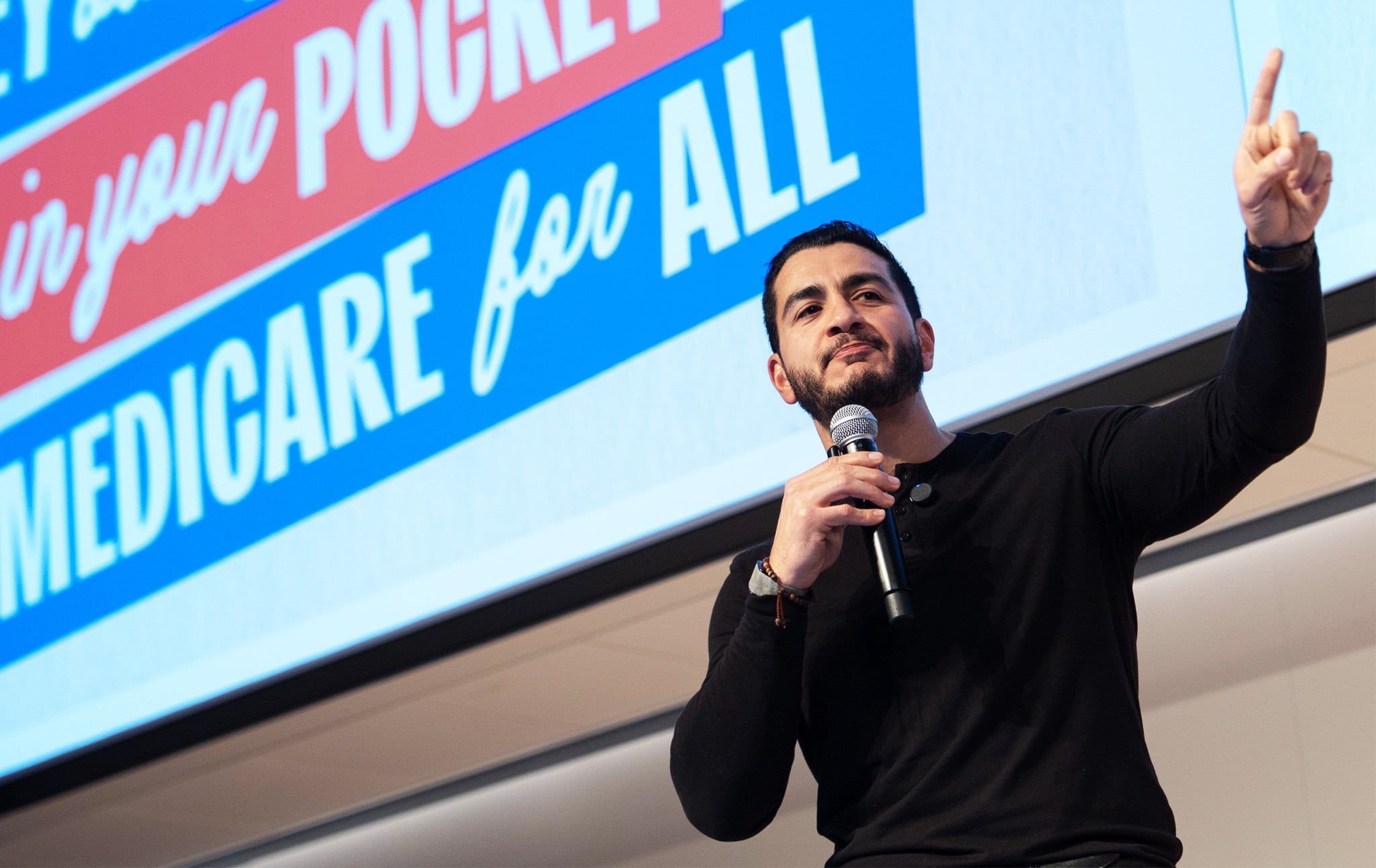
Dr. Abdul El-Sayed on the Michigan Senate race, keeping Americans’ tax money out of overseas wars, and finally winning Medicare for All.
Dr. Abdul el-sayed is, according to a new poll released on Monday, the front-runner in the Democratic Senate primary in Michigan. He joined Current Affairs editor-in-chief Nathan J. Robinson to discuss the state of the race, how politics in America seem to be shifting to the Left, why he supports Chris Van Hollen to lead the Senate, and how to stop wars and deliver universal healthcare.
A video of this interview is available on YouTube.
Nathan J. Robinson
I first came out to see your campaign in 2018 in Michigan for governor. There was a lot of excitement at that time, just like there was a lot of excitement around Bernie Sanders in 2016 and 2020. But you didn’t win. He didn’t win. And yet it seems this time as if something may feel a little different. We’ve had, since then, some very unexpected political upsets with Zohran Mamdani in New York and Graham Platner recently in Maine. Do you think things feel different this time around? And if so, what’s your explanation for that?
Abdul El-Sayed
Yes, they certainly do. You see it in room after room across the state. You see it reflected in the data that’s coming out of polling, etc. And I think it’s a couple of things. Number one, my message hasn’t changed. I’m saying the same thing I said eight years ago when I ran for governor in 2018. I think what has changed, though, is that circumstances have proven a lot of that message right. I said that Donald Trump was not himself the disease of our politics; he’s just the worst symptom of the disease, and that the system itself was the disease that allowed corporations and billionaires and special interests to buy and sell politicians in ways that leave them rigging the system against us. And I think over the last eight years, people have seen that happen in an accelerating fashion.
You think about the people who were at the dais with Donald Trump when he got sworn in for a second time. You think about the rise of AI and Big Tech. You think about the fact that we’ve watched more and more billionaires spit out of this economy at a higher and higher rate, and people feel like they are running in quicksand and cannot afford the basic means of a dignified life. You watch our tax dollars get funneled over to backstop a foreign military and its genocide in Israel, and you ask, why is my deductible higher than it’s ever been?
I think all of those things have validated what I was saying, and I think a lot of folks are a lot more interested now in a response that is about actually taking on that core system. I also think that I’ve been around, and we take for granted sometimes that in politics, you really do have to build a coalition of people, and you have to build relationships. Now, when I did not win in 2018, I went back to public service. I served Wayne County, leading Health, Human, and Veteran Services for Michigan’s largest, most diverse county. I built relationships in which people knew who I was and what I was about. We put glasses on kids’ faces. We put Narcan in 100 different locations. We eliminated $700 million of medical debt. And people came to understand that I was not just talking about ideas; that I was willing to go where the rubber hits the road and get those ideas implemented into government. I think this time around, when people look at me, they say, “Alright, he was 32 and never ran for office. Now he’s 41 with two kids and a mortgage. He’s saying the same exact thing. My life is a lot harder, and he’s been about it for the past eight years. So let’s think differently about what we can do.” And I think all of that, put it together, and recognize that we’re building a campaign that’s taken us to 90 different cities, 350 public events, going everywhere and talking to everyone. I think all of that is coming together in this campaign right now.
Robinson
You didn’t think that maybe you’d like to go and live in California, for instance, for a little bit?
El-Sayed
No, I like Michigan, famously.

Robinson
You mentioned the United States’ support for Israel’s genocide in Gaza. This is one area where the politics really seem to have changed. Public opinion has really shifted on this. There was a time when any candidate who opposed AIPAC’s influence in politics would be basically drummed out of politics, and that happened up until very recently. We saw what happened to Jamaal Bowman and Cori Bush, but Graham Platner achieved an overwhelming victory while being very firm on the issue of Israel-Palestine. It didn’t work on Zohran Mamdani either. And obviously there was an effort when you campaigned alongside the streamer Hasan Piker to suggest that he was a supporter of terrorism or an antisemite, etc., and it didn’t seem to affect your poll numbers either. So could you tell us a little bit about what you think is going on there?
El-Sayed
It’s not even about Palestine and Israel. It’s about what we do with our tax dollars in Michigan. I’m running for senator from Michigan, and it’s a crazy thing that for a very long time, wherever you were running for Senate, you had a $100 million super PAC in AIPAC telling folks that the best use of their tax dollars was to be sent abroad to backstop an apartheid regime, to subsidize genocide, and to now fight a war that we have no business fighting at the behest of a foreign government’s prime minister. I think people are looking at this and saying, “How the hell are you misappropriating my tax dollars, and why the hell are all these politicians for it?” And I think that really is the issue. As the next senator from Michigan, I want my Michigan tax dollars spent in Michigan to provide healthcare in Michigan, and in schools in Michigan. I don’t want them sent abroad. And I think people are really just sick and tired of being told that the best use of their money is to kill other people’s kids, when their own kids go to schools that look like they did 30 years ago, when their own kids can’t get the healthcare that they need, and when their own kids are at risk of dying in car accidents because our infrastructure is so broke.
All of these things, I think, have come to a head. And I also think that the old system of communication, the corporate press and media, in a lot of ways, had always been able to drum up a certain level of antipathy for somebody who is willing to deviate from the usual talking points, and they’ve just lost a lot of their power. For three weeks on end, the only thing that Fox News and CNN could agree about was that because I was campaigning with somebody who streams on Twitch, somehow I was outside the bounds of traditional politics. And I would tell them that, no, if you actually poll the issue, which they did, it’s an 80 percent issue: people want their tax dollars spent here. That’s not about antipathy for anybody. That’s about love of people—love of the people I want to serve here in Michigan, and love of Palestinians in the same way that I love Jewish folk. It is about recognizing that if you’re serious about loving people, you’ve got to love all people. If you’re serious about human rights, your human rights have to apply everywhere. So in some respects, I think in this moment people are just saying, “I am actually going to believe my lying eyes,” and they’re coming and learning about my campaign and saying, “All right, this is a guy who wants to get money out of politics, put money in your pocket, and pass Medicare for All—I’m kind of for that.”
Robinson
Let me ask you about your theory of electability. The polling that I have seen suggests that at the moment, if you look at a general election matchup between you and your Republican opponent or your two current Democratic opponents, Haley Stevens and Mallory McMorrow, they have a slightly greater chance in the existing polls of beating the Republican. You said recently on Twitter/X that you were pretty confident. In fact, I believe you said “Bet on it” that you could beat the Republican by seven points.
Now, Jonathan Chait at the Atlantic recently wrote an article about you, in which he essentially said that your theory of electability is crazy—that the classic Democratic theory is that there is a political spectrum that runs from the left to the right and Michigan is in the center, so the Democrats win by selecting someone who is in the center, the Republicans lose if they select someone that’s off to the right, and you need to run a centrist Democrat against the centrist Republican if you want to win a swing state. That’s roughly the theory. Clearly, that is not how you see the political world. And if you think you could in Michigan comfortably beat a Republican, you have reasons for thinking that. I want to know your reasons.
El-Sayed
Yes. Well, I really appreciate the question, because I really want us to step back and ask a couple of very basic points about how politics actually work, not from the Atlantic desk where you have a vested interest in sustaining a system that whitewashes neoliberal ideas and continues to tell us the best use of our money is to subsidize big corporations or a foreign government. But if that was true about moderation, why did Michigan vote for Donald Trump twice? If everybody just wanted to be perfectly inoffensive, why did Donald Trump win in Michigan twice?
Actually, just play this out. Bernie Sanders won his primary in 2016, then Michiganders elected Trump, then Biden won, then Trump won again. And one theory of the case is that Michiganders are just pinging back and forth. The other theory of the case is that they keep going up to the buffet, not really knowing what they want because the thing that they want isn’t there, and having to choose between two things they don’t really want. And my point is that you could actually give Michiganders the things that they want. Now map that into the minds of most people. I don’t think most voters out there are asking, “Where do I sit on a left-right spectrum?” I think most folks are asking, “How am I going to be able to afford my groceries? How am I going to be able to afford my overinflated gas? How am I going to be able to make sure that my kid has a good shot at life? How do I see a doctor when I get sick?” And I think your best bet is to be able to answer those questions clearly by speaking the truth about the fact that for too long, all of these things have been put out of reach because of the power of corporations in our politics to buy and sell politicians.
I’m the only candidate in my race, Democrat or Republican, who’s never taken a dime of corporate money and never will. And so when I tell you I want to show up and fight for you, you can trust I’m going to show up and fight for you. Now, a lot of folks looked at Donald Trump and said, “Well, he doesn’t look like the establishment, so I guess I’ll take a bet on him.” But he also looked like a narcissistic billionaire asshole, and I don’t look like a narcissistic billionaire asshole. And I think there’s an opportunity to say, “Hey, what if that package of non-establishment came in the form of a doctor who rebuilt a health department, who eliminated $700 million in medical debt and put glasses on kids’ faces for free, and put Narcan in 100 vending machines?”
And then there’s finally the point that campaigns matter. When folks looked at this race back a year ago, when we all launched, everybody said, “Well, Abdul has no chance because, well, his name’s Abdul. How’s he going to win a primary?” And now those same people are freaking out, being like, “Oh, Abdul could win the primary!” Why? Because we actually went to 90 different cities and 350 public events and had conversations with everyone about the key things people were feeling. We were able to persuade people about what was possible if we thought differently about what our politics are.
I’m going to be running against an actual guy. His actual name is Mike Rogers. He’s actually the guy who helped to architect the opioid crisis. He actually retired to Florida for a $14 million lobbyist payout for his new gig as a pharma lobbyist. He actually lost on healthcare last cycle. I’m actually going to whoop his rear end up and down the state, because I’m a doctor who rebuilt the health department, eliminated $700 million in debt, and put Narcan in people’s hands. He’s a guy who kicked off an opioid epidemic. And so, yes, I’m going to beat him by seven, and I’m looking forward to that campaign.
Robinson
What you’re talking about there is that we shouldn’t accept polls as a frozen political reality. We interviewed Mamdani on this program at the beginning of his campaign, when he was polling like 3 percent, and I said, “You’re going to win this thing?” And he said, “I’m going to win this thing.” At the time, it was crazy, or it seemed it. And then he went out, and now today he’s the mayor of New York City. I feel there’s been a lot of talk lately about gerrymandering, and I’m obviously very opposed to racist partisan gerrymandering, but there’s almost, in some of the Democratic talk about gerrymandering, this idea that, well, there are Red districts and Blue districts, and once the district is drawn Red, you give up on it. You don’t campaign in this place, and the system is rigged against us. We can’t win. You’re kind of talking about the idea of not giving up on people just because they voted for Trump and trying to win back some of what you’ve lost and saying, “Okay, it’s a Red district now, but that doesn’t mean it’s going to be tomorrow.”
El-Sayed
Nathan, the art of political discourse is persuasion. There’s a whole reason you write, because you want to persuade people about what you believe the truth to be. And it’s odd in our politics that we’ve given up on being able to persuade people. I haven’t, and that’s why we go to a lot of traditionally red parts of the state to have conversations with folks. And it turns out I’ve had a lot of conversations with folks who voted for Donald Trump, and I had a guy come up to me and say, “I don’t like you much.” I was like, “I’m sorry. I like you.” He’s like, “I know, and I’m going to vote for you.” I was like, “What, why?” He’s like, “Because I think you really want me to have healthcare.” I was like, “I really want you to have healthcare.” He’s like, “Yes, that’s why I’m going to vote for you.” I was like, “Okay, so why don’t you like me?” He’s like, “Because you’re Muslim.” I was like, “Okay, well.”
Turns out I don’t need you to like me. I need you to like yourself. And at least with me, folks know I’m not bought by the corporations who are running your healthcare system into the ground. I’m not bought by the utility that just inflated your electrical prices higher than 46 other states over the last 20 years and bought off 93 percent of the state legislature. I’m not bought by anyone. And so when I tell you I’m going to show up and fight for your healthcare, you know I’m going to show up and fight for your healthcare. When I tell you I’m going to show up and fight to put money in your pocket and give you the right to a union, you know that’s what I’m going to fight for. When I tell you I’m going to fight against corporate money, you know I’m going to fight against that. So at the end of the day, there is a conversation to be had about the things that all of us need in our lives.
And I think here’s the problem: for too long, the Democratic Party didn’t have much to say about the structural economic challenges in people’s lives, because for too long, that party was taking money from the corporations who were making those problems worse in the first place, and so we pivoted into the same kind of cultural war that Republicans were so eager to fight with us. It turns out, politics is about protecting your rights, and it’s also about assuring your access to the basic means of a dignified life: good schools, good healthcare, the ability to bargain collectively as a union—again, part of your rights—and the knowledge that your vote actually matters. These are the things that politics should be transacted on. It doesn’t matter if you’re a farmer who lives in the most rural part of town or if you’re queer and live in the city. You still need a good roof over your head, good food that you can afford at a grocery store, and to see a doctor. And I want to protect everybody’s rights so that a queer individual in Detroit gets to love who they love and be who they are, but the important piece that I can really fight on is making sure that regardless of who you are, you’ve got a roof over your head, can afford your groceries, and can see a doctor. And I think that’s the conversation we need to be having up and down the state. And it turns out that when you actually do that, you can win some people over.
Robinson
Yes, when we talked to Mamdani, he just said, “Well, I talked to New Yorkers, and all they tell me is it’s too expensive to live here, so I’m campaigning on fixing that.” And the left-right spectrum didn’t really enter into it. He’s like, “I’m a democratic socialist, but I’m trying to freeze the rent.”
What about the current Democratic leadership? One of your opponents, Mallory McMorrow, recently said she was the only candidate in the race who had called for the ousting of Chuck Schumer. I don’t know if that’s true. How do you feel about the current Senate Democratic leadership, the mistakes they’ve made, or whether they need to be replaced?
El-Sayed
Nathan, what you need to know is I’m the only candidate that Chuck Schumer wouldn’t be okay with winning. So if you think the whole issue is one person, then okay. But if you think it’s a system, ask yourself who that system opposes the hardest, and that’s me. I’ve also said that the question itself is incoherent, because here’s the issue: let’s say, when I get elected, it’s John Fetterman or Chuck Schumer, and now I’ve said I’m not going to support this one person and I’m going to support the other one? Hell no! So the only coherent answer to the question is, well, who do you support? And I’ve said very clearly that my number one pick for majority leader would be Senator Chris Van Hollen, whom I think is phenomenal. I think he is an incredible legislator, and I would love to see him as Senate Majority Leader when we win. But barring telling me who you’re supporting, it is a bit of a silly trick to try and break all of this down as if it’s one man’s responsibility, and to put yourself in a position where you’ve unilaterally opposed one person without knowing who the other alternative is. So I’m telling you who I want my alternative to be and who I’m going to be supporting, and that should be the answer that you take, which is actually an answer to a coherent question: Who do you support for Senate Majority Leader?
Robinson
You must have thought a fair bit about what your priorities should be in the Senate if you do get elected to the Senate. One of the things that a Democrat in the current Senate obviously struggles with is that the Democrats don’t have a majority. You have to do what you can with the available power that you have. If you win in November, have you thought about what you think your priorities as a senator, given the limits of what you’d be able to do, would be?
El-Sayed
Money out of politics, money in your pocket, and Medicare for All. Those are the big three goals that I will be fighting for on every single day. Let’s be clear: even when we win the majority, inshallah, we will still have Donald Trump as president, and we will have to hold him accountable as far as we possibly can—him, all of his acolytes, all of his appointees, everyone. We’re going to have to hold them accountable. But we’re also going to have to be fighting for a president who will fight to get money out of politics, put money in your pocket, and pass Medicare for All. And that is about persuasion. And I’ll tell you this: I will be a senator from the state of Michigan. The state of Michigan is one of those key states that you cannot ignore on a presidential map. And so my point will be, of all the 150 people running for president, if you would like to succeed here in Michigan, I’m going to open up a path that is a politics about people. And if you would like my support, I hope that you will sound like me on the key issues that I’m fighting on: that we should be keeping our money here rather than sending it abroad to drop bombs on other people’s kids, that we should be guaranteeing healthcare for everyone, and that we cannot continue to be beholden to corporations in our politics. And I’m planning to go and have that conversation all over this country, because I believe that we need to show Democrats what it looks like to persuade again, and I want to be doing that. So, holding this administration accountable, trying to think about the bipartisan things we can do even in the setting where Donald Trump is still in the presidency, and then making sure that we are doing the persuasive work to elect a president who is willing to get money out of politics, put money in your pocket, and pass Medicare for All.

Robinson
What about restraints on presidential power? Because, as you say, there is a way in which support for Israel is itself a domestic issue of what your tax dollars are going to, but there are other ways in which the president is just out of control in his use of executive power. We recently returned from Cuba, where the country is being strangled by a fuel blockade. People are really suffering there. Obviously the Iran war is incredibly costly and also devastating for Iranians. Or the kidnapping of the Venezuelan president. What about foreign policy? What do you think the Senate’s role is in trying to restrain the president, who has been very aggressive in the use of U.S. military power abroad?
El-Sayed
Yes, I think this president is demonstrating a lot of the holes in the governance apparatus that is supposed to condition declarations of war and the power of the purse in Congress. And I think we need to be thinking about how we address and sew up some of those holes if there should be a next Donald Trump who is smarter than this one.
Robinson
Oh, god.
El-Sayed
And similarly, you think about the presidential pardon power and the way that that’s been abused. I think there’s a lot that needs to happen over the next six years in the U.S. Senate to be able to condition the power of the presidency so that we are no longer in a situation where any one president can run amok with American foreign policy in ways that completely bypass the constitutional requirements that sit with Congress.
Robinson
Well, we know you have many events to get to, and I know that you probably have something similar to what I saw when I was there in 2018, where you were doing 40 hours a week of calling people, trying to get the campaign donations. A lot to get done. So we appreciate you giving us your time this morning to talk about your increasingly spoken-about campaign in the media for the United States Senate in Michigan. Dr. Abdul El-Sayed, thank you for joining us.
El-Sayed
Nathan, thank you so much for having me. I hope that we get to see you on the campaign trail again this summer.
Robinson
People should also follow you on social media because you’re a little bit sassy.
El-Sayed
Just a touch.
Transcript edited by Patrick Farnsworth.

%20(crop).jpg?width=352&name=wile-e-coyote%20(resize)%20(crop).jpg)