More than 75 years before Zohran Mamdani, refugees in Faridabad, India proved that the working class can run its own cities.
“A moment comes, but rarely in history, when we step out from the old to the new, when an age ends, and when the soul of a nation, long suppressed, finds utterance.”
On a chill November night at the Brooklyn Paramount theater, Zohran Mamdani became the most powerful Muslim elected official in the United States. Thousands thronged the venue, now restored to its former, decadent glory. On the sloping dance floor, amidst gilded statues, lattices and medallions, under the ornate ceiling backlit in blue, gold, and red, New Yorkers danced. To the consternation of the rich and their hangers-on, the “unapologetic socialist” (as the Washington Post labeled him) built his platform on the radical politics of his predecessors, from current progressive champions like Bernie Sanders and Alexandria Ocasio-Cortez to symbols of New York’s own rich history, like former mayor Fiorello La Guardia and labor leader A. Philip Randolph. To the people, he promised the moon and the earth and everything in between: rent freezes on a million apartments, fare-free buses, city-run grocery stores, and universal childcare, all paid for by taxing the rich. It was a dream run, and within a year he went from polling at 1 percent to a clear mandate: over 1.1 million votes, more than 200,000 over his nearest competitor.
And then, as the clock neared midnight, he gave his speech. “A moment comes,” he said, “but rarely.” These words were first spoken nearly 80 years ago by Jawaharlal Nehru, a freedom fighter and independent India’s first Prime Minister. Amidst the table-thumping, clapping and cheering by the Constituent Assembly, India became an independent nation, free to, as Nehru put it, “tryst with destiny.” While the scope of the territory under his command and the authority at his disposal were different, the central question that confronted him was the same that confronted Mamdani on the night of his victory: how do we take power from the powerful and hand it to the people? Nehru had an idea—a cooperative model of a city, organized on the basis of self-help and mutual ownership, from where one could lay the foundations of a socialist nation.
Politics is not kind to idealists. In the middle of a brewing Cold War, facing ideological warfare within his party and combatting ill health, these visions of a better tomorrow fell into the dustbin of history. But when demons from yesteryears rise with new horns, when fascism wears a new face, when the old order lays ruptured at our feet and the new struggles to be born—who can we turn to but history?

Back in India, in 1947, outside the sandstone walls of the Parliament House, things were dire. The country had been cleaved in two. Partition, the British Empire’s parting gift, divided British India into two dominions: Hindu-majority India and Muslim-majority Pakistan. The task of etching the new borders fell on Sir Cyril Radcliffe, an English lawyer and civil servant who had never visited India before. He did not bother with field surveys or community engagement to ensure that people belonged to the new nation of their choosing. Instead, Radcliffe drew on outdated maps and census reports. Then, days before the August 15th deadline, he declared his job finished and left. Consequently, communities woven together over centuries by ties of language, culture, food, and music, crafting a beautiful mosaic, were torn apart, surgically split overnight. As Bishwanath Ghosh put it in his book Gazing at Neighbours, these pencil markings were “surgical scars” running through “towns, villages, valleys, farmlands, forests, rivers, ponds and people.”
Madness soon gripped the two new nations. Not all at once; news travelled slowly in those days. Rumors of a massacre—of Hindus by Muslims, or vice versa—would reach new areas over the coming days and weeks. From the heartlands of India to the frontiers of Pakistan, 15 million people were forced to leave their homes and farms and settle in lands alien in terms of language and customs, with not a rupee to their name. At least one million died, either along the way, to starvation or disease, or to horrific acts of violence, as entire towns were slaughtered and trainloads of refugees were set ablaze. Some died in their homes before they had a chance to begin the journey, burnt alive by people who moments before midnight were their friends, neighbours, or comrades, united in the struggle for independence. Nehru was “sick with horror,” as he confessed in a letter to Lord Mountbatten, the last Viceroy of British India and a close friend. “Above everything was a creeping sense of horror,” Nehru wrote, only two weeks after delivering his hopeful victory speech. “There was still an odour of death, a smell of blood and of burning human flesh.”
Partition was not the only tragedy the fledgling state had to confront. The British had left India in truly ruinous conditions. Throughout the period of British rule, India was debilitated by dozens of famines, most infamously the Bengal Famine of 1943, which killed an estimated 3 million people. In 1946, the Health Survey and Development Committee, referred to as the Bhore Committee after its chairman Sir Joseph William Bhore, had laid bare the state of the nation and of its people. In 1941, India had an average life expectancy of 27, for a population of over 300 million people. Nearly half the deaths were children under 10. Half of those were under one year old. India was not at war, nor was it the site of any (recognized) genocide. It was just the unwilling recipient of 200 years of British “civilization.” By 1947, a polycrisis had arrived—poverty, public health collapse, agricultural exhaustion, industrial underdevelopment, an entrenched caste system, border conflicts, and, of course, being a plaything in the ideological battle between superpowers in a world slowly going mad. The Partition was adding gasoline to this fire.
Nehru set up a Ministry of Rehabilitation for the refugees that now called India home. The Ministry promised food, shelter, and eventually profitable work. Of course, bureaucracy is a Lovecraftian god; its motives and actions are impossible to comprehend, and even a mere attempt to do so would render you insane. Committees and sub-committees were set up and disbanded, meetings and assemblies called with representatives from all concerned provinces, strict letters were sent back and forth between the highest offices carrying the pettiest grievances, all while the months passed, and the refugees survived on meager rations and the generosity of strangers.
One such stranger was Kamaladevi Chattopadhyay, a socialist and the first president of the Indian Cooperative Union. Under her leadership, the ICU, a non-governmental body, promoted the development of worker cooperatives. As L.C. Jain recalls in City of Hope: The Faridabad Story, the ICU organized “refugee widows in Delhi” into “a milk cooperative,” helped provide loans and credits for already established cooperatives, and exposed government corruption, like when “agricultural land was being cornered by senior civil servants in Delhi[…] instead of being given to landless workers.” Owing to these successes, Chattopadhyay and the ICU were given their first refugee rehabilitation site at a location near Delhi. The idea was simple. The refugees would construct their own homes with materials provided by cooperative firms, generous donors, or the state. After some initial help, the refugees would have the skills to earn their own livelihood—not working under the boot of a capitalist, but arm in arm with their fellow workers.
It was not so easy in practice. As Sandip Kana notes, the land was “dry and arid” in stark contrast to the “riverine lushness of the Punjab” the refugees had fled from. In addition, many of the refugees claimed they were zamindars used to “living comfortable lives,” not working with their hands. Chattopadhyay had had the unfortunate luck of encountering landlords. These were the last embers of the zamindari system created by the East India Company with the Permanent Settlement Act of 1793. Zamindars had existed before British rule, during the rule of the Mughal Empire. But the Company turned them from mere tax collectors (albeit some so rich they were likened to kings) to an actual class, to landlords acting as intermediaries between the Empire and its peasant subjects.
Under British rule, the zamindars and their hereditary heirs lived a life of decadent luxury while squeezing the agricultural tenants toiling on their lands tighter and tighter. When the British left, the zamindari system was abolished, and their privilege went up in smoke. But, for at least a while, their pride remained. They would not work, not with their hands; it was beneath them. At Chattopadhyay’s camp, after much convincing, the women gave in first and eventually, the men followed suit. They converted a dry and arid land into a township. Following the construction of their houses and the establishment of agriculture, there were refugee reskilling workshops run by experts to prepare them for a new life.
Chattopadhyay’s system had worked. The rest of the refugees in India were in dire need of help. So Nehru gave her another project. That project was Faridabad.
If you ask the people of Faridabad, the city is named after Farid ad-Din Mas’ud Ganj-i Shakkar, a 13th century Sufi religious leader revered by Indians regardless of religion. For Muslims he is Sheikh Farid, the leader of the Chishti Sufi order, the pioneers of Sufism in India. For Punjabis, Hindus, and Sikhs alike, he is known as Baba Farid, a master of Punjabi poetry, who turned Punjabi into a literary language. His poetry and teachings grace the pages of the Guru Granth Sahib, the Sikh holy book. This cross-religious veneration isn’t unique; South Asia has a history of saints revered by people of different faiths. Together, their stories form the itihasa, the oral history and legend.
It is different from the history books which record a different Farid: Sheikh Farid Bukhari, titled Murtaza Khan, a 17th century imperial treasurer. The Sheikh built the original walled city as a resting stop on the Grand Trunk Road, a major ancient trade route linking South Asia to Central Asia. Over the decades, the city slowly expanded. Into the early 20th century, many different people lived in this old Faridabad—from rich Muslims like the Syeds to upper-caste Brahmins and Punjabi Khatris, in addition to the migration of nearby agricultural castes like the Jats and Gujjars. Per the 1911 census, Faridabad held around 5,000 people. When Nehru and Chattopadhyay talked about resettling some refugees in Faridabad, they were talking about 30,000. It was a vast, dramatic expansion of the population, almost overnight.
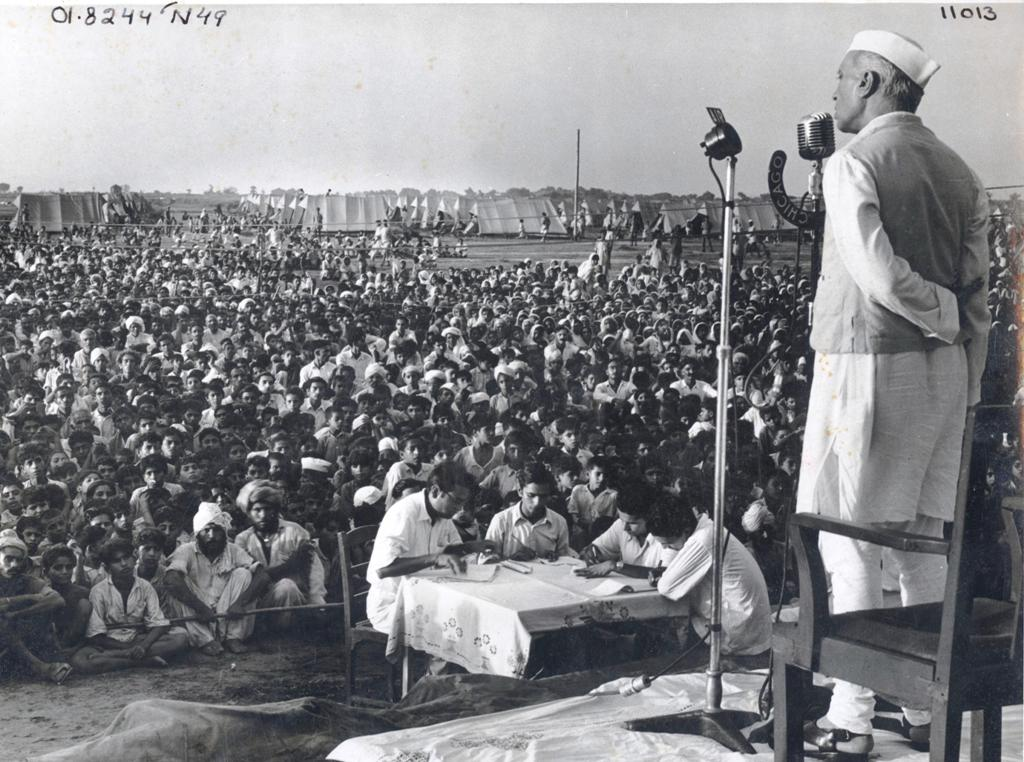
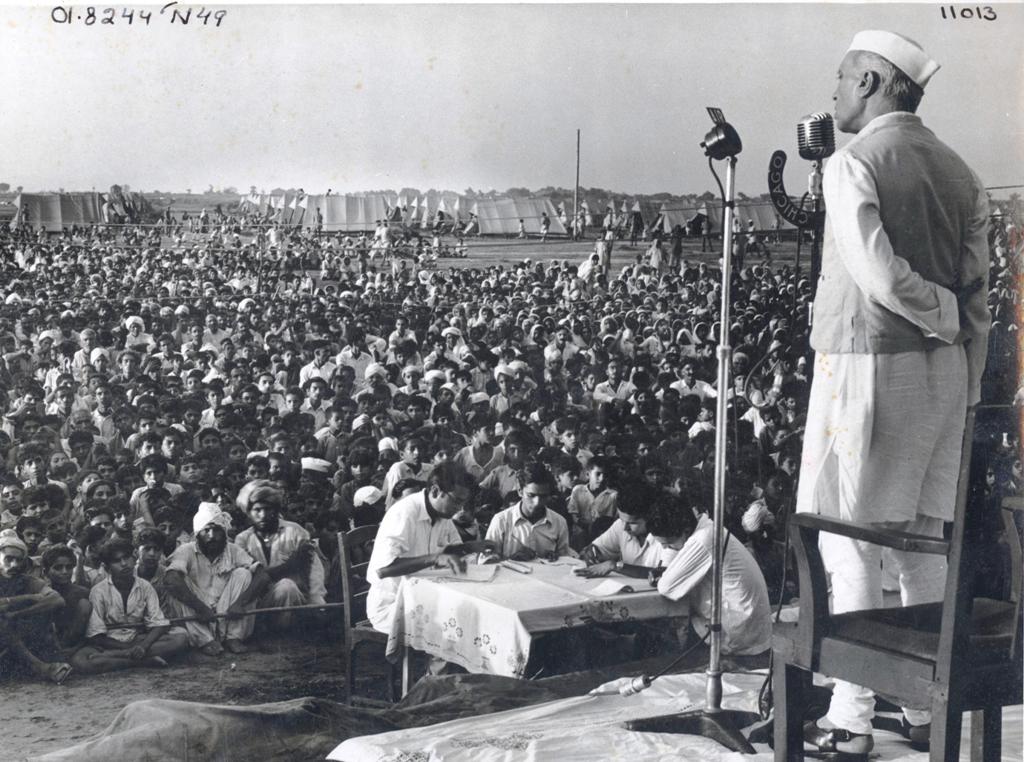
Nehru addresses the Faridabad refugees on August 10, 1949, shortly before the construction of their new city. (Photo: Wikimedia Commons)
Most of the refugees were from the North-West Frontier Province, home to Hindus, Sikhs, and Muslims, all under the aegis of Khan Abdul Ghaffar Khan, commonly called Badshah Khan or “the Frontier Gandhi.” After the Partition, he and his followers tried to protect the Hindu and Sikh minorities from the ensuing violence, but it was a doomed endeavor. The forces arrayed against them were vast, from the machineries of a modern state, to the stirrings of centuries-old feuds. The refugees were forced to flee and eventually made their way to Faridabad.
The goal, much like with Chattopadhyay’s first success, was to turn Faridabad into a self-sufficient industrial township. Swiftness was the priority rather than bureaucratic thoroughness. A semi-autonomous governing body was created for the new city, the Faridabad Development Board. While still under the central government, it was given broad latitude in conducting its affairs. Nehru, though not officially a member, attended the majority of the meetings. At first, the Board was supported in its day-to-day operations by the army units that oversaw the initial move of the refugees into Faridabad. But the army was soon replaced by an Advisory Committee elected in the first election in independent India on the basis of full adult enfranchisement. All refugees above the age of 21 could both vote and stand for elections to the Advisory Committee to the Faridabad Development Board.
Now came the first real challenge: building the city itself. The Central government’s Public Works Departments had a seemingly ambitious plan to build 5,000 houses, schools, and health centers, along with the required drainage and roads and electricity. They gave an initial estimate of five years and nearly 50 million Indian Rupees (worth $10 million in 1950, not a small amount for a poor nation) to complete the project. However, there was a catch. The money and five-year timeline were only for the construction of 10 percent of the houses, to be built by private contractors known to the PWD. The rest, they said, would eventually be developed by some private firm, enticed by some promise or another.
For a look at how these homes would likely have turned out, wander Delhi today, with its bungalows for the rich, staffed by daily wage-laborers and domestic helpers (likely the only positions the refugees would have been able to fill, rather than being masters of their own fate). Or stroll India’s countryside and look at the palatial “farmhouses”—vast tracts of land, ostensibly for agricultural use, which really serve as nothing more than mansions for the mega-wealthy. There were even plans for a golf course in Faridabad.
Thankfully, this privatization plan was rejected. The Board went with the ICU and Chattopadhyay’s idea of bringing in labor cooperatives from around the nation who would work together with the refugees to lay the essential foundations of the city. The Board and the Union hoped that after the first brush with the cooperative model in constructing their own homes, the refugees would go on to either establish their own cooperative firms or join existing ones.
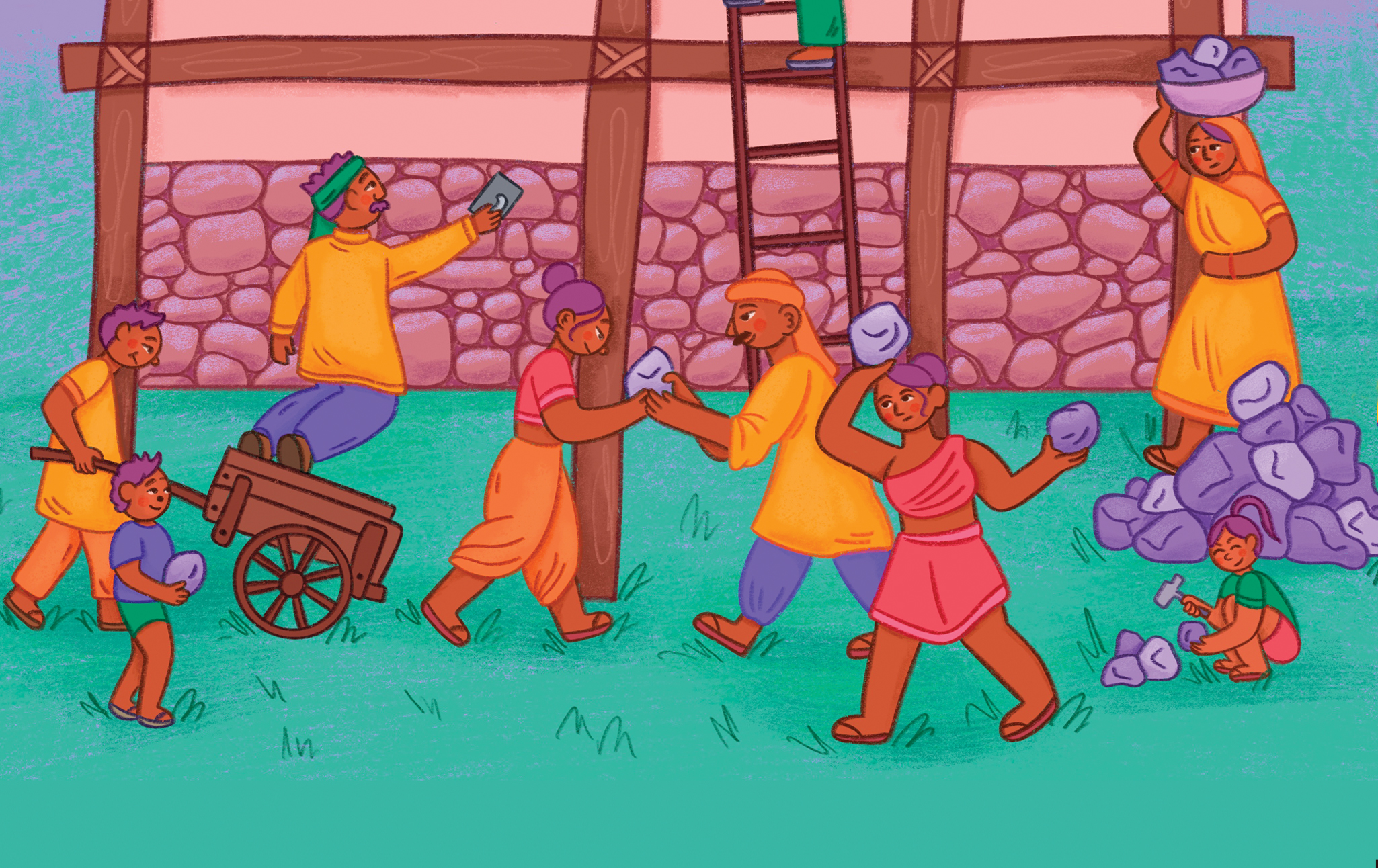
The refugees at Faridabad were no more experienced in construction than the ones at Delhi. But after some initial hiccups, these former merchants, traders, and artisans created cooperatives of earth workers, brick manufacturers and carpenters. They built houses, hospitals, schools, and factories, all run on a cooperative basis, with equal pay and without bosses. It was relentless hard work by the people, diametrically opposed to their life just a few months ago—laboring to the bone, breaking stones, all to build up a new city. In it, they saw hope for the future, for their children, free from the trauma of Partition. They finished the project, all 5,000 houses in record time—under two years and under budget.
L.C. Jain explains the methodology in The City of Hope. “The ICU organised these thousands of workers into hundreds of homogeneous working groups” of 10 to 15 people. Membership in each group was voluntary. Each group was tasked with 10 to 20 houses. Older workers were given lighter tasks like picking up “loose pieces of stones on the hillock in Faridabad and gathering them in small piles at convenient places.” One of the workers took on the role of group leader: measuring construction equipment, seeking guidance from engineers (who were overseeing the process), and collecting and distributing payments. To maintain the cooperative spirit of the whole endeavour, it was crucial to prevent this leader from devolving into a boss. The ICU came up with innovative solutions, like setting a ceiling on the salary of the leader and rotating the position amongst all the workers monthly by drawing lots.
Many workers readily accepted these changes, but the group leaders did not. The first cracks started showing on the Faridabad experiment. They complained that it was hypocritical to place a salary cap on their jobs, since India’s top elected leaders, the Prime Minister and the President among others, had not accepted a ceiling on their income: “Why should Faridabad refugees alone be made guinea pigs of socialism?” In addition to earning the enmity of these leaders, the Rehabilitation Ministry had become the primary source of antagonism. Chattopadhyay voiced her frustrations in her letters to Nehru: she talked of the Ministry warning off a foreign technician from working with the ICU, about missing payments and bureaucratic hurdles, of “higher officials in the Secretariat” who saw “this new movement of making people self-reliant as a challenge to their established leadership.”
The refugees built themselves a socialized health service, with one health center in each of the five neighborhoods and a central hospital. In the ocean of communal anger, there was a moment of solidarity—the hospital was named after Badshah Khan. The inauguration plaque read, “this hospital built by the people of Faridabad with their own hands was named after their beloved leader.” Healthcare was community-driven, with up to three health check-ups per family per week. The health centers were managed by the People’s Health Committee of the neighborhood, whose members were chosen by the residents. “Health visitors” were another unique invention, distinct from hospital staff—not doctors or nurses, but women trained in maternal, infant, and family care. They visited the families each week, built personal connections, educated them on disease prevention, advised them on common cures, kept updated medical records, and created a support network for the families to depend on.
The Neighborhood Committees together formed a higher body, the Central Health Committee, that worked with the Health Department to ensure the people understood the different medications and vaccinations that would help them survive through serious outbreaks of preventable diseases. This did not require much money, which India did not have anyway. Nor did it require many resources, which the British had stripped over centuries. In City of Hope, L.C. Jain recalls the words of Dr. Shanti Ghosh: “You need willing people. We do not need a lot of money. We need organisation.”
The health service dovetailed with Nai Talim, the broad education policy envisioned by Mahatma Gandhi as a new model of education. The neighborhood health centers doubled as public schools. The policy was antithetical to the ones established by the British, who had restricted literacy and modern education to the upper classes. In Faridabad, there were two schools in each neighborhood that, in addition to the traditional subjects of maths, science, English, history etc., taught crafts such as weaving, woodworking, gardening etc. There were classes on the cooperative model of working. And there were night schools to begin to fix the illiteracy of the adults at Faridabad.
The story of Faridabad does not have a happy ending, though. Although tremendously successful in these initial stages, the city’s independence and autonomy merely irritated the people higher up the chain of command. Prime Minister Nehru could not write a letter every time the Rehabilitation Ministry overstepped its bounds. Eventually, when problems arose, when conditions worsened, the city’s leadership was dissolved by orders from above.
After the construction was finished, refugees needed a more permanent source for their income. For the Board and the ICU, this would ideally be entirely facilitated by labor cooperatives. The refugees wished for “cooperative industries” like the ones they were now familiar with, rather than the “capitalistic type of factories”—and cooperatives did arrive, for everything from button manufacturing to wool and cotton making. Some refugees also acquired independent streams of income as weavers, tailors, cobblers, mechanics and carpenters. If this transition had been allowed to proceed over many months, if not years—if, say, as one construction group finished a project, its members joined a labor cooperative of their choosing—then maybe Faridabad would today be a story of socialist success celebrated the world over. But the sudden flood of people, now unemployed and needing help, was too much for the cooperatives alone. The government courted different industrialists, including national and international capital.
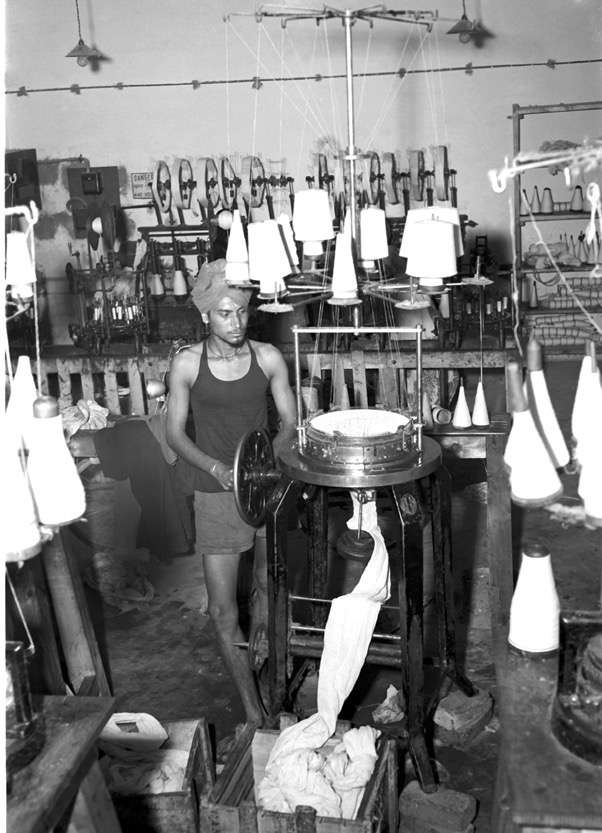
A young worker in a Faridabad clothing factory, 1951 (Photo: Government of India, via The Heritage Lab)
Capitalists stepped in, capitalists who are still big names in Faridabad. The Czech-based Bata Corporation was the first and the biggest, establishing a massive shoe factory in 1951 that employed thousands of refugees. In the years that followed, others arrived, like Escorts Limited and Eicher Motors, which focused on agricultural machinery like tractors. The Rehabilitation Ministry pounced on this moment of weakness and took direct control of the city, relegating the till-now de facto autonomous Faridabad Development Board to a hollow shell. Chattopadhyay wrote to Nehru, but defeat has a sour taste. In Nehru’s letters, recorded by L.C. Jain, he expressed frustration and exasperation at the state of affairs, as if he was tired of the whole thing and just wanted it to go away: “[Chattopadhyay] begged me yesterday to take personal interest in this and try to save Faridabad. It is not quite clear what she or anyone else expects me to do.”
Rather than seeing the Board and the ICU as comrades in a shared struggle, the Rehabilitation Ministry saw them as threats to its own power. The Ministry buried what Jain calls “the cultural revolution” of Faridabad. The Board meetings became infrequent and, eventually, the Board was declared unnecessary. Private contractors were brought in to replace the cooperatives that did exist, and the ICU was pushed out. Faridabad—the city it was becoming and the city it could have been—both were no more.
You can still see traces of what it once was. The centrally planned neighborhoods the refugees built have now become the New Industrial Township. The old houses were torn down, but the structure remains, retained in the shape of the buildings and the narrow lanes that separate them. Nearby is what was once proudly Badshah Khan Hospital, now renamed the District Civil Hospital. The memorial plaque is squirreled away somewhere in its upper floors. The hospital is in dire need of renovation, but it still serves the people—the staff are friendly, the doctors just as good as you’ll find at any other. That era still exists, at least in people’s memories.
There is, also, unfortunately, a golf course.

Back in New York, Zohran Mamdani—himself a part of the Indian diaspora—would return to Nehru and his “Tryst with Destiny” speech, when, at his inauguration, he would talk of the rarity of such moments, the need to transform and reinvent, the need for a new politics and a new approach to power. If there is one thing he could learn from Nehru’s legacy, it is how monumental the task of seizing that moment can be. And how no one, whether the mayor or the Prime Minister, can accomplish it on their own.
To witness the history of socialism, we turn not to a museum but a graveyard. Not dusty books, entombed bodies, carefully preserved artifacts. Socialism isn’t there. It is in the unmarked graves of martyred revolutionaries. It exists in crumbling buildings. Failed revolutions. Ideas that died in boardrooms, plans for a better future lost amidst rotting paper, trapped in spiderwebs. But, specter-like, socialism rises again and again.
Mamdani needs to ensure his City Hall maintains the independent spirit with which it has begun its tenure. He must not drink the sweet poison of compromise at Astoria, or playact in the telenovela at the national stage. Clear-eyed, he must drag his dream from heaven to earth, and hand the keys to the city to its people. Mamdani is not a superman who, in one term alone, can fix New York. No, he must merely be the first of many who will together, forever, dull the instruments of the billionaire class—Andrew Cuomo, Gavin Newson, Rahm Emanuel, and countless others. There is no limit when you have the people on your side—and the people are on his side! Everything from socialized medicine to education to worker co-ops: all of it and more has been done before, in Faridabad and elsewhere. You do not need money, not really. If a refugee populace could do it, with nothing but the clothes on their backs, in a nation left to rot after centuries of colonialism, why cannot New Yorkers? What is stopping them? What is stopping any of us?

%20(crop).jpg?width=352&name=wile-e-coyote%20(resize)%20(crop).jpg)