
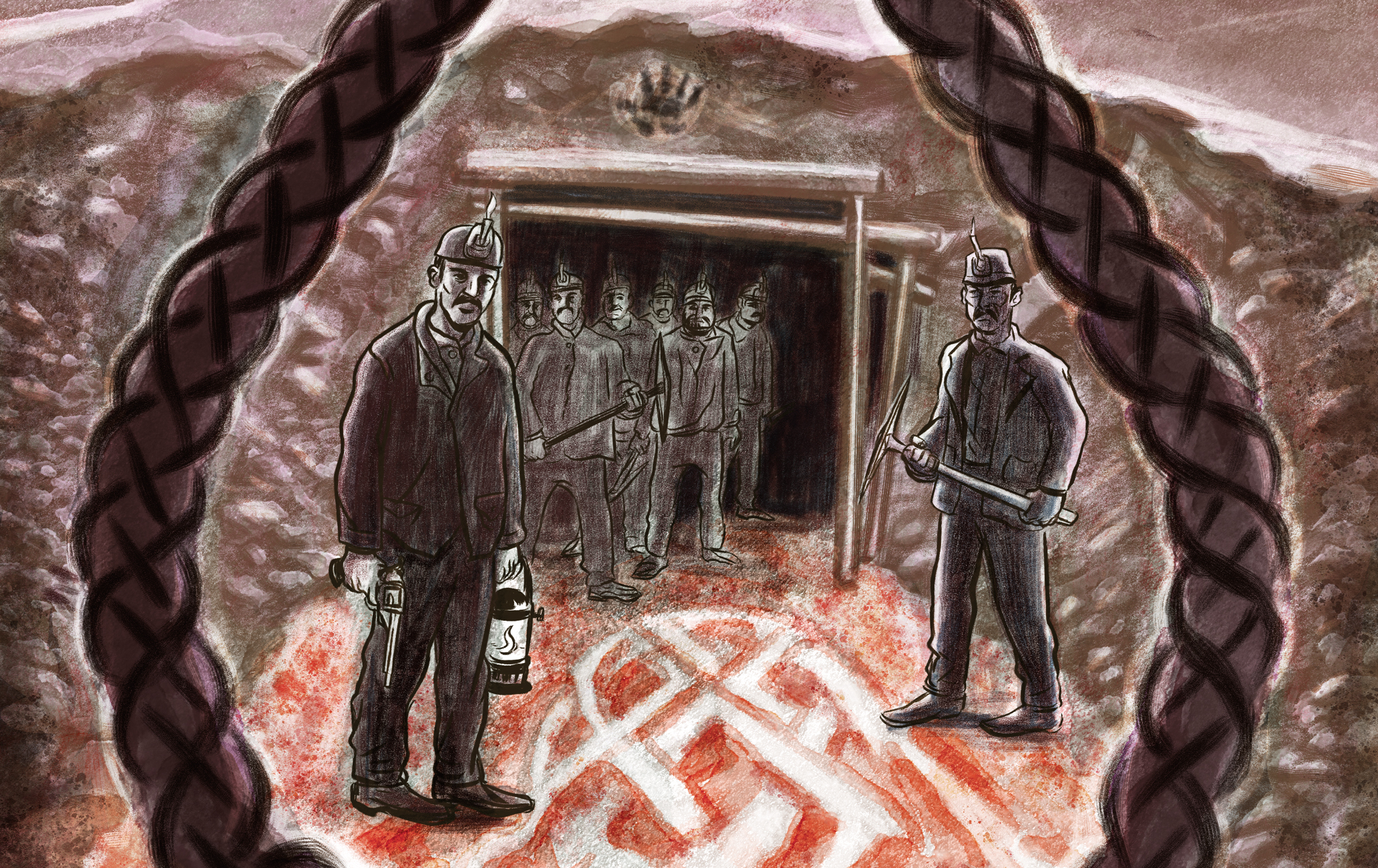
More than 150 years ago, a group of Irish coal miners called the Molly Maguires were executed in Pennsylvania. Today, the same labor wars continue.
According to his biographers, Nathaniel Hawthorne once discovered that he had an ancestor, a man named John Hathorne, who had been a judge in the Salem Witch Trials. Draconian even by the standards of the 1690s, Hathorne was known for berating innocent women on the stand until they confessed to so-called “Satanic” transgressions, which quickly led to their execution by hanging. Unlike some of the Salem judges, he never showed remorse. Horrified by the blood on his great-great-grandfather’s hands, the novelist changed his surname, adding the extra “w” to distance himself, and he made Hathorne the template for his villains in works like “Young Goodman Brown” and The House of the Seven Gables. By all accounts, the knowledge haunted him throughout his life.
As it turns out, I have something in common with old Hawthorne. We both have ancestors who played an instrumental role in getting people executed unjustly. It was my great-grandmother Geraldine who discovered this unfortunate fact, when she made a study of our family’s genealogy back in 1968. Digging through moldy old newspaper clippings in northeastern Pennsylvania, she discovered that her great-grandfather, a man named John Cox Sanders, had been a juror in the 1876 hanging trials of the Molly Maguires.
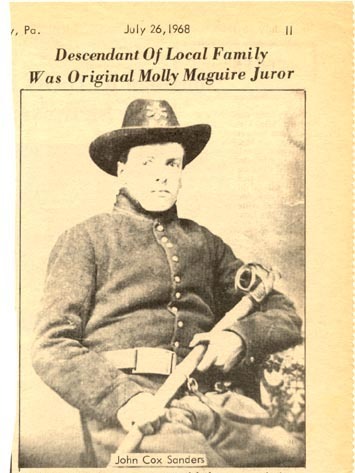
The author’s ignominious ancestor.
Semi-legendary figures in Pennsylvania history, the “Mollies” were militant Irish coal miners who were accused of forming a secret society to assassinate and intimidate mine bosses. Altogether, 20 of them were hanged, and John Cox Sanders—my four-times-great grandfather—was one of the jurors who made it happen. Except that the trials were a complete travesty, full of suspect testimony, dirty tricks from the prosecution, and rampant anti-Irish racism. Some of the accused may have been guilty, if shooting a boss who is working you to death can be called a crime, but others might well have been innocent; like the Italian anarchists Sacco and Vanzetti a few decades later, they were railroaded, and never got a fair hearing.
Ever since, the Molly Maguires have lingered in the cultural memory of Pennsylvania, becoming the subject of folk songs, lurid ghost stories, and even an underrated Sean Connery movie. Somehow, they just won’t stay dead. I suspect it’s because the underlying issues in their day—grueling labor for low pay, racial and religious discrimination, and a rigged legal system that only serves the rich—are still the animating issues of our own time. None of it has ever been rectified, and until it is, the ghosts of the Molly Maguires will haunt us.
The first thing to understand is that a job in a Pennsylvania coal mine, in the 19th century, was effectively a death sentence. There were a dozen ways to die prematurely down the mines, from being crushed by falling rocks, to drowning in a sudden flood, to blowing up in a dynamite accident or breathing in poisonous fumes. (Those canaries in cages were no joke.) In many mines, the owners mandated a practice called “pillar-robbing,” in which the miners would slowly chip away more and more coal from the pillars that supported the roof, and pray it wouldn’t cave in on them. Everyone knew the mines would kill you; the question was how and when, not if.
The “best-case” scenario was that you’d work down there in the dark for 30 or 40 years, breathing in soot and dust, until a respiratory condition cut your lifespan short—either cancer, or tuberculosis, or the feared black lung disease. Decades before the invention of the N95 mask, the retirement plan for any miner was to slowly succumb to the decades of carbon and silicon particles that had built up in their lungs. And because you might start work at the age of nine or ten, as a “breaker boy” whose job was to pick out useless slate from among the coal by hand, you never really got a childhood, either. Your whole existence on Earth was a kind of living death—just hitting a rock face with a pick, over and over and over again, the work both endless and mindless. Comparisons between the mines and the pits of Hell were common, and for good reason.
But not all jobs in the coal fields were equal, and the all-important question of who got the dirtiest and most dangerous work broke down along ethnic lines. As historian Kevin Kenny records in his book Making Sense of the Molly Maguires, there was a big difference between a “contract miner” and a “mine laborer.” The former were the elite workers, the ones who got to draw up plans for new mine shafts, plant explosives, fix water pumps, and so on. Their “contracts” paid relatively well, and they got to decide the length of their own working day. “Mine laborers,” on the other hand, took on the actual breaking and hauling of rocks, got far less money for it, and could be abruptly fired at any time. And because the mines were usually owned by British and Welsh Americans, it was usually British and Welsh workers who got to be “contract miners.” Meanwhile, the Irish—who were still a racialized group, not yet considered “white”—were condemned to a life as disposable rock-breakers, and they knew that was all their children could expect, too. So in that context, it should be no surprise at all that Irish miners became desperate, and started forming militant groups.
The origins of the Molly Maguires are mysterious, because unlike a lot of political radicals, they left behind very little writing: no manifestos, no Verso books, just a few anonymous threats. But Kenny's book traces their lineage back to Ireland, where secret societies and rebel cells were common in the 19th century. At that point, Ireland was a colonized territory of the British Empire, and as it turns out, you can’t occupy a nation without creating secretive bands of angry people with guns. (This is a historic lesson people keep forgetting, from Iraq to Palestine.) As predominantly English landlords came into Ireland, seized land, and started charging rent, they were met with violent pushback:
Landlords’ agents were threatened, beaten, and assassinated, as were tenants who settled on land from which others had been evicted. Merchants and millers who charged prices deemed unjust were threatened and attacked. Land converted to pasture was dug up at night to make it arable once again[...]
Two of the groups conducting this peasant warfare were called the “Whiteboys” and the “Ribbonmen”; a third was called the “Molly Maguires.” There are conflicting stories on the name's meaning:
One version held that an old widow called Molly Maguire had been evicted from her house and local peasants had banded together to avenge her. Another version held that Molly Maguire was the owner of the "shebeen" (illicit tavern) where the secret society met to plan its activities. According to a third version, Molly Maguire was a fierce young woman, pistols strapped to each thigh, who led bands of men through the countryside on their nocturnal raids.
Whichever story is the true one, “Molly Maguire” became a mythological figure, like Lady Liberty—a personification of Irish working-class rebellion. When they undertook the long voyage from Ireland to the United States, miners brought the legend along with them. And in Pennsylvania, the “Sons of Molly” took up the old tactics again.
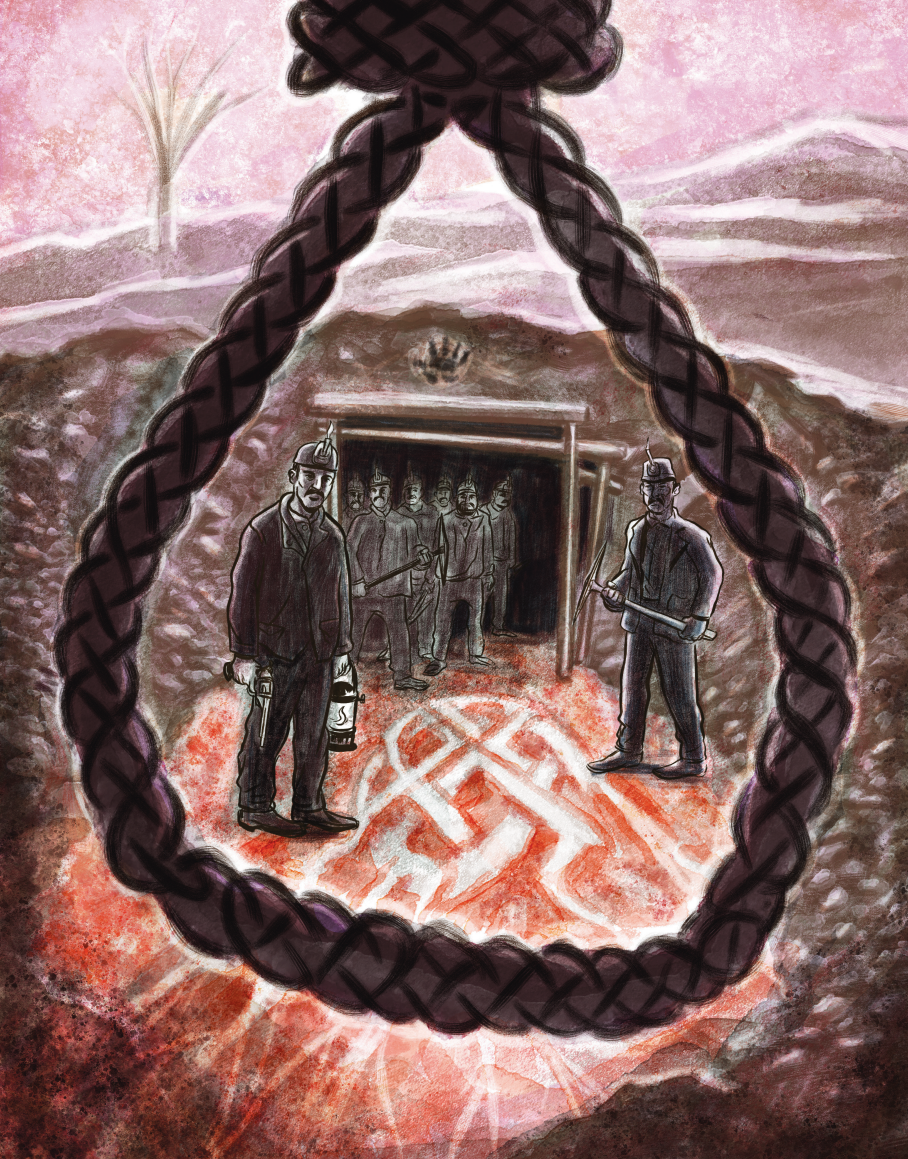
Art by Mike Freiheit from Current Affairs Magazine, Issue 58, March-April 2026
George K. Smith, a mine owner from Carbon County, was one of the first to die. According to the Miners’ Journal of Pottsville, a “party of men with blackened faces” broke into his house on the night of November 5, 1863—Guy Fawkes’ Night—and shot him with revolvers “as soon as he came downstairs.” The assassination was quick, merciless, and efficient. But this was only one blow in a much larger labor war.
The invention of the Bessemer steel forging process in 1856 had changed everything for the coal industry, dramatically ramping up demand, and so had the onset of the U.S. Civil War in 1861. Mine owners like Smith were suddenly wealthier than ever before from military contracts, but the wealth didn’t trickle down, and the Irish miners were as poor as ever. They tried to organize, forming rudimentary labor unions called simply “the committee.” They launched wildcat strikes, hoping to constrict the supply of coal, raise the price, and therefore raise their pay. But not everyone was a peaceful labor organizer. At the same time, the Molly Maguires made their presence known, issuing anonymous threats called “coffin notices” to any miner who crossed the picket lines. One such notice was found nailed to the doors of a colliery:
This is to give you the Gap men a cliar understanding that if you dont quit work after this NOTICE you may prper for your DETH. You are the damdest turncoats in the State—there is no pies fit for you bute Hell and will soone be there. MOLLY.
But the bosses were using violence, too, and the Civil War itself was their favorite weapon. Because Uncle Sam wanted the coal to keep flowing to the Army and Navy, going on strike was treated as treason, and the U.S. military could be used to crush unions. In places like Cass Township, troops were stationed to break strikes and arrest the “committee men” who started them, handing out frequent beatings as they went; today, it would be called a counter-insurgency force. George K. Smith himself was among the fiercest opponents of the unions, and he reportedly “entertained a body of forty or fifty cavalry at his house on October 20,” shortly before his assassination, to discuss strikebreaking. And so, seeing no other option left, a few of the miners shot him.
The point here is not to valorize or condemn the violence itself, but to point out that the bosses’ utter refusal to accept non-violent labor organizing made it inevitable. As Karl Marx would say, they created their own gravediggers. The historian Mark Bulik calls this era “America’s first labor war,” and although “first” is debatable, it was certainly a class war, and a bloody one. Seven other men were killed by self-proclaimed Molly Maguires in the years 1862-1870, all of them mine superintendents or foremen, and the pattern was always the same. They would earn a reputation for abusing the workers under their control, discriminating against Irish miners in particular, or forcibly breaking up a union. They would be issued a “coffin notice,” warning them of lethal consequences if they carried on. And if they ignored the warning, they’d be shot by a few shadowy figures when they least expected it.

A typical “coffin notice.”
For the owners, the post-Civil War years saw a dramatic increase in both their financial power and their capacity for violence. One capitalist in particular, Franklin B. Gowen of the Philadelphia & Reading Coal & Iron Company (PRCI), spent the 1860s buying up more and more small mining companies, bringing huge swathes of the Pennsylvania anthracite region under his personal control. At the height of his power, one journalist wrote at the time, Gowen held an “unchallenged, near-perfect monopoly over the Schuylkill coal trade,” owning both the mines and the railroads that carried the coal away. Every time he bought a mine, it got strict new work rules, a “company store” with extortionate prices, and a mandatory ten-hour working day. And to enforce this discipline, Gowen dispatched a private police force, the Coal and Iron Police, to put down any hint of unrest.
Despite all this, the guns of the Molly Maguires fell silent in the early 1870s, because an aboveground organization was doing a better job fighting for the miners’ interests: the Workingmen's Benevolent Association (WBA). Slowly, and with great personal sacrifice, the workers had managed to build up a regional labor union, led by an organizer named John Siney. Siney and the rest of the WBA condemned vigilante violence, and while the union was active, the assassinations stopped—though there were still occasional threats against “scab” miners, and some suspicious fires.
Gowen and his Coal and Iron Police were determined to break the union. As Kenny writes, the company spent the autumn of 1874 stockpiling enough surplus coal to last through a long work stoppage, then issued harsh pay cuts—between 10 and 20 percent—to force the union into a strike before they were truly ready. An estimated 7,000 miners downed tools, and they held out longer than anyone expected, in a “Long Strike” that lasted over six months. But in the end, a lack of regional solidarity doomed them. The workers at the Hyde Park mines in Luzerne County voted not to join the strike, so the company was able to keep up basic production, and poverty and hunger forced the strikers to come back and accept the pay cuts. The Long Strike took its toll on those who participated—in the aftermath, “at least one superintendent found his employees too weak to work, for want of food”—and the WBA collapsed soon after.
That same year, there were six new Molly Maguire killings, all following the old pattern. In one of the more dramatic cases, a policeman named Benjamin Yost who had a reputation for beating up union members was shot in the cemetery of a town called Tamaqua, where he had gone to extinguish the street lamps. In another, a Welsh superintendent named John P. Jones, who maintained an extensive “blacklist” of Irish miners, was assassinated at the Lansford railway station. On October 2, 1875, an anonymous miner wrote a letter to the Shenandoah Herald newspaper, explaining the group’s motivations:
i am against shooting as mutch as ye are[...] But the union is Broke up and we Have got nothing to defind ourselves with But our Revolvers and if we dount use them we shal have to work for 50 cints a Day. i have told ye the Mind of the children of Mistress Molly Maguire, all we want is a fare Days wages for a fare Days work, and thats what we cant get now By a Long shot.
The eccentric spelling and Capitalization aside, this is a remarkable document, because it’s the only surviving writing where a member of the secret society explained its agenda in their own terms. The whole focus is on economics, and whoever wrote it clearly felt they were fighting for their lives. The rest of what we know about the Molly Maguires comes either from newspaper reporters who were hostile to the group, or from their enemies in the coal companies and the police—and soon, those forces would combine to wipe them out altogether.
Besides the Coal and Iron Police, Franklin Gowen hired the infamous Pinkerton detective agency to infiltrate and destroy the Molly Maguires, once and for all. The group’s founder, Allan Pinkerton, personally dispatched one of his top detectives, an Irishman named James McParland, to pose as a miner and become a Molly Maguire himself. His job was to collect all the information he could, identify the society’s members, and “remain in the field until every cut-throat has paid with his life.” In 1876, the company felt the time had come to close the net, and the Coal and Iron Police made a sweeping series of arrests, followed by high-profile murder trials. And that’s where the real mockery of justice occurred, and Mr. John Cox Sanders comes into the picture.

In his own book on American mining unions, historian Harold W. Aurand is blunt about the legitimacy of the Molly Maguire trials: they had none. As he puts it, the whole process was:
[...]one of the most astounding surrenders of sovereignty in American history. A private corporation initiated the investigation through a private detective agency; a private police force arrested the alleged offenders; and coal company attorneys prosecuted them. The state provided only the courtroom and hangman.
In an unprecedented move, Franklin B. Gowen himself served as the chief prosecuting attorney in several of the trials. The judges allowed him to make long, grandiose speeches about the evils of the Molly Maguires, claiming the group was responsible for killing “hundreds of unknown victims whose bones now lie moldering over the face of this county.” In fact, there were only 16 killings in total, some of them with little or no evidence to connect them to an organized group.
For just one example, take the May 1876 trial over the killings of Benjamin Yost, the policeman, and John P. Jones, the mine superintendent. As Kenny writes, five alleged Molly Maguires stood in dock for these crimes: James Carroll, Thomas Duffy, James Roarity, Hugh McGehan, and James Boyle. All of them were Irish Catholics, but no Irish Catholics were allowed on the jury. In fact, Irish jurors were systematically excluded from all of the Molly Maguire trials, so the basic right to a jury of one’s peers was violated from the start. Instead, the jurors were predominantly English, German, and Dutch. Based on his surname, John Cox Sanders could have belonged to any of those groups, but it seems he kept quiet during his particular trial, so very little information about him has survived. The same can’t be said for other jurors. One man, William Becker, reportedly confessed that he “would not understand the witnesses” since he spoke mainly Dutch, while another, Levi Stein, spoke German and “[not] much English.” Both were accepted onto the Yost/Jones jury anyway.
In that case, there was no physical evidence connecting the five accused to the killings whatsoever: no bullet casings, no bloodstains, and no fingerprints (which wouldn’t be used to solve a crime until 1892). Instead, the prosecution’s case hinged entirely on the testimony of James McParland, the Pinkerton spy, and a miner named Jimmy “Powderkeg” Kerrigan, who claimed to be a former Molly Maguire who’d turned state’s evidence. McParland testified that the secret society had an elaborate system of “lodges” throughout northeastern Pennsylvania, one in every mining town, with a ringleader called a “bodymaster” in each lodge and a system of reciprocity between them. When miners in town A had a grievance with their boss, they’d send a message to the Molly Maguire lodge in town B, and killers from there would be dispatched, so nobody in town A would recognize them.
According to Kerrigan, this was how Yost had been killed: Thomas Duffy was the one who actually planned it, as an act of revenge, because Yost had previously arrested and beaten him. But Kerrigan called on Roarity, the “bodymaster” of the lodge in nearby Coaldale. So Roarity sent McGehan and Boyle to actually shoot Yost, while Carroll, a tavern owner, provided shelter and weapons for the visiting assassins. In exchange for their services, McGehan and Boyle later called on some Tamaqua miners to kill John P. Jones, who had blacklisted them.
It was certainly a dramatic story. The problem is, neither McParland nor Kerrigan were remotely trustworthy witnesses. McParland had been hired by the Pinkertons to destroy the labor movement in Pennsylvania, so he had a vested interest in getting convictions, whether or not the people he accused were guilty. Years later, he admitted that he paid at least one witness, a miner pejoratively nicknamed Daniel “The Bum” Kelly, $1,000 to testify against alleged Molly Maguires—a fortune in those days. Meanwhile, Kerrigan freely admitted that he’d been involved in both Yost and Jones’ killing, but pointed the finger at others to save himself. As Kenny writes, “his own wife publicly denounced him as a liar, and testified in court that he had told her he had killed Yost himself.” Apparently, the jury didn’t believe her. All five “Sons of Molly” were convicted of first-degree murder, and all five were publicly hanged in 1877.
The same story would play out, with slight variations, in the rest of the trials: juries where the Irish were systematically excluded, prosecutions run by the coal company, dramatic testimony from McParland and his handpicked witnesses, and swift guilty verdicts. The defense lawyers barely put up a fight, possibly because the impoverished miners couldn’t pay for competent ones. In one case, the jury deliberated for only 20 minutes before handing down the death sentence.
One man, John Kehoe, was tried in 1876 for a murder committed in 1862, and was found guilty despite an eyewitness who said he wasn’t present at the crime scene, mainly because he had called the murdered mine boss a “son of a bitch.” In 1979 Kehoe was issued a posthumous pardon. Altogether, 20 miners were executed that year, ten of them on the same “Black Thursday.” Maybe some of them were guilty; maybe the actual killers walked free, because the prosecution just grabbed whoever it could. At this point, we’ll never know. But none of them got anything resembling a fair trial. The judges failed them, and so did the jurors, my great-great-great-great-grandfather included. It was nothing more than a massacre of rebellious workers by capitalists, with a thin pretense of “law” to cover it. In America, that’s all it takes to put you in the cemetery.
It’s Pennsylvania’s folk music, though, that captures the story in its most evocative form. This was how I first encountered the Molly Maguire legend, before discovering my family’s connection to it: on a thrift-store CD from a local band called Donnybrook, who were themselves covering an older band called the Irish Balladeers. Their song, “Sons of Molly,” is a ghost story:
When the wind blows wild at night
Past the breakers melancholy
If you stand in the dark with your ear to the wind
You can hear the sons of Molly
And deep in the dark of the old mine shaft
You can smell the smoke and fire
And the whispers low in the mine below,
“Tis the ghost of Molly Maguire.”
In each of the next verses, a different ghost speaks, some proudly admitting to a killing (“I come from Carbon County / and I shot the boss of the Lansford mine / now my soul is up for bounty”), and others protesting their innocence (“No pistol did I fire / But I will fall from the gallows tall, just for being a Molly Maguire”). But in either case, you get a profound sense that an injustice was done to them, and because of it, their spirits can’t rest.
There’s even a movie about this period, filmed on location in northeastern Pennsylvania’s coal towns and released in 1970. Simply titled The Molly Maguires, it’s been largely forgotten by cinema critics, but it’s underrated. The director was Martin Ritt, who also made The Spy Who Came in From the Cold and The Great White Hope, and who had been blacklisted from working in television as a suspected communist in 1952. (He’d get his revenge in 1976 with The Front, a savage satire of the blacklist itself starring Woody Allen.) In The Molly Maguires, Ritt takes on the style of an American Ken Loach, capturing the soul-crushing environment of the anthracite mines. Visually, the film is mostly grey and brown, punctuated by occasional eruptions of bright orange flame. It boils down the extended cast of the real Molly Maguire saga into just two totemic figures: Detective McParland, played by Richard Harris, and Sean Connery as John Kehoe, his adversary. On paper, Harris is the protagonist—but the real star is Connery’s Kehoe.
Connery gives a strictly restrained performance, and doesn’t speak his first line of dialogue until about 45 minutes in. As the detective meets and befriends him, he’s still guarded and taciturn—until his mentor, an old retired miner named Mr. Raines, dies of a lung disease in the third act. As the time comes for Raines’ funeral, Kehoe realizes the old man doesn’t even own a suit to be buried in. He finally breaks, and decades of suppressed rage come loose as he talks to his friend’s corpse:
KEHOE: He never made a sound. Forty-two years in the pits, and not even an echo left hanging in the air. Go on, make your sound now, you old bastard! You’re safe among friends. Silence is golden, is that it? Seen but not heard. They beat that lesson into you, didn’t they?
Mad with grief, he storms across the town to the company store, with McParland in tow. Kehoe breaks down the door and steals a suit for Raines, then grabs all the other clothing off the racks and throws it out to the crowd of miners who’ve gathered around. Then he takes an axe to the shelves, douses everything in gasoline, and sets the whole place ablaze. It’s a moment of fierce, revolutionary joy. The company stores were all too real, and the mine bosses of this era exploited them ruthlessly, often clawing back the majority of their workers’ wages by overcharging for basic necessities like food and clothes. But Ritt captures the moment where the workers finally see the house of exploitation for what it is, and destroy it. That moment is the essence of all revolutionary politics. For one night, humanity triumphs over money. After that, the trials and executions feel like an afterthought.

The astute reader may notice that this whole saga is not exactly a “current affair.” Some miners got a crooked trial in 1876—so what?, you might ask. But there’s a reason this story has stuck in people’s minds for so long. The events themselves are specific to the world of the 19th century, but the political forces that made them happen are not.
For one thing, the coal mining industry never ended, and neither did the miners’ labor struggle. It should have ended; coal is the filthiest and least efficient of all the fossil fuels, and even China is now beginning to phase it out in favor of renewables. It’s frankly embarrassing that “burning rocks” is still a real industry. But the two Trump presidencies have seen a concerted push to keep coal around, aided and abetted by Democrats like West Virginia’s Joe Manchin. Lately, Trump and his flunkies have taken to using the absurd phrase “Beautiful Clean Coal” in all their propaganda. They've even deployed a cartoon mascot called “Coalie.” Worse, Trump has signed executive orders allowing coal mines to emit more pollution, while cutting health programs for workers with black lung disease. More than 150 years after the Molly Maguires, he and the rest of the financial elite are still sacrificing coal miners’ lives and health for profit. Franklin Gowen would approve.
The Trump government has also embraced another tactic that Gowen and the Pinkertons pioneered: accusing immigrants of being in criminal gangs, with little or no evidence, and punishing them without fair trials. Back then it was the Irish; now it’s mainly Latinos in the crosshairs. Remember Andry Hernandez Romero, the gay hairdresser the Trump administration abducted to El Salvador’s CECOT prison camp? He was accused of being in the Tren de Aragua gang simply because he had a tattoo of a crown. Kilmar Abrego Garcia, another deportee, was labeled a member of MS-13 because he wore a Chicago Bulls hat, and because an anonymous informant said so. None of it is proof of wrongdoing, any more than John Kehoe calling a mine boss a “son of a bitch” all those years ago was proof. But because these people aren’t wealthy, and aren’t white, it doesn’t matter. They can’t afford rights.
It was the same with Sacco and Vanzetti, who were never proven to have committed any crime, but were hanged in 1927 regardless. It was the same with Ethel Rosenberg, who was executed as a spy for the Soviet Union in 1953, despite no solid evidence that she shared in her husband’s espionage. Countless Black defendants across the South in the Jim Crow years, tried and falsely convicted by all-white juries, could tell you about the “rule of law.” So could the Native American activist Leonard Peltier, who spent 50 years in prison for murders he was never proven to have committed, and only got his sentence commuted in 2024, as Joe Biden was shuffling out the door of the White House.
It’s all still happening today. Environmental lawyer Steven Donziger spent more than two years under house arrest thanks to a private prosecution by the oil company Chevron, exactly like the private prosecution Franklin Gowen mounted in 1876. In Atlanta, activists who oppose the “Cop City” law enforcement facility have been slapped with RICO charges designed for Mafia bosses. Time after time, we see that when the interests of big corporations and the state conflict with those of ordinary people, it’s the ordinary people who lose, no matter the facts of the case. In The State and Revolution, Vladimir Lenin famously said that “Freedom in capitalist society always remains about the same as it was in the ancient Greek republics: freedom for the slave-owners.” We might adapt the quote today, and say that law in capitalist society remains the same: law for mine bosses.
The person who really troubles me, though, is John Cox Sanders, and not only because of the long-attenuated genetic connection between us. He’s a perfect example of how easy it is for someone to become an instrument of injustice and death, just by quietly accepting what they’re told by authority figures. He probably wasn’t a particularly bad man. But when he saw that he had been placed on a segregated jury with no Irish people on it, he didn’t speak up. I’ve spent a lot of time scrolling through PDFs of old newspapers, and there’s no record I can find of anything specific he said, during what was obviously a series of rigged and unfair trials. It seems he just meekly did what was expected of him, nodded along, and cast his “guilty” vote. He trusted in the institutions and the rule of law, like a good liberal. When Gowen and McParland were giving their speeches, he didn’t ask the all-important question: is it actually true? And when that question isn’t asked, the consequences are almost always grim.
There’s a line in that old folk song, “Sons of Molly,” that sticks with me, too. It’s part of the chorus, after each of the condemned men announces his guilt or innocence:
But I will die with my head held high
For I fought for the men below
The men who slave and sweat and die
Down in the black hell-hole.
This is exactly what John Cox Sanders could never say. He didn’t fight for anyone, let alone the miners, and his memory will always be a shameful one because of it. But if you tweak the gendered language a little, it’s the best epitaph I can think of: For I fought for the ones below. I wouldn’t mind having that on my own tombstone, when the day comes. We should all aspire to be the kinds of people who can say it truthfully: that we didn’t just sit quietly in the jury box and let the rich and powerful do whatever they want. That in the long war between the classes, we struck a blow back. That when we had the chance, we burned the company store to the ground. Only then will we be able to hold our heads high, in a better world.