Turn the Lights Back On
Witnessing the cruel effects of the U.S. oil blockade against Cuba.
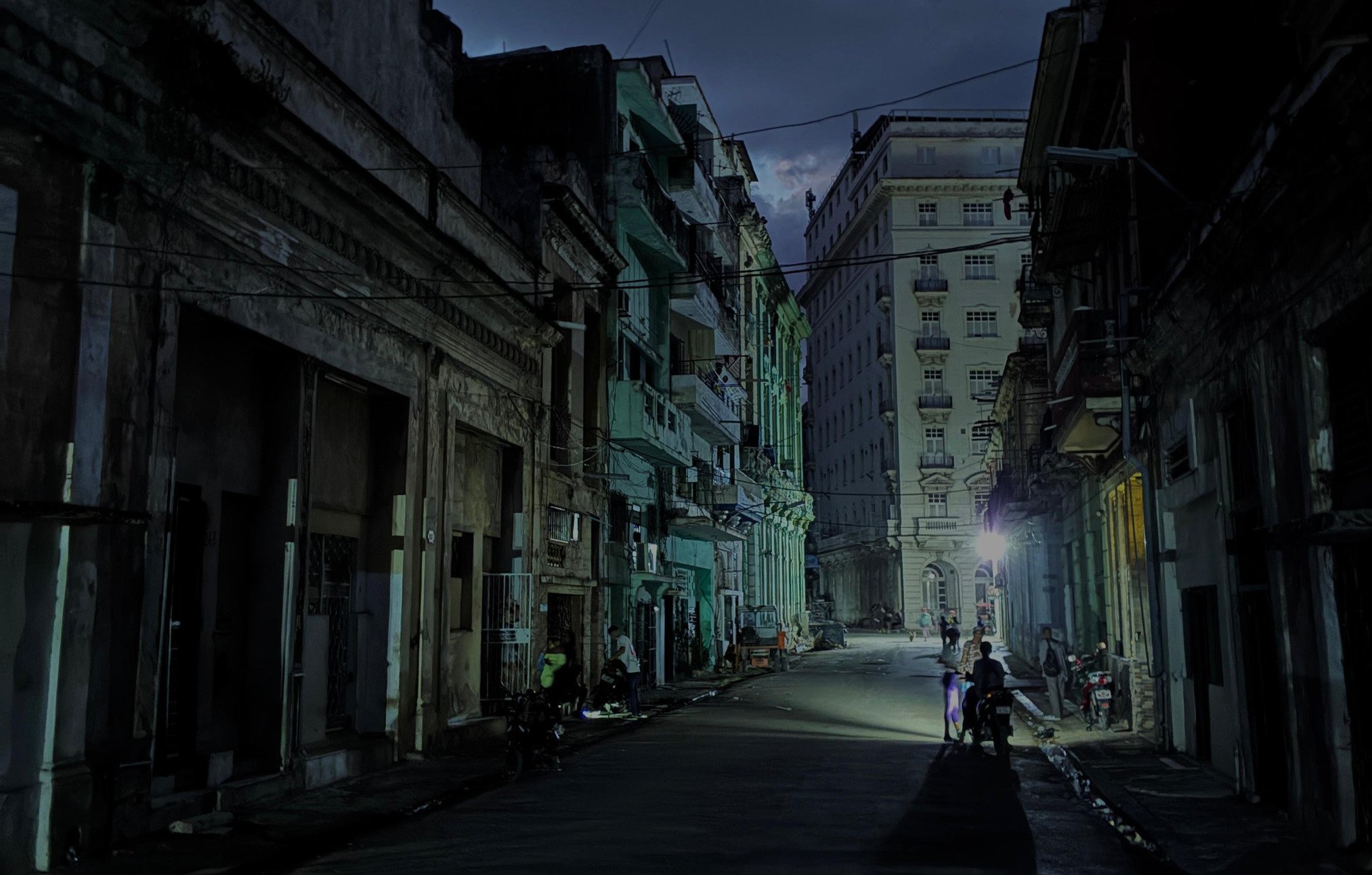
The whole city is dark. No streetlights. No lights in the windows. No TV. No AC. Occasionally there’s a solar powered emergency light, or someone has a generator. But you fumble through many streets in Havana in almost perfect blackness, as if you have been blinded. You don’t know how much you need or want light until it vanishes.
Cuba’s electric grid has failed for the second time in less than a week, the result of a U.S. blockade on oil shipments. Even before the full collapse, there were persistent rolling blackouts across the country. Venezuela was the main supplier of oil to Cuba, but the U.S. invaded their country, killed 80 people, kidnapped their head of state, and prohibited the oil shipments. The U.S. has taken extraordinary measures to ensure the lights stay out in Cuba, threatening countries with tariffs if they do anything to relieve the humanitarian crisis.
My colleague Alex Skopic and I are currently in Havana reporting with the Nuestra América aid convoy, which has brought tons of humanitarian supplies to provide some small measure of relief amidst Cuba’s deprivation. The aid they have brought cannot itself change the situation, however, so the mission is also an effort to draw attention to Cuba’s crisis and encourage Americans to change their government’s policy, and countries around the world to defy U.S. policy and relieve the Cuban shortage.
When the power went, I was watching a concert held at the Pabellon Cuba, a delightfully strange Brutalist outdoor event space. The place was packed with hundreds of ordinary Cubans enjoying a spring concert. Then the power went, the music stopped, it was over. You could feel the joy dying. Everyone is now pretty much used to having good things ruined by power cuts, but it’s still demoralizing when everyone is having fun and the plug is pulled.
People can live without music if they have to, I suppose. (The Cubans refuse to, though, and as I walked through the streets tonight I saw plenty of dancing in the dark.) What they cannot live without is healthcare, and the blackout is of course hitting hospitals hard. People aren’t able to get crucial surgeries, or even get to the hospital, which means Trump is simply killing the sickest Cubans.
It has been tragic and depressing watching the effects of the blockade. This is already a poor country. People didn’t have much to start with. But now they can’t take buses, they can’t afford to run their cars (I have been told gas costs anywhere between 10 dollars a gallon and 40 dollars a gallon, if you can find it—this in a country where a nice meal will cost you about $20). Food in restaurants is starting to run out. Garbage is accumulating in the streets. I had to sprint to get through a city block where the flies were so thick it was a struggle to breathe without ingesting one. The entire supply chain appears to be breaking down. Tourism is drying up—few want to come and experience shortages and sanitation crises. Taxi drivers can’t drive their taxis. With the evaporation of tourists comes greater despair, since so many depend on this influx of foreign money. Everyone in Cuba is warm and friendly, but you can tell they’re desperate. At the large San Jose art market, sellers had booths overflowing with souvenirs, and hardly anyone was there to buy. The merchants were outcompeting each other on pushiness—it was obvious many of them would not make a single sale all day.
I cannot believe how cruel what my country is doing is. To take bread from the mouths of the poor, to destroy livelihoods, to turn old people into beggars, to kill sick people. I knew we were capable of this—the history of U.S. foreign policy since World War II, from dropping napalm Vietnamese peasants to Tomahawk cruise missiles on Iranian schoolchildren, has been a history of unbelievable cruelty and violence. But as I look off the hotel rooftop at a blacked-out city, and realize that we could turn the lights on, if we wanted to, I feel such deep rage that the wealthiest country in the world would inflict this totally needless misery on its poor, tiny neighbor. A billionaire president is taking these destitute people’s last means of eking out a living—and for what?
Certainly not because Donald Trump cares about Cuban freedom. I cannot emphasize enough that this has nothing to do with human rights. The Trump administration is not interested in whether Cuba democratizes its political system or guarantees civil liberties. As in Venezuela, where Trump was open about simply wanting to take the country’s oil even if that meant leaving authoritarian governance in place, Trump’s primary demand for Cuba is a piece of the economic pie. It tells you everything that the first concession Trump secured from the Cuban government was the right for foreign investors to profit from Cuba.
In fact, the entire thrust of U.S. policy toward Cuba has been toward privatization, not liberty. By law, Americans are only allowed to stay in privately-run hotels, often owned by foreign companies. (I am staying in one owned by a Spanish corporation.) These hotels are exempt from the restrictions on oil, which means that the power is on in my hotel even while almost all of the rest of the city is in darkness. It’s abundantly clear that what the U.S. wants is not for the Cuban government to respect the freedom of the press—irrelevant, since Cubans are already being deluged with online propaganda from Miami telling them that the blockade is being imposed by their own government, not the U.S.—but to secure Cuba for foreign corporations. The foreign hotels are a kind of beachhead. The U.S. plan is to use maximum pressure to slowly get Cuba to undo its large-scale public ownership, handing as much of the economy as possible over to Trump’s cronies, who will “develop” it.
This has always been the driving factor behind U.S. opposition to the post-revolutionary Cuban government. The Eisenhower administration turned against, and tried to destroy, Fidel Castro’s new government because it nationalized the assets of U.S. companies, not because it was dictatorial. Castro’s predecessor, Fulgencio Batista, was a dictator with what U.S. officials described as a murderous “Gestapo,” but the U.S. was just fine with him because he ensured U.S. businessmen made money and kept Cuba’s assets out of the hands of the Cuban people.
In fact, U.S. leaders told themselves that dictatorship was good for Cuba. Vice President Richard Nixon said that “Latinos had shown a preference for a dictatorial government rather than a democracy.” Eisenhower himself believed that Cubans simply didn’t want democracy, but just to drink and have a good time, telling the British prime minister that “the average Cuban sugar worker wants to receive his earnings in cash and go to the store, buy a white guayabera, white shoes, a bottle of rum, and go to a dance.” Secretary of State John Foster Dulles believed Latin American states were filled with “people who have no capacity for self-government and indeed are like children.”
Unfortunately for Dulles, in the 1950s many in Cuba and elsewhere in Latin America did not agree that they were ill-suited for self-government. Dulles warned that “many of the Latin American states are leaping ahead to irresponsible self-government.” Some even believed that their country’s resources should be used for the benefit of the country’s people themselves, rather than the shareholders of the United Fruit Company. In the face of this threat, Eisenhower’s National Security Council stated U.S. policy bluntly: “Our purpose should be to arrest the development of irresponsibility and extreme nationalism and their belief in their immunity from the exercise of U.S. power.”
When Fidel Castro came to power and began nationalizing American assets, the U.S. nightmare was coming true. The National Foreign Trade Council warned that “if Castro stays in power, all American investments in Cuba are doomed.” As the assistant secretary of state warned his boss, “if Cuba gets by with the actions she is taking against American property owners, our whole private enterprise approach abroad could be in serious danger.” The Treasury Secretary, a Texas oil executive, did suggest one familiar solution: “If we were to cut the Cubans off from their fuel supply, the effect would be devastating on them within a month or six weeks.” In the end, the U.S. chose terrorism instead, with the CIA launching a campaign of sabotage and destruction, trying to assassinate Castro, and ultimately staging the (legendarily disastrous) Bay of Pigs invasion to try to overthrow the government. When the costs of direct invasion and overthrow became too high (since Castro was popular and had fortified his government against an armed attack) the U.S. chose slow economic strangulation instead.
U.S. policy toward Cuba was both immoral and illegal long before Trump’s present fuel cutoff. Cutting off U.S. trade with Cuba entirely has cost the country billions of dollars a year. There are absurd rules like the “180 day rule,” which prohibits any ship that has docked in Cuba from coming to the U.S. for 180 days, a measure purely designed to reduce shipping to Cuba.
But seeing this latest sadism up close is eye-opening. It’s so tragic watching a country collapse like this—although notably, I would not say the society is collapsing. Cubans are an astonishingly resilient people. They are responding to their present condition with what Brits might call the “Blitz spirit”—keeping calm and carrying on. The streets are safe—I felt much more secure walking through the blacked-out streets of Havana at night than I would have in New Orleans on a night with the lights on. Everyone is warm and friendly. They are innovative and coming up with ways to keep living a dignified and bearable life in darkness. They just have no fuel and no power, and it’s hurting them terribly.
We need more people to follow the lead of organizations like CODEPINK, the Progressive International, and Global Health Partners, which organized this aid convoy. Their logistical achievements have impressed me throughout this trip. Cuba also needs visitors. I am not saying that tourism is a political act, but the United States government is trying to crush Cuba’s economy, and visitors with money are a lifeline. Cubans need people to come and stay in the hotels, buy their art, visit their restaurants. Long-distance flights have been canceled, because they cannot refuel in Cuba, but there are still planes on major airlines coming from Miami every day. It is still legal to come to Cuba. It is legal to spend your money here. It is legal to bring aid. The conditions are trying, and anyone who visits needs to be prepared for some inconvenience—the power went out in the restaurant we were in Friday night, and menu items are often limited. But the deprivations facing visitors are so minimal compared to those of residents, and I have not spoken to one person who doesn’t want more Americans to come.
Other countries need to step up and defy the Trump administration. Where is the UN in the hour of Cuba’s need? Why are there not round-the-clock shipments of food, fuel, and medicine? If I could tell world leaders one thing, it would be: if you do not defy Trump, he will not stop with Venezuela, he will not stop with Iran, he will not stop with Cuba. His appetite for power is insatiable. You will be next. Save Cuba because it’s the right thing to do, but save Cuba to save yourselves as well.
And to Americans: Cuba is not a side issue. We must force our government to change course. The present policy is an outrage against basic human morality. It does not matter what you think of the Cuban government. What Trump is doing doesn’t affect the Cuban government, it affects the Cuban people, who are treading through garbage and catching diseases because we have cut off the fuel they need for their garbage trucks. We are responsible for our government’s policy, and we have to do everything we can to change it. Demand your elected officials take concrete steps to relieve Cuba. Members of Congress should come here. I realize there are many injustices in our world at the moment, but the Cuba crisis is on our doorstep. We cannot look away. Do not leave these people in the dark. Make America turn the lights back on.
Top photo: Gerard Dalbon