
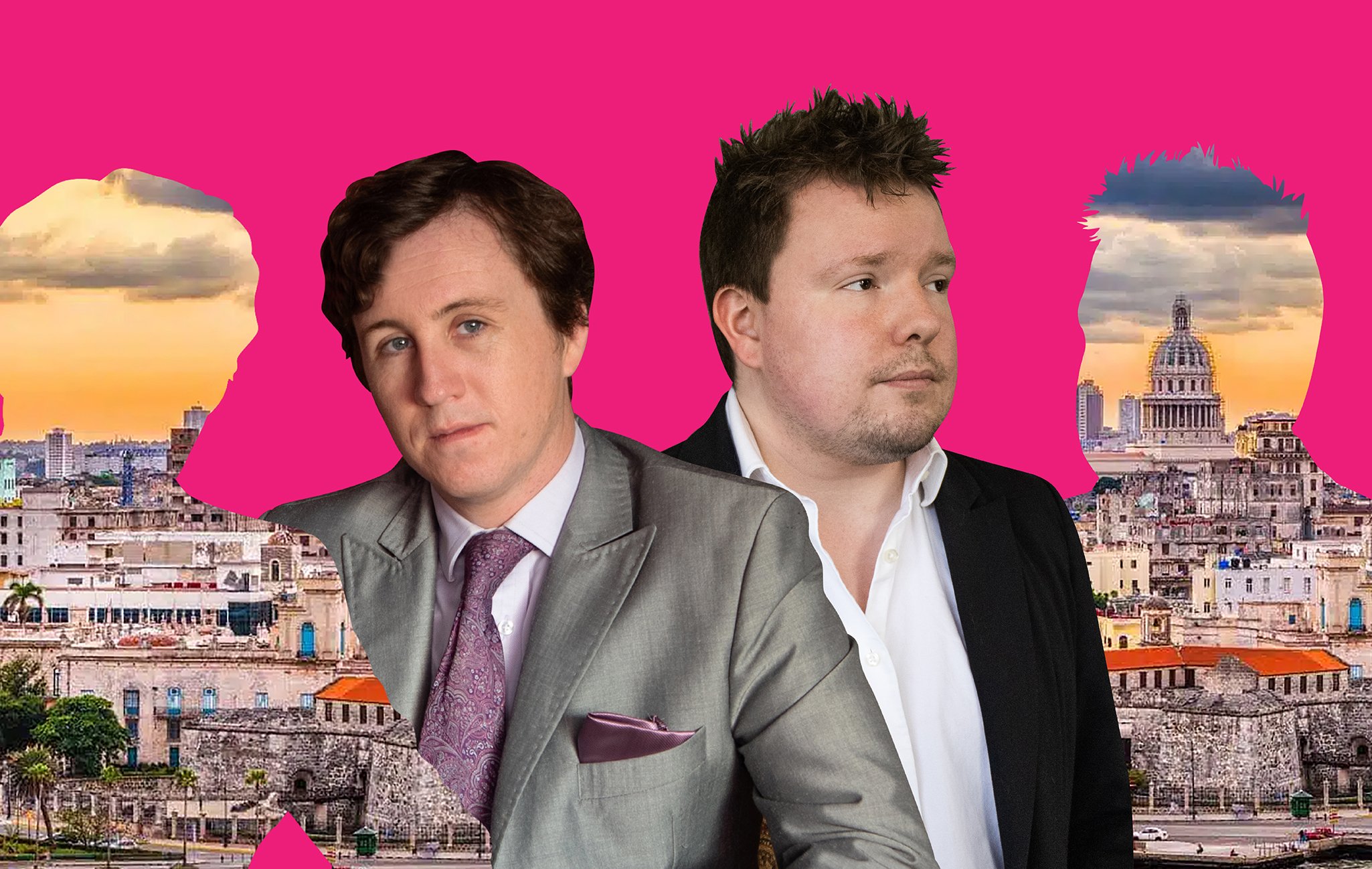
Donald Trump is trying to starve the island nation into submission, but an international coalition of volunteers is coming to Cuba’s aid. We’re joining them.
In the medieval era, deprivation was the deadliest wartime weapon. Dramatic battle scenes like the ones you see in Hollywood films, where hundreds of soldiers storm the walls of a castle, were more the exception than the norm—too dangerous, and too costly. Instead, armies preferred to encircle their enemies and starve them out. They'd build walls of their own, in a practice called circumvallation, to keep supplies from reaching the besieged fortress. They'd dig trenches and divert streams to cut off the water supply. One of the longest recorded sieges of this period, at Kenilworth Castle in England, lasted a full six months. But that was on a trivially small scale compared to the nationwide siege warfare the Trump administration is now waging against Cuba.
On January 29 of this year, Trump announced a de facto oil blockade against the island nation, threatening to slap harsh tariffs on any country which “directly or indirectly sells or otherwise provides any oil to Cuba.” In February, the Russian tanker Sea Horse abruptly diverted its course from Cuba, carrying more than 200,000 barrels of oil the Cuban people had been counting on. Since then, widespread electricity blackouts have become a regular occurrence. People can’t refrigerate their food, garbage is piling up in the streets since there’s no fuel for trucks to collect it, and preventable disease is spreading. Worst of all, doctors in Havana report that over 3,000 people who rely on dialysis machines are at risk of dying from loss of power.
Words like “sanctions” and “restrictions” really don’t capture the reality. This is an undeclared economic war, and a lethal one. Trump and Secretary of State Marco Rubio want to bring about regime change in Cuba, and have demanded that President Miguel Díaz-Canel resign from office. So they’re inflicting as much pain and suffering on the Cuban people as they can, in hopes of bringing the entire nation to its knees. If the blackouts continue, they will kill people; it’s possible they already have.
The blockade is obscene on a human level, and it’s illegal under international law. You couldn’t ask for a more clear-cut case of collective punishment. Last September, the General Assembly of the United Nations voted overwhelmingly to lift U.S. embargo on trade with Cuba, with 165 countries in favor of sanctions relief and only seven against—including, tellingly, both the United States and Israel. But the U.S. has so far gotten away with its role in the collective punishment and starvation of Gaza, and it’s now committing the same crime against Cuba.
“I do believe I’ll be having the honor of taking Cuba,” Trump said at a press conference on March 16. “Taking Cuba in some form—whether I free it, take it, I think I can do anything I want with it, you want to know the truth.” On another occasion, he said that he’ll “put Marco over there” to oversee regime change, like a British monarch assigning a colonial administrator. You can practically see him salivate, and given that Trump recently deposed and kidnapped Venezuela’s head of state, we should take these threats very seriously.

This is only the latest stage in the U.S. government’s decades-long war against Cuba. Ever since 1959, when Cuban revolutionaries overthrew the U.S.-backed dictator Fulgencio Batista, driving out organized crime and private plantation owners alike, the U.S. has never forgiven Cuba for having a successful revolution. Famously, the CIA and its handpicked paramilitary forces launched the Bay of Pigs invasion in 1961, only to be defeated in humiliating fashion. The agency also tried to assassinate Fidel Castro on numerous occasions, and at one point the Department of Defense even considered hijacking U.S. planes, bombing Miami, and fabricating evidence to blame the attack on Cuba as a pretext for another invasion. (The plan was called “Operation Northwoods.”)
But just like in medieval times, the most damaging tactic of all has been cutting off supply lines. In a remarkable internal memo from 1960, U.S. official Lester D. Mallory—then a Deputy Assistant Secretary of State—laid out the strategy explicitly. “The majority of Cubans support Castro,” Mallory admitted, and so the best approach would be “denying money and supplies to Cuba, to decrease monetary and real wages, to bring about hunger, desperation and overthrow of government.” John F. Kennedy’s Cuba Task Force explicitly aimed at “the destruction of targets important to the economy.” Or, as President Lyndon B. Johnson put it more crudely a few years later, it would be necessary to “pinch their nuts more than we’re doing.” That has been the official U.S. policy line ever since, and since 1962 the U.S. has enforced a devastating trade embargo on Cuba, both forbidding American companies and strongly discouraging other nations from doing business there. As it stands today, any ship that docks in a Cuban port “to engage in the trade of goods or the purchase or provision of services” is forbidden to dock in a U.S. port for 180 days—and so many nations simply avoid Cuba altogether.
The U.S. has always been clear that the policy of “pinching their nuts” is not about human rights. “Castro represents a successful defiance of the U.S., a negation of our whole hemispheric policy of almost a century and a half,” as the State Department Policy Planning Council put it. The CIA warned that Castro could inspire other populations of poor people in Latin America to rise up against their governments. Arthur Schlesinger Jr. warned President Kennedy in 1961 that the risk was “the spread of the Castro idea of taking matters into one’s own hands.”
Authoritarian governance itself was not a problem, however. During the Cold War, the U.S. was allied with, and directly supported, many dictatorships more brutal than Castro’s government—Augusto Pinochet in Chile, Carlos Castillo Armas in Guatemala, the Shah in Iran, and so on. Today, the U.S. continues to have friendly relations with absolute rulers like Crown Prince Mohammed Bin Salman of Saudi Arabia and the sheikhs of the United Arab Emirates, both of whom are responsible for modern-day slavery, severe state censorship, executions for petty crimes, and even genocide. The problem with Cuba, then, has never been that it lacked a free press or opposition parties. The problem was that it challenged U.S. hegemony in Latin America.
Under the two presidencies of Donald Trump, the assault on Cuba has ratcheted up to a new level. When he took office in 2017, Trump immediately reversed the “thaw” in U.S.-Cuban relations that Barack Obama had pursued, placing new restrictions on trade with the island nation and adding red tape for travelers. In 2020, while Trump was seeking reelection, he hosted a bizarre ceremony for what he called the “courageous veterans” of the Bay of Pigs invasion. And now, he is clearly hoping to finish Cuba off for good.
This is all especially perverse because historically, Cuba has been one of the first countries to answer when people around the world called for help. In the 1980s, Fidel Castro sent tens of thousands of Cuban troops to defend Angola when the apartheid regime in South Africa invaded it, helping to win the pivotal Battle of Cuito Cuanavale and prevent another nation from falling to white supremacy. More recently, Cuban doctors and healthcare workers have traveled around the world on humanitarian medical missions, saving lives during outbreaks of Ebola in West Africa, cholera in Haiti, and COVID-19 across Latin America. But Trump and Rubio have even levelled specific, targeted sanctions against the heroic doctors who take part in those programs—and in the last few weeks, Jamaica and Guyana bowed to U.S. pressure and ended their agreements to employ Cuban medics, cutting off yet another source of income to the island.
Now, it’s the rest of the world’s turn to come to Cuba’s aid. This month, a coalition of activists from around the globe are launching a humanitarian aid mission to Cuba to break the siege. Modeled after the Global Sumud Flotilla that attempted to bring aid to Gaza last year, the Nuestra América Convoy will converge in Havana on March 21, with participants coming from around the world by air and sea. So far, organizers at the Progressive International report that they’ve collected “more than $400,000 worth of humanitarian aid, including medical equipment, medicines, staple foods, infant nutrition, and hygiene supplies,” along with “more than $500,000 worth of solar panels and generators,” 220 suitcases full of medical supplies from Italy, “500 kilograms of solar-powered equipment from Colombia, half a tonne of medical supplies from Brazil,” and additional shipments from France, Mexico, Argentina, Turkey, the United Kingdom, and the United States, among other nations.
The political left has always had a proud tradition of internationalism, from the American socialists who joined the Abraham Lincoln Brigades to fight fascism in 1930s Spain, to the more recent volunteers who fought ISIS alongside Kurdish communists in Rojava. In the 1980s, as the Reagan administration armed and funded the brutal Contras in Nicaragua and death squads in El Salvador, the Central American solidarity movement helped turn public opinion against U.S. intervention. This mission carries that tradition forward, and some of the most well-known figures in today’s left are coming along: labor activists like Chris Smalls of the Amazon Labor Union, artists like the Irish rap group Kneecap, streamers like Hasan Piker, journalists like Katie Halper and Owen Jones, and too many others to count.
As your editors, we’re proud to announce that we will be among them. We’re both getting on an airplane for Havana on Friday, March 20, and we’ll be covering the entire Nuestra América mission in Current Affairs, from the ground. Because electricity is currently hard to come by in Cuba, we don’t exactly know what kind of material we’ll be able to get out to you—articles, videos, or otherwise. We’re going to be writing in old-fashioned paper notebooks. But now is a good time to follow the various Current Affairs social media pages for updates, and more importantly, to follow the work of CODEPINK, the Progressive International, and the other humanitarian groups who have done the heavy lifting in putting this mission together.

The whole world’s eyes should be on Cuba right now, because the U.S. oil cutoff is a crime against humanity. It’s understandable that attention is directed elsewhere, given the human toll of U.S.-Israeli attacks on Iran. But Cuba’s needs are pressing, and they could be addressed easily if the world took its responsibilities seriously. That’s why drawing as much attention as possible to this aid mission is vitally important. The Trump administration relies on fear; they want to scare people away from Cuba, and make everyone think there’s nothing that can possibly be done. But it isn’t true. It’s perfectly legal to bring humanitarian supplies to the island, and it’s just a short 90-mile trip from Miami, around an hour by plane. There’s no reason an aid mission like this can’t be launched every week, and national governments around the world should be doing much more. The fact that it’s fallen to a handful of activists to carry out this work should bring shame to every elected official, everywhere in the world, who hasn’t launched a ship full of supplies to Havana—and if this mission becomes a big enough international news story, perhaps more governments can be pressured to do exactly that.
Beyond food, medicine, and energy infrastructure, this mission sends a message. As Americans, we want to make it crystal clear that the Trump administration does not speak for us when it talks about “taking over” Cuba, and we’re sickened by what Trump and Rubio are doing to the Cuban people in the name of U.S. foreign policy. But we’re determined to do what we can, and we’re going to make sure the people of Cuba do not stand alone. Spread the word, and stay tuned.


.png?width=352&name=Screenshot%202026-09-04%20at%204.00.52%20PM%20(1).png)
%20(1).jpg?width=352&name=miasma-1%20(1)%20(1).jpg)