%20(1).jpg)
If you’re an ordinary American, war with Iran threatens your safety, your civil rights, and your ability to afford basic necessities. But for the financial elite, it’s just good business.
The United States is now at war with Iran, and nobody knows when or how it will end. Officially, the Trump administration is reluctant to admit this is a war, preferring to use words like “operation” instead. But if we understand “war” to mean “organized killing,” no other word applies. Already, the U.S. and Israel’s missiles have struck not just military targets, but schools, hospitals, and apartment buildings across Iran. In photos, aid workers are dragging children’s stuffed animals and bloodstained backpacks from beneath the wreckage. At the time of writing, the death toll stands at roughly 1,300 Iranian civilians and 13 U.S. soldiers, and rising. Our government is massacring the people of a country that has not attacked us, in blatant violation of international law. Or, as Secretary of War Pete Hegseth proudly puts it: “Death and destruction from the sky, all day long.”
The U.S. government would like us to believe that, as Americans, we stand to benefit from this bloodshed. They claim attacking Iran will make us safer, or secure “national interests” we supposedly have in the Middle East. Judging by public opinion polls, most Americans aren’t buying it: 59 percent oppose the war, far more than the 24 percent who opposed invading Iraq in 2003. Still, that means 41 percent support it. For others, the bombings might seem unfortunate and scary, but ultimately far away—something happening “over there,” and not “around here,” which will have little effect on Americans’ daily lives. You might have parents, siblings, or coworkers who believe that, or you might even think that way yourself. But you’d be dangerously mistaken.
Clearly, Iranian civilians are most directly in the shadow of death. They desperately need international support, and an immediate ceasefire. But war with Iran will be a disaster for Americans, too. Whether you live in Louisiana, or Pennsylvania, or California, you can’t escape its consequences. The longer this war goes on, the more it will erode our civil liberties, threaten our safety, and worsen the cost-of-living crisis that’s already ravaging our communities. Only the arms dealers, military contractors, and Trump administration insiders will benefit, and they’ll profit handsomely. And that’s exactly why we should all be demanding an end to this stupid, brutal conflict.

The first thing to know is that this war is extremely expensive. A single Tomahawk cruise missile, like the one that killed all those schoolgirls in Minab, costs “roughly $2.5 million.” An F-15 fighter jet costs at least $94 million. Already, three of those jets have been shot down over Kuwait in a bizarre friendly-fire incident, for a collective price tag of $282 million. According to the Pentagon’s own estimates, “the first six days of war in Iran cost U.S. taxpayers at least $11.3 billion in munitions alone,” or roughly $1.9 billion per day.
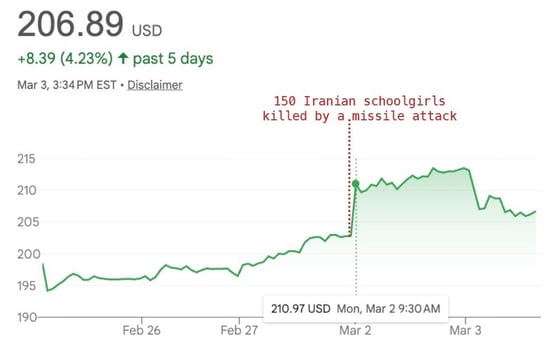
If you’re in the for-profit arms industry, that’s great news. As Representative Thomas Massie puts it, “there’s about 50 billion dollars a year of things that need to be blown up and replaced in order for that sector of the economy to stay healthy,” and a regional war in the Middle East will do the job nicely. On the stock charts for companies like Raytheon and Northrop Grumman, you can see the exact point where the U.S. and Israel struck Iran on February 28, and the little green line ticked sharply upward. The executives at those companies stand to literally make a killing. By herself, Northrop Grumman CEO Kathy Warden made over $24 million in 2024, while Raytheon CEO Christopher Calio made $18 million. And in the Pentagon itself, reports have come out that Pete Hegseth and his cronies have been going on a massive $93.4 billion spending spree with our tax money, spending “$6.9 million on lobster tails during a single month in late 2025,” “$15.1 million on ribeye steaks,” “$2 million on Alaskan king crab,” and purchasing a “$98,329 Steinway & Sons grand piano for an Air Force residence.” The top brass are feasting like medieval kings, at a time when ordinary Americans are struggling to pay the rent.
And then there’s the terrible opportunity cost of this war. You probably remember that term from high school economics, and everybody intuitively understands it. When you spend money and resources on something, it also costs you the “opportunity” to spend it on something else instead. Crucially, all of these military spending numbers represent money that is not being spent to benefit our own communities, here at home. In 1953, President Eisenhower famously said that “Every gun that is made, every warship launched, every rocket fired” was “a theft from those who hunger and are not fed, those who are cold and are not clothed.” He was exactly right, and now the thieves are running rampant.
Can you imagine what $11.3 billion would do for the poorest people in your city, or your state? According to the National Alliance to End Homelessness, it would take only $9.6 billion to provide housing to everyone currently staying in a U.S. homeless shelter, for a full year. We could virtually eliminate homelessness for the cost of bombing Iran for a week, and still have $1.7 billion left over. Or we could provide every American with free tuition to a community college for a year, which the Biden administration estimated at a cost of $10.9 billion. But our leaders, Trump foremost among them, are making a conscious decision to give our tax dollars to Raytheon instead. They are forcing people in the U.S. to keep sleeping on the streets, in order to keep killing people in Iran. In this way, we can most accurately think of war as a massive upward wealth transfer, lubricated by blood.
We pay for the arms companies’ windfalls, too, with our safety. It’s incredible that anyone thinks war with Iran makes us more safe, because as it turns out, Iran is more than capable of fighting back. In the past week, Iranian missiles and drones have struck data centers, airports, and a hotel in Dubai, oil storage tanks in Oman, and Amazon Web Services buildings in the UAE and Bahrain, among others—essentially, any country from which the United States or Israel launched attacks at Iran. The Wall Street Journal also reports that Iranian hackers conducted a “major cyberattack” against an American medical company called Stryker on March 11. This was entirely preventable, because we did not have to attack Iran; it was a war of choice. And Iran’s retaliation should not be a surprise. American culture is full of stories about heroic men with guns taking revenge for the loss of their loved ones, whether it’s Keanu Reeves in John Wick or Jason Statham in Wrath of Man, so it should be a familiar concept: when you kill other people’s families, you get blowback for it. The only question is what form that blowback will take, and whether we can end the hostilities in time to prevent more of it.

The risk of nuclear annihilation, in particular, has gotten worse since the outbreak of this war, not better. A lot of Americans don’t realize this, because our media consistently portrays opponents of the U.S. as irrational monsters, but the Ayatollah Ali Khamenei had issued a fatwa against the development of nuclear weapons in the mid-1990s. Now, Le Monde reports that we are still “in the dark” about whether his son, Mojtaba Khameini, will choose to remove it. By treacherously attacking in the middle of nuclear negotiations, we’ve just provided Mojtaba with a brutal object lesson that the U.S. cannot be trusted, making future deals much harder to reach—and reports suggest the airstrikes also killed his wife and sister, giving him a powerful reason to want revenge. For other nations, the Trump administration has just demolished a core pillar of international law, setting a precedent that you can just assassinate heads of state if you believe it serves your goals. All around the world, political leaders will take note that it was Khameini—who lacked nuclear weapons—who got killed, like Muammar Gadaffi before him, while Kim Jong Un is sitting safe and secure in Pyongyang with his own missiles. They will, quite reasonably, conclude that they need nukes of their own to deter the U.S. from attacking, leading to a new era of nuclear proliferation. And every new bomb that’s built in a new country will take the whole planet closer to apocalypse.
The environmental toll, too, will be cruel. In Tehran, it rained oil and petrochemical waste after the refineries were bombed on March 8, and health experts are warning of “long-term respiratory and neurological risks” for the people living nearby, in an echo of Vietnam and Agent Orange. On March 11, Reuters reported that “Iranian explosive-laden boats appear to have attacked two fuel tankers in Iraqi waters, setting them ablaze,” while “drones struck oil storage facilities at Salalah port” in Oman with the same effect. When an oil tanker burns in the Persian Gulf, the fumes and the chemical waste spread to everyone in the area, soldier and civilian alike. The missiles and the warships and the jets themselves create vast amounts of pollution, spewing toxic exhaust, spilling fuel and hydraulic fluid, everywhere they go. In fact, the U.S. military is the world’s single largest source of pollution—or, as filmmaker Abby Martin calls it in her new documentary, Earth’s Greatest Enemy. Stoking the fires of war in Iran will only make matters worse, and because we all live on the same planet with the same air, the poison will spread.
In the nearer term, though, the really frightening thing is that Donald Trump has floated escalating his attack further, even to the point of putting American troops in Iran. He says he doesn’t “have the yips with respect to boots on the ground,” a disturbingly cavalier way to talk about invading a country, and the Wall Street Journal has just reported that a unit of “5,000 Marines and sailors” is heading to the Middle East aboard the USS Tripoli. Likewise, White House press secretary Karoline Leavitt recently refused to rule out a military draft, saying Trump was keeping “his options on the table.” But if there is a draft, don’t hold your breath expecting to see Barron or Kai Trump on the front lines. Historically, that’s not how war works. The children of the rich always find a way to keep themselves safe, whether it’s George W. Bush spending the Vietnam War years in the Texas Air National Guard or Donald Trump himself with his famous “bone spurs.” It’s the poor and working-class people who get to do all the dying—and last year, Congress took the first steps toward updating the Selective Service system so registration for the draft is no longer voluntary, but automatic and compulsory. So if there’s anyone you care about who’s between the ages of 18 and 25, and especially a young man, you really have a vested interest in not invading Iran.

Our basic civil liberties, too, are at risk. From the past, we know that any time war breaks out overseas, it enables the government to ramp up domestic repression. It happened in the 1910s, when the U.S. government imprisoned and deported people simply for saying they opposed World War I. It happened in the 1940s, when over 120,000 Japanese Americans were forced into internment camps. It happened in the 2000s, when the Bush administration simultaneously invaded the Middle East and waged a security crackdown against Americans, complete with warrantless wiretaps, watch lists, undercover agents in mosques, and the whole apparatus of mass surveillance. More than 25 years later, we still haven’t got back the rights we lost to the PATRIOT Act. More recently, we got a new round of repression after the October 7 attacks, when police forces across the U.S. violently broke up protests against Israel’s genocidal retaliation, and activists like Rumeysa Öztürk and Mahmoud Khalil were summarily abducted and jailed by ICE for nothing but their speech. We already know Trump has issued sweeping national security orders instructing federal agents to go after people for vague political charges like “anti-Americanism.” The First Amendment is hanging by a thread, and now that we’re at war with Iran, there is very little stopping the government from cracking down on you, too.
And it doesn’t help that all of this is taking place in the middle of a brutal cost-of-living crisis, when Americans were already having a hard time paying for basic necessities like fuel, food, and housing. Compared to the deaths of hundreds of Iranians, of course, it can seem crass to even mention financial concerns. And for the wealthy, it doesn’t matter very much that picking a fight with Iran has caused the “largest supply disruption in the history of oil markets,” or that “Gas prices have jumped by nearly 17 percent since Feb. 28, when the United States and Israel first attacked Iran.” For them, the difference between a $20 tank of gas and a $40 one is negligible. But for millions of Americans, it isn’t, and higher prices are going to cause genuine pain. And it won’t stop with oil and gas, because everything else we buy, from groceries to household staples like toilet paper, is shipped to stores on trucks that burn gasoline and diesel fuel. So there’s a direct link between Trump’s decision to bomb Iran, and people having to make hard choices between eating properly and driving to work each week. This is what our leaders call the “defense” of our “national interests,” but only their own interests are being served.
This war is already an unspeakable crime on a human level. We shouldn’t need vested interests of our own to oppose it, because it’s indefensible on its face. Invading other people’s countries and killing their children is wrong; that really shouldn’t have to be said. But those vested interests exist, too. Every day this war drags on, it will make Americans poorer, while enriching the military contractors who live, ticklike, on our paychecks. It will make us less safe, and it will make us less free. But the good news is, most Americans already oppose this war, and there are things we can do to bring it to an end. We can pressure our legislators with phone calls, emails, and surprise appearances at their offices, and demand that they stop the bombing. We can throw our support behind anti-war candidates for office, and punish the current political class at the ballot box. We can organize mass protests, which are already springing up across the United States. The military-industrial establishment relies on ordinary people not realizing the stakes of what’s going on, and not believing they have the ability to do anything about it. It’s high time we corrected them on both counts.
Top photo: Bystanders help an elderly Iranian man after an airstrike on Enghelab Square, Tehran. Photo by Mostafa Tehrani, Tasnim News Agency, licensed under Creative Commons 4.0 International.