In a region built on struggle and survival, local artists continue their fight to "tear the fascists down."
Justice is the one thing you should always find/ You gotta saddle up your boys/ You gotta draw a hard line/ When the gun smoke settles we'll sing a victory tune.
These lyrics were sung by a well-known Oklahoma singer at a political rally in 2017. The artist was Toby Keith. His performance took place before the first inauguration of Donald Trump.
Eight years later, another Oklahoman would take the stage at a Trump inauguration event: Muskogee’s own Carrie Underwood. She sang “America the Beautiful” at the Capitol Rotunda in January 2025.
Although today, many Oklahoma musicians—and the state at large—are associated with the Christian anti-immigrant conservatism that pervades American politics, such was not always the case. During the Dust Bowl and the ensuing migrant crisis, Oklahomans became representative of the abject misery of the American working class.
Displaced, hungry, and desperate for work, their stories, art and music became a cry for economic justice and government intervention. In 2026, Oklahomans are in an eerily similar position: stuck in perpetual recessions, constantly on the brink of a world war and hounded by corporations swearing that their proposed data centers pose no actual environmental threat.
While some of the best known Oklahoman musicians have aligned themselves with the dominant political establishment, local artists in Tulsa have made themselves into a vocal opposition. In the depths of Trump country, the Tulsa music scene is an oasis for those who wish to resist.
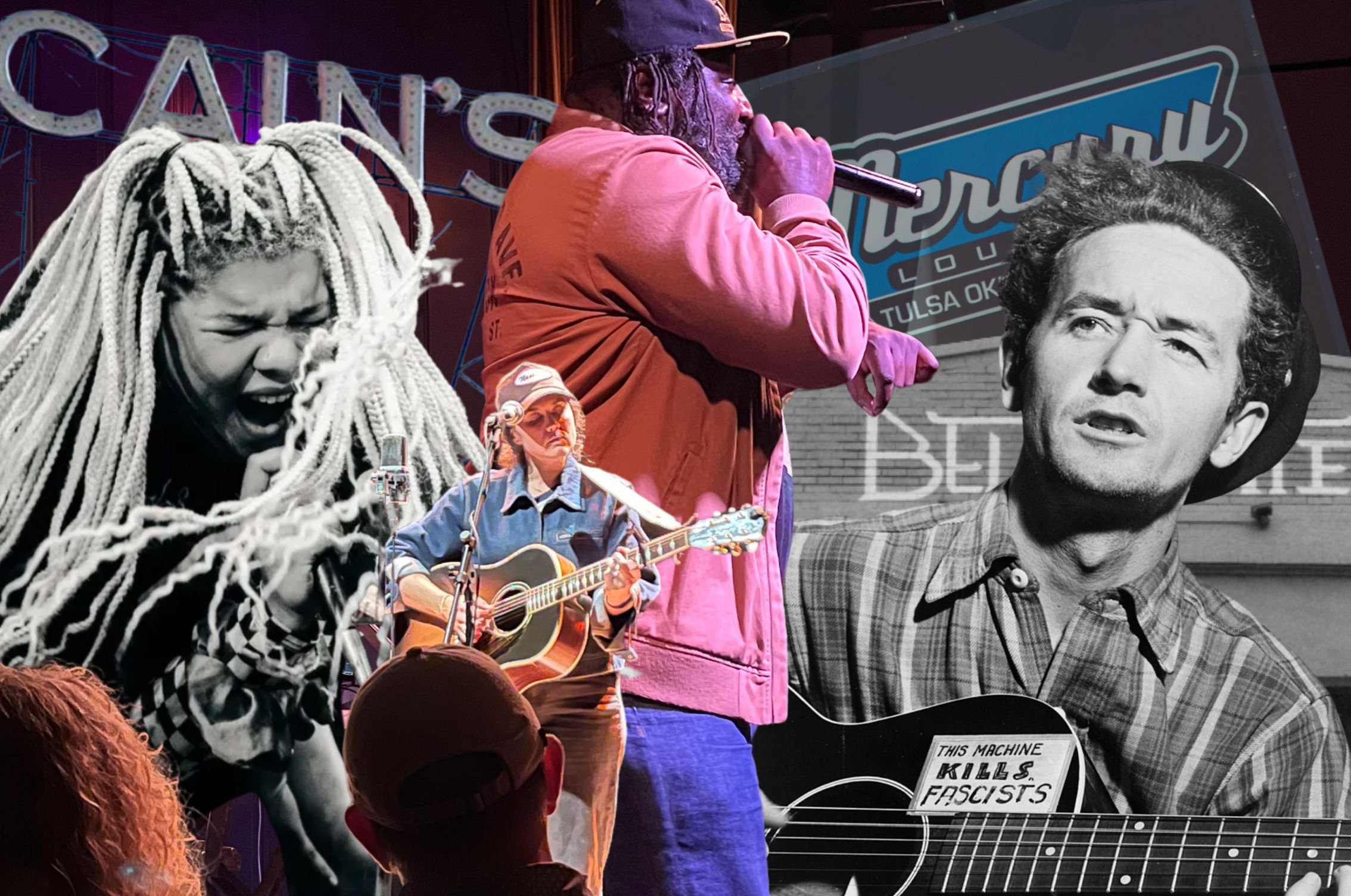
More than 80 years ago, the most famous singer from Oklahoma also sang about America’s beauty and gun-wielding boys in search of justice. Woody Guthrie was known for his folk ballads about the Dust Bowl, the plight of the working class and the brave Soviets fighting the Nazis on the eastern front. He often played a guitar that had the words “this machine kills fascists” engraved on the front.
Guthrie’s relationship to the Trump family was very different from that of Keith and Underwood. Fred Trump, President Trump’s father, owned and operated the Brooklyn apartment complex where Guthrie lived in the 1950s. In a recently unearthed song titled “Old Man Trump,” Guthrie described his feelings towards his landlord:
I suppose that Old Man Trump knows just how much racial hate
He stirred up in that bloodpot of human hearts
When he drawed that color line
The song, written in 1954, was a response to the racist housing policies rampant in Trump owned apartment buildings. In 1972, the Department of Justice sued Trump Management, Inc., then headed by a 27-year-old Donald Trump, for violating the Fair Housing Act by refusing to rent to Black families. Like father, like son.
If you looked at the polls, you’d think Woody Guthrie’s Oklahoma was long gone. The state hasn’t voted for a Democratic president since Lyndon B. Johnson, and in the last three presidential elections, every single county in Oklahoma voted for Trump. Even in Tulsa County, the home of the Woody Guthrie Center, Trump won the 2024 election by a healthy 15 percentage points.
Yet in Tulsa’s music venues, in the words, music, and attitudes of musicians, the spirit of Woody Guthrie has managed to survive.
On an early Sunday afternoon, I found myself amidst taxidermied quarry, neon beer signs, and men wearing trucker hats at Tulsa’s Mercury Lounge watching Johnny Mullenax and his band perform at the weekly Bluegrass Brunch.
“This place is like church to a lot of people,” said Jason Bauer, one third of the band Petty Fox. The Mercury Lounge is nothing like what one might expect from a church in America’s Bible Belt. It’s not just the booze, the scent of smoke and the wailing guitars. Among the usual dive bar decor hang gay pride flags and signs warning guests that discrimination is not tolerated in this bar.
“We are in one of the more progressive, fun bars,” Tulsa rapper, activist and fellow Petty Fox member Damion Shade told me as we sat outside the lounge, blues rock music blaring in the background. “I guarantee you there are no fewer than 30 guns in that room right now.”
Progressive almost feels too passive an adjective to describe the politics of the community of artists that thrives in Tulsa.
“There's something about the ruby red nature of Oklahoma that makes the art here much more progressive in a unique way than what you'll find in New York or San Francisco,” theorized Shade. “If it really is pushing back against the dominant culture, it's pushing against something way different.”
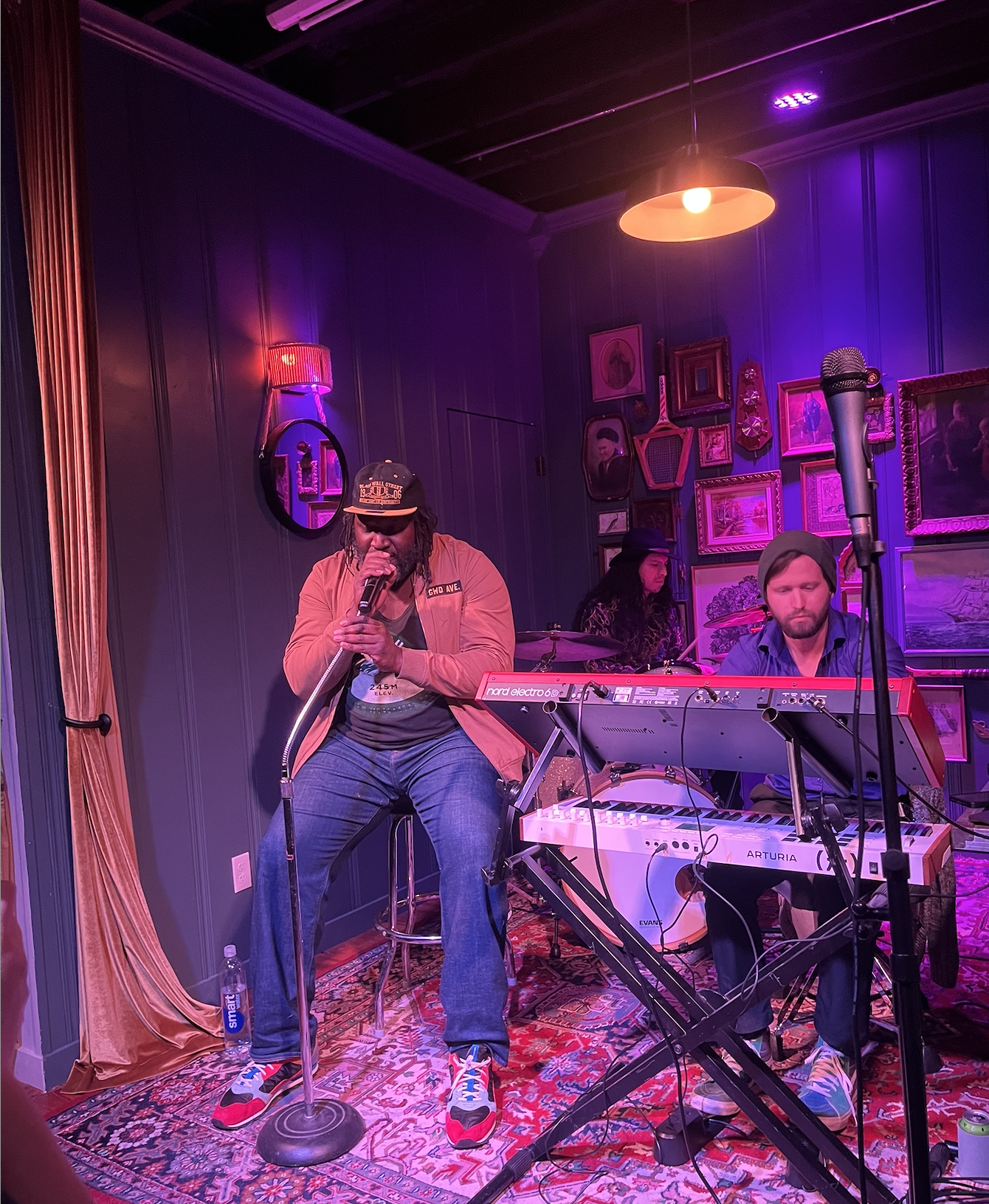 Damion Shade, left, performs alongside fellow Petty Fox members, drummer Kris Davis and keyboardist Jason Bauer, at the Belafonte venue in Tulsa, Oklahoma. (Photo by Emma Lucía Llano)
In Tulsa, as opposed to coastal liberal enclaves, your opposition isn’t hypothetical: it’s not just a politician on TV or a social media commenter. Your adversaries are all around you and in order to resist, one has to be both creative and confrontational.
That is not new to Oklahoma. The state’s history is marked by a certain push: pushing into, pushing out, pushing back. The Trail of Tears ended in Oklahoma, when more than 60,000 indigenous Americans were forced out of their homelands and pushed into the foothills of the Ozark Mountains. Tulsa sits at the intersection of three reservations that were created as a result of this ethnic cleansing: the Muscogee (Creek) Nation to the south, the Cherokee Nation to the northeast and the Osage Nation to the northwest.
Many of the city’s performance venues and musical institutions are located in the Greenwood District, which was a uniquely affluent majority-Black neighborhood until the summer of 1921, when a mob of white supremacist terrorists destroyed it. The second largest Black community in Oklahoma, which had been built over decades, was burned to the ground in 18 horrific hours. As many as three hundred people were murdered, hundreds more were injured and thousands were displaced.
Oklahoma has become synonymous with the Dust Bowl, thanks in part to John Steinbeck’s The Grapes of Wrath and the music of Woody Guthrie. Nearly half a million Oklahomans were pushed out by an ecological disaster caused by capitalism's excesses. Though the majority of Dust Bowl refugees were not from Oklahoma, “Okie” became a derogatory word to describe migrant workers.
While Oklahoma is now considered a quintessential part of the American heartland, during the Great Depression, so-called Okies were considered invaders and parasites—reflecting the same language conservatives use to describe immigrants today. As Steinbeck put it in The Grapes of Wrath, “Okie use’d ta mean you was from Oklahoma. Now it means you’re a dirty son-of-a-bitch. Okie means you’re scum.” The Los Angeles Police Department even created a “Bum Blockade,” an informal border patrol effort meant to stop “suspicious” individuals from entering the state, despite the fact that the LAPD had no jurisdiction over the California desert borderlands.
“ The contrast is why I love Tulsa. It's a big boom in a place that never should have happened,” said Briana Wright, lead singer of Tulsa-based pop punk band CLIFFDIVER, “That spirit couldn't get crushed by the jacked up nature of the surrounding community, but we're still very much Okies.”
What makes an Okie? According to Wright, stubbornness. “We are cowboys. We're just cowboys about different shit.”
That could be it. A historical stubbornness of people who refused to be pushed out regardless of dust storms, political violence, and the powers that be. A group of voices that though they may be in the minority, refuses to be silenced.
“ We're very vocal about certain things especially on stage and a lot of it has come from a responsibility we feel for representing Tulsa to the rest of the world,” said Wright, “ It's important to us to represent the Tulsa that we are a part of.”
The Tulsa that Wright is a part of is one that welcomed her with open arms when she made the decision to join CLIFFDIVER and fulfill her lifelong dream of singing in a pop punk band.
Wright grew up going to alternative rock shows with her older sister. Though she loved the music, as a Black woman, she never saw herself being able to make it. She got her start as a musician while staying within the “Tulsa sound”—a genre that is a mix of folk, country, and blues.
It wasn’t until two life altering events—the COVID-19 pandemic and having a daughter—made her challenge a longheld belief. As she wondered when she would get to perform live again, she wondered why she kept herself from making the music she loved. She knew that if her daughter ever told her that she was doubtful about pursuing her passions due to her race and gender, Wright would encourage her to unapologetically chase her dreams.
When CLIFFDIVER released their first single with Wright as their singer, Briana was terrified of the response. The fears turned out to be unfounded.
“ I had so many people reach out and be like, ‘What took you so long?’” said Wright.
“Okie” came back into the American lexicon thanks to Merle Haggard’s song “Okie from Muskogee,” which peaked at 41 on the US Billboard Hot 100 in 1969. According to Haggard, an Okie is someone who doesn’t do drugs, burn draft cards, or disrespect the college dean—a far cry from the “scum” Steinbeck had described only 30 years before.
Haggard’s version of an Okie is closer to the one local musician Whitney Fenimore grew up in. She now lives in Nashville and makes music full time, but got her start in Tulsa in church.
“ Growing up in the church, I was always in involved in music and putting together different bands and worship teams,” she told me outside the Woody Guthrie Center, where she had just finished a solo acoustic set. “ I'm thankful for that. I'm not stoked on some of the religious trauma that came from it, but I try to pull out the good.”
In recent years, Fenimore has started to open up more about her experiences growing up in a conservative religious environment. In 2022, she released a song called “Holding Hands” about coming out as queer to her religious family.
I’ve been bending the truth
And calling it honest
I’m too good at playing the part
Selling these lies
But I hate that they bought ‘em
Can we just be who we are
Instead of holding hands in the dark
“ I felt for the longest time I was holding back out of fear, for whatever reason,” she said.
The Woody Guthrie Center is the perfect place for an artist who was stifled by her upbringing in Oklahoma to finally sing her truth. Common Chords is a new series at the Woody Guthrie Center meant to “explores the traditions of folk, protest and storytelling.” More than 300 artists from the U.S. and across the world applied. Fenimore was one of five artists selected.
When she took the stage, the overhead lights fell on her trucker hat, causing a shadow that obscured her eyes. Still, one could feel the calm power and vulnerability in her voice, backed only by an acoustic guitar.
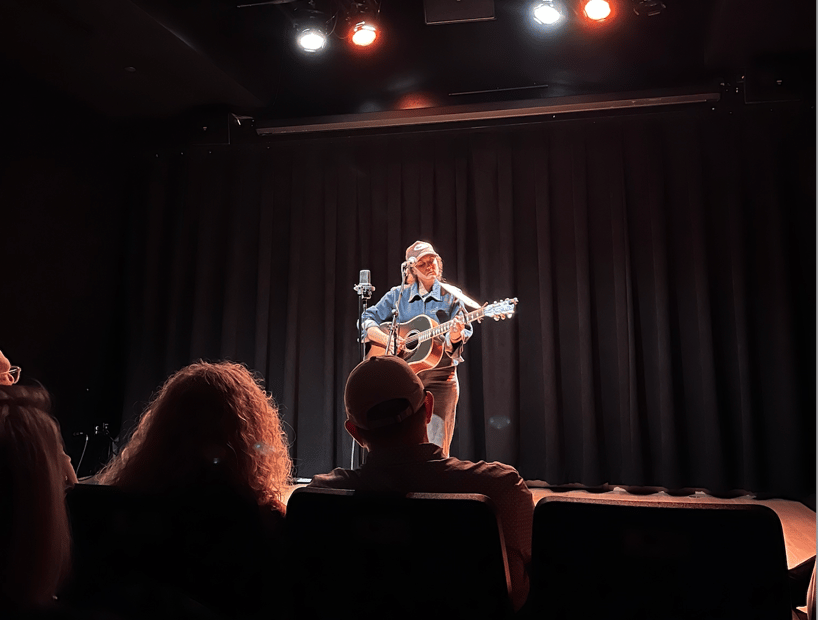 Whitney Fenimore performs onstage at the Woody Guthrie Center in Tulsa, Oklahoma. (Photo by Emma Lucía Llano)
In her most recent album, State of Being, Fenimore goes further than just singing about her experiences growing up in a conservative environment: she directly challenges those beliefs. In songs like “Come Around” and “Wrong About Jesus,” she gently, but directly, questions the ideologies of the people she grew up around.
Fenimore isn’t the only one. According to Josh Crutchmer, a journalist who has written extensively about the Oklahoma music scene, though the scene was made in the spirit of Woody Guthrie, it hasn’t always been so explicitly political.
“It never had anything to do with politics until the political environment in the country became so charged that it was impossible to avoid being labeled as one side or the other,” says Crutchmer.
Tulsa musicians and their naturally independent streak planted their flag on the side of the opposition.
One artist who embodies musical independence in Oklahoma is Mike Hosty, who brings his one-man show to The Hunt Club once a month. The Hunt Club is much more like the stereotypical image one might conjure of a midwest music venue: cowboy hats, denim, and long blonde hair surround wooden picnic tables with ashtrays and cigarette butts aplenty. Hosty, however, is not your typical dive bar entertainer.
Though he has collaborated with dozens of musicians throughout his career, he prefers to perform solo. At the Hunt Club, and venues across Oklahoma, Hosty sings covers and original songs, while playing guitar with his hands and drums with his feet.
To him, the nature of Tulsa’s music scene comes not from political ideology, but from the reality of living in a so-called flyover state.
“You gotta work with what you've got and if you're in a big city like New York you have access to everything,” the musician says. “In Oklahoma, we are fortunate enough to have just a little bit of this and a little bit of that.”
Historically, Tulsa and the state of Oklahoma have not been common tour stops for bigger name artists. While this has changed slightly since the openings of the Paycom Center in Oklahoma City and BOK center Tulsa in 2002 and 2008, respectively, if Oklahomans wanted to regularly have live music, they would have to make it themselves.
Though the Tulsa music scene has its roots in country and folk, in the present day it spans across many different genres and it's commonplace for local musicians to create projects that vary wildly in style. According to Hosty, this can also be attributed to the size of the music scene.
“There's not many people to choose from. You can have a cross pollination of artistry and it makes it more diverse.”
Damion Shade agrees. “For dope culture in Tulsa, you gotta do it yourself. This creates a really unique situation where it's like, if you want to be dope here, you have to be dope in a different way. Creativity is measured differently here.”
The higher standard for creativity doesn’t create a cutthroat environment—at least it didn’t for musician Brianna Wright. She says about her switch from Americana to alternative rock, “I wasn't put through a gauntlet, I'm not gonna get that in L.A. I'm not gonna get that in New York. And I recognize that.”
The support of the community isn’t simply emotional, it’s material as well. Funders like the Kaiser Foundation and the Red Dirt Relief fund help Oklahoma and Tulsa musicians continue to create in the face of financial hardships. In one of the poorest states in the country, as the current government cuts funding to public services like SNAP and Medicaid, there is a surprising amount of money available for arts and music.
In July of 2025, Petty Fox had an unexpected attendee at their show in Tulsa: musician Zach Bryan. Unlike his fellow Oklahomans Toby Keith and Carrie Underwood, he had stayed away from D.C. during Trump’s presidency, but politics had been on his mind.
“ [Bryan] was like, ‘Man, with all this. Politics and like shit in the world. I just don't know what to do,” recounted Shade, “ I'm like, ‘You're a fucking songwriter. Tell the truth, the thing that you would say if you were laying in a ditch, bleeding out, there's only a few minutes left and it's God and you in the ditch.’”
That October, Zach Bryan posted a preview of a song called “Bad News” that featured lyrics critical of Immigration and Customs Enforcement. The song immediately received admonishment from Kristi Noem and other individuals within DHS and the White House.
There are far more popular artists who have made statements condemning the actions of the Trump administration, but few received the direct ire of Trump’s associates the way Bryan did. Country is their genre and receiving even mild criticisms from one of mainstream country’s most recognizable stars could signal that the MAGA movement was beginning to lose its base.
During a Petty Fox show at the venue Belafonte, Shade rapped and sang his truths: about love, religion and politics over Jason Bauer’s electrifying keys and Kris Davis’s sharp drumming. Shade wore a jacket commemorating Black Wall Street, reminding the audience of the unseen ruins they gathered upon.
Making music in a leftist enclave of an overwhelmingly conservative state sharpens ideology and strengthens community. When your political adversaries are not only your neighbors, but a vocal majority, resistance is an everyday practice that takes great courage. The determination to continue existing in inhospitable climates seems to be a part of the Oklahoman spirit: re-establishing cultures in an unfamiliar land, rebuilding communities from literal ashes, enduring through exoduses and now vocally resisting in the heart of MAGA country.
Though Damion Shade does not credit himself for inspiring Zach Bryan to release “Bad News,” the country singer still included the song on his most recent album, despite the backlash.
In the song, Bryan references Woody Guthrie’s most popular song: “This land’s your land/this land’s mine, too.” A hint, perhaps, that the stubborn, independent and assertive attitude of the Tulsa music scene has begun to seep through its boundaries.