Rough, warm, and human: in the age of AI slop and billionaire rule, we need a 21st century Woody Guthrie. Fortunately, we’ve got one.
If I may coin a term, the Great Slopwave has started to wash over us. AI-generated images, music, and videos are sloshing their way across the internet. They are soulless, creepy, and devoid of any cultural value. While I’m not entirely anti-AI—I think the term describes many different types of programs, some of which automate away truly painful tasks—I share design consultant Matt Corrall’s view that a lot of this technology threatens to kill art itself.
The effortless, instantaneous nature of AI generation prevents it from having real meaning[…] Art has always been intrinsically human. It comes as much from our flaws and mistakes as it does our successes. Through the process of making it, we express what’s inside us - our joy and frustration, longing and sadness - in a way which is instinctive and deep-rooted[…] More often than not, we discover what the artwork is to be through the process of creation, rather than having a firm vision at the outset and simply assembling it, as a machine does[…] By thinking on your behalf, and by reducing creative decisions to an algorithmic, wholly quantitative process, they severely constrain the possible outcomes, and no true artistic surprises or discoveries are possible.
The word “dystopian” comes more and more to mind these days. Whether it’s Nike putting out Lorraine Motel-themed MLK Jr. sneakers, well-connected fraudsters getting pardon after pardon, scam calls and posts and emails flooding our communications networks, the president threatening to go to war because he didn’t get a peace prize, a billionaire man-child gleefully taking poor kids’ medicines away, sports betting getting people addicted to letting corporations suck their wealth away through their phone, masked state thugs tear-gassing babies, data centers sucking towns’ power so they can generate brainless nonsense that destroys the line between reality and fakery, and prediction markets betting on where the next disaster will strike, there just seems something fundamentally broken about our time. Donald Trump is the ultimate embodiment of all of it—the greed, the dishonesty, the AI fakery, the militarism, the climate denial, the corruption. But we would still live in a culture of crypto scams, ChatGPT universities, and MrBeast videos even if Trump dropped dead tomorrow, so we have to have a broader reckoning than just ridding ourselves of a single deranged billionaire autocrat.
Plenty of people feel there is something deeply wrong going on, but struggle to articulate what an alternative would be. Politically, I think the alternative is democratic socialism, and this magazine has published a great deal about the hope offered by the politics of Bernie Sanders and Zohran Mamdani. Mamdani appears to be doing his best to show what a government for the people looks like in practice, every day introducing new initiatives—from expanded public bathroom access to universal childcare to cracking down on predatory landlords—that aim to restore people’s faith in government. He also presents a cheerful, upbeat, fun public persona that offers much-needed reassurance and optimism in dark times. We’ll see how his mayoralty goes—the obstacles he faces are formidable—but I think in politics we do finally have a basic vision for what a powerful, popular alternative to Trumpism looks like.
But I think we need more. We don’t just need a vision for the political agenda we want, but for the kind of culture we want. We need to see what real art, real music, and real literature look like, so that we know what will be lost if book-hating tech oligarchs become the tastemakers.
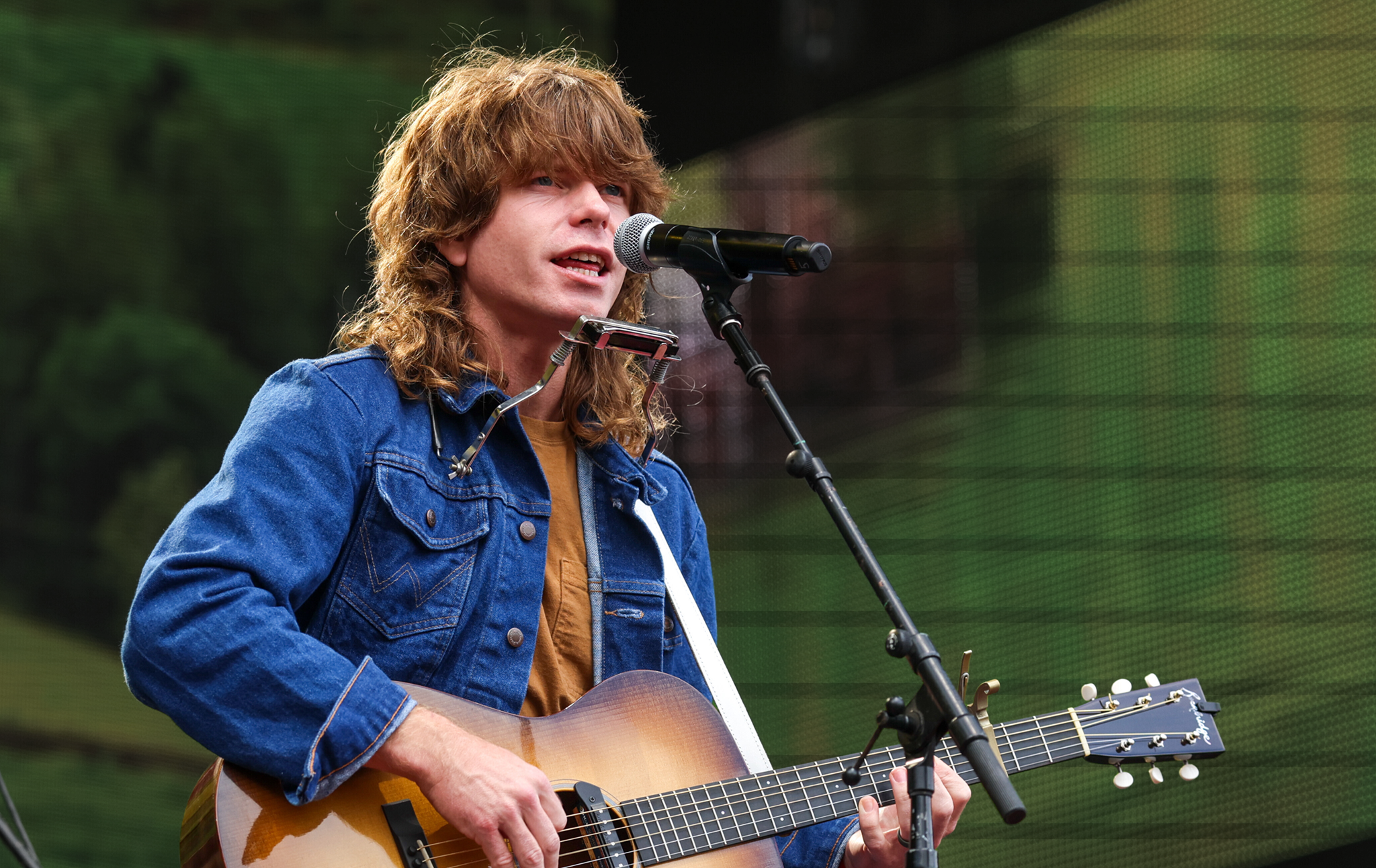
That’s why I’m so grateful Jesse Welles exists. Welles is a one-man antidote to everything that sucks in the culture right now, and every song he sings is a kind of manifesto for the rough, human, and natural against the slick, artificial, and brutal. Welles’ videos are shot in fields and forests. The production value is minimal; it’s just him, a guitar, and sometimes a harmonica. Sometimes you can hear cicadas and birds in the background.
Welles is steeped in the American dissident folk tradition, the heir of Pete Seeger and Woody Guthrie—although his voice sounds like John Prine, and in his ripped-from-the-headlines topicality and bitter satire, he is perhaps best compared with Phil Ochs. (Check out the latest print edition of Current Affairs for an essay on Ochs and his legacy.) Welles is clearly not only disgusted by war—many of his songs are about the cruelty and folly of state violence—but has read his pacifist classics, from Bertholt Brecht’s War Primer to Mark Twain’s War Prayer. He sounds like an anachronism, like he stepped out of O Brother Where Art Thou, and if it weren’t for the references to cryptocurrency and Palantir in his songs, you’d think he was frozen in time 80 or so years ago—who uses a phrase like “atomic power” these days? I’m not sure he has articulated a political ideology, but he attacks all the right targets: sports betting, health insurance companies, the IDF, plutocrats, ICE (“They got a sign-on bonus of 50 grand / They’re in need of you needing to feel like a man.”) As with Ochs, his songs can be angry. After the killing of UnitedHealth CEO Brian Thompson, Welles bitterly documented the workings of this parasitic corporation in song:
The procedure that you need ain't the cost effective route
And only two-percent of peoplе end up winning a dispute
So, if you get sick, pray to God for hеlp
'Cause all your doctor's prayers go up through UnitedHealth
But Welles doesn’t just hate all the right things. Because his music is raw, simple, and weird, he is an antidote to the creepy smoothness of AI-generated text and music. It’s often endearingly childlike—“I like bugs and I'll tell you why / They’re alive and so am I”—and who else sings a song naming the four compartments of a cow’s stomach? (“Got the rumen, reticulum, omasum, abomasum.”) Welles respects his elders, and the tradition he comes from; he has performed with Joan Baez and John Fogerty. Sometimes he sounds like he’s outright ripping off Dylan or Guthrie, but that’s okay—everyone steals from their ancestors.
In fact, Welles seems like a leftist rebuke to a guy named Oliver Anthony, a ginger-bearded troubadour who went viral a couple of years ago with a histrionic song about the “rich men north of Richmond,” the DC swamp creatures ruining the lives of “people like me, and people like you.” Anthony’s song, too, was recorded with a single guitar in leafy surroundings, an aesthetic that directly inspired Welles. But Anthony’s song contained nasty swipes at “the obese milkin’ welfare” and expressed resentment at his taxes “[paying] for your bags of fudge rounds,” and he was quickly embraced by the MAGA movement, which is desperate to find some politically-aligned music that isn’t horrible. Unfortunately, it turned out he had nothing else to say, and other than a love song to a Chevy and a John Denver cover he’s barely been heard from since. There is, perhaps, a lesson here in the superficiality and emptiness of MAGA populism, which has almost nothing to say about the world beyond identifying D.C. Elites and welfare fraudsters as the Enemy.
Welles, on the other hand, is prolific. Perhaps excessively, even. He released six albums in 2025, which is just too many, and it must be said that not all of his output is gold. How could it be, at the rate he drops songs? But he’s certainly a fount of creativity, and unlike Anthony, he doesn’t kick the little guy. While capable of gently lampooning the shoppers at Walmart, he clearly understands that it’s corporate titans who deserve our scorn, and is scathing of those who blame ordinary individuals for problems that clearly stem from corporate greed. Compare Anthony’s scorn for “the obese milkin’ welfare” to the lyrics of Welles’ “Fat”:
Well it's your own damn fault you're so damn fat
Coca-Cola just walked in with the results
They did a self investigation like a Florida sheriff station
So you know they won't be found at fault
Sucrose monosaccharides
Diastatic malt
High-fructose corn syrup
It's your own fuckin' fault
Well it's your own damn fault you're so damn fat
Shame, shame, shame
All the food on the shelf was engineered for your health
So you're gonna have to take the blame
As I say, I have no idea if Welles calls himself a socialist, but his anti-imperialism, anti-authoritarianism, and scathing attitude toward capitalist institutions certainly make him much more like the legendary pinko Guthrie (with his “this machine kills fascists” guitar) than Anthony or the resolutely apolitical Dylan.
A writer named Grayson Haver Currin, in a recent essay savagely attacking Welles, says that Welles is simply criticizing, and is not performing the fundamental task a protest singer should take up, namely to provide an affirmative vision of an alternative. In other words, the protest singer is protesting too much:
I think we need art that imagines a way through and out, an art that does more than point fingers in songs that are barely written, an art that dares to dream about the escape. But pointing fingers is all that Jesse Welles—the reply-guy of folk songs, the protest singer not that we need but maybe that we deserve—ever does.
But I think this is asking too much of Welles. Isn’t it enough that he articulately, often uproariously, helps people better understand the absurdities and cruelties of their society? Isn’t that far more than most other musicians are doing? I also think that Currin is silly to look for a blueprint for a future society in Welles’ lyrics. Welles does provide a hopeful template, but it’s in the form of his music. To me, a quite clear vision comes across in his songs, which is of a place where people speak honestly and plainly, respect the natural world, question authority, and don’t blame victims. And while Welles is known for the acidic satirical songs, they’re actually only a minor part of what he does, and he has committed himself to “includ[ing] only one social-commentary song per record” precisely because he doesn’t just want to sing howls of protest all the time.
I’m not even much of a listener of Welles’ music. It’s a little too rough for me. I like stuff I can dance to, and I like to escape the world’s troubles when I put on a record. But every time I see him standing in a sunflower patch, singing earnestly about peace or birds, or skewering Lockheed Martin or the opioid industry, I think to myself, this is the music we need. This is the music that will keep humanity going, that will fight back against all that’s dishonest and horrifying and dumb in the world. Welles fights for the beautiful and the pure, he gets us offline and into nature, he respects animals and hates war. Perhaps he’s the vanguard of a new movement for simplicity, tradition, and good wholesome American folk music, with its love of life and commie politics. So I hope Jesse Welles does continue putting out too many YouTube videos and too many albums, because we couldn’t need him more right now.