For a generation disillusioned by endless war overseas and financial hardship at home, China is starting to look like a promising alternative.
Call it what you want. Post-America. The American Century of Humiliation. The decline of the Burger Reich. However you slice it, the United States’ de facto role as the global hegemon is waning. The wheel of disillusionment turns, and reasons for Americans to grow tired become redundant: dire economic conditions for working people; the cringe-ification of the government apparatus through DOGE; civilians shot in the street by ICE agents; militarized police; towns driven to madness by the hum of AI data centers; the U.S.-Israeli strikes on Iran; President Donald Trump’s links to convicted sex offender Jeffrey Epstein; the disappearance of immigrants at home; and a direct hand in the Gaza genocide abroad, to name just a few. Who, then, could blame American youth for looking at how other countries govern?
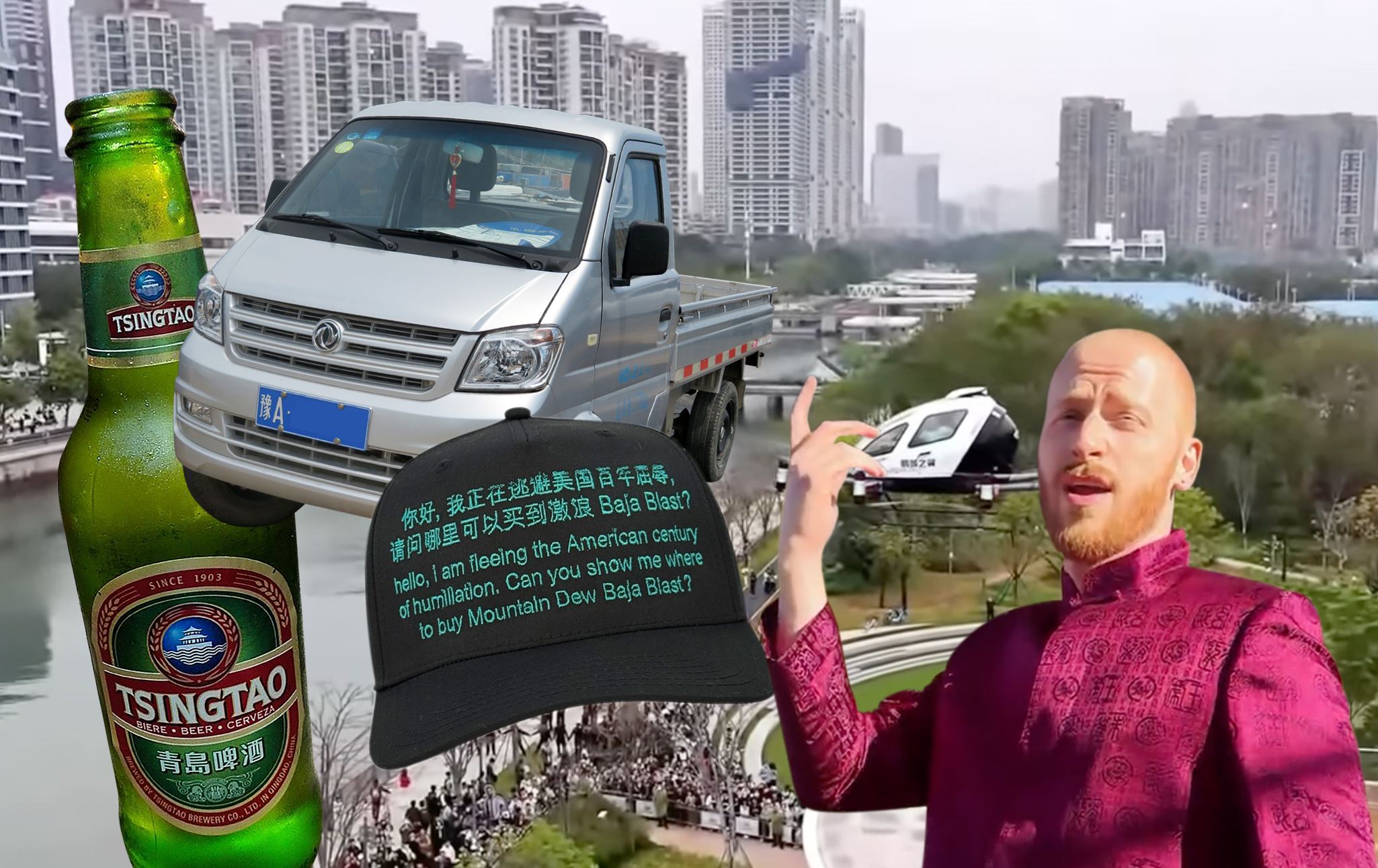
And look elsewhere they have. “Chinamaxxing” is a recent online phenomenon where young Westerners have filled TikTok and Instagram with videos of themselves indulging in commonplace Chinese habits like drinking Tsingtao beer, squatting, and doing qigong, all while coining flippant phrases like “You met me at a very Chinese time in my life” and “You will wake up Chinese tomorrow.” These videos have confounded older generations, whose feelings on China are overwhelmingly negative and aligned with the billions of dollars poured into anti-China propaganda. According to one study from last year, 70 percent of Americans aged 65 and above feel that China poses “a great deal of threat to national security,” compared to just 46 percent of adults under 30. Younger Americans are by far the most sympathetic toward China, and ironic memes aside, their sympathies only seem to be growing stronger.
Pro-China sentiment has spread through American youth culture, blending satire, shitposts, and general disillusionment with the West. This should not be dismissed as simple memery. At a glance, “Chinamaxxing” and related trends may seem purely ironic—arguably even offensive and reductive—but look closer and you’ll see young people, repulsed at the sight of America, turning away and looking East.
“I just see that the policies that China imposes really help people,” Hollow, a 25-year-old artist, tells me. “And in the U.S., like all of our policy is just to help businesses.” To the Gen-Z Californian, most Americans have an extremely propagandized view of China—one that rehashes racist stereotypes of backwater villages, dog-eating, and a brainwashed populace.
Of course, China is not beyond reproach, and outdated falsehoods should not mask genuine criticism. It would be a mistake to give naive, unconditional support when Amnesty International says that in 2024 “the [Chinese] government continued to enforce repressive laws and policies that restricted the right to freedom of expression and other human rights.” Not to mention the ongoing restrictions on religious and cultural freedoms, particularly that of the Uyghurs in Xinjiang, and the often brutal conditions for workers in Chinese factories.
On the other hand, to view China only through a U.S. lens—disruptive, dangerous, a threat to American existence—casts aside its important qualities and accomplishments. For Hollow, one of the biggest shocks was learning how the country has managed to achieve things thought impossible in the United States.
“Literally just material conditions, like 90 percent home ownership rate, with a massive population of almost 1.5 billion,” he says. “And I’m not saying it’s perfect[…] but they genuinely fucking execute billionaires that act against public interest. And so much of the industry is state-owned, state land ownership, so that you can’t have people just buying up every fucking house like we have in the U.S.”
The TikTok shutdown that happened early last year, which most people aged 13 to 39 opposed, was a watershed moment for shifting perceptions. TikTok—an app owned by Chinese company ByteDance—is currently used by six in ten Americans under 30. And when the U.S. threatened to ban it nationwide, millions of young users found themselves on the side of China, with their home country on the opposing side. But for Hollow, the attempted shutdown wasn’t a shock: “I was already on my pro-China shit. But that was for a lot of people, like, just seeing the reality. I’m like: ‘Dude, we’ve been telling you.’ But for some people seeing is believing, I guess.”
If seeing is believing, then the abundance of video information being beamed to our phones is an automated propaganda-busting network. In recent months, more and more young people have been witnessing Chinese citizens access healthcare, ride efficient public transport, and own their own homes. And it’s not just video clips: statistics bear it out. In 2021, more than 95 percent of China’s citizens were covered by its public insurance system (it is so efficient and affordable that many Western foreigners travel there for medical treatment). One report states that China’s railways serve 90 percent of its urban population, compared to 50 percent across North American cities. Shocking most of all is China’s home ownership rate: 90 percent of more than 1.4 billion people.
But can an endless torrent of scrolling video content reshape the narratives that have been petrified in the West for so long? Emily Welsh certainly thinks so, and she’s participated in it herself. Welsh, a 25-year-old geopolitical risk analyst and content creator, was born in Beijing into a mixed-race household but now holds an EU passport. She recently caught both flak and praise online after posting a video where she proclaimed: “Of course you’re in a Chinese time of your life! You don’t have a choice. Your country is collapsing!”
Emily tells me how young Americans are becoming aware of a world that increasingly contrasts their own: “People are realizing that they are not, in fact, financially more free than people in the rest of the world, they don’t have better health care or infrastructure, they don’t have better social services or a better government, and they’re also not morally righteous.”
“I got a lot of backlash from my own followers,” she explains, “so there is still that baseline belief system, but I think the memes are a gateway into kind of transforming that and making people start asking questions.” To Emily, large amounts of disillusionment can be put down to the Israel-Palestine conflict and the United States’ complicity in war crimes and genocide. This, she says, “has kind of led to people attaching, memeifying other cultures.”
Of course, this curiosity came from somewhere. For decades, there has been an increasing cultural and commercial exchange between China and the West, with “made in China” stickers appearing on people’s favorite clothes, toys, and gadgets since the 1990s. But recent trends have seen Chinese exports penetrate—and actually become—American popular culture, far more than the cheap manufactured goods that placed the country as the workshop of the world. There are smatterings of consumerist cultural trends that signify this wearing down of the hemispheric divide: Chili cupboard staple Lao Gan Ma’s sales exploded post-pandemic and the company now reportedly produces 1.3 million bottles of product a day, which are sold in more than 30 countries, including Australia, the U.K., and the U.S.; German sportswear brand Adidas released a new traditional-style jacket in line with Chinese New Year, and the piece suddenly became sought-after by young people across the globe; and of course, the preposterously viral Chinese toy brand Labubu that dominated global headlines and perplexed countless parents last year simply needs no introduction.
Exports aside, though, what has truly galvanized eyes to wander toward China is a frustration born at home. American unexceptionalism has created a restless generation. Recent polling found that economic and political uncertainty was a “defining feature of daily life” for a majority of 18- to 29-year-olds in America. In the same poll, 57 percent of young Americans said they think the country is currently on the wrong track.
“I think it was very clear, before even the 2016 election in the United States, before Brexit and all that, that we saw the effects of the so-called China shock,” Kaiser Kuo tells me. “The hollowing out of manufacturing in much of the developed West.”
Kuo has been the host of the most popular English-language Chinese current affairs podcast, Sinica, for more than 10 years now. His parents both hail from China, but Kuo was born in America in a household that embraced both sides of his heritage. After spending years both in China and the U.S., he’s uniquely equipped to talk on how one country views the other.
“We spun into a moral panic and sort of lashed out violently at [China] and we demonized it in a lot of ways,” he tells me. “There is now, I think, a backlash to that. A lot of young Americans especially, really feel like they were gaslighted by the way that American elites, the American strategic class, and the American media presented China to them.”
We only need to dig into recent living memory to find examples of this. Back in early 2025, Chinese AI company DeepSeek unveiled its open-source large language model chatbot, turning the industry upside down after it was announced that it cost just $6 million to train—a sliver compared to the more than $100 million used to produce the fourth iteration of OpenAI’s ChatGPT in 2023. China was no longer imitating U.S. tech, but competing and innovating beyond it. Suddenly, a window in the stuffy locker room that is Western tech-bro AI machismo seemed to open.
At the same time, when Trump passed a law against Chinese-owned TikTok, app “refugees” flocked to Chinese app Xiaohongshu (RedNote) in protest, and curious young Americans were thrust into a historic trans-continental culture exchange that managed to dispel myths on everyday Chinese life. While Xiaohongshu is not representative of the entire Chinese experience (the app is favored by young, wealthy urbanites,) it’s hardly a “Potemkin village,” as Kuo puts it; the appeal of young adults dining, partying, and socializing within shimmering metropolises is obvious.

The veil of a once mysterious China was only lifted even further when just a few months later, millions watched content creator IShowSpeed livestream hours of fast-paced shenanigans across cities like Beijing, Chengdu, and Shanghai. The unrelenting broadcast followed the 21-year-old Speed—real name Darren Jason Watkins Jr.—through streets, shopping centers, temples, and even KFC, spotlighting China in a candid light to his audience of more than 3.5 million followers. In one pivotal moment, three hours into his trip, Watkins summarized the uniquely American experience of seeing metropolitan China, free from the lens of propaganda: “Damn, this is what China looks like. This is China right here.” No big surprise, then, that three months ago left-wing stalwart Hasan Piker took his own visit with the goal of busting Western myths. A few years ago, among a swell of Sinophobia during the COVID-19 pandemic, it would have seemed an impossibility. But today? China is an attractive, even cool, place in the young American imagination.
It’s important to remember that not all—and arguably very little—of this surging sympathy is related to political allegiance to the Chinese government. Instead, new and emerging economic opportunities allow politically untethered Westerners to capitalize on burgeoning tourism markets in China, tailored to blow-ins from the U.S. and Europe.
Shamya and Markalious are a couple from Houston now living in Chongqing. The pair of 26-year-olds moved from the U.S. three years ago. They tell me about their travel business, through which they’ve helped other Americans move to the country—including one queer household. But despite taking the plunge in moving East, they are by their own admission “not really political.” Despite living in China for years, the couple are holding on to their American roots, and they show little desire to become naturalized Chinese citizens: “Our goal coming here was just to show our American point of view, and actually keep our identity as Black Americans,” Shamya explains.
What has instead kept Shamya and Markalious in China is the difference in day-to-day life: the low cost of living, and the ease of simple existence compared to America. “It’s the new American dream,” Shamya declares. “That’s why a lot of people are gravitating towards going to other countries. If I’m not happy, I feel like I’m always having to punch the clock and stress about my kids eating, maintaining the lifestyle that I’ve always dreamed of, it’s like, what is really the point? That’s why a lot of Americans are considering moving over here.”
McKenna agrees: “Now that things are the way that they are, a lot more people are becoming disillusioned with the American dream.” The 30-year-old from Florida worked for her aunt’s student exchange company and taught in China when she was 18. Spurred on from her first-hand experiences, she went on to study sociology with a minor in Mandarin. Now back home after years spent in Shanghai, she thinks Americans are hungry for knowledge on how other countries are succeeding in different ways.
For Kuo, this hunger has been sated by the pro-Chinese propaganda machine that learned to adopt an approach of show, don’t tell. “We saw this parade of major American influencers going to China, sometimes at the invitation of [China] that had understood, finally, that one way to reach people would be just to let people travel around and talk about what they’ve seen. These had a really, really major impact.”
It’s this hands-off approach to influencer dissemination that causes an internal conflict in the minds of young Americans around what they’ve come to expect from the People’s Republic. “I think it’s difficult because America was founded upon the values of freedom, individualism, making your own way, being able to work your way to the top,” McKenna explains. “And China’s values are flopped in a lot of ways, where it’s like: well, we need to make sure the society functions, and I might sacrifice this personal will of mine so that the whole can function better.”
McKenna thinks of going back to China every day. But like many others, she will find any permanent move there practically impossible due to the notoriously difficult process of obtaining naturalization. Instead, she predicts some Americans will pick up sticks and move to other economic hotspots like Taiwan and Japan. Despite the interest in China, policies both at home and abroad may keep any desired migration limited to the short term.
What will not be short-term is the redistribution of power between East and West. “The West will not occupy the influence and economic leverage that it has for the past seven or so decades,” Emily explains. “This is inevitable, and China isn’t the center of anything. China is not going to be another hegemon. I think we will be—and in some ways already are—moving into a multipolar world where there are many different regional hegemons.”
These new geopolitical allegiances are already being mapped. According to a report of UN voting records by Focal Data, Donald Trump’s second term has accelerated a general diplomatic shift away from the U.S. and toward China. Meanwhile, a survey across 24 countries showed blossoming opinions towards China and worsening ones towards the United States. In a marked shift towards softening relations between the countries, citizens of the U.S.’ closest allies, the U.K. and Canada, can now travel to China visa-free. “I just think we will have to coexist with China as a major power in the world and live with it.” Emily considers. “Hopefully a lot of people will be open-minded towards it rather than antagonistic, because that will help everyone.” For Kuo, China is already ready for this cooperative global era: “They sing a different tune. They are still talking about win-win cooperation. They’re talking about how we need to work together to solve the big problems that the world faces, especially global warming.”
Whether young people decide to leave or demand more from their political representatives back home, the U.S. ruling class’s views on China are increasingly out of step with swathes of the American public. Younger people are leading the change in perceptions towards China, but the trend can be seen across generations more generally, depending on what question individuals are asked. For example, in 2024, 44 percent of Americans had a “very unfavorable” opinion on China in 2024. In 2025? Just 33 percent. When asked which countries posed a threat to the U.S., only 33 percent answered China in 2025, compared to 42 percent the year prior.
This has not stopped legacy media outlets from trotting out Red Scare tactics. As a recent op-ed in the New York Times read: “I Just Returned From China. We Are Not Winning.” The author, Steven Rattner, an investor and writer who served as counselor to the Obama administration’s Treasury secretary, goes on to embody the financial class’s realization that China is succeeding, as well as their ardent refusal to see it as anything but an enemy: “The only real solution is to get our house in order and beat China at its own game.”
Pundits and the establishment commentariat may blow and bluster about China’s threat to Western existence, but the wind is pointing Eastward, and even Trump can notice the flags swinging in the opposite direction. As Kuo points out: “China was the only major state that has defied him [on economics] and held up with massive punitive counter-measures, and that culminated in October, when China rolled out the rare earths export controls, and Trump had to just fold. There’s just no other way to look at it. Trump completely folded.” Even the top brass of the Democratic Party—whose last president, Joe Biden, called Xi Jinping a “dictator” in 2023—would agree with Kuo’s assessment. Chuck Schumer, the Senate Democratic Leader, said on the Senate floor at the time that “China has called Donald Trump’s bluff and Donald Trump has folded.” More candidly he wrote on Facebook: “Don’t believe his bullshit. Trump folded on China.”
The recent fervor around China came into being the way most things do online: through memes. On Chinamaxxing in particular, some commentators were quick to point out a covert sort of ironic, shit-postery racism that fuels many online jokes, and the trend was certainly not without its orientalism. Many have, appropriately, identified the blurry line between Chinamaxxing’s appreciation and appropriation. In an online essay, Raymond Wei spoke of his own experiences growing up in America surrounded by an ever-present Sinophobia, and his frustration at a lack of solidarity towards Chinese Americans suffering at the violent hand of the U.S. government. “I grew up in the U.S., and for the majority of my life China was the target of horrible propaganda campaigns to paint the country as the land of cheap knock-off items and a backward, primitive people,” Wei tells me over email. “For me personally it’s nice to see China not being the ‘bad guy’ in people’s eyes for once, but I mostly hope it inspires people to dig deeper into the history of Sinophobia in the country and organize for better relations, rather than just focusing on the aesthetics of the culture.” As Wei rightly points out in his piece, the West has a tendency to boil down Eastern cultures into “neat and consumable boxes.” Conversely, while Kuo readily admits that Chinamaxxing is “shallow and stupid,” he still wants to encourage people to drink hot water and wear their slippers. “Even though it’s tongue in cheek, I think that it’s having a real effect on the way that young people think about China now,” he explains.

It is a confusing time for working people, who have been given access to levels of information thought impossible just a few decades ago. We are witnessing, in real-time, Americans wrangle with their own perception of their home country and its place in the world. Regardless of whether public appreciation for China stems from passion or protest, it speaks to a permanent change on the global stage. We are entering a multipolar world. Regardless of individual reasons for “becoming Chinese,” young Americans are simply reacting, viscerally, to the violent pangs of the second Trump presidency, with its gold-leaf Oval Office, ICE raids, and overseas bombings.
It feels appropriate that a consumerist superpower like the United States, worried for its own future, would manifest its own fears in the best way it knows how—the marketplace. In this case, a $35.99 metaphor, a baseball cap adorned with the following message in both Mandarin and English: “Hello, I am fleeing the American century of humiliation. Can you show me where to buy Mountain Dew Baja Blast?”