
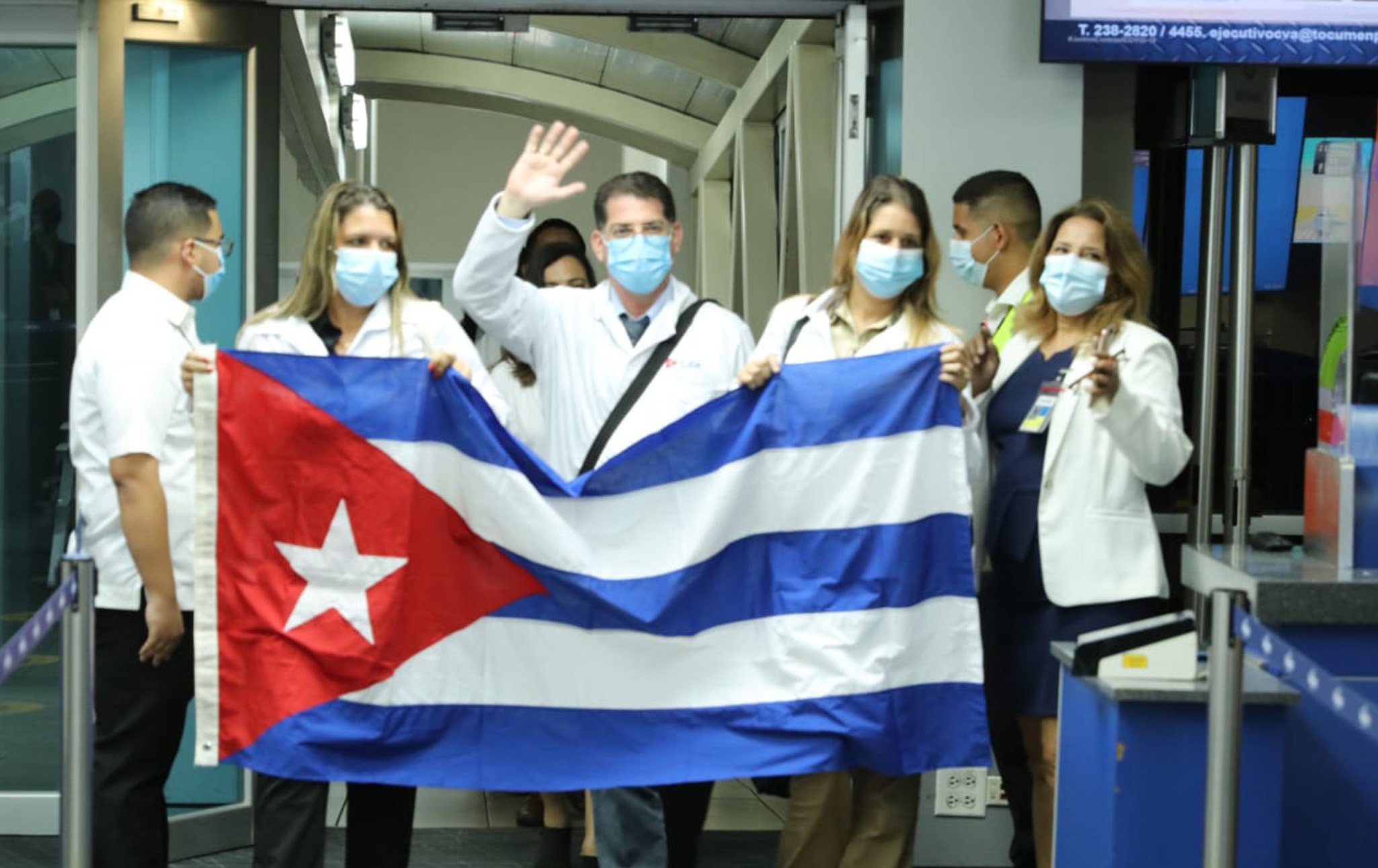
Cuba’s medical aid missions are a vital lifeline for people around the world. That’s exactly why Donald Trump’s imperialist State Department is trying to destroy them.
Donald Trump came into his second term in office proclaiming his intention to tighten the United States’ grip on Latin America, proudly invoking the Monroe Doctrine. As part of this agenda, one of the administration’s earliest foreign policy moves was to strengthen the brutal, longstanding sanctions against the island of Cuba.
On his first day in office, Trump placed Cuba back on the official “state sponsors of terrorism” list, reversing its last-minute removal by the outgoing President Biden. Trump has also put Western Union’s local Cuban partner on a watchlist, effectively shutting it down and forcing the wire service to indefinitely suspend operations in Cuba. Since 70 percent of the population receives some form of remittances from abroad, this further puts the squeeze on an already-punished nation. But one act of economic warfare was even more egregious. This February, Trump and Secretary of State Marco Rubio announced targeted sanctions against Cuba’s famous international medical missions, with visa restrictions for anyone who participates. The sanctions extend beyond doctors to anyone deemed “complicit” with the missions, including “current and former” officials and the “immediate family of such persons.”
These attacks are just the last addition to over a half-century of U.S. aggression against Cuba. By targeting one of the most notable and lucrative aspects of Cuba’s socialist government, the U.S. continues to violently punish a nation that offers a model of resistance to the U.S. empire—not to mention a compelling alternative to the for-profit healthcare system—through its very existence.
Revolution and Retaliation
The Trump administration’s campaign against Cuba is only the latest chapter in a centuries-long U.S. effort to dominate the island. From the very inception of the United States, Cuba was envisioned as a natural outgrowth of imperial ambitions. In 1823, Secretary of State John Quincy Adams famously declared that Cuba, “like an apple severed by the tempest from its native tree,” was “incapable of self-support,” and “can gravitate only towards the North American Union which, by the same law of nature, cannot cast her off from its bosom.” That same year, the Monroe Doctrine was issued—an explicit declaration that the Western Hemisphere belonged within the U.S. sphere of influence and was off-limits to European powers. After the Spanish-American War in 1898, the U.S. asserted the right to militarily intervene in Cuban affairs and ensured that any self-governance remained conditional on American approval. This laid the groundwork for decades of U.S.-backed authoritarian rule, culminating in the brutal dictatorship of Fulgencio Batista. Ironically, even prominent Cuban-American politicians like Marco Rubio and Ted Cruz—staunch opponents of the Cuban Revolution—have acknowledged that their families actually fled Batista’s regime, not Fidel Castro’s.
After Castro led a revolution against the dictatorship, the leftist government shifted power in the country away from monied landowners and to the general public. Cuba began a program of land reform which redistributed land and resources from the wealthy landlord and capital-owning class on the island and gave the land to a peasant class. At the same time, these lower classes were benefiting from mass literacy programs that gave the people the tools to develop in this new revolutionary Cuba.
The very success of the revolution is what incited America’s economic war. In April 1960, the State Department under John Foster Dulles issued a memorandum that described the U.S. policy for Cuba that has persisted for the last 65 years. The memo declared that the only US option to achieve regime change was to induce “disenchantment and disaffection based on economic dissatisfaction and hardship.” This meant that “every possible means should be undertaken promptly to weaken the economic life of Cuba.” The memo proposed “denying money and supplies to Cuba, to decrease monetary and real wages, to bring about hunger, desperation and overthrow of the government.” Along with the blockade came the largest most sustained campaign of terrorism against any country by the U.S. This campaign included industrial sabotage, plans to kidnap “some of the key people of the Communist regime”, assassination attempts against Castro himself, and raids against the Cuban island, most notably in the failed Bay of Pigs invasion.
The hostility remained constant until 2014, when President Obama announced a thaw in U.S.-Cuba relationships, taking steps to normalize relations. However, elements of the embargo still remained, and the Obama administration refused to close down the Guantanamo Bay torture site and return it to Cuba. Furthermore, the positive changes were quickly undone by a hawkish Trump administration. President Biden repealed some of the harshest Trump-era expansions of the sanctions regime, but continued the hardline policy against Cuba, actually implementing new rounds of sanctions on the Island. As mentioned earlier, the Biden administration eventually removed Cuba from the list of states supporting terrorism. However this only lasted for a few days, and we’re back to where we are now with Trump’s assault on Cuba’s medical internationalism amidst direct invocation of the Monroe Doctrine.
Medical Internationalism
Despite decades of U.S. sanctions and antagonism, Cuba has managed to build a healthcare system that is admired around the world. Central to Cuba’s socialist vision is its practice of “medical internationalism”—a far-reaching program that last year saw over 24,000 Cuban doctors deployed to 56 countries, making it larger than the field presence of the World Health Organization (listed as “8,000+ professionals”).
The origins of this program can be found in the earliest days of the Cuban Revolution. Che Guevara, one of the architects of the modern Cuban state, was a doctor before he was a guerilla leader, and in his essay “On Revolutionary Medicine,” he relates how his desire to help the sick was the first impetus for his radical politics:
I have visited, to some extent, all the other Latin American countries. Because of the circumstances in which I traveled, first as a student and later as a doctor, I came into close contact with poverty, hunger and disease; with the inability to treat a child because of lack of money; with the stupefaction provoked by the continual hunger and punishment, to the point that a father can accept the loss of a son as an unimportant accident, as occurs often in the downtrodden classes of our American homeland. And I began to realize at that time that there were things that were almost as important to me as becoming famous or making a significant contribution to medical science: I wanted to help those people[...] Then I realized a fundamental thing: For one to be a revolutionary doctor or to be a revolutionary at all, there must first be a revolution.
Having finally overthrown Batista and seen Castro take power in Havana, Guevara envisioned how the practice of medicine could become something new—not a commodity to be traded for profit, but a universal good, to be offered freely to whoever needs it:
A few months ago, here in Havana, it happened that a group of newly graduated doctors did not want to go into the country's rural areas, and demanded remuneration before they would agree to go. From the point of view of the past it is the most logical thing in the world for this to occur; at least, so it seems to me, for I can understand it perfectly[...]
But what would have happened if instead of these boys, whose families generally were able to pay for their years of study, others of less fortunate means had just finished their schooling and were beginning the exercise of their profession? What would have occurred if two or three hundred peasants had emerged, let us say by magic, from the university halls? What would have happened, simply, is that the peasants would have run, immediately and with unreserved enthusiasm, to help their brothers. They would have requested the most difficult and responsible jobs in order to demonstrate that the years of study they had received had not been given in vain.
Soon, the revolutionary government put the idea into practice, and working-class Cuban medics were indeed taking on “the most difficult and responsible jobs” around the world. The same year Che wrote his essay, the devastating Valdivia earthquake—the most powerful ever recorded—struck Chile, and Cuban doctors were among the first to step into the wreckage and save lives.
They did the same in revolutionary Algeria in 1963, when the abrupt departure of the occupying French government left the nation without adequate healthcare services; in Guinea-Bissau during its war of independence against Portugal in the 1970s; in Haiti in 2011, at the height of the cholera outbreak there; across western Africa when Ebola broke out in the mid-2010s; and in a dozen other times and places. Speaking recently about the Mais Médicos (“More Doctors”) program she helped orchestrate between the two nations in 2013, former Brazilian president Dilma Rousseff said that “today, if Brazil has a different primary healthcare system, we owe it to Cuba.” In 2005, Cuba even offered aid to the United States in the aftermath of Hurricane Katrina. (President Bush declined). These missions have brought critical care to underserved and crisis-stricken regions, including a 2020 deployment of 583 doctors to 14 countries during the COVID-19 pandemic.
One 2023 study estimated that Cuba’s medical assistance, if reclassified as economic aid, would be worth more than $71.5 billion between 1999 and 2015—roughly 6.6 percent of the nation’s GDP. Some of these costs have been offset through barter-like arrangements, such as the 2004 deal with Venezuela trading medical services for oil. Since 2004, these kinds of deals have brought in an estimated $11 billion a year, making it one of Cuba’s top sources for revenue, beating even tourism.
Forced Labor?
Despite the humanitarian impact of these missions, the U.S. government has consistently attacked the program, accusing it of imposing harsh conditions on its medical workers and even labeling it a form of "forced labor.” The accusation goes as far back as 2019, when it formed the basis of a Rubio-Cruz anti-Cuba bill. Since then, organizations affiliated with Western governments have striven to provide some legitimacy to the accusations.
According to the U.S. State Department, the most recent wave of sanctions are based on a 2022 complaint filed to the International Criminal Court by a group named Prisoner Defenders. According to the organization, they collected over 1100 testimonies from Cuban professionals who have participated in the medical missions. The complaint contains a mixture of serious accusations and blatant misrepresentations of Cuban policy. It alleges that many participants never volunteered for the position, never saw a contract, or had their passports confiscated while on mission. While these accusations are serious, they are not coming from disinterested sources and much of the evidence for the claims remains hidden, while what evidence is presented appears to be distorted or out of context.
For one, the complaint criticizes Cuba for criminalizing defection from the program, as if a Westerner abandoning an official government mission wouldn’t face consequences for their desertion. The report also alleges that this program constitutes “forced labor” in part because 87 percent of the alleged professionals claimed that the “situation of extreme poverty in Cuba” had an influence on their decision to enroll in the program. Another 66 percent noted the “impossibility of obtaining viable alternatives to the precarious labor situation in Cuba” as a reason. Some 29 percent claimed that since “it had been instilled in me that I was indebted to the state for [receiving] free education” as a “coercive” reason for their enrolment. But by this same logic, anyone who takes a job in the U.S. because the alternative is “extreme poverty,” or because they feel a sense of duty after receiving public benefits in one form or another, is also engaged in “forced labor.”
Despite the filing, none of the underlying evidence or the testimonies themselves have been made available to the public. Furthermore, Prisoners Defenders note on their website that they are closely affiliated with the Ministry of Foreign Affairs of the Czech Republic, a U.S. NATO Ally. This sponsorship by a bloc that is aligned against Cuba raises questions about the impartiality of the organizations. To date, the ICC has not issued any response to the filing. Instead, the largest effect of the complaint has been to serve as a justification for increased U.S. sanctions.
When Cuban medics are allowed to speak for themselves, they sharply contradict these accusations from the West, and regularly speak positively about their experiences. Vijay Prashad, who co-wrote the book On Cuba with Noam Chomsky, spoke to several medical mission workers in 2020, all of whom were proud to be a part of the internationalist project. “I decided that I wanted to be part of this brigade and its honorable work for the world,” one doctor told Prashad. “Believe me, my choice could not make me prouder to be Cuban.”
But even if there were compelling evidence for the accusations, this clearly wouldn’t be the primary motive for the United States’ sanctions. If U.S. foreign policy were motivated by humanitarian concerns, Cuba would be low on the list of priorities compared to modern-day slavery in the United Arab Emirates or Israel’s systematic starvation of Gaza, to mark just two dire examples from countries that remain close U.S. allies. When it makes geopolitical decisions, human rights are the last thing the U.S. cares about; power and dominance are the first.

Economic Crisis
Trump’s sanctions are aimed at worsening an already dire economic crisis that the United States has created on the island. Because of U.S sanctions, the Cuban economy has largely been running on life support for decades—especially after the fall of the Soviet Union in 1991 took away its largest ally and trading partner. Residents on the island endure fuel shortages that lead to regular blackouts, food and water shortages, and an ongoing crisis of migration that has seen the country depopulated by over 10 percent over the last few years.
According to Robert Muse, an expert in sanctions law and author of Cuba: A Legal Guide to Business, U.S. sanctions against Cuba have created what he calls a culture of “overcompliance” in the private sector that acts as a force multiplier for the sanctions. Rather than navigate the complex waters of what is and is not prohibited under U.S. sanctions, companies steer clear of the island entirely.
As a result of food restrictions, Cubans are not only deprived of food, but also enough animal feed and fertilizer to adequately support domestic agriculture. The fuel shortage also results in increased deprivation on the ground:
Drivers often wait more than 12 hours at gas pumps and are limited to about 10 gallons. The nation is short about 14,000 working public buses, according to the government’s blockade report, leaving the public transportation system all but collapsed. There are frequent sidewalk foot races as people sprint for a place on the already packed boxy American mini-trucks from the 1950s that serve as collective taxis.
Despite Cuba’s medical care system, there is often no substitute for life-saving machinery restricted by the US embargo. For example, there is a national shortage of pacemakers, and there was a waiting list of over 86,000 people waiting for surgeries of all types. Billions of dollars of medical cargo goes undelivered as shipping companies grow increasingly spooked by the resurgence of sanctions.
Since the sanctions have been reintroduced, the Cuban tourism industry—one of the country’s largest revenue generators—has declined from a 2018 peak of 4.7 million tourists to 2.2 million in 2023. For American tourists, this decline has been more pronounced, falling from a 2018 peak of 638,00 tourists to just 163,000 in 2023. Cuba’s estimates for the economic cost of the sanctions, affirmed as accurate by the United Nations Economic Commission for Latin America and the Caribbean, put the total at over $164 billion by 2024.
An International Affair
The Trump administration’s campaign against Cuba’s international medical missions has sparked sharp backlash across the Caribbean, where Cuban doctors play a vital role in national health systems. “I will prefer to lose my visa than to have 60 poor and working people die,” said Ralph Gonsalves, the prime minister of St. Vincent—a sentiment echoed by his counterparts in Trinidad, Jamaica, and Guyana. But despite their reliance on Cuban medical aid some governments, such as the Bahamas, quickly capitulated to U.S. pressure and canceled long-standing contracts with Cuban physicians.
Washington’s efforts to dismantle the program extended beyond bilateral diplomacy. Through the Organization of American States (OAS)—a body long criticized for operating as a proxy for U.S. foreign policy—the administration sought to enforce sanctions under the guise of regional oversight. In May, the Inter-American Commission on Human Rights (IACHR), a division of the OAS, demanded that member states submit extensive information on their countries’ Cuban medical operations within 30 days. This included current and past contracts, legal complaints, and even the identities of personnel who had abandoned missions.
This sweeping demand came right as the U.S. continues to shape the organization to its liking. In June, the U.S. successfully pressured the IACHR to appoint Rosa María Payá—a right-wing Cuban-American activist and vocal supporter of the U.S. embargo against Cuba—to a prominent position within the body. Her appointment was widely condemned as a conflict of interest, given her alignment with policies that have caused documented humanitarian harm. The Cuban foreign ministry accused the U.S. of “blackmailing” OAS members into legitimizing an activist who openly defends the embargo—a measure condemned internationally and ruled illegal under the UN Charter.
As Francesca Emanuele of the Center for Economic and Policy Research told Jacobin, “The IACHR may be acting as an enforcer for the United States, a kind of policing arm advancing Washington’s agenda of tightening the sixty-year-old blockade to try to overthrow the Cuban government.”
While the OAS appears increasingly subordinated to U.S. strategic goals, the United Nations General Assembly remains an arena of resistance. In October 2024, the UN General Assembly voted for the 32nd consecutive year to condemn the U.S. embargo on Cuba. The resolution reiterated that the embargo violates the UN Charter—since it was never authorized by the Security Council—and, by extension, contravenes the U.S. Constitution’s Supremacy Clause, which deems ratified international treaties the “supreme law of the land.”
Ultimately, Washington’s campaign against Cuba’s medical diplomacy has shown little regard for international law, regional sovereignty, or humanitarian principles. Instead, it appears driven by a singular objective: to isolate and undermine a small island nation whose global influence continues to exceed its size.

Healthcare Miracle vs. Healthcare Horror
Perhaps the most striking example of Cuban success is that their state-of-the-art healthcare system produces comparable outcomes to the Global North despite the crushing sanctions regime. Even the U.S. military-affiliated RAND Corporation hailed Cuba’s healthcare system as “doing more with less” in a 2017 study comparing healthcare outcomes between the U.S. and Cuba. Data compiled by the World Bank, another firmly capitalist institution, show that the comparison is still relevant. U.S. Healthcare spending per capita is more than ten times that of Cuba. But Americans’ health outcomes are scarcely reflected in this massive amount of spending. Today, Cubans have a similar life expectancy to Americans, and for a long period between 1999 and 2013, Cuban infant mortality rates even fell significantly below those of the United States. Even today, the figures remain comparable, and Cuban scientists have invented new forms of medicine—like a vaccine for lung cancer or a drug that saves diabetes patients from amputation—that are difficult or impossible to get in the U.S., precisely because of the sanctions regime.
Despite the billions spent on healthcare a year in the U.S., over 100 million Americans are burdened with medical debt, and two out of every three bankruptcies are due to medical expenses. For this reason, nearly 2 in 5 Americans say that they or a family member have skipped medical care due to cost. In the U.S., we are used to Facebook posts from friends and family pleading for donations to a medical GoFundMe.
This disparity is due primarily to the predatory and for-profit nature of the U.S. healthcare system. While we spend over a trillion dollars per year on what is called “healthcare,” much of every dollar goes towards sustaining enormous salaries and overhead of staggering pharmaceutical, insurance and hospital bureaucracies. Indeed, in several states, these bureaucracies are the single largest source of employment for working people. These bureaucracies aren’t oriented towards actually providing care. In the case of insurance, the business model incentivizes as little care as possible. Like all corporations, their goal is money, even if that means actively causing harm.
In Cuba—and much of the world where healthcare is considered a right—scenes from the U.S. healthcare system evoke shock and horror. Cuba’s healthcare achievements in the face of more than a half century of economic warfare from the most powerful country in the world is nothing short of a miracle. Likewise, the fact that they are exporting this miracle to other parts of the world can only be seen as an affront by their U.S. tormentors, who are now trying to destroy a system that’s proven itself superior to theirs.
Instead Of Sanctions, Give Them A Nobel
Much of the horror inflicted on Cuba has been done in the name of democracy. But any problems that Cubans have with their government are exacerbated by the harsh conditions sanctions bring—and again, the U.S. has no problem allying itself with dictatorship in other cases. In reality, America’s crushing assault on the island has always been about deterring what Chomsky and other scholars call “successful defiance” of U.S. domination by demonstrating the costs of success. Any compassionate observer would be advocating that instead of sanctions, Cuba and its medical missions deserve widespread international acclaim.
In the wake of the missions’ performance during the 2020 COVID-19 crisis, several organizations began a campaign to award the Nobel Peace Prize to Cuban doctors. While this has so far been unsuccessful, the current farcical push to get Donald Trump the prestigious award is raising questions about who would seriously be deserving of such recognition. If anyone is, it is the mission that has defied an empire in service to humanity for over a half-century.


.png?width=352&name=Screenshot%202026-09-04%20at%204.00.52%20PM%20(1).png)
%20(1).jpg?width=352&name=miasma-1%20(1)%20(1).jpg)