
Saving New Orleans Is Not Optional
A new study suggests we should simply give up on the city's long-term future and begin to relocate the population. This is a morally indefensible proposal. New Orleans can and must be saved.
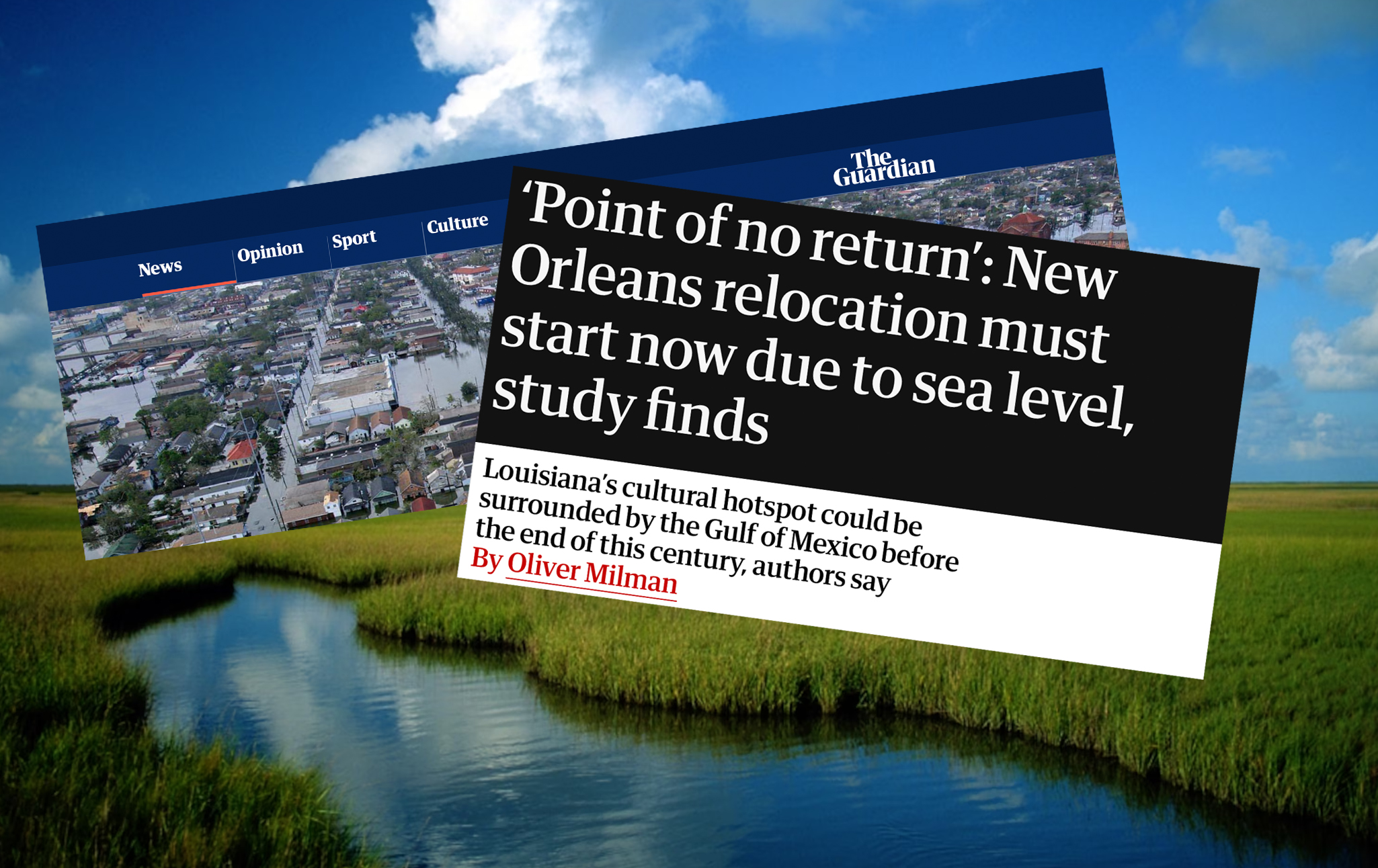
People in New Orleans sometimes say casually that the city “will be underwater” eventually, and we should enjoy it while we can. But a new paper in Nature Sustainability, covered by the Guardian, argues that this is no hyperbole. Yes, the authors say, New Orleans will be underwater, and sooner rather than later. The city is doomed, they say, and we should all leave. The situation, they claim, is hopeless. Rising sea levels will inundate south Louisiana within one generation, and the question we should now be asking is how to relocate the entire population in an orderly manner.
The language used in the paper and article is terrifying. New Orleans has “crossed the point of no return.” The city’s “days are numbered.” And the time frame is “most likely decades rather than centuries.” It is time to “plan a retreat,” because the city is in “a terminal condition, and we need to be clear with the patient that it is terminal.”
The first point to note is that the paper is written in a way that is deeply offensive to the people of New Orleans, and treats their “relocation” as something that has essentially few downsides. Its authors “highlight the positive aspects of the recently commenced out-migration in this region,” writing:
Contrary to conventional discourse where population loss is seen as a negative, we propose that it may offer a first-mover advantage to learn what policies and plans are effective at advancing social welfare and environmental quality in the managed shift from sending to receiving zones.
New Orleans, in this passage, is a “sending zone,” which will transfer people to “receiving zones.” Nowhere in the paper do the authors acknowledge what a devastating, incalculable, horrifying loss it would be for people to lose a place they are so deeply attached to, which also happens to be the most important cultural center in America. (Sorry, New York.) Rather, the catastrophe barreling towards us is framed as an exciting opportunity for social scientists to address a novel puzzle: What do you do with 300,000-plus people when all of their homes are decimated? “It almost reads as if they want to treat us as a petri dish for policies, to experiment, to see what works,” as a commentary from Noirlands put it. Local investigative publication The Lens argued that the Guardian’s framing of the story is “more damaging than helpful—a modern day redlining of an entire city; a scarlet letter upon the breasts of our downtown to scare away new businesses; shackles around the necks of those of us that choose to remain here; and, a death sentence for those without the means to leave.” The paper discusses the future of New Orleans as if it should be settled by academics and policymakers with no input from the people themselves, who are just a “population” to be moved around on a map.
But the paper, and the Guardian’s coverage of it, are also largely silent on one of the most important factors in any discussion around the fate of New Orleans: the question of responsibility. The Guardian article does not discuss the fossil fuel industry’s role in producing the rising sea levels that now imperil this part of the country. As with too much media coverage, climate change is treated as if it is a natural disaster, rather than one that is caused by particular choices made by corporations. This matters, because those who have endangered New Orleans should bear the financial cost of saving it, rather than that cost falling on the population who are simply expected to move.
It’s not the first time that New Orleanians have been treated as expendable, and the disasters that befall them as a mere act of God rather than an act of policy. Because of its precarious location, New Orleans has faced numerous natural catastrophes. Any lasting devastation, though, has always been manmade. When Hurricane Katrina decimated the city in 2005 after the levees broke, George W. Bush said he didn’t “think anybody anticipated” the failure—but experts did; no one listened. Homeland Security documents show that leaders were aware of the subpar infrastructure, while residents had previously reported water pooling in their yards near the floodbank barrier. Had the government been proactive, nearly 1,400 people wouldn’t have died. It was entirely preventable. Claims that New Orleans is destined for destruction are similarly ignorant of the degree to which human choices affect the city’s fate.
After Katrina, the federal government abandoned residents—much like it is doing now, as we face new warnings of disaster. The paper’s authors acknowledge that the city lost 20 percent of its population immediately following Katrina, “with return rates strongly influenced by housing damage, socioeconomic status and race.” The largely poor and Black population who lost their homes were treated as disposable then, too: if they died or were expelled, if their neighborhoods were left in ruin, who cares? Some even suggested that if they managed to escape, they were better off anyway. Just days after the storm, House Speaker Dennis Hastert said it looked “like a lot of that place could be bulldozed,” while then-Louisiana Congressman Richard Baker was overheard telling lobbyists: “We finally cleaned up public housing in New Orleans. We couldn’t do it, but God did.” When thousands of evacuees arrived in Houston, Barbara Bush acted like a gift had fallen in their laps, claiming that many “were underprivileged anyway, so this is working very well for them." This shockingly blasé attitude is echoed in the recent Nature Sustainability paper, which asks residents to view “relocation” as “an opportunity, not merely as a threat or burden.”
But the resigned, pessimistic presentation is also scientifically misleading in important ways. Co-author Jesse Keenan of Tulane University says that “in paleo-climate terms, New Orleans is gone,” because “even if you stopped climate change today[…] it will be surrounded by open water, and you can’t keep an island situated below sea level afloat. There’s no amount of money that can do that.” First, Keenan is assuming, but the paper does not attempt to demonstrate, that no conceivable engineering solution on any scale can possibly protect New Orleans in the long term. They do not provide estimates of costs to protect New Orleans, and explain how long each solution would last or why it would ultimately fail. They just resign themselves quickly to the idea that nothing can be done, and tell us we have to get used to it. But policy choices are being made, such as governor Jeff Landry’s decision to cancel major coastal restoration projects, that are worsening the problem. This is the time to focus on pressuring politicians to make decisions that will best protect New Orleans, not to open up a conversation about when we should abandon ship.
When people are committed to a place, they work to protect it, not to come up with innovative ideas for how to abandon it. Take the Netherlands. While Louisiana’s coastline is eroding at a faster rate than the Netherlands’, their leaders are actually committed to addressing the issue—in part, because the Dutch constitution guarantees “habitability and protection of the environment.” After Hurricane Katrina flooded New Orleans’ levees, city leaders reached out to Dutch engineers for help: “The Netherlands' flood defenses—a sculpted landscape of dunes, dikes, dams, barriers, sluices and pumps designed to repel the twin threats of ocean storm surges and river flooding—are light years ahead of the New Orleans area's busted-up levee system,” wrote nola.com in 2005. After modeling our new system on theirs, the rebuilt levees withstood the storm surges of Hurricane Isaac in 2012, and later Hurricane Ida in 2021. Today, we could learn from the Dutch battle against coastal erosion, which involves harnessing the power of ocean tides to replenish sediment. Climate Central writes: “Along the coast, the Dutch are using the wind and waves to spread the millions of tons of sand that serve as the first line of defense against sea level rise and storm surges. Similar work on the Louisiana coast, which relies more on machine power, moves much less sand at a far greater cost.”
Leaders refuse to invest in saving the city, though, because they view it as precisely that: an investment, with little economic return. New Orleans doesn’t house the headquarters of major companies; it’s not a hub for industry; and so it doesn’t matter. Of course, the U.S. spends vast sums of money each year ensuring that humans can survive in the inhospitable desert, but no one is asking residents of Las Vegas to abandon their homes. Phoenix, Arizona is no more naturally sustainable than New Orleans; the city survives because of a 336-mile aqueduct system pumping water uphill through the desert from the Colorado River. It uses an enormous amount of energy, and cost the federal government billions to build. Why is this a worthwhile endeavor, but protecting the people of New Orleans is not?
What we stand to lose in this city can not be measured in profit: culture, music, and history unlike anywhere else in the world. As Adam Kushner wrote for the Chicago Tribune:
How many books and articles and TED talks instruct us to slow down, to keep perspective, to focus on the things we love, to enjoy life before it ends? New Orleans is an entire city dedicated to those ideas. A place like that should be protected at any cost — even $100 billion — not closed down for the sake of some imagined greater good. [...]
New Orleans has no place in a cost-benefit analysis, because what it offers — what it adds to America — cannot be counted.
Implicit in the paper is the treatment of New Orleans as expendable. If you see preserving the region as non-negotiable, then the question you ask is: What will it take to keep New Orleans from flooding long-term? The answer might be costly, it might require a vast national effort and a lot of creative thinking by engineers, but the alternative (“population relocation”) is simply taken off the table until all other solutions have clearly failed. But if you think relocating the population is a reasonable thing to do (which the paper’s authors think it is, pointing to the history of human migration and adaptation to changing climates), because you don’t see the loss of New Orleans as incalculable, then you don’t need to start trying to come up with creative ways to save the city, because after all, the “managed shift from sending to receiving zones” is not actually “a negative.”
The paper by Keenan et al., and the Guardian’s coverage of it, is downright dangerous, because it normalizes the idea that saving New Orleans is optional, and we can simply accept climate change as a given, rather than a challenge we must fight against. It makes “population relocation” a politically viable option and encourages us to discuss it. In fact, they tell us we should be discussing it immediately, that the process of emptying New Orleans should begin within the next few years!
This is, first off, alarmist, because there is no proof that we are facing an imminent calamity rather than a long-term challenge. The paper’s most terrifying graphic shows all of Southeast Louisiana underwater, because of a 7-meter sea level rise. On the paper’s map showing a 3-meter sea level rise, they anticipate that New Orleans could still be successfully protected by a coastal defense. Notably, the paper says “no timeline provided” on the graphics. But without a clear timeframe of what is actually likely, and a precise understanding of what can be mitigated and what can’t, the idea we should be evacuating New Orleans immediately is scientifically baseless. In fact, the idea that New Orleans is in a “terminal” state is not supported by the evidence of the paper, which acknowledges that “it is currently unknown when this future shoreline position [i.e., full inundation] will be reached.” Yet despite offering no proof that the city cannot be protected for multiple centuries to come—if we get serious about making those who caused the problem pay to solve it—the authors appear to warn that we should stop trying to save New Orleans, because adapting in place, “while demonstrating community resilience… creates additional barriers to future mobility—through increased financial investment in property improvements, deepened social networks and place attachment, and psychological commitment to community continuity.” In other words, the more we deepen our ties to the place and try to save it, the harder it will be to get people out. But they don’t offer any proof that we can’t solve this, and they are exhorting people to leave even though they don’t anticipate any of them are actually going to live to see the city flooded, concluding that: “while nobody alive today will see the end result, this cannot be an excuse for delay.”
In fact, the problem with saving New Orleans in the long run may prove to be more political than technical. No matter what, it will be incredibly costly to build the kind of infrastructure necessary to keep the people of south Louisiana protected from rising seas. And many people here are not wealthy. For politicians, it will be tempting to solve the problem by simply giving up New Orleans as hopeless. But that instinct must be resisted. We must aggressively make the case that this city is worth too much to be sacrificed.
Papers like this one, ostensibly presenting neutral scientific analysis, help to clear the path for politicians to endorse abhorrent solutions like forcibly relocating the entire populations of cities. These “solutions” let fossil fuel climate-killers off the hook, and they continue a pattern of treating New Orleans residents as people who must simply accept the catastrophic results of policy choices made by both local and national elites who have failed to curb the industry that threatens the fate of the planet. It is a shame that those who study climate risks are not putting their thoughts toward figuring out how our city can be saved, instead of wasting their time thinking about how it can be depopulated in an orderly manner. (Not that this could happen. Many people here are fiercely loyal to the city and would choose death before departure.) As the climate catastrophe worsens over the next decades, we are going to have to face difficult political conversations about the vast amount of effort it will take to help people avoid the worst consequences. But we should agree on one non-negotiable at the outset: New Orleans is not going to be allowed to drown. Not in ten years, not in a hundred. This city can be saved, it must be saved, and our task is to figure out how to do it.


%20(crop).jpg?width=352&name=wile-e-coyote%20(resize)%20(crop).jpg)