
Politicians say they have “national security concerns.” In fact, Chinese cars are better and cheaper, and American corporations know they can’t survive market competition.
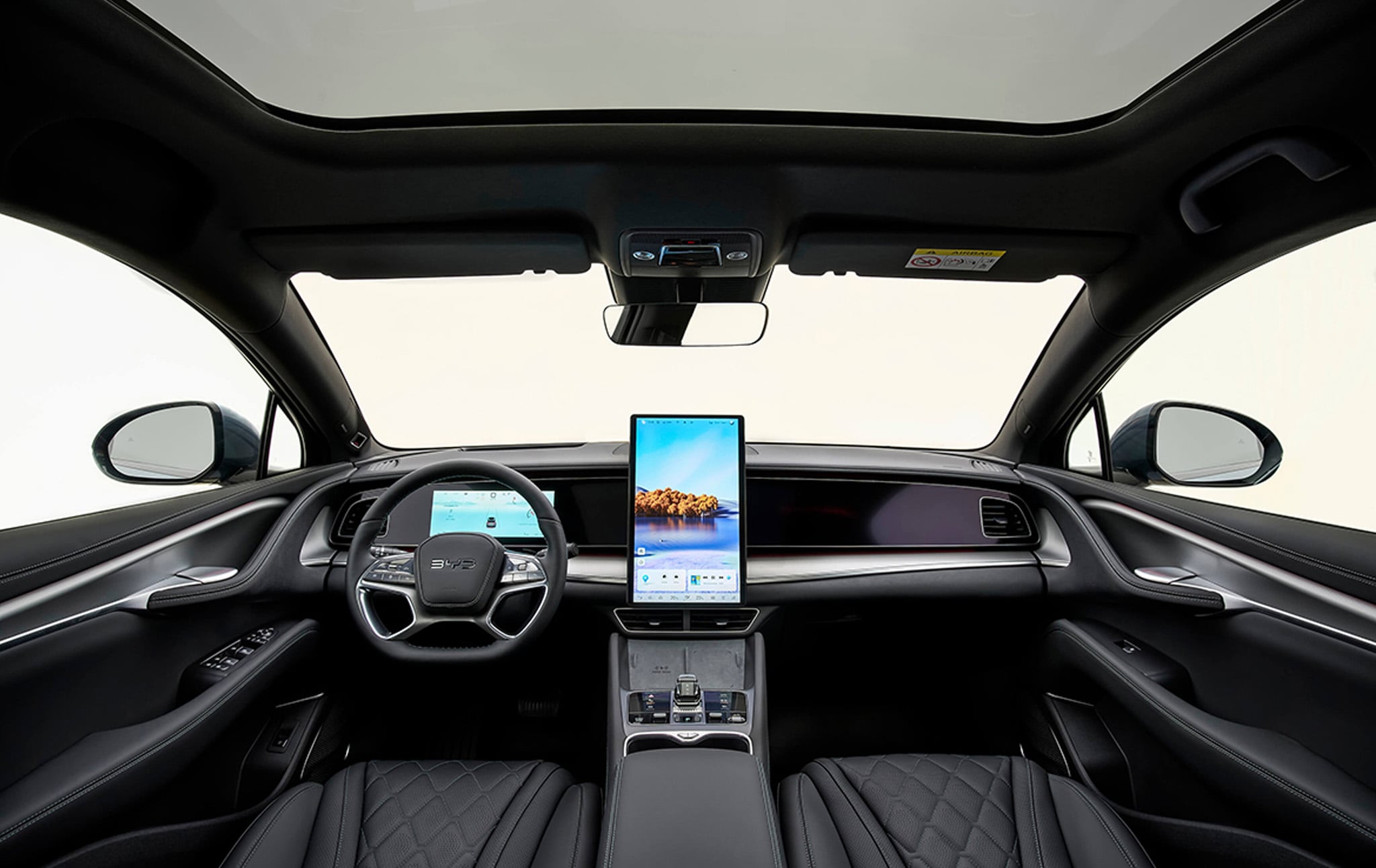
I took my first ride in a Chinese car recently. Not in the U.S., of course, since sky-high tariffs have made them almost impossible to import. I was visiting family in the U.K., and we rented a BYD Sealion SUV. And let me tell you: I saw immediately why American car companies are desperate to have these things kept out of this country. It was elegantly designed, incredibly comfortable, and a smooth ride.
The Wall Street Journal’s car reviewer, Joanna Stern, had a similar experience. After driving an electric Xiaomi SU7 Max for a few weeks, she literally started writing it love notes:
My dearest Xiaomi SU7 Max, It’s been about a month since we were last together. Now, every time I climb back into my Ford Mustang Mach-E, I can’t stop thinking about you—your long range, your modular interior, your absurdly large infotainment screen.
Stern says her first reaction to driving the car was “holy crap,” and she “I fell for the SU7 Max inside and out, and now I’m left wanting what I can’t have.” She was impressed with the way its infotainment system integrated with a phone, the between-seat minifridge, the karaoke system, the walkie-talkie system, the driver-assistance system, the range, and the comfort. “I fell in love with all things about this car, including its price tag,” she said, noting that it was a better experience than a similarly priced Tesla. The Xiaomi, she says, is not even in the same universe as American cars. “It’s like if Apple had actually built the long-rumored Apple Car and everything just… worked.” “I will wait for you, Xiaomi,” she concludes. “We shall be together again one day.” One is relieved the Journal took her car away before things between them got too physical.
And if Stern sounds like lovesickness may have compromised her judgment, consider this: the CEO of Ford himself drives one. "I don't like talking about the competition so much,” he admitted to a podcaster, “but I drive the Xiaomi… I don’t want to give it up.” Noting that the car is “fantastic,” he told a company board member that the Chinese auto industry is an “existential threat.”
American manufacturers are terrified of the Chinese auto industry, because Chinese cars are good, and they’re cheap. Their executives admit as much, saying that “the arrival of affordable, high-tech Chinese cars could upend” the industry. So they’re trying to ensure not only that Chinese cars can’t be sold in the U.S., but that Americans will never even be exposed to one. A group of Congressional Democrats recently sent Donald Trump a letter pleading with him to ensure Chinese cars never enter the United States. Supposedly progressive Democratic congressman Ro Khanna has been particularly aggressive in pushing for new rules, claiming the cars “put Americans at risk.” “Chinese cars are a serious threat to America’s national security and Michigan’s economic security,” Senator Elissa Slotkin has said. Astonishingly, even though the Biden administration already “imposed sweeping regulations that effectively ban Chinese automakers from selling passenger vehicles in the United States,” lawmakers are now trying to ensure that people can’t even drive Chinese cars across the border to visit the United States. They apparently envision an absurd scenario where agents at the Mexico border inspect every car to ensure it’s not Chinese before it’s even allowed to drive on U.S. soil.
One problem is that U.S. manufacturers have focused on (deadly, inefficient) large SUVs and trucks, and the average new car now costs around $50,000. Car prices hit a record last year, and American auto loan debt hit a record $1.68 trillion, leaving many Americans with “more and more of their paychecks eaten by their car payments.” There are almost no new cars for sale under $20,000. But Chinese cars can sell new for as little $8,000 in China itself, and China may well be able to offer cars in the U.S. close to $20,000 new—if it’s allowed to compete. That’s why the industry sees Chinese cars as an existential threat: they worry that consumers will prefer them, and so the power of the government must be used to ensure that consumers are forced against their will to buy more expensive, lower-quality cars, in order to prop up the U.S. automotive industry. (They’ll say that’s about Jobs, of course, but it’s also about profits.)
Now, you might think that protecting the domestic car manufacturing industry is worth that cost. But we should be clear that this is what the policy is about. Lawmakers also cite their deep “national security concerns” about allowing Chinese cars into the country. Supposedly Chinese cars will be Trojan horses that steal our data and use it to, I don’t know, tell Xi Jinping how many times you’ve been to Publix this week. But these concerns are bogus—Chinese companies have been clear that they’re willing to abide by any domestic cybersecurity regulations that are put in place, and it would be quite easy to say that if Chinese car companies were gathering and misusing data, they would lose access to the U.S. market. But American policymakers surely know that Chinese cars have entered European markets—countries where data privacy is a much greater concern—without an issue. In fact, around the world, Chinese cars are becoming hugely popular, with one in ten cars sold in Europe now being Chinese. (In Mexico, it’s one in five.) And notably, our policymakers don’t worry about how surveillance tech in cars could enable abuses by our own government.
Automakers and politicians often say that Chinese cars should be banned because China competes “unfairly,” with the government subsidizing its auto industry and allowing it to be more competitive. “China has been cunningly building its automotive market with vast state subsidies,” as an op-ed in the Detroit News put it. (Oh, those “cunning” Chinese!) This is still an admission, of course, that the cars would win out with U.S. consumers if they were permitted a choice, because many Americans would prefer cheap cars to American cars. But it also amounts to saying that China simply does industrial policy better than we do. The U.S. has subsidized its auto industry plenty, and produced the most car-friendly (and pedestrian-hostile) infrastructure imaginable. Our car companies have just failed to keep up with Chinese innovations.
One complaint that is justified is that while many American car companies are unionized, Chinese workers are more exploited, which contributes to the lower cost of cars. But notably, the opponents of Chinese cars are even opposing them being built in the U.S. by American workers. Interestingly, Donald Trump has suggested he’s open to Chinese companies manufacturing cars here, which is part of what triggered a panic among legislators, with Democrats yet again proving that sometimes they can be even more hawkish on China than Trump.
Provided some protections are attached for labor, though, there is no good reason to oppose the entry of Chinese cars into the United States. Economist Noah Smith, who is often terrifyingly militaristic in his writing on China, sees the espionage risk as overstated, and believes that there would in fact be considerable benefits to allowing Chinese cars into the country, since they would force the U.S. auto companies to get more competitive and start trying to offer cars that can win a market competition. The alternative is continuing to make U.S. consumers pay more for cars than they would like to pay, and miss out on all the technological superiority of Chinese cars that European and Mexican consumers benefit from.

%20(1).jpg?width=352&name=Parrots_by_a_nest_in_the_Green-Wood_Cemetery_gate_(61841)%20(1).jpg)