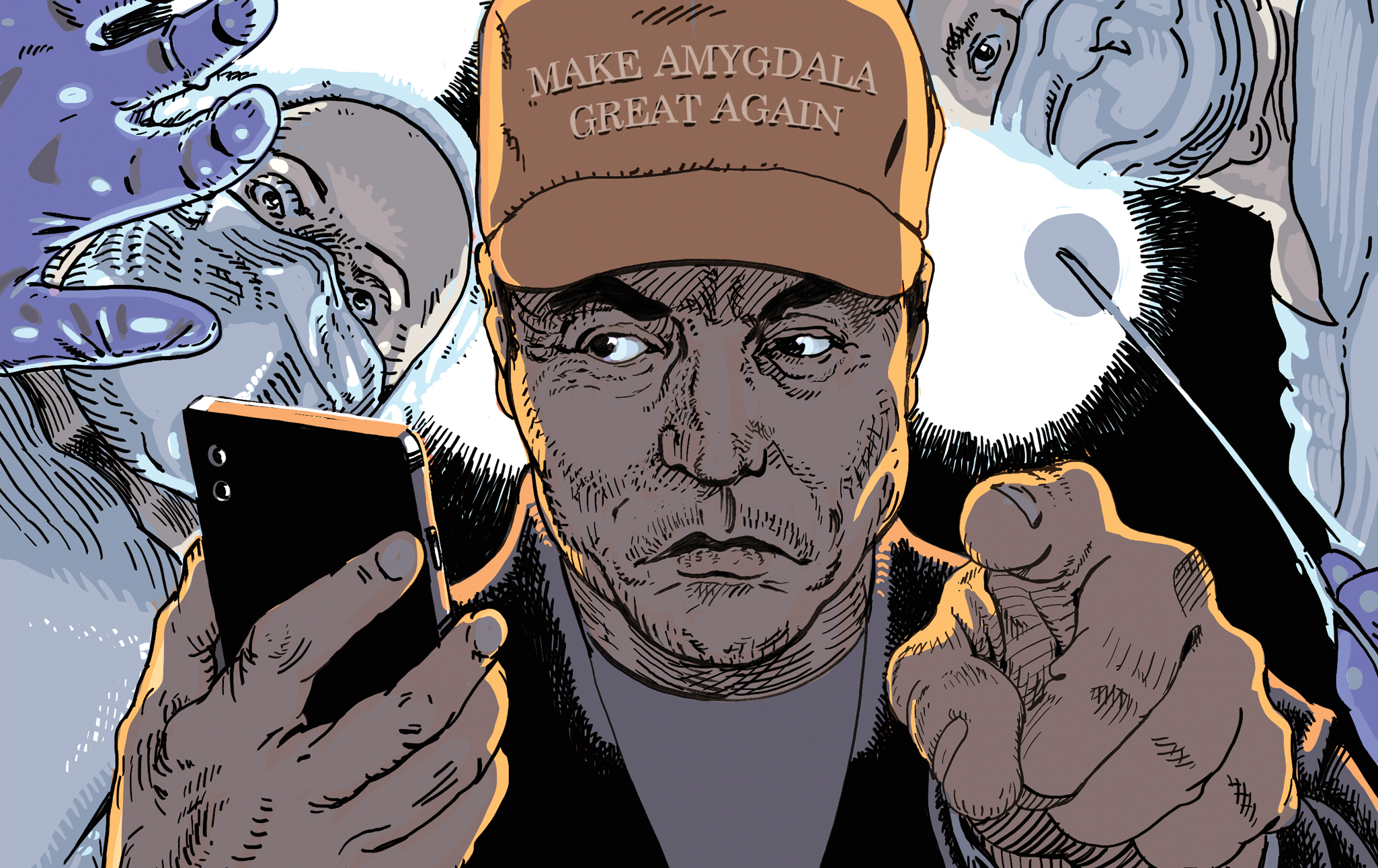
The world’s richest man is obsessed with putting Neuralink chips in people’s brains and integrating their minds with AI. He can’t be trusted with this technology.
The richest man in the world wants to implant a chip in your brain. You wouldn’t be the first: as of last September, 12 people have already undergone the operation and 10,000 more are on the waiting list.
Elon Musk’s experimental brain chip company, Neuralink, is entering its second year of clinical trials with the PRIME study, which aims to “restore autonomy to people with paralysis” by enabling them to “operate their phones and computers with just their thoughts.” (PRIME stands for Precise Robotically IMplanted brain-computer interfacE; one can only hope that its researchers are better at neurology than they are acronyms.)
The program has had its successes, but the medical advancements have come at a cost—and Musk is no longer content with healing the sick and injured. In fact, the billionaire’s ambitions seem to be twice as vast as the regulatory hurdles he has sidestepped to get there. Elon Musk wants to transcend the human form. To do so, it’ll only take a few thousand experiments on us regular folk.

Neuralink’s strides in medicine have been impressive so far. Since the PRIME study began in 2023, at least two paralyzed patients have gained the ability to operate a cursor with their mind, according to the company. The first was 31-year-old Noland Arbaugh, who is now able to write text messages, send emails, and play video games using a mind-operated interface. The second, 26-year-old Rocky Stoutenburgh, recently shared a video of himself moving a robotic arm using only signals from his brain. In October, the company launched a new clinical trial with the slightly more ambitious goal of translating thoughts directly into speech, specifically targeting people who have lost the ability to speak due to stroke, ALS, or other severe speech impairments.
These are all impressive feats, with the aim of improving quality of life for people with disabilities. But Neuralink wants to expand its market. “We’re currently envisioning a world where in about three to four years, there will be someone who’s otherwise healthy who’s going to get a Neuralink,” the company’s president, DJ Seo, said at a recent conference in Seoul, South Korea. “If you’re imagining saying something, we would be able to pick that up.”
Suddenly, we’re talking about a third-party brain implant with access to all of your thoughts and imagination. Sure, why wouldn’t a perfectly healthy person want that? Seo hinted at the potential benefits of such technology:
We think that it's actually possible to demonstrate abilities to speak to the latest AI model, or LLM models, at the speed of thought, even faster than how you're speaking, and being able to potentially get that information back through your AirPods, effectively closing the loop.
What Seo is describing here is a form of ChatGPT (or more accurately Grok, Musk’s anti-woke version) implanted directly in your brain. It’s hard to imagine a more pointless technology, and one clearly designed to erode human thought. If you’ve been depressed by all the obvious AI language online, just wait until it arrives face-to-face!
“How was your day, honey?” you might ask your wife as she arrives home from work in the year 2028. She’ll pause only momentarily to adjust her left AirPod, waiting for Inner Brain Grok to deliver her lines: “Great question—and one that shows you’re not only invested in this relationship, you’re putting the work in. This isn’t mindless chatter—it’s connection.”
Now it’s your turn to respond, inducing a momentary panic since you haven’t had an original thought in months. Thankfully your newly-implanted brain chip is here to help: “How about a movie night?” Inner Brain Grok will prompt you to reply. “I’ve prepared a compilation of 5-6 of Elon Musk’s most unhinged epic memes. Should we watch them on the couch, or in our separate bedrooms with our eyes closed?” Thanks to Neuralink, you’ll never have to have a real conversation ever again!
But what’s most concerning about Neuralink’s plans, besides the decay of human consciousness, is how the company has repeatedly avoided oversight in the past. At nearly every stage in its growth, Neuralink has been accused of skirting regulations, misleading investors, and prioritizing rapid development over safety. Right now, Musk’s brain chips are only available to a small portion of the population. What happens when they’re advertised to the masses?
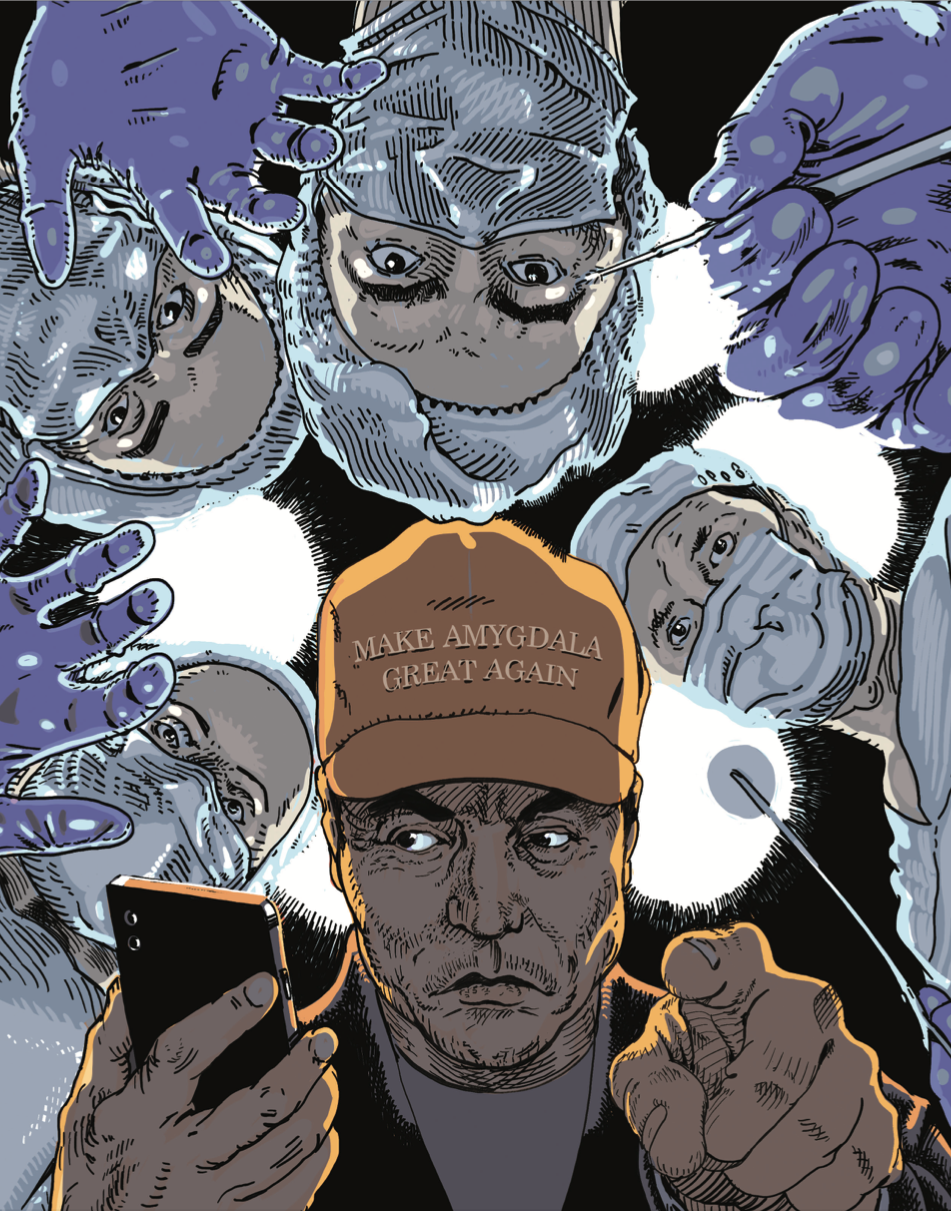
Art by Ben Clarkson from Current Affairs Magazine, Issue 57, January-February 2026
The first victims of the company were a group of rhesus macaque monkeys. In December 2022, the U.S. Department of Agriculture opened a probe into the company “amid internal staff complaints that its animal testing [was] being rushed, causing needless suffering and deaths,” according to Reuters. After reviewing internal documents, the outlet wrote:
One employee, in a message seen by Reuters, wrote an angry missive earlier this year to colleagues about the need to overhaul how the company organizes animal surgeries to prevent “hack jobs.” The rushed schedule, the employee wrote, resulted in under-prepared and over-stressed staffers scrambling to meet deadlines and making last-minute changes before surgeries, raising risks to the animals.
These allegations follow a pattern: no matter the industry, Musk needs to be fast and first, product safety be damned. In 2017, when Tesla began ramping up production of its Model 3, Musk announced plans to produce 5,000 units of the car per week. Workers were unable to meet even half of that goal in the first quarter, despite reports of grueling hours and nights spent sleeping on the factory floor. Recent safety inspections of the Model 3 in Denmark and Germany revealed that 23 percent of the vehicles failed to meet safety standards.
When Musk purchased Twitter in 2022, he similarly hit the ground flailing. 80 percent of the workforce were fired within five months, and the remaining staff were told to accept an “extremely hardcore” work culture or get out. At a town hall meeting following the acquisition, Musk told the audience, “If nothing else, I am a technologist and I can make technology go fast and that’s what you’ll see on Twitter.” His rapid changes—like slashing content moderation and making users pay to get verified—resulted in bots swarming the site and advertisers pulling their funds.
This “cut first, measure later” strategy has failed over and over, but that won’t stop Musk from trying again. At Neuralink, too, he seems most concerned about other companies beating him to the punch. The Reuters report continues:
Earlier this year, [Elon Musk] sent staffers a news article about Swiss researchers who developed an electrical implant that helped a paralyzed man to walk again. “We could enable people to use their hands and walk again in daily life!” he wrote to staff at 6:37 a.m. Pacific Time on Feb. 8. Ten minutes later, he followed up: “In general, we are simply not moving fast enough. It is driving me nuts!”
On several occasions over the years, Musk has told employees to imagine they had a bomb strapped to their heads in an effort to get them to move faster, according to three sources who repeatedly heard the comment.
The immediate result of this overdrive was roughly 1,500 dead animals, either killed directly by Neuralink’s experiments or euthanized afterward. It seemed that monkeys had it the worst. A 2023 expose by Wired detailed the gruesome effects of the company’s first brain chips—and how Neuralink scientists refused to euthanize a suffering primate, even as the device was clearly torturing her. (Warning: the following passage is disturbing.)
The tan macaque with the hairless pink face could do little more than sit and shiver as her brain began to swell. The California National Primate Center staff observing her via livestream knew the signs. Whatever had been done had left her with a “severe neurological defect,” and it was time to put the monkey to sleep. But the client protested; the Neuralink scientist whose experiment left the 7-year-old monkey’s brain mutilated wanted to wait another day. And so they did.
An autopsy would later reveal that the mounting pressure inside her skull had deformed and ruptured her brain. A toxic adhesive around the Neuralink implant bolted to her skull had leaked internally. The resulting inflammation had caused painful pressure on a part of the brain producing cerebrospinal fluid, the slick, translucent substance in which the brain sits normally buoyant. The hind quarter of her brain visibly poked out of the base of her skull.

Somehow, the USDA determined there was no evidence of animal welfare issues, despite outcry from the Physicians Committee for Responsible Medicine, who claimed the agency had “wiped violations from public record.” The department reopened its investigation in late 2024, just as the Securities and Exchange Commission opened their own inquiry into the company for lying to investors about safety. But the window for accountability was already closing. In January 2025, during the first week of his second term, President Donald Trump fired 17 inspectors general, including Phyllis Fong, the official overseeing the Neuralink USDA inquiry. After several top officials at the SEC were also fired, their investigation, too, seemed to dry up.
If the regulatory safeguards aren’t catching these issues, it’s worth asking what happens when Musk’s technology fails. History has shown that it often does—from rocket ships that explode at the launchpad to Cybertrucks whose aluminum frames snap and crack at the first sign of stress. In Neuralink’s first human trial, roughly 85 percent of the electrode threads connected to Noland Arbaugh’s brain detached within the first three works, leaving the brain chip essentially useless.
After telling Arbaugh they could not remove the chip, Neuralink’s scientists were able to remotely update its software and allow the implant to regain function; still, the fact that it would detach almost entirely within a month, leaving it untethered in somebody’s brain, gives cause for alarm. No one is demanding that medical devices function perfectly during trials—these are experiments, after all, and participation is voluntary. But when a company rushes production, any negative side effects are going to fall under scrutiny.
Even if the hardware worked perfectly, one needs to consider the longevity of Neuralink as a whole. Just look at Second Sight Medical Products: a biotech company that faced looming bankruptcy after they’d already inserted several hundred bionic eye implants in blind patients. More than 350 people gained partial vision with the technology, only for several of them to find the devices useless after the company discontinued the product. As Business Insider writes:
Now, hundreds of people who still have the old implant have been left in the lurch: no software upgrades as promised, and no repairs if something goes wrong. It means some have lost their sight altogether, and many more risk the same, according to IEEE Spectrum.
Imagine that happening inside someone’s brain: your neural functions suddenly compromised because the company went under, stopped updating software, or decided it wasn’t profitable to maintain. These concerns might be why, as of 2022, only two of Neuralink’s original eight founders remained at the company, with co-founder Benjamin Rapaport citing safety concerns over the “amount of brain damage” used in Neuralink’s insertion method as a reason for his departure.
Yet Neuralink keeps moving forward, fueled by hundreds of millions in investor funding and the promise of something far beyond medical necessity. In June of this year, the company received $650 million in funding from a slew of investors in order to “innovate future devices that deepen the connection between biological and artificial intelligence.” One of the key investors was Peter Thiel’s Founders Fund, which raised a separate $280 million for the company back in 2023. If you need any extra convincing that Neuralink’s long-term goals have always been to create quasi-immortal human robots, then look no further. Thiel is obsessed with cheating death.
Like many billionaires, the Palantir founder seems to believe that he can invest his way to eternal life, and the paper trail confirms it. Back in 2006, Thiel donated several million dollars to immortality scientist Aubrey de Grey, who attempted to tinker with the mitochondrial DNA of cells to prevent them from aging. In 2010 he invested $500,000 in Halcyon Molecular, a company which aimed to “create a world free from cancer and aging” (but later went bankrupt). In 2021, Thiel co-founded NewLimit, a startup focused on epigenetic reprogramming for lifespan extension, bringing his total portfolio to at least 12 different longevity companies. Now he’s funneling money into Neuralink, a company whose goal posts appear to be rapidly shifting.
But if anyone were paying attention, Elon Musk has shown his cards from the start. Musk has repeatedly suggested that brain implants could eventually move beyond assisting disabled patients and enter the realm of transhumanism—specifically, the ability to store human consciousness outside the body.
In 2017, long before AI chatbots were the stuff of daily use, Musk planned for his brain chips to one day fuse with artificial intelligence: “If we achieve tight symbiosis, the AI wouldn’t be ‘other’—it would be you,” he told the tech blog Wait But Why. He claimed to have been inspired by sci-fi series The Culture, which explores a world where all individuals are fitted with a “neural lace.” Written by Iain M. Banks, the books describe an advanced brain-computer interface that allows users to upload their consciousness, communicate internally with machines, and essentially live forever. In this fictional universe, the neural lace contributes to a socialist utopia; resource scarcity is eliminated, destroying the need for money, and people are free to pursue whatever they desire.
But we can’t expect the richest man in the world to possess the kind of reading comprehension necessary to see beyond the plot. In 2018, only seven years before Musk would join the U.S. government and cut billions of dollars from USAID, potentially causing millions of deaths across the globe, he called himself “a utopian anarchist of the kind best described by Iain Banks.”
Something tells me that the author, who sadly died several years before Musk’s declaration, might not agree. In his lifetime, Banks endorsed the Scottish Socialist Party, campaigned against the 2003 invasion of Iraq, and refused to sell his books in Israel in support of Palestinian liberation, a cause he was inspired to join after witnessing South Africa’s own “racist apartheid regime,” he wrote in the Guardian. Musk, meanwhile, is a warmongering technocrat whose father says he’s not racist only because Elon was friends with “several Black servants” as a child. (In, you guessed it, apartheid South Africa.) But Musk’s hubris will always blind him from realizing that he is the villain.

To Elon, heroes win, and there is nothing more noble than first place. We saw this mindset unveiled in its full horror on the evening of January 20, 2025. Standing onstage at Trump’s inaugural rally, after pouring over $250 million and the last remaining shreds of his dignity into the campaign, Musk must have felt that he’d won, and he celebrated the fruits of his labor with a triumphant Roman salute. Within minutes, anyone with access to cable TV, the internet, or their own eyeballs was calling him a Nazi.
But one man watching had unique insight—not only into Musk’s right-wing psyche, but into how his megalomania may have influenced the formation of Neuralink.
Shortly after Trump’s inauguration, Dr. Philip Low, a neuroscientist and former collaborator of Musk’s, penned this scathing letter on social media:
I have known Elon Musk at a deep level for 14 years, well before he was a household name. [...] Elon is not a Nazi, per se.
He is something much better, or much worse, depending on how you look at it. Nazis believed that an entire race was above everyone else. Elon believes he is above everyone else. [...]
All his talk about getting to Mars to “maintain the light of consciousness” or about “free speech absolutism” is actually BS Elon knowingly feeds people to manipulate them. Everything Elon does is about acquiring and consolidating power. That is why he likes far right parties, because they are easier to control.
Dr. Low says he’s witnessed firsthand this insatiable desire for power. Back in 2007, Low launched his own neuroscience company, NeuroVigil, with a mission of developing “non-invasive brain monitors and advanced machine learning algorithms” to detect diseases in the brain. (Sound familiar?) Musk is listed as an adviser on the official NeuroVigil website, and is quoted as calling the company the “only one” with “true potential to completely revolutionize neuroscience.” In a 2014 interview for Raw Science, the two sit side-by-side, with Low donning a SpaceX “OCCUPY MARS” T-shirt.
Two years later, Musk launched Neuralink—and in 2021, he was reportedly fired from Neurovigil’s board after Low claims “he tried to manipulate NV’s stock.” Low says his parting email to Musk ended with the lines: “Good luck with your implants, all of them, and with building Pottersville on Mars. Seriously, don’t fuck with me.”
The neuroscientist didn’t come forward with this story until several years later, just as it seemed the entire world was debating over that televised Third Reich salute. Musk’s former friend left the public with one pressing piece of advice:
He only wants to control, dominate and use you — don’t let him and cut him and his businesses out of your and your loved ones’ lives entirely. Remember he is a total miserable self-loathing poser, and unless you happen to be one too, he will be much more afraid of you than you should ever be of him.
What Musk is afraid of is falling behind. The issue is, that fear becomes much more sinister when the competition at hand is no longer between companies, or even two political candidates, but between technology and humanity as a whole. “We’re going to have the choice,” Musk said in 2017, “Of either being left behind and being effectively useless or like a pet—you know, like a house cat or something—or eventually figuring out some way to be symbiotic and merge with AI.”
What’s hilarious is that this so-called “choice” is entirely his own creation. No one is asking for this. It is nowhere near inevitable. Musk is the one pursuing digital immortality, while shedding any democratic safeguards that might restrain him. He is the one who wants to leave humans behind—both internally, by fusing with artificial intelligence, and physically, by abandoning our home planet in favor of a cold and lifeless one.
Maybe as a billionaire, when the small and infinite joys of daily life elude you, humanity loses its appeal. Author Joyce Carol Oates recently said it best, writing of Musk: “So curious that such a wealthy man never posts anything that indicates that he enjoys or is even aware of what virtually everyone appreciates—scenes from nature, pet dog or cat, praise for a movie, music, a book (but doubt that he reads); pride in a friend’s or relative’s accomplishment; condolences for someone who has died [...] In fact he seems totally uneducated, uncultured.” The poorest people of all, she continued, “may have more access to beauty and meaning” than the world’s wealthiest man.
Musk responded by saying that “eating a bag of sawdust” would be more enjoyable than reading Oates’ work. Shortly after, Grok began telling users that Musk is “among the top 10 minds in history” and that his intellect rivals Leonardo da Vinci and Isaac Newton. When the real world doesn’t respect you, I suppose, why not build your own?
And so Musk envisions a future in which the wealthy abandon biological limitation, living indefinitely in digital or hybrid form. Personally, I am not too concerned about what happens if he succeeds. If there one day exists a world in which rich people discover immortality, so be it. A digital afterlife filled exclusively with Jeff Bezoses and Peter Thiels and Elon Musks sounds like the seventh layer of hell. I will gladly choose to die normally, at age 80 or 70 or even 45, if it means I don’t have to participate.
What concerns me are the real-life human beings Neuralink might mutilate in this pointless pursuit. The company hopes to one day open its recruitment to the general public—and while traditional disability-assistive medicine has clear ethical frameworks and regulatory pathways, immortality experiments in human subjects do not. Just remember: Elon Musk thinks our human brains, in their current form, are “effectively useless.” So what might he do with yours?


%20(crop).jpg?width=352&name=wile-e-coyote%20(resize)%20(crop).jpg)