“We’re All Just Open Targets Now”: Rania Khalek on Expanding War in Lebanon
From inside a city under fire, journalist Rania Khalek describes the devastation in Beirut, and the dissonance of Americans who think they'll remain unaffected.
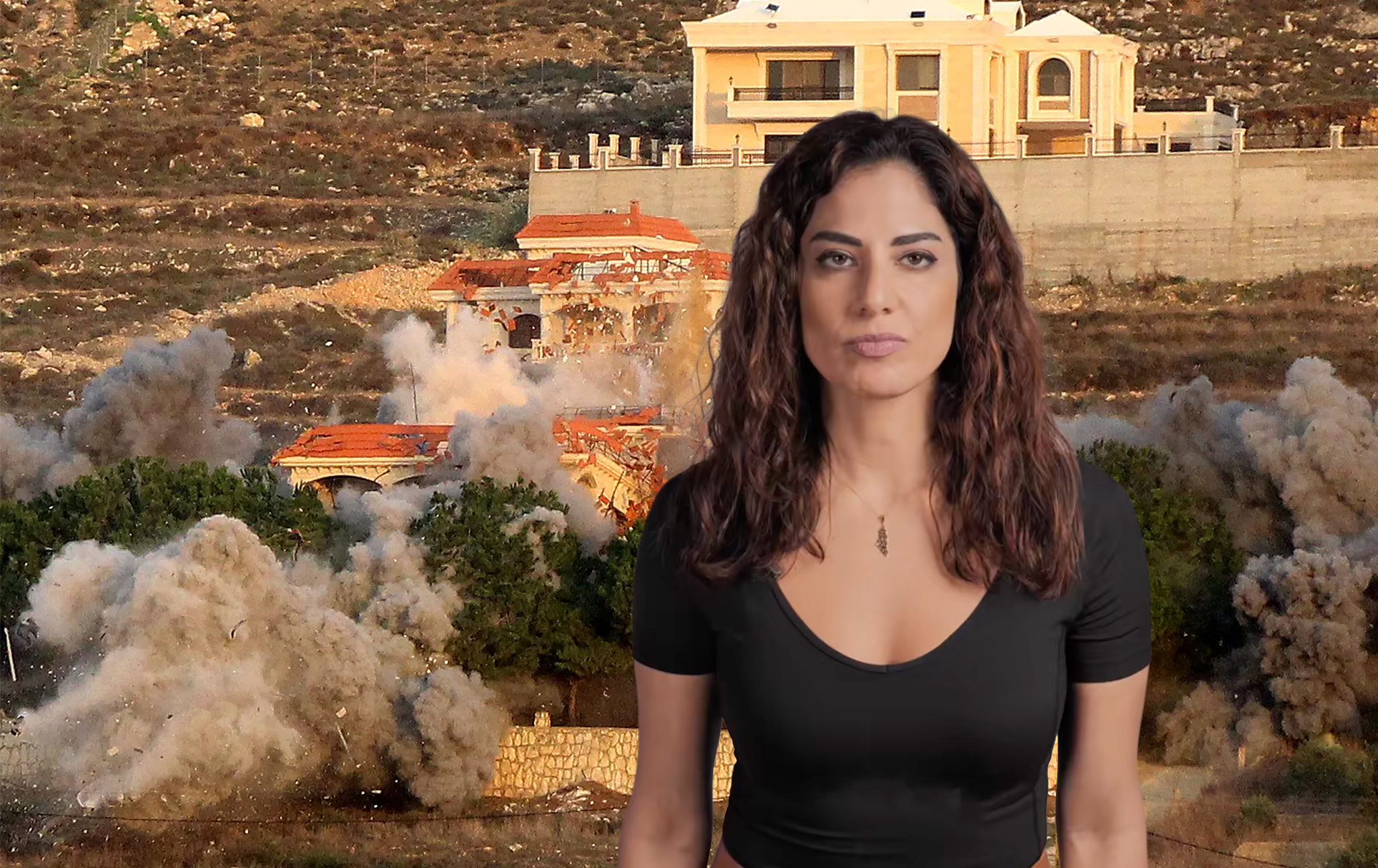
Rania Khalek is a Lebanese-American journalist and host of the Dispatches podcast from BreakThrough News. Khalek spoke to Current Affairs from Beirut—amid ongoing airstrikes—to discuss the brutal on-the-ground reality of Israel's attacks, the complicity of U.S. politicians, and the responsibility of ordinary Americans to speak out against the bloodshed. Although war may seem distant, she warns, it is closer than people think: "People need to treat this as being serious," says Khalek. "Because there is something called an imperial boomerang, and this will come home."
Nathan J. Robinson
Well, let's start with the situation that your country is presently in. And perhaps you could tell us, from your view there, what it is like in Lebanon right now.
Rania Khalek
In Beirut, which is where I'm talking to you from right now, it's very tense. Part of the suburbs of the city, what you'll often hear in the media called the southern suburbs of Beirut or Dahieh, is basically emptied of people, mostly because a couple of weeks ago, the Israelis gave these displacement orders for people to leave that area. About 500,000 people live there, and they've been just bombing it relentlessly, promising to turn it into Gaza.
This is an area of the suburbs of Beirut that's predominantly Shia and votes for Hezbollah because we have elections here, and Hezbollah does run in those elections. So Israel is basically attacking that area for that reason. And then the rest of Beirut in past wars, except for maybe 2024—but even then, except for a few exceptions—is typically sort of safer, and that's where displaced people will go to take shelter in.
But just last night—I don't know when this is going to come out, but I'm talking to you on Wednesday, March 18—the Israelis unleashed a pretty heavy barrage of violence on central Beirut, which is typically considered a safe area. They did four airstrikes, or strikes—some of them might be coming from the sea—one of which actually downed an entire building, and it was in the middle of the night.
They often do these kinds of strikes in the middle of the night. So people are getting either displacement orders or getting no warning at all at 2am, 3am, or 5am. It's just pure terror, and it kept the whole city up, and nobody slept. So all that's to say the city is quite tense. I should mention we're in week three of this war, and we can talk about how Lebanon entered into this war.
But at this point, just to give you a few numbers, on the day that we're talking, over 900 people have been killed by the Israelis. That number is probably going to be higher when this comes out. One hundred and eleven of those killed have been children, and over a million Lebanese—it's a very small country, Nathan—have been displaced, and they've been displaced from southern Lebanon forcibly by the Israelis, who basically have created a kill zone there, just like they did in Gaza, where they say this area is now red, get out, and anybody who stays is basically killable. So the people of South Lebanon have been forcibly displaced—southern suburbs of Beirut and also huge swaths of the Beqaa, which is in eastern Lebanon. And so that's one in five people. Lebanon is a very small country. It's a country of about 5 million people.
So one in five people in Lebanon is currently displaced. They're almost entirely Shias. This is basically a war on the Lebanese Shia population, which is considered Hezbollah space. And the Israelis are invading Lebanon right now in the south, and just yesterday, the Israeli Defense Minister stated that the Shias of South Lebanon will not be allowed to return to their homes until Israelis feel safe.
Robinson
As we know, they never do.
Khalek
Right. So what's happening in Lebanon right now is totally devastating, has completely shocked the country, and it's a really bad situation.
Robinson
Where do people go? If they evacuate the entire southern part of the country or the southern part of the city, what are people doing in these "evacuations"?
Khalek
So the Lebanese Government is known for being very weak. They've done very little to basically help the displacement situation, even less than they did last time around in 2024 when there was mass displacement like this as well. But they have opened some shelters across the country, several hundred, but for over a million people, it's just not sufficient. And people will go stay with family. After 2024, people who were middle class or upper middle class foresaw another war would likely happen, and they put contingency plans in place. So from then, after the 2024 war ended, they rented places. Some people had those backups available to them as soon as this war broke out. That's not very many people, though.
And other people, Nathan, are sleeping on the streets. In Beirut, there's an area called the Corniche, which is basically the seaside promenade, and there are people sleeping in tents there. There's a public beach called Ramlet al-Baida in Beirut, where, just last week, the Israelis actually bombed displaced people there. It's still unclear if they were targeting somebody and bombing people, or if they were bombing them to terrorize them, or both. But all that's to say, the displacement situation is very alarming. And just to give some background about why this is happening as well, there was a war in Lebanon that lasted about two months back in 2024.
You might remember it started with the pager attacks and then the elimination of Hezbollah's entire senior leadership, including its Secretary General, Hassan Nasrallah, and it lasted until the end of November 2024, at which time a ceasefire was put into place. And 15 months after that, Hezbollah had abided by that ceasefire and had kind of slowly been giving up arms south of the Latani River, which is what the Israelis and Americans were demanding. They were being disarmed by the Lebanese army, which is largely funded by the Americans and some Gulf States. But all that's to say, for 15 months, there was this ceasefire in place that only one side abided by. The Israelis violated that ceasefire over 15,000 times and regularly, almost every day, bombed Lebanon and killed 370-plus people in that time. So there was only a ceasefire for one side.
I raise all that to say that in those 15 months, the Americans were basically putting a gun to the head of the Lebanese government and saying, "Disarm Hezbollah, or we'll let Israel do it for you." But the thing is, Hezbollah represents a huge swath of Lebanon. They win a big number of seats. They're part of the biggest political bloc in the country in parliamentary elections here because they represent a community that feels that they're not protected by the Lebanese government. Because they're not.
The Lebanese army is very poorly funded. It's given hand-me-down weapons by the Americans that amount to broken guns and one or two really old helicopters. And the reason the Americans do that is because they don't want Lebanon to have an army that's capable of standing up to the Israelis. And tasking the Lebanese army with essentially disarming Hezbollah is how you start a civil war, because you're causing a confrontation between basically two armed groups in the country. So the Lebanese government has refrained from kind of following American dictates on that as much as they possibly could.
And meanwhile, the reason Hezbollah exists is that the Israelis invaded and occupied Lebanon in the early 1980s, and they stayed for over 15 years. It was a brutal occupation. They committed massacres, and they subjected people to torture. They funded proxy militias that did terrible, terrible things. All the things that the Israelis are known for, they did in Lebanon. And Hezbollah formed under those conditions, with help from the Iranians after the Iranian Revolution, and as a result, they were able to sustain guerrilla warfare against the Israelis throughout the late '80s and the '90s, until the year 2000, when they kicked the Israelis out. The Israelis actually withdrew, and southern Lebanon was liberated. And then they fought the Israelis again in 2006 and kind of humiliated them. They were this big, powerful army funded by the Americans, and they tried to invade Lebanon, and they were incapable of doing so because Hezbollah really excels at on-the-ground guerilla warfare. And then there were years of an understanding of a kind of deterrence, until the year 2024, when Israel unleashed this massive escalation on Lebanon in September 2024. All that's to say now we're in a situation where Israel has once again invaded Lebanon.
And of course, the media will say it was prompted by Hezbollah's entrance into the Iran war on March 2. And it's true, on March 2, Hezbollah fired after 15 months of zero ceasefire violations from Hezbollah and only by the Israelis. Hezbollah, after the American-Israeli assassination of the Iranian Supreme Leader, Ali Khamenei, launched six rockets at Northern Israel, and they did no damage. They were almost entirely intercepted, or I think one landed in a field or something. And the Israelis had planned to attack Lebanon, and so they went ahead and unleashed their attack on Lebanon. And that's where we are now.
We can talk a bit more about that, because there are lots of opinions in Lebanon, a lot of anger at Hezbollah for doing that. But all that's to say now we're in a situation where Israel has invaded and Hezbollah is essentially a part of the South, and that is the only thing that's standing in the way of a full-fledged Israeli occupation, which, by the way, could still happen if Hezbollah and Iran lose.
Robinson
And it's important to understand, of course, this occurs in the context of a war of aggression by the United States against Iran. So I'm sure there are many people who are critical of Hezbollah responding to that attack, but that is the defense of an ally against an aggressive, totally unprovoked attack by two outside nuclear-armed powers.
It might be strategically unwise for Hezbollah, but I think we have to admit the legitimacy of self-defense against the United States and Israel, given what's just happened in the last few weeks.
Khalek
Oh, absolutely. And I'll also add from Hezbollah's own calculation too. Because a part of this is, yes, stepping in to defend an ally, but also, this is a huge gamble, and we'll see if it works or not. But just like it's a war of survival for the Iranians, it's a war of survival for Hezbollah as well. And they are not okay with the status quo of Israel just bombing Lebanon whenever they want to.
And so entering into this war, wise or not wise, is a gamble in the sense of, okay, there's a regional war, and our big patron is a part of it. We want to not just defend them, but we want to have a seat at the table to change the status quo of the ongoing attacks on Lebanon. And it stands to be seen, because, again, it's a massive gamble, but if Iran does come out victorious, the Iranians have stated that Lebanon will be a part of their settlement. So we'll see.
Robinson
It's especially a gamble given that we know that the United States and Israel are willing to engage in outright genocidal warfare and have no regard whatsoever for the rules of war. You mentioned that Israel gives warnings and then bombs. I think one of the important things to understand there is Israel always presents this as proof it's the most moral army in the world. "We warn people before they bomb them."
But in fact, what that operates to do is to legitimize the killing of everyone who's in an area afterward. Like if we've dropped a pamphlet or sent a text, then if you don't leave, you know we've shifted the burden onto you, and we can do to civilians what we otherwise couldn't do to civilians.
Khalek
The difference between Lebanon and Gaza is Lebanon is not surrounded on all sides by the Israelis, so it's harder to cut Lebanon off, though they still absolutely could do that at some point, but just not in the same way. And Lebanon's a lot bigger. It has more strategic depth than Gaza, and Lebanon is a very diverse country with several different sects. I would say that this is certainly a war on Lebanon, but first and foremost, it's a war on the Shias of Lebanon, because that's who's seen as Hezbollah's backbone. There are also different sects of Christians that are part of the Lebanese social fabric. There's the Druze sect. There are Sunni Muslims as well, who make up a large portion of the Lebanese population.
And so there's been a civil war in Lebanon, where these sects have fought each other in the past. People do have other places to maybe go, like other parts of the country, whereas in Gaza, it just all became one kill zone. But part of Israel's strategy in displacement is to push all of these Shias into non-Shia areas and create this social tension that they want to spill over into civil chaos. And that could very easily happen in Lebanon, because there is a lot of sectarian tension always bubbling under the surface in this country, and sometimes on the surface itself. And there is a lot of anti-Shia sentiment across this country that has a historical precedent but has also, in the last couple of decades, been provoked and propagandized about in Gulf state-funded media, oligarch-funded media, and American-funded media.
Robinson
Now, I want to ask you about something you tweeted recently. I want to talk about the United States. Obviously Donald Trump, with Israel, instigated this war against Iran. Technically, what's happening in Lebanon is an Israeli attack. But of course, every Israeli action is really a US-Israeli action, because it only occurs with tacit US permission and, of course, occurs with US funding and arms. But in the United States, the media attention to what's happening in Lebanon, even though the death toll, as you point out, is not totally dissimilar, and in fact, probably higher as a percentage of the population than even what is happening in Iran. You pointed out,
"Watching my US tax dollars invade and bomb my family's country. It's crazy that the only person I've seen speak out on Lebanon is Marjorie Taylor Greene."
And you said, "Hello, Democrats. Are you there?"
So can you talk about the reaction that you've seen among United States politicians in the US media?
Khalek
I've seen very little commentary from US politicians on Lebanon, and part of that is probably because the war on Iran is happening, and it's a much bigger deal in terms of how it's impacting the world and the region, and so I understand that aspect of it. But you have Israeli politicians who are openly, every single day, threatening to turn areas of Lebanon into Gaza. Nathan, just last week, I was in Beirut, and I heard three loud explosions that sounded like airstrikes. And it turned out the Israelis had dropped leaflets over Beirut. And one of the leaflets literally invoked Gaza to terrify the population. The other leaflet demanded that Lebanese turn on Hezbollah, and here's a QR code and WhatsApp us if you've got any information. It was that sort of thing.
But all that's to say, you have the Israelis in their media repeatedly invoking Gaza. The Israeli Defense Minister has said they're going to turn parts of Lebanon into Gaza. We know what that means. And American politicians know what that means.
Robinson
Right. It's genocide.
Khalek
Yes, they are talking about genocide. Exactly, and they're doing it. They've killed healthcare workers. They've bombed healthcare facilities and ambulances intentionally. They even said that ambulances are being used by Hezbollah, and that makes them a legitimate target. These are the same talking points that we heard in Gaza. And I do pay American taxes. I was born and raised in the US, I spend a lot of my time throughout the year in the US, and so my family's American. I am wondering where the hell Democrats are. I might have missed a comment. It's possible. Maybe Bernie Sanders said something, and I missed it because I've been so focused on trying to figure out where the Israelis are going to bomb next. I don't know, but all I've seen so far is Marjorie Taylor Greene, who I disagree with vehemently on almost everything. She's basically like a fascist, but Marjorie Taylor Greene went on CNN, I think it was, and spoke out against what Israel's doing in Lebanon and said it's like Gaza.
And why is AOC not? Where is AOC? Where are you people to protect me and my family? Where the hell are you?! You saw what happened the last two years. It's literally repeating itself in Lebanon and in Iran. And I just don't—I don't understand. Are you guys just sitting on your hands, hoping that enough chaos and carnage and destruction will take place and everybody will blame Trump, and then you can just waltz right in to Congress come midterms? Are we all just collateral damage for that? Step the fuck up and do something!
Robinson
No, I think I actually admire your restraint given what's happening all around you right now. It has been remarkable and disturbing, and this is one of the reasons we wanted to talk to you, Rania. All the news, to the extent that there is news, is entirely about Iran, and Lebanon is just ignored. One of the things that I want Americans to understand—I'll ask you what you want Americans to understand—is what their country is responsible for that they don't notice their country is responsible for. The US could curtail Israeli aggression tomorrow if it made any kind of effort to.
Khalek
Yes, and look, I watched Gaza happen. I cried, I got angry. We saw this livestreamed genocide. And being in Lebanon, seeing some of these same tactics being used, is terrifying. This terrorizes you. No one is sleeping. This is horrific. It's scary. We don't know how it's going to end, or if and when it's going to end. It's so frightening. And I think about the fact that people in Iran are going through this as well. People in Gaza have been going through this for two-plus years. People in the West Bank are going through a version of this. How much are we going to allow the Israelis to spread the scope of their genocide? The circle is getting bigger and bigger and bigger. It's terrifying. And I know people might feel numb. I even feel numb to it, even as I'm dealing with a version of it. But this is happening because of our government. The Israelis cannot do this without our government letting them. And I have to say, Nathan, I find it somewhat startling that the vast majority of Americans oppose this war on Iran.
The vast majority, or increasing numbers, of Americans oppose the Israeli government and actually sympathize more with Palestinians. I think that's fantastic. This is the most unpopular war, I think, in the history of American wars. So my question is, what are people going to do about it? Get in the streets. Do something! Do something. Because you just have a bunch of populations—we're all just open. The air is open for Israel to just bomb us and America to just bomb us. And so it is your duty, as an American, to get together, to organize around this, and to do something. And I know I have something very personal at stake here. But I'm not just talking about Lebanon. Also, look what's happening in Cuba. Look what we did to Venezuela. This isn't going away. It's getting worse, and we have to step up. We have to treat this the way we treated those ICE killings in the US. Because people getting in the streets actually slowed that down a little bit. People need to treat this as being serious, because there is something called an imperial boomerang, and this will come home.
Robinson
Yes, it's important you point that out. Because humans can kind of get used to anything, almost, or we're creatures that get numbed to things, and there's a very real danger that Americans come to think that we just wake up and we've bombed a different Middle Eastern country today, and that's US foreign policy, and what can you do? That's over there. But you pointed out two things there. First, if you think things stay in one place, that's wrong. Even self-interested Americans have to understand when you wipe out entire families and schools, people get angry. Israel, after October 7, wanted vengeance. Things do boomerang. There's blowback from these things. You can't do these things without consequence.
But also, as you pointed out, protest does have power. It is remarkable—there was just a news story that said Donald Trump has kind of stopped talking about mass deportation as a goal because he realizes that actually it's incredibly unpopular. People saw what that involved, they didn't want it, they reacted in the streets, and the government overreacted to those demonstrations. Instead of leaving them alone, they killed people, and it tanked the popularity of the policy, and they have had to back off a little bit. It's still awful. There are still people in these immigration jails. But I think what you emphasize there is the importance of understanding that we do have some agency and therefore some responsibility.
Khalek
Absolutely. And it can't just be that we sit and let Trump get really unpopular and we don't have to do anything about it. People have to step up and do something, or else he's going to starve Cuba and collapse it. Gaza is going to happen in Lebanon. It kind of already is. And God knows what happens from this region on fire. He is collapsing the global economy, Nathan. I know people like us who follow the news, who think like us, are probably already like, "Yes, this is horrible."
But I'm actually like, how much do gas prices have to go up for the rest of the American population to care? I guess 50 cents isn't enough. But guys, it's going to get so much worse if this continues, and so far, there are no off-ramps. And it's like, where's the light at the end of the tunnel? We don't know, because one day it's going to be over in a week, and the next day it's going to be over in months, and they're invading.
Robinson
Israel obviously insists that all of its strikes are very carefully targeted to take out Hezbollah commanders and maybe their families, but at least targeted at people. And I think one of the important things that Americans need to understand is—because I get emails from pro-Israel people who are like, "Oh, you don't understand. Israel takes great care to select its targets"—that over the past decades, Israel has really, more and more and more, turned into a country that is just saturated with Nazi-like racist understandings of people and surrounding countries. And the idea of just wiping out entire civilian towns, entire populations, has become very, very normalized in Israel. And so, I think it's important to say, if we don't rein this in, we are dealing with a state that is perfectly capable of committing further genocides.
Khalek
Yes, I actually want to make a point. To everything you said, I agree with you 100%. Israel is a Nazi society that is endlessly trying to expand its borders and carrying out fascistic atrocities to do it, and it has been in front of the world. And the more its soldiers go out and carry out the atrocities, the more fascist they get. They have total impunity, and they know that, and it's making them more insane. They have an endless desire to continue to kill everyone around them and turn everything into this apocalyptic moonscape.
But I had Zachary Foster, who's a fantastic historian, on my show, Dispatches, just yesterday. And I'm not saying that just to plug it. (You should go check out that episode; it was really good.) But I'm also saying that because he made a really good point. We were talking about the idea: could this war on Iran escalate into Israel using a nuke? And it sounds kind of crazy, but at the same time, he made this really good point: this is a Nazified society that has demonstrated before a global audience that they are perfectly comfortable committing mass extermination of an entire population. So if anybody was going to use a nuke, it would be people who think like that, who are okay with killing a lot of people. And so that actually really terrifies me, on top of everything else.
Robinson
Well, Rania, that's an important point, because obviously, both the United States and Israel, despite insisting that they don't want Iran to have a nuclear weapon, both claim the right to have nuclear weapons themselves. And of course, the United States is the only power in world history that has ever used a nuclear weapon in war. They dropped it on a civilian population. And I think that the polling still shows that the majority of Americans still believe that was justified.
Now, that's the majority of normal Americans. If we start to think about truly deranged people like Pete Hegseth who are in positions of power, those people think of nuclear weapons as a legitimate weapon of war. They think that the ends justify the means, and if you have to massacre large numbers of civilians, it doesn't matter whether you do it with a nuke or not. They might be a little concerned about the potential for nuclear world war, but that's basically their only concern. There's no moral concern for them.
Khalek
Yes, at all. No, zero. These people don't have morals. I just saw a story that—first of all, there's the Epstein stuff. Everybody's watched that there's a political class of people who are fine doing sex-trafficking rings and raping little girls and calling them sex parties. And it's like a global cabal of these people in positions of power that are doing this. But the reason I raised the issue of rape is for some reason people are more horrified by that than bombing people. Both of those things are horrible. But I saw the story about how Israeli settlers, just a couple of days ago, apparently raped this older Palestinian man in front of his family with objects.
This is the kind of disdain for humanity that we're dealing with. And I know that's like a really extreme version of it, but there's this logic of a hierarchy of humanity, and a lot of us are on the bottom of it, and very few people are on the top of it. And it's just kind of the ethos of the American Empire right now. And so these people sitting in the White House don't have any concern whatsoever for the vast majority of people in the world, and the Israelis are an extension of that because they basically just are America's little clients. So, yes, it's a really disturbing world we're living in right now where these people just seem to have so much power and nobody is capable or willing to stand up to it.
Robinson
Yes. I think something Americans need to understand is that once you dehumanize people in the way that the United States and Israel certainly do, it legitimizes doing absolutely anything to them, and that may take the form of the way that Israeli settlers treat Palestinians in the West Bank, or it may take the form of firing a Tomahawk missile into a kid's school and really not thinking twice about it. And so we're going to see more of these kinds of atrocities, and we're probably going to see more silence in the United States media because of this pervasive implicit dehumanization that characterizes how the American discourse discusses people in Lebanon and Iran.
Khalek
Yes, it's really disturbing. I tune into a lot of Al Jazeera during times like this because they've just got coverage of everything, and then local Lebanese stations. And then every so often I'll flip over to CNN, and it's all these just talking heads talking about a video game or something. It's all just kind of a chessboard or the political horse race. And I'm just like, what the hell is this crap? This is what you're feeding Americans. No wonder they don't understand the severity of all of this. Because people like Jake Tapper, when that guy—who was it? Joe Kent? Sorry, the guy who resigned?
Robinson
Joe Kent, Trump's counterterrorism director.
Khalek
Yes, the guy who resigned yesterday. You had Jake Tapper being like, "Well, he's a neo-Nazi, so it doesn't count." And it's like, what? You people are just so pro-war. You love this so much. You love watching the entire destruction of the region that I come from. It's the same about Latin America. It's the same about Africa. I just want to go back to how disturbing it is, because there's just nothing they won't justify.
Robinson
But I think one of the important points you made there is the way that we can get into, and I think even people who oppose the war can find themselves lapsing into strategic or geopolitical discussions where we say, does the United States have a plan for how to deal with the closure of the Strait of Hormuz? And it's like, I don't know...But also, as you pointed out—
Khalek
That's the last thing on my list. It should be acknowledged that the US went into this completely incompetently. Absolutely, because it is kind of stunning how incompetent they've been. But also, when that's all that's being talked about, which is basically what the US media is—it's all this horse racing and chessboard stuff. And I get it. America reveres its soldiers. Every country does.
But I'm like, dude, they killed 168 school children. Those are human beings who had parents and families who loved them. One hundred and sixty-eight of them. And that's just one of the schools the Israelis and Americans have bombed in Iran. You can't even wrap your head around how insane it is. And that's after Gaza; we don't even know how many people they killed in Gaza.
Robinson
Well, it's the same as the reporting on Vietnam was, where there's a lot about, "Is the US waging the war competently?" as if we want them to be competent at their war of aggression, and that would be better. Where you are, is Israel waging the war "competently"? I don't know. Maybe they are achieving their strategic objective of pushing your country towards a civil war. I just think it's heinous.
Khalek
Yes, it's heinous when that's the primary and dominating conversation, as opposed to, wow, we're just killing a shit ton of people and destroying an entire region of the world that's full of so much history that America does not have, because America genocided the Native population and is just over 200 years old and can't even compare. We have ancient Roman ruins all across Lebanon, and I hope the Israelis don't bomb those. That's not the top of my priority list, but it is a part of our history here.
Iran has so many ancient buildings and mosques and all kinds of things the Israelis are destroying right now—a country that's not even like 100 years old, because it's just a settler colony that came into creation in 1948 and still keeps trying to decide what its borders are. And so I watch all this from here. This is a bit of a tangent, but something that was so bizarre for me to see being in Lebanon right now was to see Zohran Mamdani, who I really have a huge soft spot for, and I still do, but to see him denouncing Susan Abulhawa. I'm just like, this seems like not a great use of your time or attention. And I'm just sitting here, and American politics looks so dumb to me when I see that.
Robinson
Well, I think at the very least we could say that given the moral stakes right now, if you're not speaking out on what is being done to Lebanon with American tax dollars, if you're not pointing attention to what is still happening to Gaza despite the "ceasefire" and you're not relentlessly drawing people's attention to those things, your priorities are misplaced.
Khalek
Absolutely, and I really want people to consider how much it would suck to get pushed out of your home, how much it would suck to have Israel start treating you like they treat Palestinians and to tell you your land is now theirs, and to literally drop bombs on your neighborhood so that no structure exists anymore. That's what they're doing in southern Lebanon right now. And the idea that Hezbollah should give up its weapons to make that stop, when everyone knows that won't make it stop, is just completely insane. And the idea that people in Lebanon, whether they call themselves Hezbollah or not, shouldn't fight for their land and their territory and their sovereignty, knowing exactly what will happen if they don't, is just an insane prospect to me.
Anybody who thinks that is crazy, because I know nobody would ever be willing to give up everything they have—give up their land, give up their home—just hand it over without a fight. Most people would fight back. And that's what's happening in Lebanon right now. There is a country that has invaded Lebanon, and people in the south are fighting back in the organized fashion that they can. And the idea that we call that terrorism is just insane. We don't call it terrorism, but the idea that CNN is like, "Well, they're terrorists," and I'm just like, what are they supposed to do? Just hand over the keys to the Israelis and give them flowers and be like, "Enjoy my house; it's yours now"? That's insane! That's actually insane!
Robinson
Well, the same was true when Israel attacked Gaza after October 7. You can describe the October 7 attack itself as an act of terrorism, but when Israel invades, do people not have a right to defend their homes, schools, and mosques from being taken, flattened, and destroyed? Don't they have a right of armed self-defense against an invading force? There's often this refusal to grant the rights to others, the rights of self-defense, the right to live in peace and not be terrorized from above by bombs. We want all these things for ourselves.
Khalek
The right not to live in a ghetto and be treated like slaves. It's just amazing what we're able to be conditioned to allow, what circumstances we're just conditioned to be okay with for so many massive parts of humanity. And then the second they act out or fight back or use weapons to fight back against literal Nazis, it's like the whole world—and by the whole world, I mean the Europeans and Americans, so that's not the whole world, but what we consider the whole world—totally loses their shit. There were a lot of people who were saying, after October 7, when it became clear—and it became clear within a few days after October 7 what the Israelis were planning to do in Gaza. I think a lot of us were surprised how long it has gone on for and what they were willing to get away with.
But every time, every day, we heard more stuff—every time they bombed a new hospital or killed another family or carried out whatever horrific violations of humanity that they did—you had warnings from people like Gustavo Petro saying, "If we don't stop this, it's going to be used against the rest of us. This is a message to the Global South, specifically. But do not think this will not come to your doorstep."
Gaza is the worst of it, absolutely, but this is a new world they've created. The Americans and Israelis have created a new barbaric, savage world, where everything is ruled by whoever has the most powerful destructive weapons, and it might feel like you're safe from it because you live in a suburb of some state in the US, but I think that, actually, you shouldn't get comfortable in that sense of safety. We have a crisis of capitalism and a crisis of imperialism in this world right now. And when the ruling class has a crisis like that, they get very violent and very fascist very quickly.
Robinson
Well, if you attack civilian populations, you have legitimized that as a tactic, and you can't be surprised when that comes back and is used against you. I know that it's very controversial that The New York Times just reported the basic fact that the attacker on a synagogue recently had lost family in an Israeli airstrike in Lebanon. It just seems like an obvious point that if you kill people's families, you could say—which I would say—that attacking innocent Jewish civilians in a synagogue who are worshiping is abhorrent. But what you can't say is that it's unexpected that the same indiscriminate targeting of civilians, which is heinous when anyone does it, comes back and is used in reverse.
Khalek
No, totally. You've created new rules, or no rules. You've gotten rid of the rules at this point. And it's like with what Iran is doing right now. All these Western countries are condemning Iran, and the Gulf states are condemning Iran.
And fine, they're attacking the Gulf states, but they are responding in kind. You don't get to have wars where only one side has to follow rules and the other one doesn't. That's not realistic. It sucks. It sucks this is the world that the Israelis and Americans have created. But they have created a world where they have trampled over international law to the point where why should anybody follow it anymore? If you're going to play dirty, then your enemy's going to play dirty too.
Robinson
It's important to note that in the years leading up to this war, Iran's responses to US-Israeli provocations were very restrained. Whenever there was an assassination, they would fire off a few missiles that they knew were going to be shot down. And obviously there's outrage at the indiscriminate targeting of civilian areas or whatever. This is noted by very mainstream US foreign policy analysts, but Iran clearly didn't want to get into a conflict with the United States and Israel and was trying very hard to avoid it. But when you escalate, you invite escalation in response.
Khalek
Yes, totally. Look, the Iranians did everything they possibly could to avoid this war. They really did everything they possibly could, and then they were attacked. And once you're attacked, you have every right to defend yourself, and Iran is no different. Iran is a country. Like their government, hate their government—it doesn't matter how you feel about Iran's government; they, as a recognized country, have a right to defend themselves. And when you corner a country and put them in a position of desperation—this is an existential war for Iran. It's existential. If they lose this war, their country could collapse into complete chaos. You can't control what it collapses into. Just completely destabilized indefinitely.
And we've seen what that looks like in places like Libya. Iran is a country of 90 million people, and the Europeans understand that collapse could be very damaging for them because they hate refugees from the Middle East, so they're coming out against this war now too. But all that's to say it's a war for survival. And so when you corner somebody into survival mode, they're going to lash out with every piece of leverage that they have. And everybody said so. Anybody who has any measure of understanding or expertise on Iran was like, "If you attack Iran, here's what will happen." So they knew all of these possibilities. None of this is surprising. None of this is surprising.
Robinson
The United States government has no one to blame but itself for any of the consequences of this war. Well, obviously, here at Current Affairs, we are deeply concerned, Rania, as we see the escalating terrorism against the people of Beirut, which seems to be reaching further and further north as Israel is emboldened to even more indiscriminately attack targets. So we hope that you stay safe, and that everyone around you stays safe as this terror continues.
Khalek
I really appreciate the sentiment. And yes, I will do my best, and I appreciate you letting me come on to talk about all this.
Robinson
Well, I also have to say, I admire your constant ability to maintain your seemingly cheerful and sunny disposition. You're always a joy to talk to, Rania.
Khalek
I'm stressed out, but you've got to do it with a smile on your face.
Robinson
Yes, well, it's so important that Americans understand that this is not just a war against Iran. There is also a war against Lebanon, and we are no less responsible for that because it's done with our money and our weaponry. Rania Khalek, thank you so much for coming on the program.
Khalek
Happy to come on anytime. Thank you. Nathan,
Transcript edited by Patrick Farnsworth.

%20(crop).jpg?width=352&name=wile-e-coyote%20(resize)%20(crop).jpg)