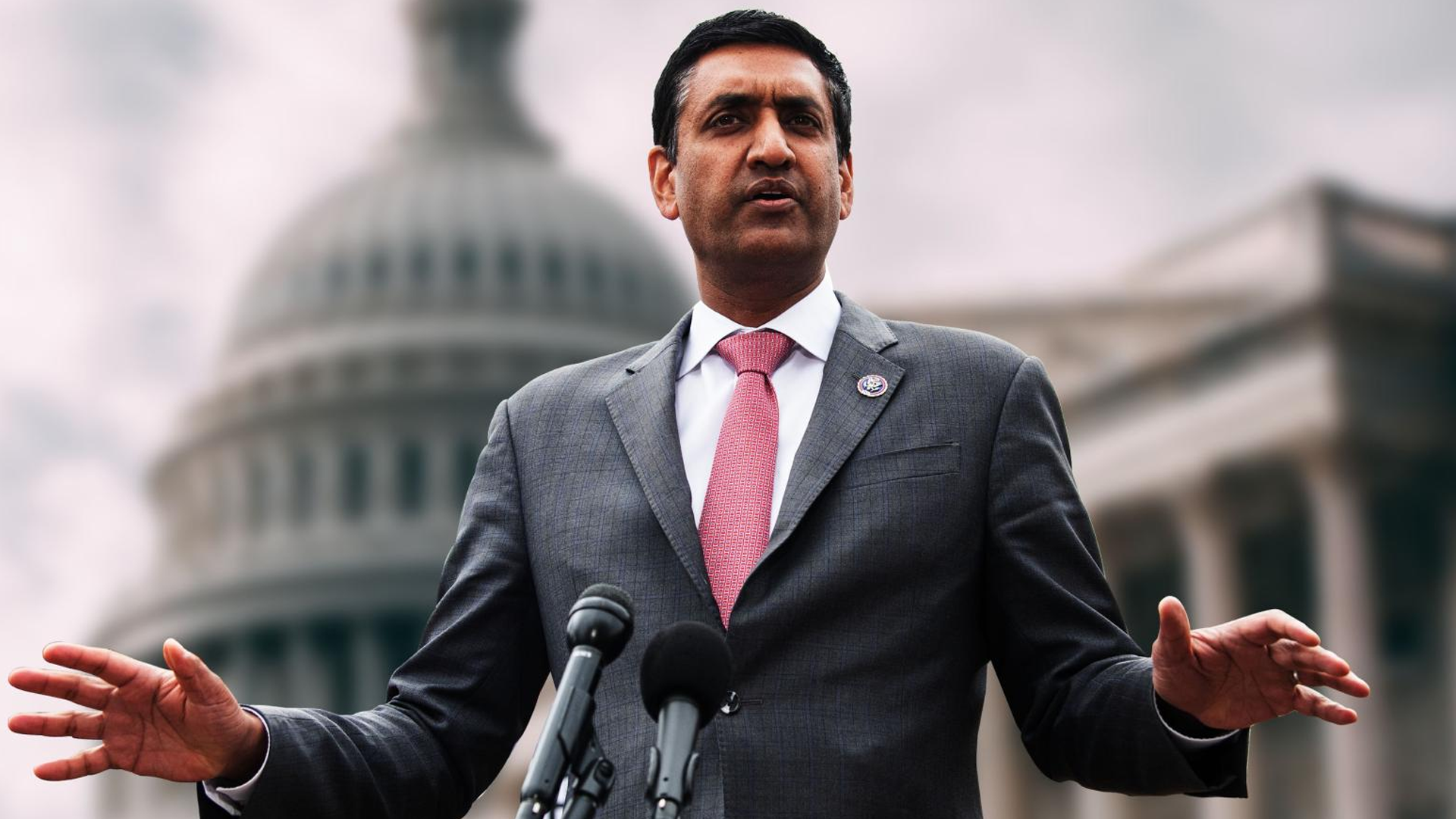
The ballot measure’s loudest critics in Silicon Valley are way off-base. Unfortunately, Representative Ro Khanna has some misconceptions too.
Recently, Representative Ro Khanna has distinguished himself as one of the few prominent Democrats with ambition, initiative, or really any virtues at all. Along with his Republican ally Representative Thomas Massie, Khanna has been at the forefront of the push to release the full Epstein files and expose any co-conspirators the wealthy pedophile may have had in U.S. political circles. In the lead-up to the Trump administration’s criminal assault on Venezuela, Khanna was one of the loudest and most consistent voices opposing U.S. aggression, going back to 2019. He has called for the arrest of the ICE agent who murdered Renee Good, which is more than Mayor Jacob Frey or Governor Tim Walz have done. Unlike a lot of Democrats, Khanna also understands how to engage people online, appearing on everything from the Adam Friedland Show to the Revolutionary Blackout Network in a sweeping tour of independent media. He makes no secret of the fact that he wants to take a leadership role in the House, and there’s growing speculation that he may even run for president in 2028. But it’s his latest economic move, endorsing a five percent tax on the wealth of billionaires, that really has people riled up.
For an ambitious politician in search of a winning policy, a billionaire tax is a promising choice. In an Economist/YouGov poll published last December, 61 percent of Americans said billionaires aren’t paying enough in taxes (including 34 percent of Trump voters!), while 80 percent said wealthy people “have too much political power” in the United States. At the recent inauguration of Mayor Zohran Mamdani, one of the biggest applause lines came when Bernie Sanders mentioned getting wealthy people to pay “their fair share,” leading the crowd to erupt in chants of “TAX THE RICH!” Economic inequality is one of the top issues on everyone’s mind—and how could it not be, as the cost of rent and groceries keeps soaring higher while the plutes gather their super-yachts at the island of St. Barthélemy to ring in the new year?
Now, Ro Khanna didn’t create this particular wealth tax. Officially named the 2026 Billionaire Tax Act, it’s a California ballot measure initiated by the Service Employees Industrial Union (SEIU), who say it’s necessary to offset the “massive cuts” to Medicaid and other health services that came with Donald Trump’s “One Big Beautiful Bill.” The union is now trying to collect the necessary 874,641 signatures (roughly four percent of California voters) to get the issue on November’s ballot. But although he didn’t start the movement, Khanna has become an enthusiastic champion of the wealth tax, telling the Nation that “there is a social contract to make sure there’s shared prosperity, and that is what we need.” He’s being slightly opportunistic here, jumping onboard with an idea that’s already popular. But it’s earned him enemies too, including California’s Governor Gavin Newsom, who is dead-set against the tax. And because Newsom and Khanna may end up as adversaries in a 2028 presidential primary, the conflict gains extra significance in the ongoing civil war for the fate of the Democratic Party.

Because some extremely wealthy and influential people have been talking nonsense about this tax—which we’ll get to—it’s worth taking the time to read the bill in full, and judging for yourself. The latest draft is only 34 pages long, and the language is fairly clear, straightforward, and non-boring. It’s an excise tax, meaning one targeted at specific goods and activities—in this case, “the activity of sustaining excessive accumulations of wealth by applicable individuals with net worth of $1 billion dollars ($1,000,000,000) or more.” For each billionaire in California, it would tax “5 percent of the net worth of such individual,” and “the Act provides for taxation on all forms of personal property and wealth, whether tangible or intangible,” with a particular focus on “shares of capital stock, bonds or other evidences of indebtedness.” If they want to, billionaires can opt to “pay annually in five equal installments commencing in the year the tax is due,” meaning they’d only have to pay 1 percent of their total wealth in any given year—although taking the delayed payment plan triggers an “annual nondeductible deferral charge of 7.5 percent of the remaining unpaid balance,” so dragging the process out for longer is more costly.
The most important part, though, is what the money would go to fund: 90 percent to healthcare, especially California’s Medicaid program, and 10 percent to food benefits and education. The SEIU estimates it would raise up to $100 billion for those causes. That’s a lot of medicine!
For all the outrage this bill has raised among the hyper-rich, its actual proposals are fairly accommodating to them. “Real property” like houses and land isn’t included in the definition of net worth, and there’s a range of other exceptions and carveouts, including pensions, Roth IRAs below $10 million in value, and up to $5 million of “other assets, including art and collectibles, financial instruments other than those that are publicly traded, intellectual property rights, debts and other liabilities owed to the taxpayer[...] and vehicles and other personal property.” None of that stuff is taxed, so Mark Zuckerberg’s $900,000 wristwatch is safe. (Let’s all take a moment to breathe a collective sigh of relief.) On top of that, “genuine debts and other liabilities owed by the taxpayer shall be taken into account for purposes of determining the taxpayer's net worth.” So if you have $1 billion in your stock portfolio, but you have even five bucks in debt somewhere else, you wouldn’t be considered a “billionaire,” and wouldn’t be taxed. All things considered, it’s not a bad deal. But inevitably, the billionaires don’t see it that way.
Fine California Whine
Ever since this wealth tax, and especially Ro Khanna’s strong support for it, were announced, the capitalist class has been throwing a public tantrum. They really, really don’t want to pay the tax, and they’re being incredibly dramatic about it. You’d think Khanna and the SEIU were robbing them at gunpoint. “Silicon Valley is finally realizing what time it is. Dinner time. And they’re on the menu,” writes venture capitalist David Sacks on Twitter/X. David Friedberg, another venture capitalist, agrees, calling the proposal “an organized government seizure of private property from citizens,” rooted in “the darkest of human fantasy—socialism.” Reid Hoffman, the co-founder of LinkedIn, calls it “horrendous.” Amjad Massad, the CEO of an AI company called “Replit,” writes that “the net effect will only be the destruction of the [Silicon Valley] startup ecosystem.” The co-founder of Reddit, Alexis Ohanian, has chimed in to tell everyone that although he’s concerned with “a rapidly increasing wealth gap,” the “answer is definitely not taxing unrealized gains.”
Interestingly, this group is politically bipartisan. Sacks is currently an advisor to Donald Trump, while Hoffman donated heavily to the Kamala Harris campaign. But they all agree on tax avoidance. According to the Wall Street Journal, they have a Signal chat where they gripe to each other about the ballot measure, calling it “communism.” It’s safe to say the mood in there is not happy.
As usual, though, California’s resident Scrooge McDucks are talking nonsense. A wealth tax is not socialism, let alone communism. It will not destroy Silicon Valley, and nobody is “on the menu.” Let’s start with the obvious: five percent is not a large portion of anyone’s net worth. Suppose you had $10,000 in the bank—an optimistic number, since most Americans famously can’t cover an emergency expense of even $1,000, but let’s roll with it. If you got charged the exact same tax David Sacks is now soiling himself over, you’d pay just $500, leaving you with $9,500. And because the purpose of the tax is to provide medicine to people who otherwise can’t afford it, you’d probably pay that sum willingly, because you’re not a sociopath who’s willing to watch other people suffer just to keep slightly more money for yourself. You wouldn’t go online to moan about how you’re “on the menu” now, or claim your whole field of work was slated for “destruction.” If you did, everyone would rightly make fun of you.
What these Silicon Valley blowhards are doing is actually more absurd than that hypothetical, because they’ve reached a level of wealth that’s almost beyond imagining. For them, five percent is like dropping a quarter down a storm drain. Take Reid Hoffman. Forbes estimates his LinkedIn fortune at $2.5 billion; tax him at SEIU and Khanna’s proposed rate, and he’d pay $125 million, but retain the vast bulk of his wealth, keeping more than $2.3 billion. If going from 2.5 to 2.3 is enough to seriously hurt him, he should frankly have planned better and been more financially literate, the way the elite are always lecturing the rest of us to do. But it wouldn’t be. As the SEIU points out, “The average rate of growth for the wealth of billionaires in the United States is 7.5% per year. This tax would be less than that amount, so even if they pay it all in one year, their wealth would still increase.” So Hoffman’s quality of life wouldn’t decline one iota. Even if you taxed him far more aggressively, at something like 75 percent, he’d still be “never have to work again” rich. They all would. And a lot of poor people would get medical checkups, who won’t get them if the rich have their way.
It’s also worth remembering that the richest Americans have been given a sequence of massive tax breaks in recent years. Donald Trump slashed the personal income tax for anyone making over $400,000 in 2017, along with a “deep, permanent cut in the corporate tax rate—from 35 percent to 21 percent.” Trump made even more dramatic tax cuts in last year’s “One Big Beautiful Bill,” again disproportionately benefiting the rich, and he cut poor people’s medical services to pay for them. It’s the rich who have been robbing the poor blind through the tax code, not the other way around, and a proposal like SEIU’s is only an attempt to repair the worst of the damage.
In Which Garry Tan Panics Over Nothing
One of the most common objections to this tax is the one Alexis Ohanian mentioned, about “taxing unrealized gains.” The phrase “unrealized gains” is a convenient tool for the billionaires and their allies, because it’s misleading if you take it at face value. It sounds like the tax is targeting hypothetical money that someone might get at a future point, but isn’t certain to get. But it’s not. It’s just talking about wealth that exists in a form other than U.S. dollars. That means stocks and bonds sitting in a portfolio, which have a specific dollar value at any given time, along with more exotic stores of value like art collections or gold bullion.
It’s important to tax those, because that’s how billionaires tend to store their wealth. With Elon Musk, for instance, a lot of his ever-expanding hoard consists of Tesla and xAI shares rather than hard currency. This is also how billionaires avoid tax: by borrowing money using their assets as collateral, so they technically don’t have “income” or “capital gains,” and using the borrowed money instead of their own to fund their lavish lifestyles. It’s called the “buy, borrow, die” cycle, because they just keep doing it until their deaths, and taxing the assets themselves is one of the only ways to address it. Ordinary people are taxed this way all the time: as Nina Turner recently pointed out, a property tax on the value of your house is also a tax on “unrealized gains,” because you haven’t actually sold the house and received the money. Pretending that houses are fair game, but mammoth stock portfolios and Caravaggios aren’t, is just incoherent.
The single most ludicrous use of the “unrealized gains” narrative, though, belongs to Garry Tan, the CEO of venture capital firm Y Combinator. In a long tweet from January 9, Tan claimed that one clause in the 2026 Billionaire Tax Act would devastate the founders of tech companies, including Google:
Larry [Page] and Sergey [Brin] can’t stay in California since the wealth tax as written would confiscate 50% of their Alphabet shares.
Each own ~3% of Alphabet's stock, worth about $120 billion each at today's ~$4 trillion market cap.
But because their shares have 10x voting power, the SEIU-UHW California billionaire tax would treat them as owning 30% of Alphabet (3% × 10 = 30%). That means each founder's taxable wealth would be $1.2 trillion.
A 5% wealth tax on $1.2 trillion = $60 billion tax bill, each.
That's 50% of their actual Alphabet holdings—wiped out by a "5%" tax.
Palmer Luckey, a Peter Thiel acolyte and the founder of the Tolkien-themed weapons company Anduril, agrees with Tan, writing in a response that the tax “makes founder-led companies practically illegal”:
If a founder-CEO of a $1B private company owns 3% but keeps 100% of the voting power, he gets taxed on the value of the whole company.
$50M tax bill for $30M net worth.
All of that certainly sounds scary and unfair. Fortunately, it isn’t true. There is a clause in the bill, which Tan quotes, that says so-called “super-voting” stocks (which confer more than one vote per stock, and are often used to give founders and other insiders more control over a company) can be taxed at a higher rate than regular stocks. It’s number 50303(c)(3)(C), and it reads like this:
For any interests that confer voting or other direct control rights, the percentage of the business entity owned by the taxpayer shall be presumed to be not less than the taxpayer's percentage of the overall voting or other direct control rights.
Now, if that were the only relevant clause, and it stood alone, it might result in the situation Tan describes, where a holder of “super-voting” stocks is charged dramatically more in tax than the dollar value of those stocks. But it isn’t. In the first place, the paragraph (3) which contains the troublesome clause begins by saying that it doesn’t apply to “assets and entities governed by paragraphs (1) and (2).” Paragraph (1) says that “For all publicly traded assets, the fair market value of the asset shall be presumed to be the asset's market trading value on the valuation date.” As you might be aware, and as Garry Tan certainly is, Alphabet (Google’s parent corporation) is a publicly traded company. So the clause 50303(c)(3)(C) doesn’t apply to it, which makes his whole nightmare scenario about poor “Larry and Sergey” getting soaked nothing but a fantasy. They’d only ever be taxed based on the market value, not a multiplied one.
Palmer Luckey has a slightly more valid reason to be concerned, since Anduril isn’t publicly traded. But he, too, is wildly overreacting. There’s another clause, on the very next page, which seems specifically designed to address the scenario that troubles him. It’s number 50303(c)(3)(F):
If the taxpayer or the Board can demonstrate with clear and convincing evidence that the presumed value under subparagraphs (C), (D), or (E) would substantially overstate or understate the actual value of the business entity owned by the taxpayer or the percentage owned by the taxpayer, the taxpayer or the Board may instead submit a certified appraisal of the percentage of the business entity owned by the taxpayer and then use the certified appraisal value in place of the presumed percentage method.
See, the people who write legislation typically aren’t stupid. They think about the possible unintended consequences of their bills, and they make provisions for them. In this case, the writers of the Billionaire Tax Act have given shareholders a safeguard: if the rule about “super-voting” stocks causes an unfair and inaccurate valuation, you can contest it and file your own appraisal, and provided your evidence is legit, it’ll be used. Even the business-friendly Tax Foundation, which opposes the wealth tax overall, admits that in a situation where a holder of “super-voting” shares like DoorDash CEO Tony Xu were taxed based on his voting rights, the valuation would be “so clearly incorrect that he would almost certainly prevail on this point,” and the California Franchise Tax Board would just immediately rule in the CEO’s favor. The worst you can say is that it would be an annoying bureaucratic hassle.1 In a nation with disgraceful rates of preventable illness among children, that simply isn’t a serious problem.
If we’re being charitable, it’s possible that Garry Tan and Palmer Luckey just didn’t read the bill very well. Maybe they were in a hurry, or sleep-deprived, or something. But it’s not very plausible. They’re both well-educated people, and they’re intelligent, if only in a way the Victorians would have called “low cunning.” It’s far more likely that they know the wealth tax won’t hurt tech founders the way they claim, but they’re choosing to spin a propaganda narrative anyway, taking what’s basically a non-issue and treating it like an existential threat. Players who flop and fake injuries in NBA games should take notes.
But really, the whole business about clause 50303(c)(3)(C) is a distraction. It’s not an essential part of the bill, and it’s a little unclear why it was even included. You could easily just strike it, leaving the wealth tax itself intact, and that’s probably the simplest solution. Certainly, Ro Khanna is willing to be accommodating, saying that he supports “commonsense workarounds for startup founders whose companies are not profitable and who have illiquid stock.” But that hasn’t stopped Silicon Valley’s best and brightest from calling for his head.

“Time to Primary Him”
Bernie Sanders uses the word “oligarch” for a reason. It’s not just that billionaires pointlessly hoard wealth while others struggle to get by, although that’s bad enough. It’s also that they think their money entitles them to control the country’s politics. We saw this pattern play out in the 2024 election, where Reid Hoffman was pressuring Kamala Harris to fire Lina Khan as head of the Federal Trade Commission, using his donations as leverage. We saw it last year in New York City, where billionaire hedge fund manager Bill Ackman tried to dictate who would become mayor, promising that “hundreds of millions of dollars of capital” would “pour in” for anyone willing to oppose Zohran Mamdani. (Fortunately for New York, Ackman is as bad at politics as he is at tennis, and he ate dirt.) Now, we’re seeing the same pattern play out again with Ro Khanna.
The tech bros are furious at Khanna for going against them, and they want his career ended. As Current Affairs alumnus Stephen Prager reports for Common Dreams, Garry Tan posted recently that it’s “time to primary him,” to which Martin Casado—yet another tech investor, and a partner at Andreessen Horowitz—responded “Count me in. Happy to be involved at any level.” The New York Times also reports that “wealthy Californians are now quietly mobilizing on WhatsApp chats and conference calls to try to put together a well-funded but long-shot bid to oust Mr. Khanna,” with a little-known gubernatorial candidate named Ethan Agarwal floated as a possible contender. Meanwhile, Peter Thiel has donated $3 million to an effort to defeat the ballot measure itself.
Even for a cynic, it’s a little shocking how open they are about trying to buy elections. Keep in mind, the majority of Americans support taxing billionaires, so opposing that position is already anti-democratic. But these executives don’t care. In their minds, the will of the people is irrelevant. All that matters is their will. It’s not even about the money, as such; in Mamdani’s mayoral race, he aptly pointed out that “they’re spending more than I’d tax them.” It’s about power, and the principle that “what we say goes.” Billionaires want the power to do and have whatever they want, whenever and however they want, and spit in the faces of anyone who tells them “no.” As an American, I take it as a personal insult that they dare to talk to us this way, and you should too. Ironically, by trying to crush political candidates they dislike, they’ve provided a perfect object lesson in why their wealth and power needs to be curtailed. That kind of arrogance should be harshly punished, and that concentration of power can’t be allowed to stand.
In Which Gavin Newsom Serves His Class
One politician the elite don’t have to buy is Governor Gavin Newsom, because he’s already one of them. An “informally adopted” scion of the Getty oil dynasty, Newsom’s inner circle contains plenty of billionaires, and he himself is a multimillionaire who owns wineries and nightclubs across California, among other things. He’s also a cartoonishly vicious oligarch, one who’s previously vetoed protections against extreme heat for agricultural workers at those same wineries and raided homeless encampments with his own hands. Really, he’s not a Democrat at all. He belongs to the Party of the Rich, which has a red and a blue wing. So it should be utterly unsurprising that he opposes the California wealth tax, and is reportedly “relentlessly working behind the scenes against the proposal.”
Like the billionaires themselves, Newsom has a narrative. He claims that the tax is a bad idea because it will cause companies and their founders to flee California for states like Texas and Florida that have friendlier tax regimes. He says that the proposal “makes no sense” and would be “really damaging to the state,” since “we live in a competitive reality with 49 other states.” It’s basically the exact same argument the Bezos-owned Washington Post made in a recent editorial, titled “California will miss billionaires when they’re gone”: that the tax “would be a disaster for California’s economy, and its budget, and eventually, for the union jobs that would be funded by confiscating successful people’s money.” Newsom could have saved himself some trouble and just recited the editorial, or cut out the middleman and let Bezos govern California directly.
But once again, all of this is wrong. We’ve heard the “billionaires will flee” line before, in New York. Throughout the mayoral election, people like grocery store kingpin John Catsimatidis kept threatening to leave and take their companies with them if Mamdani got elected. Bill Ackman was doomsaying about “the flight of businesses from New York” too. But at the time, Robin Kaiser-Schatzlein wrote for the American Prospect that it was an empty threat:
[R]esearch shows that the truth of the matter is closer to the opposite: Wealthy individuals and their income move at lower rates than other income brackets, even in response to an increase of personal income tax.
The first research comes from the Fiscal Policy Institute, which recently studied New York state tax filings from 2023 to determine how many millionaires left New York due to a personal income tax increase in 2021. They found that the top 1 percent of income earners (who make above $815,000) typically move out of the state less than any other income group. This top slice of income moved out of the state at an average rate of 0.2 percent on net.
Time has proven Kaiser-Schatzlein right, and the doomsayers wrong. In fact, the predicted stampede of the billionaires has not occurred, and Catsimatidis is still in New York, amusing himself by going to the Marty Supreme premiere with Governor Kathy Hochul. (You know, because he’s absurdly wealthy and doesn’t really have to care about anything, ever.) There’s actually been a “Mamdani effect” where wealthy people are moving into the city, as realtors report that “sales of luxury homes in the Big Apple—priced above $4 million—were up by 31 percent in November” compared to the previous month. The bluff was exactly that, a bluff, and it didn’t work.
Obviously, the comparison between New York and California isn’t exact. They’re different places with different political climates, and the California proposal is a one-time tax on assets, unlike the more familiar income taxes Mamdani wants to hike. But the broad outlines are the same. On the whole, billionaires don’t suddenly transplant gigantic businesses to different states, because it’s just difficult and expensive to do. Catsimatidis has a bunch of physical supermarkets, and he’s basically stuck with them. But that’s nothing, compared to what it would be like to actually move a company like Google.
Take a second to imagine you’ve been tasked with relocating Google to Texas. You’d have to convince all your highly specialized technicians and engineers to move their homes, which gives your competitors a great opportunity to poach them if they don’t want to move. Then you’d have to physically pack up all the important equipment and infrastructure from the company’s sprawling “Googleplex” headquarters (or sell it all off and buy the equivalent in the new state), while somehow keeping up daily operations at the same pace. It would be a logistical and financial nightmare. Just paying your taxes is almost certainly easier—especially since, as we’ve seen, these CEOs are so rich they won’t really notice the loss of money anyway. You might get a few who really do pack up their Hermès bags and go; famously, Elon Musk moved to Texas, and is now trying to create his own city called “Starbase.” But the fear Gavin Newsom is expressing about the prospect seems a tad overblown.
So why is he saying it? Well, the journalist and political writer Bob Fitch used to say that “vulgar Marxism explains 90 percent of what goes on in the world,” and it certainly explains Gavin Newsom. You rarely see a politician who’s so nakedly driven by class interests. Newsom is a rich guy, surrounded by other rich people, so he makes decisions that favor the interests of rich people. He’ll put a nice, socially liberal veneer over it; he’ll march in the Pride parades, mock Donald Trump online, and even refuse deranged demands from states like Louisiana to persecute abortion doctors. But when it comes to money, he has a lot more in common with Trump than he does with you or me, because they belong to the same class. And when a policy involves wealth and the people who hold it, he’ll side with the wealthy. Ro Khanna is learning that lesson the hard way.

The Myth of “Progressive Capitalism”
Everyone is getting Ro Khanna’s wealth tax wrong, and unfortunately, that includes Ro Khanna. To be clear, he’s right about the need to tax the rich, and he’s right that passing this particular tax is imperative for California. $100 billion for Medicaid could mean the difference between life and death for a lot of people; between getting pain meds, and trying to suffer through a working day without them. But Khanna doesn’t really seem to grasp the bigger economic and political picture he’s operating within.
The problem is, he’s not a socialist. He sometimes seems like one, because he’s close with Bernie Sanders, and he says all the right things about inequality and militarism. He definitely has a better track record than the vast majority of Democrats. But when he talks about his core principles, he describes himself as a “progressive capitalist,” and he says the reason he doesn’t mind Sanders’ democratic socialism is that it “does not mean that you’re going to seize the means of production.” (In other words, actually achieve socialism.) When it comes right down to it, Khanna doesn’t want to fundamentally change the economic order. His goal, like a lot of people’s over the years, is just a kinder, friendlier capitalism—what Financial Times journalist Samuel Brittan famously called “capitalism with a human face.”
As a result, he’s entirely too nice to his enemies in Silicon Valley. In fact, he doesn’t even seem to consider them enemies, just well-intentioned people he happens to have a disagreement with. When he defends the California wealth tax, he keeps saying things like “we need entrepreneurs to commercialize disruptive innovation” to placate them. At one point, he even told Palmer Luckey that “I appreciate your work with Anduril.” (That “work” includes helping the United Arab Emirates, a country deeply implicated in genocide in Sudan, build killer drones.) It’s like he’s been representing Silicon Valley for so long, he’s absorbed some of the Kool-Aid about how special and important its "founders" are.
Essentially, he’s doing the right thing for the wrong reason. Khanna thinks capitalism is redeemable, that a modest wealth tax will do the trick, and that the billionaires should recognize that and go along with him, so the system can be maintained. I’m not speculating here; this is what he actually says. In a recent interview with the Washingtonian, Khanna explicitly called his ideal wealth tax an “anti-revolution tax,” saying that a little redistribution was necessary to prevent, not just “nativism,” but “a total tearing-down of the economic system.” He added that “it’s FDR’s argument—he said that to save capitalism from itself, we needed a New Deal.” When Reid Hoffman summed up Khanna’s politics, saying that the representative “wants to preserve and evolve capitalism through creating a contribution loop from the massively wealthy to helping the rest of the people in the state,” Khanna enthusiastically agreed.
This explains why Jensen Huang, the CEO of Nvidia, isn’t bothered by the wealth tax. “We chose to live in Silicon Valley, and whatever taxes they would like to apply, so be it. I’m perfectly fine with it,” he told Bloomberg. Huang sees more clearly than most of his peers. He understands that Ro Khanna and the SEIU tax aren’t a threat to him, not really. So if paying up is the cost of doing business, “so be it.” That’s how you “preserve capitalism.”
But “progressive capitalism” is an oxymoron, and it’s a dangerously naive way of looking at the world. Khanna says he’s “surprised by the freak-out” over this tax, but he shouldn’t be. Historically, the retaliation he’s facing is mild. Since he likes to invoke FDR so much, he should also know that America’s big capitalists plotted to overthrow Roosevelt for his New Deal and install a fascist government, and if it hadn’t been for Brigadier General Smedley Butler, they might have done it. In other countries, they succeeded, installing murderous dictators like Pinochet in Chile and Suharto in Indonesia to crush workers’ movements. Today, people like Peter Thiel and Elon Musk are flirting with fascism and openly saying they don’t believe in democracy. Bill Ackman just donated $10,000 to the jackbooted ICE thug who murdered Renee Good.Time after time through history, the rich demonstrate that they’d rather brutalize people than share the wealth. That’s what capitalism is: the dominance of the wealthy few over the exploited many. The rich are perfectly clear-eyed about this. As Warren Buffet once said, “There’s class warfare, all right, but it’s my class, the rich class, that’s making war, and we’re winning.” Capitalism is killing and enslaving people right now, in sweatshops and mines all over the world. It’s killing the planet through fossil emissions. It’s deliberately denying life-saving medical care, for profit. That’s the only way a billion dollars happens. Calling yourself a “progressive capitalist” in 2026 is like calling yourself a “progressive monarchist” in 1848, and then meekly asking the king to be a little more generous with the peasants.

Really, the problem with the wealth tax is that it won’t destroy the Silicon Valley elite, or cause “a total tearing-down of the economic system.” It would be better if it did. We don’t, in fact, need people like Garry Tan and Reid Hoffman to “commercialize disruptive innovation,” because most of the “innovation” in question isn’t very useful. These people aren’t building bullet trains, colossal bridges, or flying wind turbines, like their counterparts in China. They’re not solving hunger or homelessness. They aren’t inventing cures for lung cancer, like Cuban communists. In fact, they’re spending money hand over fist to prevent people getting their sicknesses cured.
They’re also creating a plethora of gambling apps, from DraftKings and FanDuel to Kalshi and Polymarket, for you to get addicted to. They’re making idiotic “meme coin” cryptocurrencies with names like “Fartcoin,” and apps to trade them on. They’re building data centers that poison Black communities in Memphis, all so they can replace your job with a chatbot. They’re making LinkedIn, for god’s sake. These are not activities that should be encouraged, and these are not people whose policy preferences should be catered to. We could wipe out a lot of these companies, like Kalshi, bulldoze their headquarters, and plant spinach on the patch of dirt that’s left behind, and it would make the world a better and cleaner place. A five percent tax won’t do that, or anything like it, and that’s the sad part.
Mamdani seems to know what time it is. He has said that “I don’t think we should have billionaires,” and not so long ago, he talked about “the end goal of seizing the means of production” too. Ro Khanna thinks we should have billionaires, and let them continue to own and control everything, but somehow persuade them to be nice and voluntarily share. Khanna wants to give workers a "seat at the table"; socialists want to give them the table, and everything on it. I know which approach I’d bet on working out better. Maybe now that the oligarchs are trying to run him out of Congress, Khanna will too.
1: Incidentally, credit for some of these observations goes to pseudonymous Twitter user “SurrealistShip,” who’s the first person I’ve seen call Tan’s bluff. Like the Tax Foundation, Ship calls the wealth tax as a whole a “bad enough bill,” but is still honest about what it says and doesn’t say. Also, fellow political writers, you should really be giving people credit when you use ideas you originally saw in anonymous tweets.