
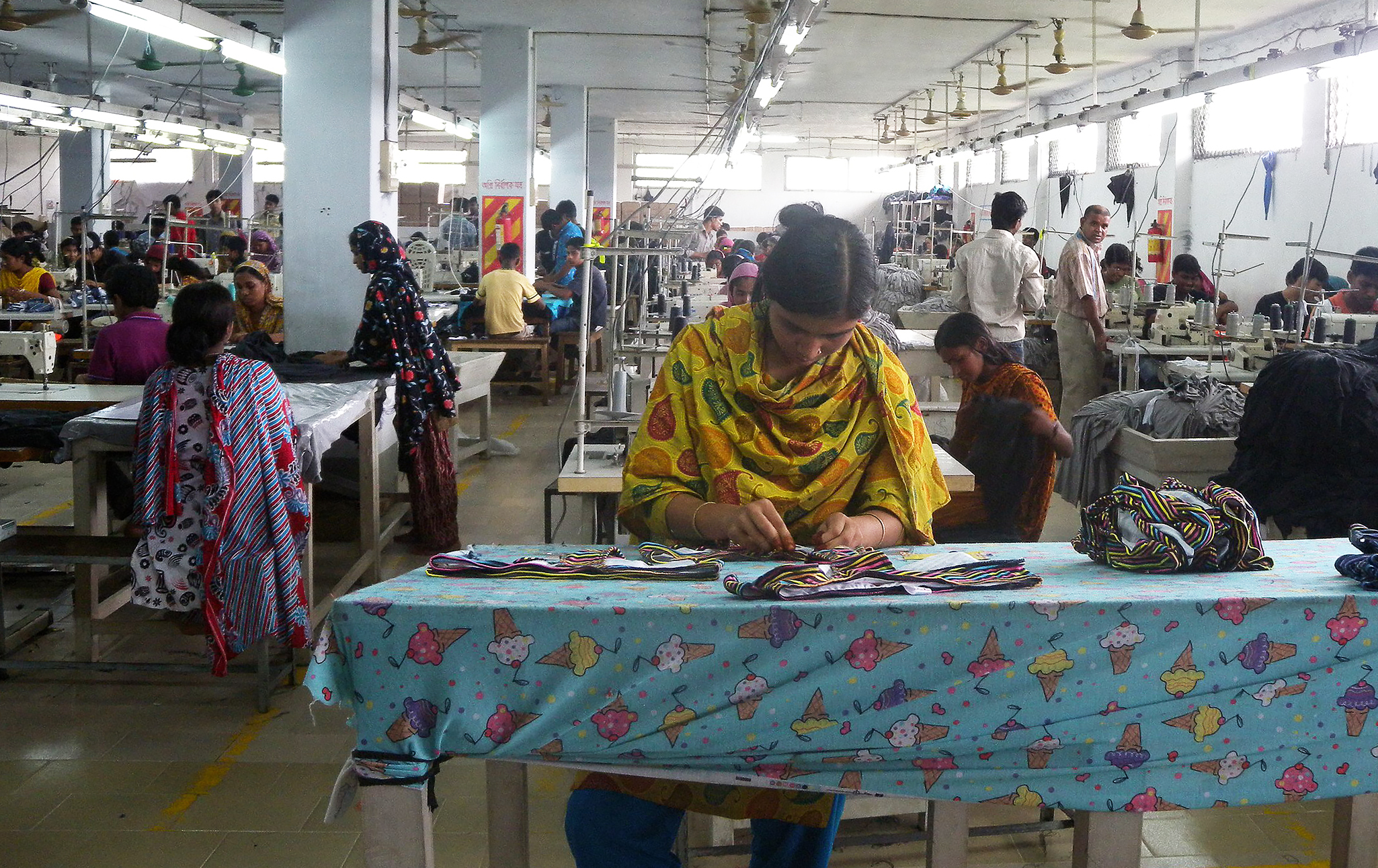
In 2023, a young Bangladeshi woman named Tureza Akter committed suicide after facing repeated abuse at a sweatshop in Jordan. Subsequent investigations found that factory managers withheld employees’ passports to prevent them from leaving, forced female employees to strip naked, and required workers to labor 16 hours a day, seven days a week, threatening to withhold already-earned pay if they did not comply. The clothes produced in this factory bore the logos of Under Armour, Columbia, and American Eagle.
These conditions are not an outlier. Walk Free, the nonprofit responsible for the Global Slavery Index, counts nearly 50 million people as enslaved worldwide; they also estimate that the garment industry is the second-largest market of products likely produced with modern day slavery. A 2024 Department of Labor report found evidence of forced labor in the garment industries of Argentina, Bangladesh, Brazil, Myanmar, China, India, Malaysia, Mauritius, Thailand, and Vietnam. This ranges from debt bondage, where workers are forced to work to pay off bogus debts imposed by their employers, to state-sponsored abuse. A fifth of Earth’s cotton is grown in Xinjiang, where “authorities use threats of physical violence, forcible drug intake, physical and sexual abuse, and torture” to force Uyghur Muslims to work.
This is the context of the many center-left pundits who appreciate the fine art of sweatshops. Matt Yglesias and others have used events of mass tragedy and death as an excuse to discuss why sweatshops, actually, are good. Most recently, popular economics blogger Noah Smith felt the urge to write a 3,000 word piece defending factory fashion in Bangladesh in response to a social media post that mentioned Akter’s death. According to Smith, the 47-word tweet committed the cardinal sin of describing abuse in a sweatshop without properly acknowledging “the benefits that those garment factories bring to poor countries.”
Smith agrees that workers face “poor working conditions in many garment factories around the world.” But he argues sweatshops are necessary for poor nations to become rich, and so “progressives in the rich world should be very careful” criticizing sweatshops, since “the only thing worse than sweatshops is no sweatshops.”
The case for sweatshops is as simple as Smith makes it out to be. Poor countries are full of poor people. (Makes sense.) We all should want people to be less poor, and sweatshops are part of a process of industrialization that makes poor countries’ economies grow. (Brilliant.) Rising GDP means lower poverty. (Not always, but that’s for a different article.) Other authors have taken this train of thought further, arguing that because people choose to work in sweatshops knowing the labor conditions are terrible, those conditions must be better than the alternative job opportunities. Ergo, sweatshops are, from a consequentialist perspective, morally good (or at least better than the horrific alternatives).
Some sweatshop supporters, unlike Smith, note that it is wrong for companies to use slave labor, lie to prospective hires about wages they’ll be paid, abuse workers, or withhold wages. It’s generally in good taste to assume writers dislike slavery, so we’ll grant Smith that. But Smith doesn’t separate out forced labor from his defense of sweatshops, which, remember, is a response to a tweet criticizing the fashion industry for using forced labor.

Let’s start by addressing the reasons progressives dislike sweatshops, according to Smith. While he acknowledges most people have “a very reasonable disgust at the sort of working-conditions that prevail in sweatshops,” he argues that leftists dislike sweatshops because it’s “just one of those things that American progressives are supposed to believe.” He summarizes this belief as a combination of the ideas that factory owners unfairly take the products of garment-makers’ labor, and the fact that the developed world got rich, in part, through stealing the resources of poor countries.
Much of why Bangladesh, in particular, is poor is due to the centuries-long history of British colonial rule. Colonizers starved three million people during the Bengal famine, drained $45 trillion worth of resources from the region and, since Smith is so interested in the garment industry as a ladder out of poverty, I’ll note that the British dismantled what once was a world-leading textile market in order to protect British-made fabric. One story, perhaps apocryphal, is that the British East India Company cut off skilled weaver’s thumbs so royal fabric could reign supreme.
But history is the realm of academics. The argument for sweatshops does not need to look to the past. Nor does the argument against them. Let’s put aside the reasons why workers were born into poverty—could GAP Kids afford to pay their child laborers a living wage? GAP’s 2024 net income was $844 million; workers’ wages are a tiny fraction of the cost of clothing. When H&M promised to pay all laborers a living wage in 2018, some advocates argued that the cost of labor makes up between 1 and 3 percent of the cost of clothing. But they, like many other retailers, have struggled to follow through on commitments to end forced and child labor. For what it’s worth, the CEOs of Under Armor, Columbia, and American Eagle—the three American brands made in the factory that killed Akter—make a combined $24 million a year. It’s difficult to ignore, too, that those three men made their money on the backs of an overwhelmingly female workforce. In Jordan, where Akter died, nearly 75 percent of all garment workers are women.
The fact that they could make more money by exploiting more people does not justify exploitation in the first place. Perhaps it is better to make fifty cents a day in a factory than twenty cents a day farming. But the choice to pay someone fifty cents a day as opposed to, say, enough to afford food, is a morally wrong choice on the part of the factory. Or, to put it another way, it’s a morally wrong result of choices by major retailers, who through a web of suppliers, conveniently do not know much about the factories that actually make their clothes.
But the sweatshop defender downplays the agency of these brands and factories. In fact, in this line of thinking, the agency of everyone is downplayed except for sweatshop employees. Employees are not forced to work, they choose sweatshops because it’s what’s best for them. But when companies opt to leave Bangladesh in search of cheaper labor costs elsewhere, they’re being “forced out” by activists demanding safety standards. And those progressive activists don’t rationally believe what they’re saying; opposing sweatshops is a dogma they’re “supposed to believe,” like the rest of the “fantasy extended universe” they inhabit.
The 18th-century economist Adam Smith introduced the metaphor of the “invisible hand,” which dictates that individuals’ self-interest may lead them to promote unintended social goods. Later economists expanded the theory to argue that competitive free markets create socially optimal outcomes. The arc of the economic universe bends towards prosperity. But in this case, both Smiths are wrong—Noah in his defense of sweatshops, and Adam in the way his metaphor has been misappropriated. The hands that improve working conditions aren’t invisible at all; they’re as real as those severed in Rana Plaza.
The Rana Plaza factory in Bangladesh collapsed on April 24, 2013, killing 1,134 people and injuring 2,500 more. It is the largest garment factory disaster in history. The eight-story building was built without permits and showed signs of imminent failure in the days before collapse. Yet garment makers were ordered to return to work the next day or lose a month of already earned wages. They had no choice but to pay the ultimate price. Now we ask what happened next. Did Smith’s cycle of economic growth continue? Yes. GDP per capita has more than doubled since 2013. But did that growth naturally translate into better working conditions? No. The benefits workers received in the wake of the disaster were hard-fought wins after intense, sometimes violent protests.

Credit their consistency: those who defend sweatshops do not tend to care about worker’s rights; nor do they care within the factory walls. Their argument is about progress, and their argument against worker’s rights is that those benefits come at the expense of economic growth. Except, Smith doesn’t actually think this is so. In his view, the economic literature on the issue is mixed. Activism might force companies to invest in better, safer technology that ultimately improves worker productivity and economic growth: “Activism to force factories in poor countries to raise wages and improve working conditions might be the right thing to do anyway.”
But if the sweatshop defender thinks activism may actually be good, what are they defending sweatshops from? It seems, mostly, from liberals’ insincere guilt. In the wake of Rana Plaza, Alex Massie wrote that deploring sweatshops is, really, just “a way of propping up our own self-esteem.” The Cato Institute’s Pierre Lemieux described labor activists as “hid[ing] their interests behind moral high horses.” It’s not simply that sweatshops are good—you should feel good about them.
Matt Yglesias was refreshingly honest when he said the “overwhelming personal response” he had to criticism of his pro-sweatshop writing was “to be annoyed.” How dare bleeding hearts cry over workers bleeding out; the Bangladeshis chose to work in a dangerous factory. (The Rana Plaza victims, in fact, had not freely chosen to return to work after discovering safety risks.) That pesky parenthetical aside, Yglesias argues that the global poor choose to accept more risks in exchange for more money, because they need money more than we do.
Is it good that the poor die earlier than the rich? Former Harvard President and World Bank Chief Economist Larry Summers once wrote that “the economic logic behind dumping a load of toxic waste in the lowest wage country is impeccable.” Bangladeshis have lower earnings than white collar Americans, so their premature deaths are less economically impactful. (After the “Summers Memo” was leaked, Summers claimed both that he hadn’t written it and that it was ironic.)
But if the value of your life is determined by your earnings potential, so is the value of all your other rights. And if your rights are bought and sold, they cease to be unalienable rights. This brings us back to forced labor. The defense of sweatshops as an exercise in workers’ choices cannot account for the fact that their passports have been stolen and the exits are locked. If Tureza Akter had an alternative, she would not have chosen death.
The defense of sweatshops as beneficial for economic growth, on the other hand, must grapple with a decision. How much slavery is justified? How many workers ought we subject to beating, stabbing, choking, verbal abuse, sexual harassment, sexual assault, PTSD, wage theft, forced birth control, indentured servitude, debt bondage, child labor, sleep deprivation, cancer, intimidation, depression, suicide, lung damage, public humiliation, witheld earnings, predatory fines, mandatory overwork, witheld passports, union busting, bad air, deadly fires, building collapses, and murder? The correct answer is none.


.png?width=352&name=Screenshot%202026-09-04%20at%204.00.52%20PM%20(1).png)
%20(1).jpg?width=352&name=miasma-1%20(1)%20(1).jpg)