Laws against public drinking criminalize working-class people and make public life less fun. It’s time to repeal them.
This article is written by Miles Kampf-Lassin, Senior Editor at In These Times, a magazine that has spent more than 50 years telling the stories corporate media ignores, with a deep focus on labor, rural communities, and investigative reporting. If you enjoy this piece, In These Times is well worth your time. For a limited time, Current Affairs readers can get a full year subscription for just $15.
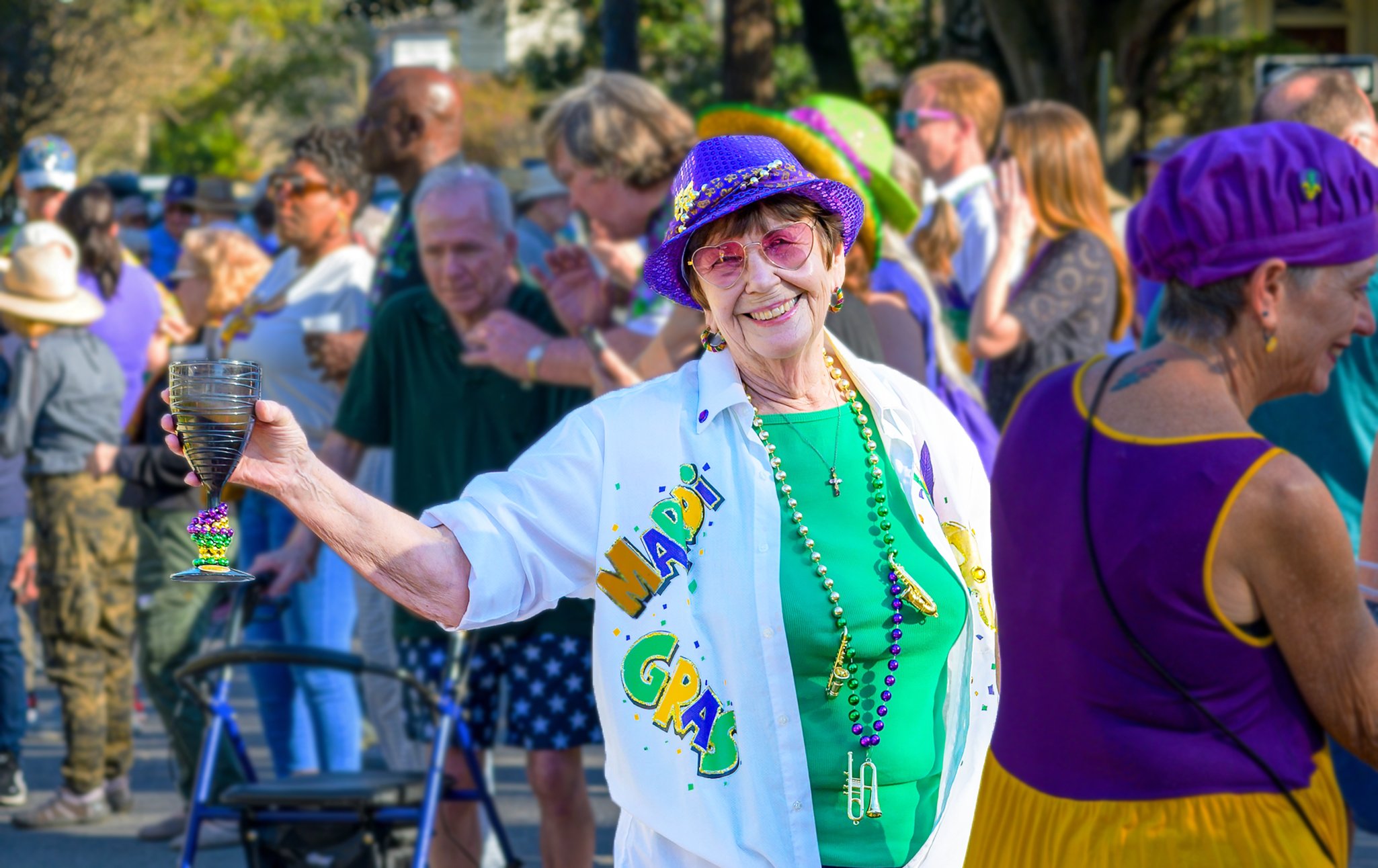
The aromas of freshly stewed gumbo and boiled crawfish wafted out onto the street in front of Broadview Seafood at the edge of New Orleans’ Seventh Ward. On Ash Wednesday, as I recovered from the revelry of Mardi Gras, I salivated as I considered my meal: Should I pick up some crab legs? A po’boy, with freshly fried shrimp enveloped in a crunchy French roll? All important questions, but my first order was the most essential—an ice cold tallboy of a hazy IPA. And since I was in one of the few bastions of legal public drinking in America, I purchased it to go.
Having received my bounty of gumbo, crawfish, and a po’boy, my beer cradled under my arm, I considered my next move. Grateful for the lax public drinking laws, I had a full range of options: walk up the nearby iconic Esplanade Ave and sit in oak-laden Fortier Park, surrounded by stately 19th-century mansions and brightly decorated homes; or walk a bit further west and sit on the banks of Bayou St. John. I chose instead to bring my banquet to the pastoral City Park, joined by friends. We splayed out in the park, talking and eating and laughing—all while freely sipping alcoholic beverages in public, without fear of reprisal.
It was a joyous experience. But currently, such experiences are limited to those living in or visiting the Crescent City and a small number of other locales around the country. This is a travesty: we all should be able to drink in public.
But today, 87 years after the ratification of the 21st Amendment, we’re still living with vestiges of a Prohibition-era legal framework, where alcohol consumption is severely constrained and policed. Alongside the nationwide minimum drinking age of 21, almost every state has established strict regulations banning public drinking, commonly referred to as “open container” laws.
It’s time to repeal these outdated disciplinary laws and realize the unfinished work of the Prohibition repeal movement by finally legalizing public drinking across the United States.
Socialists Fought for Your Right to Drink
To understand why our public drinking laws are so repressive, we have to go back to the American movement to ban booze. From its origins, the Prohibition movement was animated by a puritanical spirit.
The late 19th century saw temperance activists, many motivated by strict religious codes, push for total abstinence regarding consumption of alcohol, considering it a personal sin. Religious revivalists of the time saw the movement as an opening to secure a level of political legitimacy.
As James Morone writes in Hellfire Nation: The Politics of Sin in American History, “Prohibition offered them their one link to national authority, the one public commitment to resisting moral decay.”
That attitude percolated up into legal rulings, such as the 1887 Supreme Court decision in Mugler v. Kansas that claimed, “public morals[…] may be endangered by the general use of intoxicating drinks” and that “the idleness, disorder, pauperism and crime existing in the country, are, in some degree[…] traceable to this evil.”
But it wasn’t just religious influence that led to virulent anti-alcohol agitation—it was also the logic of capitalist accumulation. Leading economists of the time, such as Simon Patten and Irving Fisher, also pushed for Prohibition in the early twentieth century as a means of boosting worker productivity and, as Fisher dubiously argued, adding a supposed $6 billion to the US economy.
Combined with feminist activists, who saw prohibition as a way to combat the male-only drinking culture of saloons and domestic violence carried out by drunken husbands against their wives and other women, this combination of arguments eventually led to the passage in Congress of both the 18th Amendment and the Volstead Act to enforce it, which went into effect on January 17, 1920.
Of course, rather than actually stamping out alcohol consumption, these laws simply pushed it underground, as a latticework of bootlegging and home distilling became commonplace in the years that followed ratification. The result was a spike in organized crime around illicit alcohol distribution, as well as disease and death deriving from poisonous forms of black-market booze—consequences of shoving alcohol consumption (as well as the consumption of any other kind of drug) into the dark corners of society.
But Prohibition also had its fierce opponents. Throughout U.S. history, the cause of liberalizing drinking laws has been taken up by socialists and other left-wing leaders who’ve fought to allow Americans the freedom to drink as they please.
Prohibition wasn’t officially ended in the United States until the ratification of the 21st Amendment on December 5, 1933. But three years earlier, in 1929, Wisconsin residents had already embraced the legal consumption of alcohol when voters repealed the Severson Act, the state’s Prohibition enforcement law. The leader in overturning that Act was Milwaukee socialist assemblyman Thomas Duncan, who first introduced legislation calling for a referendum on the question. Duncan was a member of the “sewer socialists,” known for effective public works, who governed Milwaukee for 50 years, beginning in the early 20th century.
Ahead of the vote, Duncan warned that if the referendum was defeated, the “state will be delivered over, bodily, to the Klu Klux Klan (KKK) and the Anti-Saloon League (ASL), to do as they will with it”—a reference to the violent enforcement of prohibition laws by the KKK and ASL, through both political and extralegal means. The plebiscite was ultimately backed by 64 percent of residents.
Duncan wasn’t the only left-wing Milwaukeean to push for legalized drinking. He was joined by six other assemblymen and three state senators, all socialists, and the decision was embraced by Mayor Daniel Hoan, also a socialist.
In 1932, the Socialist Party voted three to one to add to its official platform a plank reading: “Repeal the Eighteenth Amendment and take over the liquor industry under government ownership and control.”
The following year’s repeal was a major stride toward expanding personal freedom and curtailing the criminalization of alcohol. By the time Duncan and his fellow Milwaukee socialists successfully overturned Prohibition in Wisconsin, support for the liquor moratorium was already diminishing among American voters. Yet even after repeal in 1933, individual states were still allowed to ban or restrict alcohol sales and use, which led to “dry” counties where booze is prohibited—many of which still exist today—along with a bevy of other laws designed to limit alcohol use.
Punishing the Poor for Having a Brew
The current regime of public drinking laws has led to a system of enforcement that disproportionately punishes Americans based around racial and economic lines. As Niki Ganong, author of The Field Guide to Drinking in America, recently told Eater of open container regulations: “It’s another racist law used almost universally against the poor, it’s usually an excuse for police to stop and investigate.”
As the New York Times reports, in 2011 New York City police issued 124,498 summonses for drinking in public, “far more than for any other violation.” Unsurprisingly, in one month in Brooklyn, 85 percent of summonses were issued to blacks and Latinos, while 4 percent were issued to whites (who make up 36 percent of the borough’s population).
The findings led New York judge Noach Dear to write in a court decision: “I am hereby recommending that the practices and policies of the N.Y.P.D. with respect to enforcement of the open container law be scrutinized and immediately stopped if found to be discriminatory.”
Racial disparity in the application of drinking laws tracks across the rest of the country, as does outsized enforcement in poor and working-class communities. These disparities helped motivate New Orleans lawmakers to finally shuffle off the coil of public drinking laws in 2001. As Henry Grabar writes, “the New Orleans City Council repealed the city’s open container law, which had been enforced with an 80-20 racial bias, after a black man carrying a beer was shot and killed by police.”
Many modern open container laws derive from previous “public drunkenness” and “vagrancy” ordinances that criminalized not just alcoholism, but also poverty and homelessness. In 1953, Chicago established such a law against “drinking in the public way” as a means of expelling what were called “bottle gangs”—groups of men who were, in reality, often doing nothing more than congregating on city streets.
In the 1960s, as the Civil Rights Movement gained momentum, the racially motivated enforcement of these laws was contested in court, and many were ruled unconstitutional. As a result, rather than outlawing “drunkenness,” in subsequent years, many cities and municipalities moved to instead simply ban the act of public drinking itself.
These new laws fit into a broader pattern of “broken windows” policing that took hold of much of American policing in the 1980s and beyond, viewing petty violations like open alcohol consumption as a pathway to criminality. In effect, they offer law enforcement new opportunities to ticket and detain large numbers of people for doing nothing wrong or socially harmful while hanging out in public. As Grabar points out, the language of New York’s bill banning open containers was hardly subtle: “When New York City banned open containers from its streets in 1979, lawmakers were quite explicit about the law’s intent: ‘We do not recklessly expect the police to give a summons to a Con Ed worker having a beer with his lunch,’ a sponsor of the bill told the Times. ‘This is for those young hoodlums with wine bottles who harass our women and intimidate our senior citizens.’”
This motive continues to inform the law’s enforcement. In the period from January 2020 to July 2020, 91 percent of public drinking tickets handed out by the NYPD went to Black and Latinx New Yorkers, even as the Covid-19 pandemic ravaged the city. The takeaway is clear: These laws have never been meant to improve public safety, but rather give police tools to target those who they see fit. This unjust order will continue to produce racist and biased outcomes, until it’s overturned.
As an alternative to open container laws, some cities such as Louisville and Memphis have embraced so-called “entertainment districts.” Yet these spaces, often just a few city blocks, are not bastions of freedom. They’re ultimately profit centers—often administered by private companies and littered with mega developments—that restrict, rather than expand, personal autonomy.
Instead, we should end disciplinary policies toward public drinking outright and liberate our public spaces, allowing all adults to publicly enjoy alcoholic beverages, if and when they desire. The New Orleans model could easily be replicated in cities and municipalities nationwide.
Of course, behaviors that risk the safety of the public like driving while intoxicated shouldn’t be allowed or encouraged. And alcohol addiction is a manifest problem in America, which requires deep investments in recovery and mental health programs. A Medicare for All system, for example, could go a long way toward making these necessary public health advancements. But such problems already exist in the United States, and are not being solved by the execution of open container laws.
Full Repeal, Full Stop
The repeal of public drinking regulations was made all the more urgent due to the Covid-19 pandemic, which upended the US bar and restaurant industries.
Rather than embrace a robust system of testing and contact tracing as most every other developed country did, President Trump decided instead to treat the virus as a pesky distraction, refusing to take even the basic steps to get the pandemic under control. Facing these conditions, the social distancing measures necessary to suppress Covid-19 made it all but impossible to reopen indoor dining and drinking establishments in areas where the virus was still circulating.
As a result, many cities relaxed enforcement of open container laws, and some—such as Alexandria, Virginia, Chicago, and New York City—passed new ordinances allowing for the sale of to-go cocktails along with other more liberal codes around alcohol vending and consumption. As the BBC reports, in an effort to lower the jail population to prevent further spread of Covid, “Baltimore, Maryland has said it will dismiss pending criminal charges for people arrested for many non-violent crimes, including breaking open container laws.”
Such changes are welcome, but they don’t get to the heart of the issue. Even if criminal charges are dismissed, or you’re allowed to purchase a gin and tonic to go, that doesn’t change the fact that public drinking has remained an illegal act in these areas. Instead, what’s needed is a full repeal of open container laws.
Such a change has been proposed in New York by socialist state senator Julia Salazar, who in July 2020 introduced Senate Bill S8675 that “Makes it lawful for a person to possess an open container of alcohol and consume alcohol in public during the Covid-19 pandemic.” As the justification section of the bill lays out:
“In many places throughout the world, open consumption of alcohol is permitted. In New York the police and others turn a blind eye if the imbiber is drinking a glass of wine while listening to the New York Philharmonic on the great lawn in Central Park, but if you’re a young person on the beach at Coney Island drinking a nutcracker or a beer on your block with friends, you can get a ticket. That’s discrimination and hypocrisy.”
The section continues, asserting of the bill, “It only makes sense since the city has already permitted thousands of bars to serve drinks to-go. Where do we think they’re being consumed?” Salazar has continued to re-introduce the bill in subsequent years.

Today, Drinking in Public. Tomorrow, Publicly Owned Drinking.
There’s nothing radical about allowing people to drink alcohol outdoors. Public drinking is a victimless act (save for yourself, if one too many cocktails leads to a hangover or an ill-advised late-night text to an ex).
The cause of repealing inordinate drinking laws has been unfulfilled for over a century. Such a repeal could help us develop a healthier relationship to intoxicating spirits, taking alcohol consumption out of the shadows.
It could also allow us to imagine even deeper and more radical changes in our relationship to booze, like who controls its production—and who gets to share in the revenue. Even prior to passage of the 18th Amendment, prohibition was already the law of the land in many states, leading American socialist leader Eugene V. Debs to write in 1916:
“Socialize the liquor business, take out the profit, and let it be controlled by the state, as Socialism proposes, and there will be a summary end to the evil, but never through prohibitionary legislation. There is far too much ‘prohibition’ in the world and often the spirit of it is bigoted and tyrannical. There are tens of thousands of laws on the statute books which prohibit almost everything conceivable, and for all the good they do they would better be repealed.”
In the hundred-plus years since Debs wrote those words, we’ve continued to live under far too much prohibition. Let’s instead choose freedom, and legalize public drinking.
This article was first published at Jacobin, as “Let Us Drink in Public.”

%20(crop).jpg?width=352&name=wile-e-coyote%20(resize)%20(crop).jpg)