God, I hate Downton Abbey. The beloved ITV post-Edwardian period drama and domestic PBS mainstay is purported to be ending with a third theatrical release, closing as I write. Created by the Right Honourable peer Julian Fellowes—who is also the sole scriptwriter—the series is beloved among masses of good-hearted PBS viewers for its lovely photography, exquisite locations, fine cast, and great performances.
But the show is also marred by an utterly inexcusable whitewashing of the notorious class chasm of the interwar U.K. aristocracy. The grand Crawley family are seldom even brusque with the downstairs servant staff, let alone abusive, and mix frequently with them. The social expectation in country houses of the period, that staff keep their heads down rather than take in the lordly spectacle of the castle in which they labor, is absent from this series, where the principal Lords and Ladies are surprisingly down to earth. Watching this disgrace, one wonders why the landed aristocracy was ever saddled with a troublesome elected parliament.
In fact, the show is surprisingly effective at making sympathetic the only people who are literally entitled.
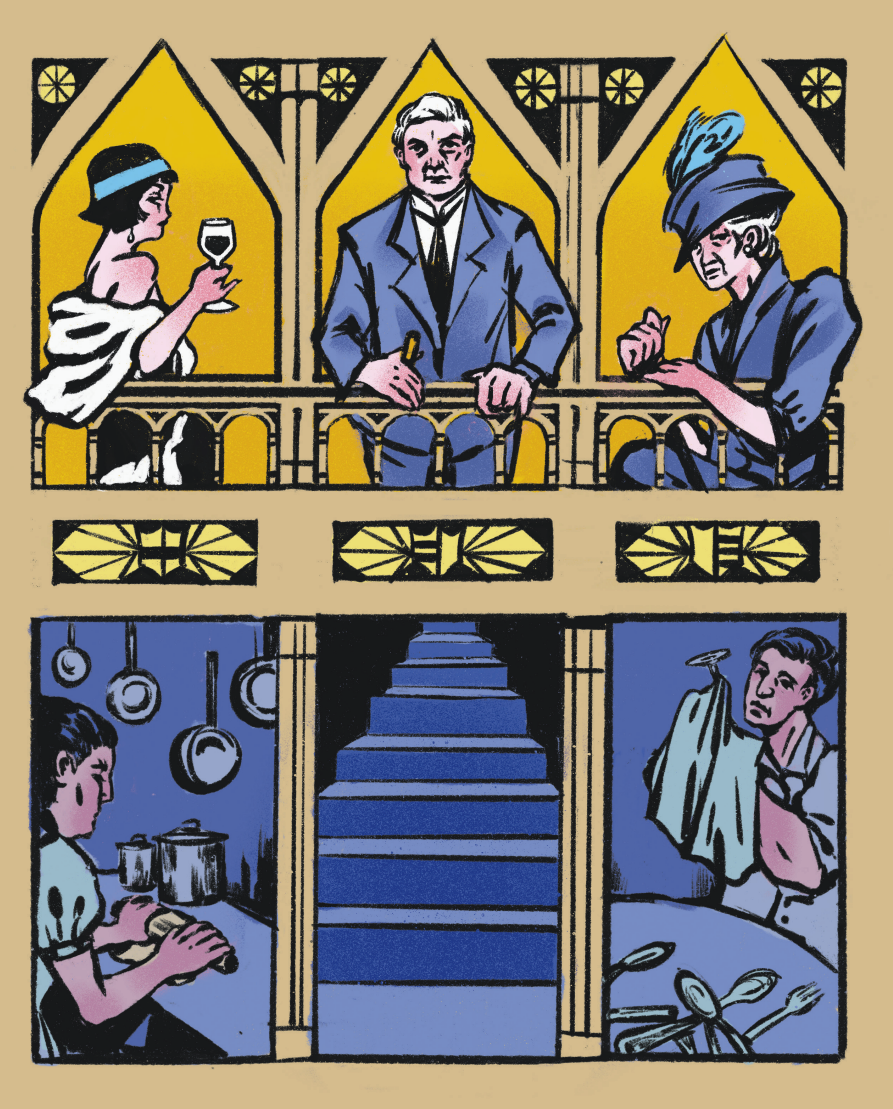
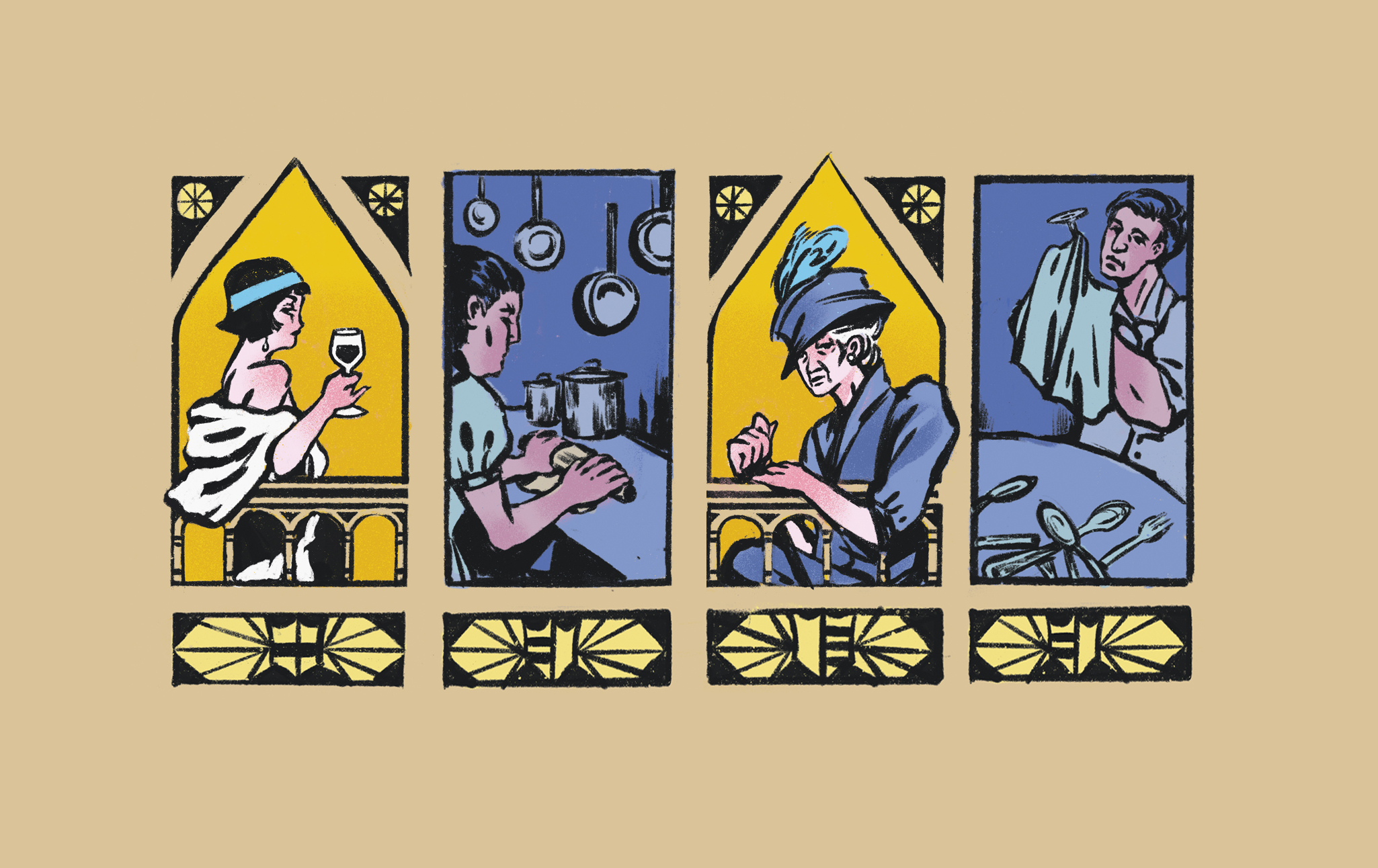
Art by Tiffany Pai from Current Affairs Magazine, Issue 57, January-February 2026
Soap Operatics
The series follows the lives of the aristocratic Yorkshire Crawley family, led by the kind-hearted Lord Grantham, and their household staff in the early 20th century. Beginning with the sinking of the Titanic and ending on the eve of the Great Depression, each episode explores relations among the elite and servants, the declining role of the U.K. aristocracy, and in particular the great estate’s difficulty in transitioning to a model of economic self-sufficiency. The period costume drama has been slathered in honors, including dozens of Emmy Awards, and is considered highbrow entertainment.
Before the start of the series, protagonist Lord Grantham marries a rich American, and we’re led to understand they only later fell in love. But due to the loss of the family’s heirs in the Titanic sinking, the title and estate will pass to a distantly-related middle-class attorney, which causes great discomfort. Efforts by the lawyer, Matthew, to right the estate’s ship continue protractedly throughout the series, along with perennial efforts to marry off the family’s various ghastly daughters. A major role is played by Dame Maggie Smith, who is often considered the show’s mascot and gets many of the choicest lines, including often-clipped classics like “What is a weekend?” The Dowager Countess has never worked, you see, so the concept is unfamiliar. The joke works on multiple levels, making us working viewers feel more worldly than the insulated nobles yet still portraying them as almost charmingly oblivious.
The series and movies were filmed at Highclere Castle, and the show never wastes an opportunity for a giant splashy money shot of the grandeur of this towering symbol of the older, mostly pre-capitalist British upper class. The interiors and locations are, indeed, pretty stunning. Giant arches, huge drawing rooms, sprawling gardens, and secret corridors allow status-insecure Americans to fantasize about being such an elite, or at least being invited to visit one. Presumably some are imagining themselves as the plucky downstairs staff as well, including the tall underbutlers and an implausibly long succession of conspicuously hot maids.
Now, I’m not a writer who’s known for divulging a lot of personal detail. Yet consider characteristically lazy libertarians like Ron Paul ghostwriter Lew Rockwell, who incredibly lazily reviewed my record-shattering smash hit book Mastering the Universe by simply saying that “the left promotes envy.” This kind of astoundingly slothful argument could be used of course against any critic of any regime, from the Soviets to the monarchy, and it’s just the weakest sauce. Too lazy and callow to engage with any actual points raised.
But I will allow, there are indeed two specific things I do in fact envy about the rich. Their travel, and their libraries. We at Current Affairs greatly love libraries, and good god, Lord Grantham’s library in this series, the actual library of course of Highclere Castle, must be a rich blessing to live with. Of course, his Lordship happily lends his books out to family and even staff, just the kind of thing you’d like someone in such a position to do, except that they usually don’t.
While the show looks incredible with the sound off, with the dialogue on we come to its first major weakness. Fellowes brings to the series a great deal of fascinating firsthand experience of the lives of the U.K. nobility from which he comes, but dear God, his plots feel like film scripts that were cruelly stretched out to eight-episode seasons. Dilemmas, mysteries, and personal struggles are introduced in the first episodes, drag on for hours with little progress, then are hurriedly resolved in the season finale or post-season specials.
These storylines are strung out with dreadfully literal and contrivedly protracted devices. Characters fall in love, out, and in again. And look, mid-wit plot writing isn’t the end of the world, but the gorgeous photography, stately locations, and such an outstanding ensemble cast surely deserved better. The settings and scene work are undoubtedly beautiful, with endless eye candy. But like candy, the show ultimately feels like empty calories with no nutrition. The gorgeous British Isles landscapes and stately architecture are weighed down by shitty, repetitive, slow-moving plots.
Fellowes has written impressive scripts before, but he flails badly in the wide-open format of TV, clearly without enough interesting plot ideas to keep the relationships and quests fresh. There are endless, endless plotlines surrounding whether Lady Mary and Matthew upstairs, or Daisy and Alfred downstairs, will succeed in their romances. Characters like the Bateses, a maid and valet, serve as perpetual Christ figures, their love constantly blocked by bitterness, jail, and sexual assault. Surreally repetitive plots revolve around two rich biddies bickering over who gets to boss around the village hospital’s henpecked Scot doctor.
A pretty program, but with such messy elongated plots that it’s difficult to enjoy, no matter how much expensive scotch I consume.
Déclassé
Most painful, though, for any left-wing viewer is the character of Tom, a socialist Irish nationalist. Hired to serve as the Crawleys’ chauffeur, he develops a love affair with Sybil, the least unlikeable of the daughters. He refuses to fight in the folly of the Great War, a quite accurate portrayal of socialists at the time. “I may be a socialist, but I’m not a lunatic,” he says, ha ha.
But Tom is soon portrayed as an abettor of revolutionary violence in Ireland, where he is involved in the burning of the grand country houses of the English-installed Irish noble families. There is zero mention of the evil settler role of those families and their history of abetting the outrageous acts by Britain against the people of Ireland, including ethnic cleansing of the native Gaelic Irish and rule of the island from London, which Tom is given a little screentime in one scene to decry. He says he found himself disgusted, though, at the sight of the Anglo-Irish families being thrown out of their mansions before the estates were burned. And later, he is painted as a coward for apparently leaving Lady Sybil to make it back to the U.K. from Ireland on her own. He is stricken by these experiences, and over time explicitly steps away from his youthful socialism, and is called by Lord Grantham “our tame revolutionary.”
By mid-series, Tom is completely transformed into a capitalist, although he remains uncomfortable in the Crawleys’ refined circles. He lives for a time in Boston and falls in love with American capitalism, saying a working man can go “right to the top!” He works in a family member’s garage repairing cars, and this being the “top” is apparently not intended ironically. The character becomes a classic U.S. petty-bourgeois, thinking himself a king while running a penny-ante firm that will be swept away in the coming Depression.
His character arc is quite cruel for the leftist viewer, and extends clear to the final film where he is made to decry socialism a final time (quote absent, as I was drinking in the theater). Series creator Fellowes, the Tory Peer in the House of Lords, does a far better job of belittling socialists than the usual reactionary slop that paints every social democrat as an embryonic Josef Stalin. This is done by making the character at first a sympathetic supporter of Irish freedom, with family members killed by the British occupying army, but who by the end of the series literally saves the life of the King of England. Pretty rich.
And yet Fellowes’ aristocratic mien can’t help but betray frequent discomfort with the crass commercialism of the capitalist order rising to replace the genteel gentry. In the second season, Mary’s new fiancé is a powerful and unpleasant newspaper kingpin, who constantly refers to his money and ability to buy anything, and is clearly portrayed as both shallow and threatening. Fellowes is irresistibly drawn to portray socialism as a youthful infatuation to move on from, but still includes unflattering portrayals of some capitalists, even in a quite pro-capitalism program, mainly to unfavorably contrast them with the more enlightened aristocracy.
New Old Money
A conspicuous feature of the show’s depiction of the English aristocracy is the seemingly unrepresentative personal niceness and surprisingly progressive views of the family. While Lord Grantham and his mother the Dowager Countess are surely stuffy, they are unusually egalitarian. Lord Grantham, played by Hugh Bonneville, is a truly classy figure—he’s introduced with light-filled photography and an elegant score, loves his family and his dog, and is extremely solicitous of his household staff. In his very first scene, speaking to his butler about the survivors of the Titanic disaster, the servant says many of the ladies survived. The Lord replies, “You mean the ladies in first class.” Suffice it to say this is unconvincing in the extreme. It’s funny to hear the series criticized for its use of more modern U.K. received-pronunciation, when they have a received progressivism that’s far more out of place.
The Lord also objects to the word “crippled.” In a later scene where the family has an Anglican church figure to dinner, the family members resist his claim that God is more “pleased” by Christians than other peoples. They react as modern people would, saying that surely God accepts the Catholics, and are soon defending the “Indian subcontinent.” I’m no history professor, people, but I’m somewhat skeptical that Edwardian nobles at the peak of their social position and imperial prestige, whose great minds were producing stunningly racist frameworks to justify ruling over subject peoples, were quite so insistent on spiritual equality with their penniless foreign subjects. This was the era of rampant British racist insults, from “Paddy” for the Irish to “yellow race” for the Chinese, all of which are carefully expunged from the show’s imagined past.
Worse, the most class-obsessed and often bitterly vindictive characters are servants. The scheming servants Thomas and O’Brien, the grand butler Carson, and an evil nanny are among the characters seemingly most disgusted at transgressions of class lines, like the chauffeur Tom marrying Lady Sibyl or the downstairs staff making any disparaging remark against the upstairs grandees. A few nobles are given this rigid depiction, but they appear only in relatively brief roles. The Crawleys themselves are of course scandalized at specific cases of class-line transgression, but are far less poisonously prejudiced against class mixing, and are generally shown as rolling their eyes at their institutionalized superiority in a highly unconvincing, most un-British way. They won’t hear of any deference, and repeatedly say that we must respect racial and religious minorities. It just creates a sanitized version of these powerful parasitic bastards that U.S. liberals feel allowed to like.
Re-watching this Anglophilic embarrassment, I’m struck at how, in a particular way, it resembles Hamilton, the ubiquitous 2015 Broadway musical portraying the political struggles of the U.S. founding fathers, but portrayed as Black and spitting hip-hop beats. Slave-owning, Native American-murdering founders are replaced with cool, fast librettos about economic policy. Whereas here, we have colonial genocidaires and demonic Victorian capitalists, replaced with anachronistically progressive and kind-hearted, if stuffy, romantic soap opera. It’s the Hamilton of the U.K. ruling class, and it really is pure catnip for the army of PBS-watching Anglophiles that associate the English aristocracy with the grandeur and ancient fascinations of the Old World.
It’s also somewhat reminiscent of the Hollywood film version of The Lord of the Rings, and its celebration of kings: good, handsome, family-loving men of reason and personal bravery, self-effacing even. Only the non-noble Steward of Gondor is portrayed as petty, vain, eager to control people, and focused on consumption and position. Again, this treatment of Tolkien’s work seems to launder the notorious, violent reality of monarchs in search of a yearned-for latter-day deserving ruling class. It’s entirely reactionary slop, but LOTR and Downton are highly watchable, and even Hamilton has some respectable beats.
To keep 21st-century Americans supporting elites, modern apologia has taken the simple measure of transforming them so radically that modern audiences find them charming, despite drastically mangling the real record of these figures and times.
Goslighting
And it's all especially annoying because prior to Downton, series creator Julian Fellowes wrote the excellent 2001 film Gosford Park, directed by the great Robert Altman. Nominally a murder mystery set in a British country house, the film paints a Rather Different picture of the U.K. landed elite than the show that became a hit in the U.S. Downton was in fact originally a spinoff of Gosford, later changed to a standalone series.
In Downton, Lord Grantham, the made-for-America patriarch, first appears making remarks on the “poor souls” in the lower classes. Contrast this with an early line spoken by an aristocrat in the Altman movie: a butler intrudes upon a liaison, causing the tuxedoed heel to say to the lady, “Don’t worry, it’s nobody.” Grantham first appears in a halo of light with stately music, descending the great staircase. The Gosford patriarch, Sir William McCordle, on the other hand, is a powerful, manipulative bastard who seduces his factory worker underlings and then pressures them to give up the babies for adoption. He laughs at pulling out of ventures and ruining people, resents his relations for serving in the Great War, and treats people like objects.
The sharpest contrast appears in the roles of Maggie Smith, who appears in both properties as a dowager aristocrat, and is far colder, meaner, and more belittling in this first movie. She takes labor completely for granted, and insults to their faces those characters who work for a living, specifically because their livelihoods are precarious and their incomes variable, relative to the literal entitlement around them. She employs a younger maid to avoid paying her in full, yet is utterly and petulantly dependent on her.
That abject dependency emerges as the real theme of the film. When the patriarch is murdered, another aristocrat, considered a heroic Commander from the Great War, immediately calls for the butler. When the police investigate, the bungling detective (played memorably by the redoubtable Stephen Fry) forecloses any chance of cracking the case when he says the police won’t interview most of the staff, since they only want to interrogate those “with a real connection to the man.” Meanwhile, the maid with whom Sir McCordle had for years carried on an affair, and who was sacked earlier in the evening, stands silently by.
Everything is portrayed as crassly revolving around money, and getting it out of the patriarch. By contrast, in Downton’s perennial plotline, the estate is in danger and seems to struggle like any working-class household. The effect is entirely regressive, and I think it’s telling that Gosford Park, with its quite dark portrayal of the English landed elite, was merely successful in the States, grossing decently and winning the screenwriting Oscar, while Downton, with its emphasis on stately settings and implausibly decent aristocrats, became a runaway smash hit in the U.S.
Beyond its more frank depiction of the upper class, Gosford is a tremendous piece of work, with an impressive number of individual plotlines, distributed across dozens of characters. I don’t really know a movie like it, and Fellowes deserves legitimate credit for it. Many characters are really beautifully-rendered, with some based on Fellowes’ own upbringing among the British upper class, which he refers to in the film’s commentary track.
But then again, it’s in comparison to this Altman masterpiece that the recent Downton movies are especially disappointing. Produced after the end of the ITV series, the films are even more lavish than the series installments, but are mere extensions of their lumbering plots. In the first, King George V and the royal entourage visit the estate on a national tour, leading the staff to scramble while coping with the royal staff, who once again are highly snobbish and rude. The King is never seen looking down on others, but his working staff are the hierarchy-obsessed mega-snobs. The Downton staff later lead a mutiny against the haughty royal servants.
The second film depicts the estate being used to film a movie, and the production is wracked by the transition to talkies. This installment is so dull and self-referential, so full of winks to the rising power of media, that it is barely watchable. Memorable subplots include the scheming, closeted butler Thomas leaving domestic service to work in film and the theater, and the enigma of a villa in the south of France mysteriously inherited by the Dowager Countess, whose character dies in the film as Dame Maggie Smith’s own health declines. But the overall production is so insufferable I respectfully decline to discuss it further.
The (alleged) final film, released this fall, at least has the gravitas of the terminal installment of a long-running beloved franchise. Lady Mary’s most recent marriage is ending in divorce, making her yet again a scandal in the eyes of U.K. high society, even as Lord Grantham finally accepts her as the steward of the estate, following season after season spent agonizing over the question. Robert and Cora decide to move to their lesser Dower House, taking some staff with them, and the credits depict the now-married-off characters enjoying their lives and children.
What a waste of time these movies were. Watch Gosford Park instead.
-gif-1.gif?width=1024&height=300&name=Pitch-Ad-Horizontal-V2%20(1)-gif-1.gif)
The Aristocrats!
From PBS to Fox News, the Crawleys have been used in the U.S. as avatars for kind, sympathetic job-creating wealthy families who have their hair down about their high social position. Megyn Kelly observed, quite accurately, that the show “makes rich people look good, and not evil.” These covertly retrograde themes are a handy means to steer well-meaning liberals back into voting for business-as-usual politicos, falling for anti-union “the boss is your friend” propaganda, and squandering rare chances at a more egalitarian America.
The series does not extend into the post-war U.K., so we are left to wonder how the family would respond to the endlessly-hinted-at end of the aristocracy as a major social force and the advent of confiscatory Labour Government tax rates. Perhaps Lady Mary or another heir would do as some tax-resenting aristocrats did, and tear the roof off the castle to wreck it and spitefully avoid outrageous socialist assessments. After its many economic trials, I don’t think it’s implausible for the Abbey to have joined the great number of “lost houses” of the U.K. in this period, where in the 1950s one was torn down every five days by economizing noble families.
Perhaps the cool Yorkshire rains of the 1970s ran down the elegant walls and columns of the Abbey, peeling the rich décor and inviting weeds to grow and break apart the great handsome masonry. Maybe the celebrated broad towers ultimately collapsed in a misty morning in the 1980s, atop great pools filling the servants’ dingy downstairs quarters, submerging the echoes of their constant struggles, loves and intrigues.
God, I hate Downton Abbey.
Rob Larson is a Professor of Economics at Tacoma Community College, author of books including Mastering the Universe, Bit Tyrants, and Capitalism vs. Freedom, and is the House Economist at Current Affairs.


%20(crop).jpg?width=352&name=wile-e-coyote%20(resize)%20(crop).jpg)