The new documentary Cover-Up shows what independent journalism looks like and why it matters.
In early 1968, a horrendous event took place that might have never been exposed, were it not for the work of investigative journalist Seymour Hersh. In what became known as the My Lai massacre, U.S. troops gunned down (and in many cases, raped and multilated) hundreds of Vietnamese civilians including children and elderly people. The event escaped public attention until November of the following year, when Hersh brought it to the front pages of America’s newspapers, triggering widespread horror and catalyzing opposition to the war, as the American public finally got a better understanding of the relentless, grotesque violence that was being carried out overseas with their tax dollars.
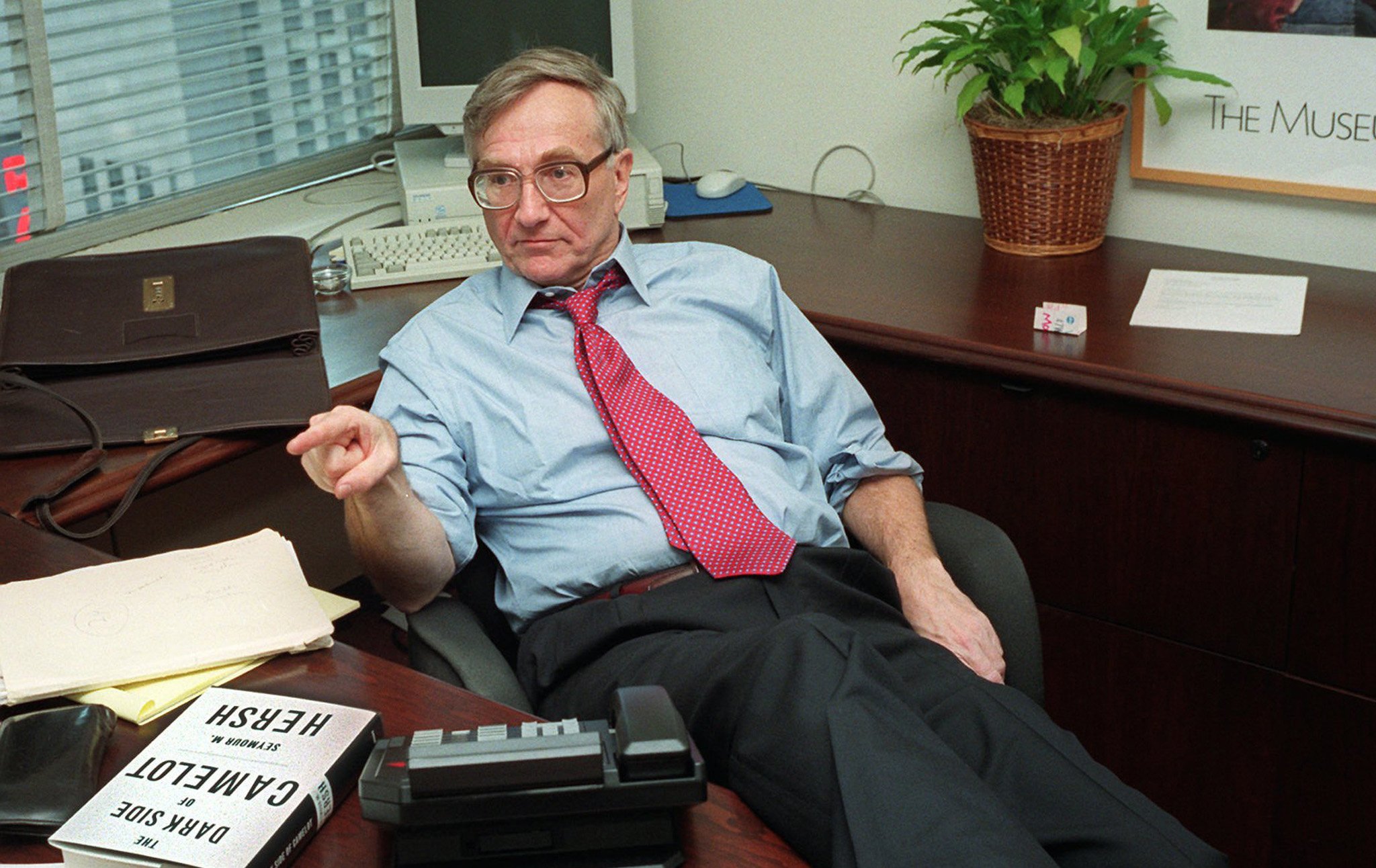
Laura Poitras and Mark Obenhaus’s highly-regarded new Netflix documentary Cover-Up is a biographical film about Hersh, showing how this indefatigable, independent journalist broke several of the most important stories of our time—not just My Lai in 1969 but also the Abu Ghraib torture scandal in 2004. (His piece for The New Yorker, titled “Torture at Abu Ghraib,” featured the now infamous photo of a hooded Iraqi prisoner standing on top of a cardboard box, preparing to be electrocuted.) Hersh even had an important, and underappreciated, role in reporting on Watergate. Cover-Up reveals much about how media functions and how it ought to function; most importantly, it will hopefully inspire a new generation to take up the work still being practiced by the now-88-year-old Hersh.
The most disturbing aspect of the My Lai story, beyond the gruesome facts themselves, is that if Hersh hadn’t sniffed out the story, it might never have gotten any attention. In fact, plenty of the most horrendous violence against Vietnamese civilians was never (and is still never) discussed, as journalist Nick Turse shows in his book Kill Anything That Moves: The Real American War in Vietnam. The bombing of Laos showed that an entire war could essentially escape the notice of the U.S. public entirely. Importantly, while the focus on the My Lai massacre in particular suggested it was an aberrational atrocity, one reason it was easy to keep a lid on was that it differed from other massacres only in scale. As David Hackworth, who created the U.S. Army’s infamous Tiger Force, recalled, “Vietnam was an atrocity from the get-go[...] There were hundreds of My Lais. You got your card punched by the numbers of bodies you counted.” In fact, the New York Times writes, “Burning huts and villages, shooting civilians and throwing grenades into protective shelters were common tactics for American ground forces throughout Vietnam.”
It was not that the reporting Hersh did on My Lai was especially difficult. The facts were there, for anyone who wanted to find them. A U.S. Army whistleblower, Ron Ridenhour, had been gathering evidence of the massacre and sending it to members of Congress, trying and failing to get someone to pay attention. The military’s arrest of Lt. William Calley, one of the perpetrators, had already been reported in the New York Times, a tiny item in the back pages. Hersh points out in the film that his main task as a journalist was to simply talk to those who had witnessed the massacre, write down the things they said, and let their stories speak for themselves. “It would have been impossible to screw up that story. All you had to do was get out of the way of the story… Just let their voice be the story.”
The story would win Hersh the Pulitzer Prize and become one of the most notorious cover-ups in military history. But the exposé was not originally commissioned by a major newspaper. Hersh failed to get a major national outlet to buy it, so he went to “Dispatch News Service,” an alternative news agency that placed the story in local papers around the country, where it took off. It’s notable that something like this would be far more difficult, if not impossible, today. Dispatch News Service itself has been defunct since 1973, but the rest of this institutional infrastructure is gone, too. We don’t have these kinds of alternative news agencies producing and distributing journalism that is then picked up by mainstream papers. Nor do we even have the papers; local news outlets have been going extinct at an alarming pace. You can, of course, publish online, but there you're competing with a vast tidal wave of slop, and much of importance simply gets buried.
In fact, much about Hersh’s career seems like, and is, a relic of a different time in media. For one thing, Hersh was working-class, and it looked like he would be working in his parents’ small dry cleaning shop on the South Side of Chicago for the rest of his life, until a teacher helped him get into the University of Chicago. (I doubt he came out with student debt when he graduated in 1958, but the school now costs over $98,000 a year.) As the Economic Hardship Reporting Project’s Alissa Quart writes for the Columbia Journalism Review, the lack of paths for working-class people to become journalists today is not only unfair, but skews coverage away from the concerns of the working class and toward the concerns of elites.

Hersh’s own class background gave him a healthy suspicion of the elite, even when he successfully ascended into it. Hersh knew that government spokespeople and CEOs were bullshitters, even as fellow members of the press corps dutifully jotted down and repeated the talking points put out by press secretaries. He was an outsider even when, after My Lai, he joined the staff of the New York Times. Hersh eventually left the Times after clashing with leadership. In Cover-Up, Hersh alleges (plausibly) that the Times was much less receptive to his scrutiny of corporations than his scrutiny of the U.S. military, in part because the Times corporation itself was committing some of the same kinds of ethical violations he wanted to call out the rest of corporate America for practicing.
Cover-Up is not a hagiography, and some of Hersh’s flaws are on full display. His irascibility and his conviction that the official story must be wrong have led him into the occasional major failure. While he was writing his book The Dark Side of Camelot, a critical analysis of John F. Kennedy, Hersh nearly fell for hoaxed letters purporting to be between JFK and Marilyn Monroe (the letters were removed before publication). Later on, in what appears rather stunning admission, Hersh says that he cast doubt on the former Syrian president Bashar al-Assad’s use of chemical weapons during the country’s civil war, in part because he simply didn’t think Assad was capable of something that heinous, a lapse in judgment he attributes to becoming too close to power. “There were reports that Assad nerve gassed his own people. I saw him two or three or four times and I didn't think he was capable of doing what he did. Period. And let's call that wrong. Let's call that very much wrong.” (Note: Aaron Maté argues that Poitras spliced together two quotes from Hersh here in order to make it appear Hersh was suggesting he now believes Assad used chemical weapons, when Hersh actually meant he now believes Assad tortured people. Without the raw transcript of Hersh’s original interview it’s not clear whether Hersh did or did not disavow his reporting that cast doubt on Assad's use of chemical weapons.)
Seeing the American government lie so shamelessly so many times might also have convinced Hersh that any criticism of U.S. enemies is probably propaganda. “We were always told ‘if the Russians say it, it can’t be true,’ ‘if the North Vietnamese say it, it can’t be true,’” he has said. “I really learned not to believe that stuff.” Well, it’s also the case that just because the U.S. president says something, that doesn’t mean it’s a lie, even if that is often the case.
Hersh has also been criticized for his use of anonymous sources, and I do think he’s failed to wrestle with the difficulties that presents for his credibility. For instance, in 2023 he published a sensational report on his Substack (yes, at 88, Hersh is still reporting, and on Substack!) alleging that a secret U.S. operation, authorized by Joe Biden, destroyed Russia’s Nord Stream pipeline. Hersh’s story relied on “a source with direct knowledge of the operational planning.” The White House called it “false and complete fiction” and major media outlets did not pick up the story.
To this day, it is not known definitively who blew up the Nord Stream pipeline, and Hersh could be right that the U.S. planned the sabotage. (The U.S. government has a long history of sinister clandestine operations, many of which Hersh himself has reported on, so nobody should assume the government is too rule-bound and principled to contemplate such a deed.) Hersh defended his decision to report the story despite having only a single source, whose identity he kept from the public, saying that he trusted his source. That’s fine for him, but one wonders what he expects readers to make of the story. Are we supposed to take him on faith? We don’t have any evidence we can examine in order to determine whether we believe the story or not. How can we be expected to believe him when we know that he has been both right (My Lai, Abu Ghraib) and wrong (Assad) in the past?

Still, if Hersh does turn out to be right about Nord Stream in the long run, it will be one of the most sensational journalistic coups of our age: the entire mainstream media missing a major story that a grumpy octogenarian on Substack managed to suss out by being dogged and skeptical. And even if he turns out to be wrong, I stand by the claim that a society needs Seymour Hershes. Hersh’s crucial reporting goes well beyond My Lai and Abu Ghraib. He exposed that the CIA had been spying on political activists in violation of U.S. law (revelations laying the groundwork for the Church Committee); he published a major exposé about the history of Israel’s secret nuclear arsenal; and he produced detailed accounts of the U.S.’s stockpile of chemical and biological weapons. He has penetrated beneath idealistic presidential rhetoric to expose the ugly realities of state violence, corruption, and abuse.
We need more reporters like this, and I’m not sure they’ll exist after Hersh. We have some intrepid new independent outlets like Drop Site, Zeteo, and the Lever, along with individual reporters like Ken Klippenstein, but in watching Cover-Up I was also struck by the fact that Hersh’s reporting only got attention because there was a public willing to care. If atrocities are reported and nobody is shocked, what then? We don’t just need new Hershes, but a public that appreciates and demands the kind of work that Hersh has done.
Hersh is infamously prickly, as memorably revealed in an expletive-laden interview with Isaac Chotiner about his reporting on the death of Osama bin Laden. (Sample quotes: “Would you care to hear the truth? Would you care to hear something that didn’t come from Vox, whoever Vox is?” “His initial approach was to say do a blog item. Go fuck yourself! A blog?” “I am done yelling.”) Cover-Up shows this side of him—at one point, on camera, he announces he is quitting the project out of frustration with the filmmakers, a moment I’m sure they knew would come. But it also reveals that he is capable of being emotional and idealistic. He describes being overcome with misery when contemplating what the American soldiers did to Vietnamese toddlers (he had young children himself), to the point of having a breakdown and needing to be talked down by his wife. He is still reporting, still collecting details and quotes in an ever-growing mountain of yellow notepads in his office, and Cover-Up depicts him in the act of working on a new story about Israel’s atrocities in Gaza. Toward the end of the film, the often grumpy, dour Hersh gives a quite straightforward answer to the question of why he continues to do what he does. Because, he says, governments should not be allowed to do this. These things should not happen. “You can’t have a country that does that… You can’t just have a country that does it and looks the other way. If there’s any mantra to what I do, that’s it.” Despite seeing so many horrors, he hasn’t quite stopped believing that we have an obligation to try to build a better world.

%20(crop).jpg?width=352&name=wile-e-coyote%20(resize)%20(crop).jpg)