
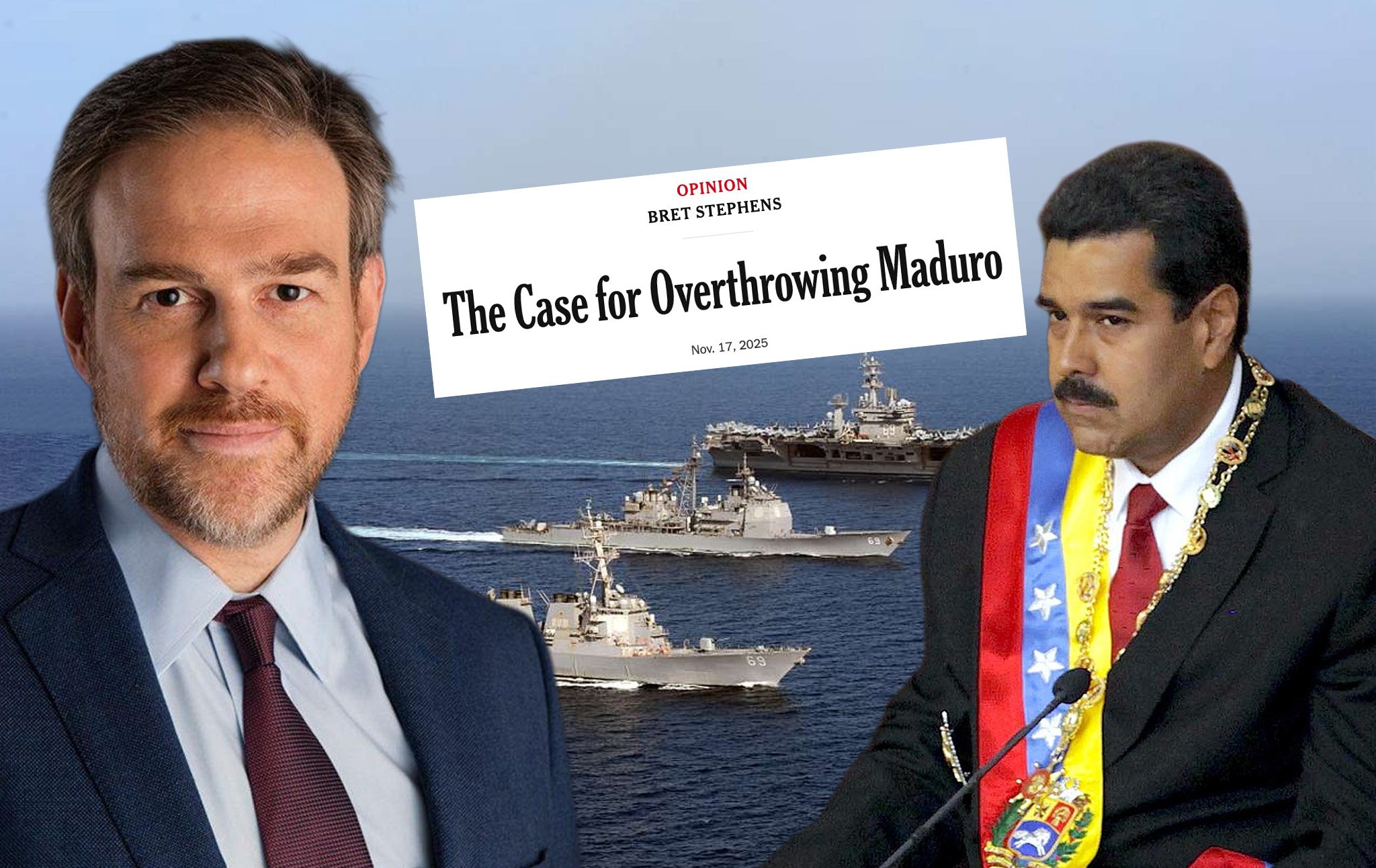
Yet again, the New York Times’ Bret Stephens advocates the overthrow of a sovereign government. Why do the readers of the “paper of record” tolerate this dangerous propaganda?
In early 2003, readers of the New York Times were treated to a column by resident foreign affairs expert Thomas L. Friedman, in which Friedman claimed that invading Iraq and overthrowing its government would be a useful, moral, and sensible thing to do:
Regime change in Iraq is not some distraction from the war on Al Qaeda. That is a bogus argument. And simply because oil is also at stake in Iraq doesn't make it illegitimate either. Some things are right to do, even if Big Oil benefits. Although President Bush has cast the war in Iraq as being about disarmament -- and that is legitimate -- disarmament is not the most important prize there. Regime change is the prize. Just by mobilizing for war against Iraq, the U.S. has sent this region a powerful message: We will not leave you alone anymore to play with matches, because the last time you did, we got burned[…] in today's globalized world, if you don't visit a bad neighborhood, it will visit you.
Friedman voiced some unease about the potential war, and at one point wrote a column in the voice of an imaginary “pro-American Arab leader” (instead of asking a real Arab leader for an opinion) to muse on the possibility of merely forcing Saddam Hussein into exile using the threat of war, rather than actually waging war. But Friedman felt that a war with Iraq would be good “shock therapy” and would “stimulate some real change in an Arab world that is badly in need of reform.”
Hundreds of thousands of Iraqis would soon die from Friedman’s recommended “therapy,” and the invasion of Iraq quickly became the worst crime of our century. As the war turned into a bloody catastrophe, rather than showing any contrition, Friedman accused France of “becoming our enemy” for having declined to support the atrocity. (In fact, France should have been praised for its good sense and foresight.)
There was little accountability at the New York Times for publishing such shameful propaganda for this terrible crime, which went well beyond Friedman’s columns. The worst offender, reporter Judith Miller, was forced to leave the paper after publishing unverified stories on Iraq’s alleged “weapons of mass destruction”—reporting which the U.S. government used to bolster support for the war, and which turned out to be false. But Friedman continues to pump out vapid columns to this day, including an outright racist flight of fancy last year imagining different Middle Eastern populations as different members of the animal kingdom. (Iranians were labeled “parasitoid wasp[s].”) Nor was there any hesitation about publishing calls to bomb or invade other countries. Subsequent years saw the publication of “Bomb North Korea, Before It's Too Late” and “To Stop Iran’s Bomb, Bomb Iran” (by John Bolton!). Neoconservative columnist Bret Stephens has published many opinion pieces calling for or praising the bombing of Iran. Now, because this type of guy always needs a new war, he’s turned to calling for attacking Venezuela and deposing its government. In January, Stephens published “Depose Maduro,” and now he’s given us a repeat in “The Case for Overthrowing Maduro.”

What’s striking about Stephens’ “case” for overthrowing Maduro is how thin it is. Stephens says that (1) the U.S. has a “vital interest” in seeing Maduro gone, that (2) there is no way other than war to dislodge Maduro, that (3) Maduro is bad at governing Venezuela, and that (4) while there is a risk the invasion will plunge the country into a catastrophic quagmire, “we can learn from our past mistakes.” Stephens does not even attempt to answer two of the most obvious questions that should face an advocate of aggressive war, namely: “What right does the U.S. have to overthrow a sovereign government?” and “Do other countries also have the right to overthrow any government whose actions negatively affect their perceived national interest?”
What “vital interest” does the U.S. have in overthrowing the government of Venezuela? Stephens doesn’t actually press too hard on the justification offered by the Trump administration, that Maduro is some kind of international drug kingpin. Indeed, as my colleague Alex explains, even the U.S. government’s own analyses have not identified Venezuela as a top exporter of illegal drugs to the U.S.. Stephens does link to a report by the State Department funded InSight Crime, but the report actually refutes the claim that Maduro operates as a ringleader of the country’s drug trafficking, portraying him instead as trying to carefully maintain power while dealing with the reality of powerful drug traders existing within the country. The report states explicitly that “Criminal groups that have grown wealthy and powerful from cocaine are growing ever more difficult to control” and “Maduro is trying to bring order to the growing criminal chaos.” Stephens does not quote this line, and the report Stephens cites actually destroys the case for regime change over drug trafficking; after all, if Maduro is not a “godfather” figure, then any Venezuelan head of state would have to deal with the reality of powerful drug traffickers, and a successor government is likely to suffer from much of the same corruption and deal-making. The report says:
The Maduro regime’s political enemies like to see the Venezuelan cocaine trade through the prism of the government’s own left-wing rhetoric; depicting drug trafficking as a nationalized state monopoly. But in truth, it is more akin to the wild west capitalism seen following the collapse of the Soviet Union: a game of wealth and power with oligarchs and gangsters jostling for position as an authoritarian leader tries to hold it all together.
If that’s the case, it sounds an awful lot like removing Maduro could well make things worse.
Probably sensing how weak this argument is, Stephens mentions it only in passing. Instead, his main accusation against Maduro is that he is “an importer and exporter of instability.” What is “instability”? Well, as is often the case in U.S. propaganda discourse, a “stable” country is one favorable to the U.S., while an “unstable” country is one that contradicts or opposes U.S. leaders even in the smallest ways. Stephens is open about this. Maduro is an “importer of instability” because “the regime’s close economic and strategic ties to China, Russia and Iran give America’s enemies a significant foothold in the Americas.” As usual, it helps to ask the question: How would this argument sound if any other country used it? Imagine China saying that Japan, South Korea, and Taiwan were “importers of instability” because their ties to the U.S. gave America a “significant foothold in Asia.” Would this justify a Chinese invasion of these countries? Or would we see that as blatant aggression?
As for “exporting” instability, what is that? Well, Stephens cites the number of Venezuelans who have emigrated (millions over the last ten years) as proof that the country is being governed poorly and we may therefore legitimately overthrow its government. He says that we have a “moral right” to invade because Venezuela’s government produces misery for its people. (He does not cite any polling of Venezuela’s people to show that they support a U.S. attack, since the opinions of a population are irrelevant to whether we should liberate them.)
It says a lot about the state of discourse in the United States that in a liberal newspaper, the “Paper of Record,” a columnist does not feel the need to provide any legal justification for waging war against another country. Attacking a sovereign nation is an explicit violation of the basic principles of the UN Charter, which says that uses of force must be authorized by the UN Security Council. Stephens doesn’t even mention international law in his columns. The right of the U.S. to rule over the rest of the world, and to “coup whoever we want” (to use Elon Musk’s memorable phrase) is simply assumed.
Stephens is not only producing propaganda for a criminal war of aggression, but he’s barely putting in any effort. His assurances that the “risk” is worth it fail to take seriously the disasters that can occur after deposing a foreign government with no day-after plan, and he doesn’t explain why we should invade Venezuela but not other dictatorial countries. If we care about stopping countries that abuse human rights, we should invade Israel and Saudi Arabia. If we care about stopping the flow of refugees, we should have boots on the ground in Sudan. Why is Venezuela being singled out for an attack? As Skopic explains, the actual reason is obvious and barely disguised. Large portions of the American ruling class resent that Venezuela’s government has violated the Monroe Doctrine and is not slavishly subservient to the U.S., and they reason that if we had a friendlier government we could, in Donald Trump’s words, get “all that oil.” For Stephens, the “real” reason may be a little different, because neoconservative columnists just always need new war crimes to advocate, lest they struggle to fill their weekly column inches. What would a columnist like Stephens even write about if he weren’t proposing new wars for other people’s children to fight in?
Sadly there is no editing, and there is no accountability. The Times editors do not make Stephens answer even basic questions that his argument raises, they do not make him address the question of legality, they do not make him represent his sources fully and accurately, and they do not seem to learn from their history of publishing vile justifications for homicidal atrocities.
But here at Current Affairs, we’ve thought of one small way you can hold the Times accountable for publishing Stephens’ atrocious, and very dangerous, opinion writing. You can cancel your subscription and subscribe to Current Affairs instead. We will even offer you a free one-year digital subscription if you send proof you’ve canceled your subscription to the New York Times. Email proof to help@currentaffairs.org and we’ll give you your subscription. (The offer also extends to subscribers of The Atlantic, the worst magazine in America. Cancel today!)
Sadly, we here at Current Affairs have to keep reading the New York Times, so we can keep holding it to account. But you don’t have to! And when you switch your dollars to supporting independent media, you are helping us build an alternative. Yes, people read the Times because of the reporting it does, much of which remains important. But when you subscribe to independent publications like this one, or our friends at Drop Site, The Lever, Zeteo, The Intercept, The Majority Report, In These Times, etc., you help us build out our own journalistic capacities. If sufficient numbers of people support these publications through their subscriptions and donations, there will be no need for anyone to get their news reporting from a publication that prints justifications for war crimes. It’s true that a few people canceling their Times subscriptions doesn’t make much of a difference to such a large company, but it’s important to exact a price from them for choosing to allow Stephens to push views that—if accepted—will result in horrific atrocities. War is not inevitable, but if we continue to fund publications who try to manufacture consent for war, then the cycle of violence will be much more likely to continue.
Email help@currentaffairs.org with proof you have canceled a New York Times or Atlantic subscription and you will receive a free 1-year digital subscription to Current Affairs.


.png?width=352&name=Screenshot%202026-09-04%20at%204.00.52%20PM%20(1).png)
%20(1).jpg?width=352&name=miasma-1%20(1)%20(1).jpg)