
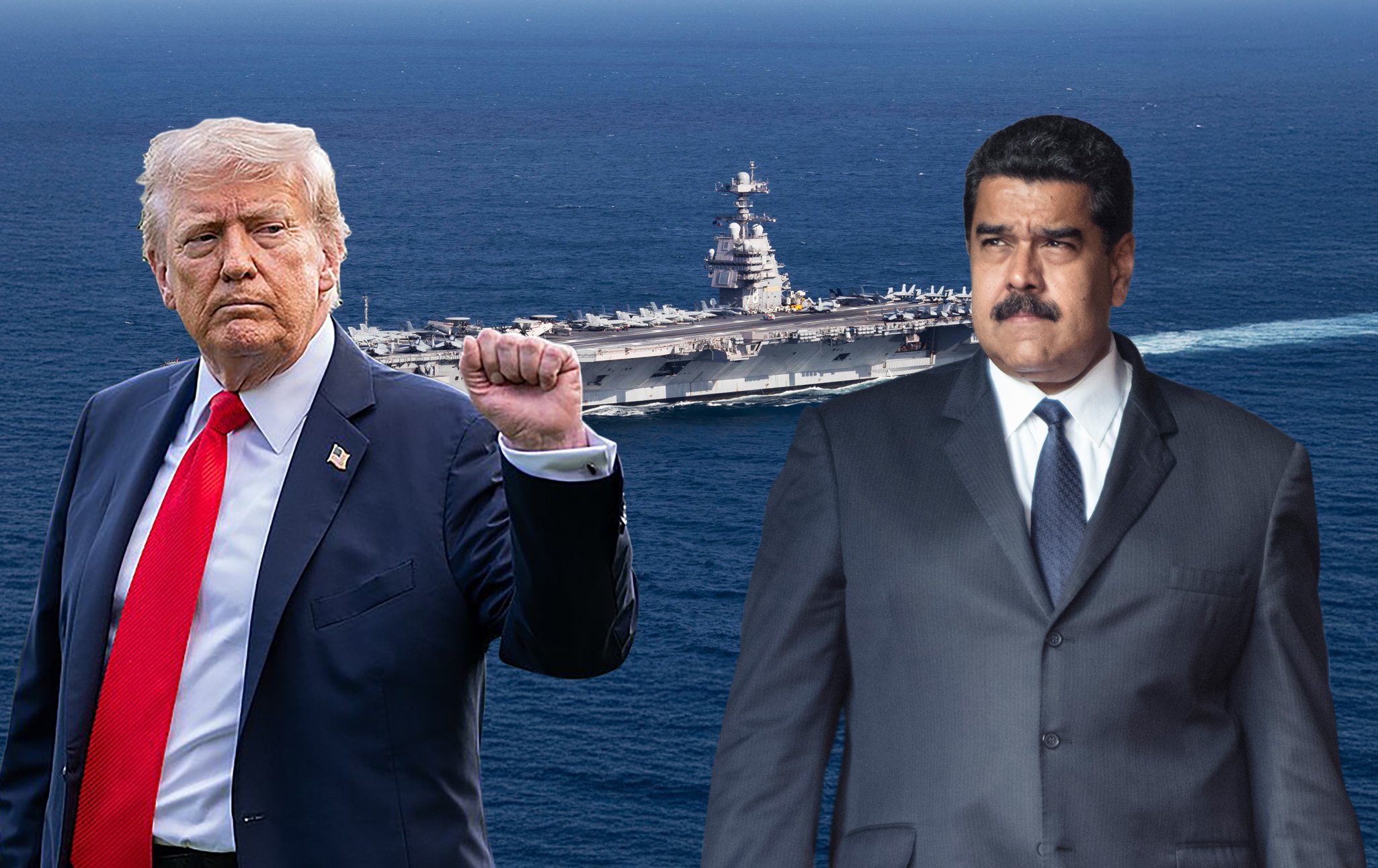
Like George W. Bush before him, Donald Trump is trying to sell an illegal, indefensible assault on an oil-rich nation. Don’t fall for it.
Donald Trump and his allies are preparing to attack Venezuela. They’re not even trying to be secretive about it. A “vast military build-up” is now under way in the Caribbean, with the USS Gerald Ford—the world’s largest aircraft carrier—dispatched there on October 26. According to the Economist, “more than ten percent of all deployed American naval assets” are now in Central and South America. What’s more, the Trump administration has authorized the CIA to conduct “lethal operations” (that is, assassinations and other forms of secret warfare) within Venezuela itself. Trump has dubbed President Nicolás Maduro a “narcoterrorist,” and top Republican politicians are explicitly threatening his life. Representative Mario Diaz-Balart has said that Maduro “can only negotiate not to have his plane downed when escaping,” while Senator Rick Scott said this Monday, “If I was Maduro, I’d head to Russia or China right now[...] His days are numbered. Something's gonna happen.”
The situation bears all the signs of a classic U.S. regime-change war. But just like the invasion of Iraq in 2003, a war with Venezuela would be illegal under international law, indefensible on any logical or moral grounds, and an abject disaster for both Venezuelans and the U.S. soldiers who would be forced to fight it. Just like Iraq, it would benefit only rich oil executives, who are already salivating at the prospect of getting access to Venezuela’s petroleum reserves—and, of course, the weapons industry. Unless we want countless innocent people killed for corporate profit margins, Trump and his gang of warmongers have to be stopped, while there’s still time.
Even the Atlantic now knows that “The U.S. Is Preparing for War in Venezuela,” that’s how obvious it’s become. Likewise, the Hill has published an op-ed laying out the case that “pursuing regime change in Venezuela is a necessary course.” The piece, titled “Venezuela isn’t just a dictatorship — it’s a criminal threat to U.S. security,” is useful, not because it says anything true, but because it gathers all the typical arguments for U.S. intervention in one place and makes them easy to debunk.
First of all, Venezuela is an awful dictatorship, writes Oswaldo Silva, a graduate student at George Mason University. Maduro uses a “sophisticated machine of social control and human rights violations” to abuse his people. And it’s not just a question of a “legitimate state corrupted by a few bad actors”; the state itself is a “criminal enterprise that harms America in numerous ways.” Foremost among these harms, we’re told, is the drug trade: “The Venezuelan regime’s most effective tools today serve to traffic drugs into the U.S.,” along with aiding various “terrorists and non-state actors” along the way. Therefore, Trump’s aggression against Venezuela—including the sudden bombing of small boats he claims are carrying drugs—is simply a “decisive escalation in counternarcotics efforts,” and is ultimately both necessary and good.
This line of argument is both stupid and reprehensible. To see why, let’s take the points in order. First, yes, Venezuela under Maduro is essentially a dictatorship—his last election was sketchy, to say the least—and the Venezuelan government commits all kinds of human rights abuses. No argument there. This is all well-documented, and nobody on the left should excuse it just because the regime in question labels itself “socialist.” But a lot of countries have awful, authoritarian governments—Turkey under Erdoğan, Hungary under Viktor Orbán, Saudi Arabia with its modern-day slavery—and we do not launch military assaults on them. Nor do we have the right to. Under international law, starting a war of aggression against a country which has not attacked you is “the supreme international crime.” Venezuela has not attacked the United States, so attacking it with the explicit goal of causing “regime change” would be the most clear-cut violation of international law imaginable. You don’t get an exception from the Rome Statute because you point at Maduro and say “but he’s a bad guy!”
Then, what about the idea that Venezuela is a “narcoterrorist” state responsible for a huge wave of deadly drugs into our country, tantamount to an act of war? False again. The U.S. military and intelligence services themselves say so. As Guillame Long notes at Al Jazeera, “the United States Drug Enforcement Administration’s National Drug Threat Assessment of 2024 does not even mention Venezuela.” (Instead, Colombia, Peru, and Bolivia all get a spot on the naughty list.) Another DEA threat assessment, this one from 2020, concluded that only 8 percent of cocaine trafficking departs from Venezuela and goes through the Caribbean, while a whopping 74 percent leaves from the area of Colombia and Ecuador and passes through the Pacific. Meanwhile, “a classified National Intelligence Council report established that Maduro did not control any drug trafficking organisation,” and a “senior U.S. official” told Drop Site News that “little to none of the fentanyl trafficked to the United States is being produced in Venezuela.” Senator Rand Paul, who is certainly no fan of Maduro, concurs, telling Piers Morgan: “Number One, there is no fentanyl being made in Venezuela. Not just a little bit, there’s none.”
So, it’s not about drugs. If the actual goal were to stop the flow of cocaine, fentanyl, and other dangerous narcotics, plenty of other nations would be in the crosshairs before Venezuela—not to mention U.S. soldiers themselves, who do their fair share of drug smuggling, as journalist Seth Harp recently detailed in The Fort Bragg Cartel. And it’s not about authoritarianism or human rights. The United States doesn’t actually care about those, which you can tell because it’s still allied with Turkey, Hungary, Israel, and the Gulf monarchies, among others. Clearly, the actual reason for Trump’s military buildup is something different.

So, what is the push for war with Venezuela really about? What are U.S. wars always about? Control of valuable resources. Oil, specifically. This isn’t even speculation, because Trump just says it openly. “When I left, Venezuela was ready to collapse. We would have taken it over, we would have gotten all that oil, it would have been right next door,” he said at a meeting of the North Carolina Republican Party in 2023. “But now we’re buying oil from Venezuela, so we’re making a dictator very rich. Can you believe this? Nobody can believe it.” Trump has contempt for the very idea that he might treat another world leader as an equal and strike a fair deal to get what he wants. He would rather just “take it over.”
This isn’t even Trump’s first attempt. In 2019, he officially recognized opposition leader Juan Guaidó as the rightful president of Venezuela, clearly hoping Guaidó would get rid of Maduro for him. Now, Trump is back in office and ready to try again—and he has a critical ally in María Corina Machado, the new leader of Venezuela’s anti-Maduro movement. When Machado recently received the Nobel Peace Prize, she dedicated it to Trump. She has also endorsed U.S. military action to oust Maduro, declaring herself and her supporters ready to “take territorial and institutional control.” In an interview with Donald Trump Jr. this February, she proudly declared that regime change would be a big business opportunity for U.S. firms:
Forget about Saudi Arabia; forget about the Saudis. I mean, we have more oil, I mean, infinite potential. And we’re going to open markets. We’re going to kick [out] the government from the oil sector. We’re going to privatize all our industry[...] This country, Venezuela, is going to be the brightest opportunity for investment of American companies, of good people that are going to make a lot of money.
For their part, the big business interests are listening and licking their chops. “If you can get Maduro out and you can get western oil companies back into Venezuela, then Venezuela could become a supply counterbalance to Saudi Arabia in the mid to late 2030s,” says Schreiner Parker, an analyst at the Norwegian company Rystad Energy, speaking to the Financial Times. That, in a single sentence, is the economic goal here: “get Maduro out,” get a pro-U.S. puppet leader in, and start the money faucets flowing.
It’s not just about getting the oil, though. Maduro has already offered that. He may be a dictator, but he’s not irrational; he recognizes that war with the U.S. would be disastrous, and wants to avoid it. As the New York Times reported on October 10, Maduro offered the Trump administration a remarkably good deal: he would “open up all existing and future oil and gold projects to American companies, give preferential contracts to American businesses, reverse the flow of Venezuelan oil exports from China to the United States, and slash his country’s energy and mining contracts with Chinese, Iranian and Russian firms,” all in exchange for an end to hostilities. Trump rejected the deal. He doesn’t just want the oil; he wants to take the oil, and be seen doing it.
We can find an explanation for this behavior in Mike Pompeo’s 2023 memoir, Never Give an Inch: Fighting for the America I Love. There, Pompeo—who served as both Secretary of State and director of the CIA during Trump’s first term—confesses that Trump considered using “the military option” against Venezuela as far back as 2017, claiming its friendly relations with Russia, China, and other geopolitical antagonists of the U.S. were a “violation of the Monroe Doctrine.” Trump talks a lot about the Monroe Doctrine, to the extent that officials around him have reportedly dubbed it the “Donroe Doctrine.” He appears to sincerely believe that Latin America and the broader Western Hemisphere are “America’s Backyard,” meaning countries there have to do what the U.S. wants or suffer the consequences. So attacking Venezuela—like the sanctions on Cuba, like the similar threats to send U.S. special forces into Mexico—would be just another example of what Noam Chomsky calls “punishing successful defiance.” It would serve as an example to the rest of the region to obey the first time when Uncle Sam speaks. The best historical parallel would be Stalin or Khrushchev rolling over a small Eastern Bloc nation to prove a point about who’s boss.
This is important to understand, because a war in Venezuela would be an unmitigated disaster. There are varying strategies and degrees of engagement Trump could use, from a few so-called “surgical” airstrikes (similar to what he deployed against Iran this year, also illegally) to a full-scale ground invasion. But none would result in a clean U.S. victory. The United States can’t even score one of those against Ansar Allah in Yemen, despite years of attempts, and Venezuela is a real nation-state with a modern military: army, navy, and air force. As the Atlantic notes, “Venezuela[...] has already flown F-16s over American destroyers operating in the region.”
For them, it would be a war for their survival as a sovereign nation. So it’s overwhelmingly likely that any regime-change operation the U.S. mounts would come with U.S. casualties, and as soon as the first American dies, the baying for blood in Washington would reach new heights. What’s intended as a scalpel can easily become a sledgehammer, and a lot of people would get killed, both Venezuelan and American. On the U.S. side, it would be predominantly young men recruited from rural and inner-city high schools in the “poverty draft.” On the Venezuelan side, like in Iraq, it would just be a wide swathe of civilians who happen to be living in the area the U.S. chooses to strike. Everybody would lose—except, of course, the oil and arms executives, who have no intention of placing themselves or their children anywhere near a combat zone.

Trump, Marco Rubio, Pete Hegseth, and their corporate cronies are counting on our ignorance and apathy. As Stephen Prager wrote for this magazine about the earlier Iran strikes, it’s notable that they’re barely even trying to justify using military force. They don’t think they have to anymore. And for its part, the Democratic Party isn’t giving them much reason to think otherwise. It’s infested with war hawks like Senators John Fetterman and Elissa Slotkin who, at a fundamental level, believe it’s legitimate for the U.S. to attack whoever it deems the “bad guys” to be. They broadly support Trump’s strikes on Venezuelan boats, stipulating only that Congress should be notified first. And then there are lukewarm cowards like Senator Mark Kelly, who only mumble that the “legality” of a military buildup near Venezuela’s shores is “questionable.” It isn’t questionable, it’s criminal. And if our elected officials won’t fight it, it’s up to us.
In 1967, the great Muhammad Ali was asked by reporters why he’d refused to be drafted into the Vietnam War. His answer was characteristically blunt, and it was perfect. “I ain’t got no quarrel with them Viet Cong,” he said. “No Viet Cong ever called me n—r.” Today, we ought to remember Ali, and say the same for our own times. I’ve got no quarrel with Venezuela, and neither should you. No Venezuelan ever raised my rent. No Venezuelan ever denied my medical care. Our enemy isn’t the people of Latin America, who have enough problems to worry about without U.S. bullets and bombs flying overhead. It’s not even Nicolás Maduro. Not really. It’s the elites sitting right here at home, in corporate boardrooms and White House conferences, who are pushing for that kind of overseas war to line their own pockets. It’s them we have to take down, before they send our relatives in the Marines or the Air Force to catch a bullet for them. Whether it’s Venezuela, Iran, or any other nation, we’ve got to resist the beating war drums with everything we’ve got: mass protest, pressure campaigns and primary challenges against pro-war legislators, and civil disobedience too. Don’t fall for another Iraq. Peace to Venezuela; war on Wall Street.


.png?width=352&name=Screenshot%202026-09-04%20at%204.00.52%20PM%20(1).png)
%20(1).jpg?width=352&name=miasma-1%20(1)%20(1).jpg)