In his new memoir, the California governor tries desperately to seem down-to-earth. Instead, he reveals himself as a shallow, inauthentic son of privilege who’ll say anything to get ahead.
Political memoirs written by ambitious politicians are rarely written to tell the truth about a life. Instead, they are written to correct the public record before someone else does. By the time a politician sits down to write a first draft, the story of their career has already been told through newspaper profiles, investigative reporting, and the occasional scandal. A memoir offers the chance to rewrite that story from the inside: to smooth out the contradictions, elevate the moments of principle, and quietly explain away the advantages that made the whole thing possible.
Gavin Newsom’s Young Man in a Hurry reads very much like that kind of book. In fact, the California governor lays out halfway through its 304 pages that changing the public perception of his relationship with the billionaire Getty family is one of his main goals. As he puts it, his “deeper entry into the Getty world would rob me of my own hard-earned story, a theft that would become one of the very reasons for writing this book.” (Surely, political ambitions for a house on Pennsylvania Avenue have nothing to do with it.)
Newsom derides the press for painting him as someone who grew up privileged, even while he admits that he plays the part with “campaign contributions from San Francisco’s elite, my routine presence at society events, my own wedding reception at the Getty mansion.” He attempts to drive home the duality of his working-class mother (who served as a waitress, an assistant buyer in a department store, and a bookkeeper, among other jobs) and his father’s connections, a duality that he thinks absolves him of any accusations of a pampered lifestyle. He doesn’t seem to understand that despite his mother working hard, the immense privilege he received through his father supersedes it. He sometimes portrays his father as absent, yet the book also presents him as a figure who often helps a young Newsom.
Newsom has long carried a reputation as the archetypal California insider: a man whose career emerged from the tightly interconnected world of San Francisco wealth, real estate, and political dynasties. His critics have often argued that the governor is less a self-made entrepreneur than the beneficiary of one of the most powerful patronage networks in American politics. The memoir appears designed, at least in part, to answer that criticism.
Throughout the book, Newsom tries to present himself as something closer to a scrappy outsider who rose through determination and hustle. He writes about being a paper boy, delivering orthotic inserts after college, studying real estate at night, and learning business the hard way.
But the story Newsom tells about his life is repeatedly interrupted by another one: a story about billionaires, private jets, inherited political networks, and friendships with some of the wealthiest families in America.
The tension between those two narratives, between the struggling kid and the well-connected insider, is the central drama of Young Man in a Hurry. Unfortunately for Newsom, it is also the reason the memoir never quite works.
I will be real for a second and say I never liked Gavin Newsom. I always thought he just oozed everything stereotypical about a politician—too polished and dishonest. Still, going into this memoir I realized I didn’t really know much about the guy, except that he is a potential 2028 Democratic candidate, and people seemed to enjoy his press office Twitter spats with the current administration. I’m a 31-year old from Ohio who lives and breathes politics, but I wasn’t aware of Newsom before he became governor, and since his 2018 election my impression is that he will not bring the change that I want to see in the Democratic Party. It seemed to me that he would be much the same as Democratic elites like Chuck Schumer or Hakeem Jeffries. The one positive thing I had to say is that he is one of our better-looking politicians, if Patrick Bateman is your type. (Unfortunately, that is my type.) So, I tried going into this memoir with an open mind, but the concept of Newsom being lab-grown into a politician was only confirmed.
The memoir begins with Newsom explaining that his father did not leave “much in the way of an estate,” setting the tone for the book’s central project: minimizing the immense network of wealth and power that surrounded him throughout his life. Newsom talks about the struggles his mother faced raising him and his sister while working three jobs. When the family moved into a new home, he writes that the “$100,000 price tag put a weighty mortgage over our heads,” and I just couldn’t help but think about the housing crisis that our country is currently in.
The implication is clear enough: this is supposed to be the story of a politician who understands hardship because he lived through it. But the difficulty with this framing is that the book repeatedly contradicts it.
Newsom’s father, William Newsom, was not merely acquainted with the Gettys. He was one of the closest advisers to the Getty family fortune, managing one of the wealthiest dynasties in American history. He was the Tom Hagen to the Godfather’s Corleones, the consigliere. William attended high school with Gordon Getty, son of oil magnate J. Paul Getty, and the two remained close friends for decades. Over time, William became a trusted attorney and adviser to the family and helped administer parts of the Getty trust. The relationship went beyond business. William was deeply embedded in the Getty orbit, so much so that he helped deliver ransom money during the 1973 kidnapping of John Paul Getty III in Italy.
Interestingly enough, a bit that didn’t make the book is that the elder Newsom also spent two years traveling around Europe with a former Nazi SS officer turned defense contractor named Otto von Bolschwing, from 1969 to 1970. Von Bolschwing became president of the Trans International Computer Investment Corporation (TCI), where Newsom was working as corporate counsel, thanks to J. Paul Getty Jr. When asked about the ex-Nazi, Newsom Senior said only that von Bolschwing “[...]was suave and plausible. He seemed to have all the credentials,” and that “He had the long cigarette holder, his hair was slicked back.” The fact that his new associate was a former officer in the force that carried out the Holocaust does not seem to have presented him with any ethical concerns, a disturbing sign of the amorality that surrounded the Getty empire.
Proximity to that empire shaped Gavin Newsom’s upbringing in ways the memoir acknowledges but repeatedly minimizes. The Gettys were not distant benefactors; they were a constant presence in the Newsom family’s social world. The families vacationed together and spent holidays together. Gordon Getty was essentially William Newsom’s closest friend.
Through that relationship, Gavin Newsom grew up spending time with the Getty family and moving within elite social circles most Americans never come close to. Newsom describes these trips in the memoir with a kind of boyish awe: “We climbed aboard private jets and yachts and limos that whisked us to luxury hotels and royal palaces.”
Despite this, Newsom insists there was always a clear divide between himself and the Getty children. The difference, he writes, was that he and his sister had to refer to Gordon Getty as “Mr. Getty” instead of using his first name. That, apparently, was the boundary between their worlds. It did not matter that they were children traveling to East Africa to see wildlife after “brib[ing] our way past checkpoints,” or that they attended the coming-out party of the king and queen of Spain’s daughter. Newsom was still, in his telling, a working-class kid helping his mother make ends meet with a paper route.
By the end of these passages I found myself wishing that I had gotten an autobiography from Newsom’s socialist grandmother—a bohemian actress who spent time in the Stalin-era Soviet Union—instead. She appears only briefly in the book, but seems to have lived a much more interesting life. At the very least, she might have been more honest about it.
One of the more revealing childhood anecdotes involves a magic show that Newsom performed at family gatherings. The act was called “The Great Gavini.” In retrospect, it reads less like a charming childhood story and more like an early rehearsal for a life spent performing politics.
Another memorable anecdote involves a trip to the mall with his sister to fix his style. Newsom describes wandering through a beauty store past different brands of various products and creams, before finally discovering one particular jar, and finding that “something about the translucence of that jar of gel spoke to me.” It was at this point that I wondered if Newsom was just writing some of this book as a joke—but the earnestness with which he describes wearing suits to school, and the long passage on hair gel being a way to fit in, makes me think that he really considered these formative events in shaping his personality.
It’s a small moment, but it captures something about the memoir that appears again and again: Newsom’s fascination with presentation. His reflections on the suits he wore to school, suits that earned him the nickname “El Presidente,” read less like a teenager experimenting with identity and more like someone already rehearsing the aesthetics of power. That tendency becomes even clearer when he discusses the influence of the self-help guru Tony Robbins. Newsom talks about the fix that he believes Robbins provided him: “Find a person who embodies all the outward traits of personality, bearing charisma, language, and power lacking in yourself. Study that person. Copy that person.”
That’s a remarkable piece of advice for a politician to highlight in a memoir meant to demonstrate authenticity. More so, when you recall that Tony Robbins was accused of making inappropriate sexual advances on fans and staff and berating abuse victims in 2019. That Newsom still holds Robbins up as a formative influence is the kind of thing you notice and then can’t un-notice. Newsom presents what he wants people to see and know. Every inclusion in this memoir was a decision. He (and his ghostwriter, Mark Arax) had time to sit with it, to think about what he wanted to say about himself and what he wanted to stand behind. And after all that reflection, he landed on Tony Robbins: not as a complicated figure worth wrestling with, not as a cautionary tale, but as a guru. Like with his father’s amiable partnership with an ex-Nazi, there’s an amorality there that’s alarming in someone so obviously seeking power.
In a political culture where authenticity has become something of a buzzword, Newsom often seems to embody the opposite. The slicked-back hair. The carefully choreographed outrage. The rhetorical rhythms that feel practiced rather than spontaneous. He does not merely resemble a politician in a Hollywood movie. He resembles someone who studied politicians until he learned how to play one convincingly.

The Getty connection would later prove crucial to Newsom’s early business career. When he launched the PlumpJack wine shop and hospitality group in the early 1990s, Gordon Getty provided early financial backing for the venture. But the Gettys were not the only powerful family involved.
San Francisco politics has long operated through overlapping networks of elite families whose influence stretches across the realms of business, philanthropy, and government. Among the most prominent are the Pelosis. Nancy Pelosi’s family has been a central force in San Francisco politics for decades, and the Pelosi and Getty circles frequently intersected in the city’s political life. The family ties are concrete: Newsoms, Pelosis, and Gettys served as godparents to one another’s children and appeared at each other’s important family events. A Los Angeles Times review of campaign finance records identified eight of San Francisco’s best-known families as among Newsom’s most loyal and long-term contributors, backing him first when he was a relative unknown running for the Board of Supervisors in 1998, providing crucial support before his campaign accounts filled with cash from labor unions and tech billionaires.
And the Newsom and Pelosi families were, for a time, literally connected: Newsom’s aunt, Barbara Newsom, was married to Ron Pelosi, Nancy Pelosi’s brother-in-law, until their divorce in 1977. The family tie may have been distant and short-lived, but it is a neat illustration of how tightly the city’s ruling class has always been bound together, less by ideology than by proximity.
Newsom himself acknowledges this in passing when describing how he pitched investors for PlumpJack in the early 1990s. Among those he approached, he writes, were “my cousins the Mohuns and the Pelosis.” It is an odd bootstrap story in which the boots are financed by billionaires.
Soon after, Mayor Willie Brown appointed Newsom to the San Francisco Parking and Traffic Commission. In the memoir Newsom recounts meetings with Local 790 of the Service Employees International Union (SEIU), representing city and public sector workers, where parking enforcement officers described the harassment and abuse they experienced on the job.
Newsom’s solution was to change the job title. “Meter maids” would now be known as “parking control officers.” Reading the story now, it feels like an early example of the kind of technocratic politics that has become common within the Democratic Party: a real social problem is identified, but the solution ultimately turns out to be cosmetic.
Soon after, Willie Brown appointed Newsom to the San Francisco Board of Supervisors. To his credit, Newsom briefly acknowledges the obvious question: “Why was Willie choosing me except that he knew my father?” The moment of reflection lasts about a sentence before he accepts the position.
On the day he was sworn in, Newsom recounts appearing on a talk show where he was asked about a proposed $525 million stadium and mall project for the San Francisco 49ers. Despite Mayor Brown supporting the plan, Newsom said he wanted more details before endorsing it.
Brown did not appreciate that answer. After the interview he summoned Newsom and reminded him that he had been appointed, not elected. Newsom writes that Brown made it clear loyalty was the expectation.
That loyalty to political elders reflects a broader culture within the Democratic Party itself. Republicans are often criticized for rigid allegiance to leadership, but Democrats have their own version of the same phenomenon. It simply presents itself differently. Instead of loud ideological conformity, the Democratic Party operates through a quieter hierarchy built on deference and patience. Younger politicians are expected to wait their turn; older ones are treated as entitled to their seats for as long as they wish to occupy them, regardless of their actual abilities. (At the time of writing, for instance, 85-year-old Representative Jim Clyburn has announced that he’ll seek yet another term in office.)
Newsom absorbed that lesson early. In the memoir he recounts the moment when he first considered running for governor in 2009. The plan quickly collapsed when then-Attorney General of California Jerry Brown entered the race. Brown was the elder statesman of California politics—and as Newsom writes, “you didn’t take on your elders.” So he ran for lieutenant governor instead and waited.
Luckily, his future platform of apathetic centrism was already years in the making. Newsom writes that while serving on the Board of Supervisors he pledged to “steer left on issues of poverty and inequality and find the middle on the economy and taxes.” One of his most prominent initiatives during this period was Proposition N, the 2002 “Care Not Cash” measure, which reduced direct welfare payments to unhoused residents and redirected funding toward services and treatment programs. Critics, including Jennifer Friedenbach of the Coalition on Homelessness, argue that the policy stripped away one of the few remaining forms of autonomy that unhoused people still had, pointing out that the city was taking away already-tiny welfare payments in exchange for housing that, in many cases, simply wasn’t there.
The tension between progressive rhetoric and centrist economic politics runs throughout Newsom’s career. As this piece from Current Affairs’ Stephen Prager has noted, the governor has often been celebrated as a progressive icon while maintaining close relationships with wealthy donors and business interests.
Tax policy provides one of the clearest examples. Newsom opposed Proposition 30 in 2022, which would have raised taxes on income above $2 million to fund wildfire prevention and electric vehicle infrastructure.
That position has remained consistent in more recent debates over taxing extreme wealth. In 2026, progressive lawmakers and labor organizations in California have been pushing a new ballot initiative that would impose a one-time tax on the state’s billionaires to help close budget gaps and fund public programs. Supporters argue that California’s extraordinary concentration of tech and finance wealth make it uniquely positioned to experiment with taxing extreme fortunes. But Newsom has again signaled his opposition, warning that aggressive taxes on billionaires could encourage wealthy residents and corporations to leave California and weaken the state’s long-term tax base.
The debate illustrates a recurring feature of Newsom’s politics. He frequently adopts the language of economic fairness and climate responsibility while remaining cautious about policies that would significantly increase taxes on the ultra-wealthy. In practice, this places him squarely within the mainstream of contemporary Democratic economic policy: rhetorically progressive, but careful not to push reforms that might unsettle the donor networks and business interests that continue to play an outsized role in California politics.
Corporate power also looms large in Newsom’s governorship, particularly in the case of Pacific Gas & Electric. PG&E equipment has been linked to some of California’s most destructive wildfires, including the 2018 Camp fire that killed 84 people. Newsom publicly condemned the company after the disaster, saying its actions reflected “years and years of greed.” Yet his administration also supported legislation creating a multibillion-dollar wildfire liability fund designed in part to stabilize utilities like PG&E after the company entered bankruptcy.
Seen in isolation, the decision looks like a pragmatic response to a complicated crisis. Seen in the broader context of Newsom’s career, it looks more like another example of the political ecosystem he emerged from. The memoir spends considerable time insisting that Newsom grew up adjacent to wealth rather than inside it. But the networks that shaped his early career—from the Getty family fortune to the donor class of San Francisco politics—are the same networks that have long defined the balance of power in California’s corporate and political world. When a governor raised within those circles confronts the largest utility in the state, the result is rarely a structural break with corporate power. More likely it is a negotiated settlement that stabilizes the system that produced the crisis in the first place.
In recent years, that sense of political performance has extended to Newsom’s positioning on Israel and Gaza, where his public statements have shifted noticeably depending on the audience. In one setting, he echoed arguments dismissing the characterization of Israel’s actions in Gaza as genocide. In another, he suggested that Israel could “appropriately” be described as an “apartheid state.” Shortly after, he walked back the comment, saying he regretted the phrasing and emphasizing that he “reveres the state of Israel.” The flip-flops on Israel and Gaza suggest a politician adjusting tone and framing to match the room. It’s hard not to think back to Newsom’s childhood persona, “The Great Gavini,” performing for an audience and refining the act as he goes. The difference is that the stage is now national and international politics, and the stakes are higher.

Young Man in a Hurry ends shortly after election night in 2018 when Governor-elect Newsom, Governor Jerry Brown and President Donald Trump flew together on Air Force One while surveying the damage from wildfires in Paradise and Malibu. He discusses the charisma of Trump and the duality of the man who at the time threw Twitter meltdowns rather than ones on Truth Social.
In my later attempts to decipher Trump, so that I could be the best advocate for California I could possibly be, I would return again and again to this first peek. His act on TV was easy to dismiss as pure carnival. But this flick-you-on-the-knee Trump was not so simple to pin down. It seemed to me that he wanted to connect and be loved, but it was illusory. He couldn’t connect in a genuine way.
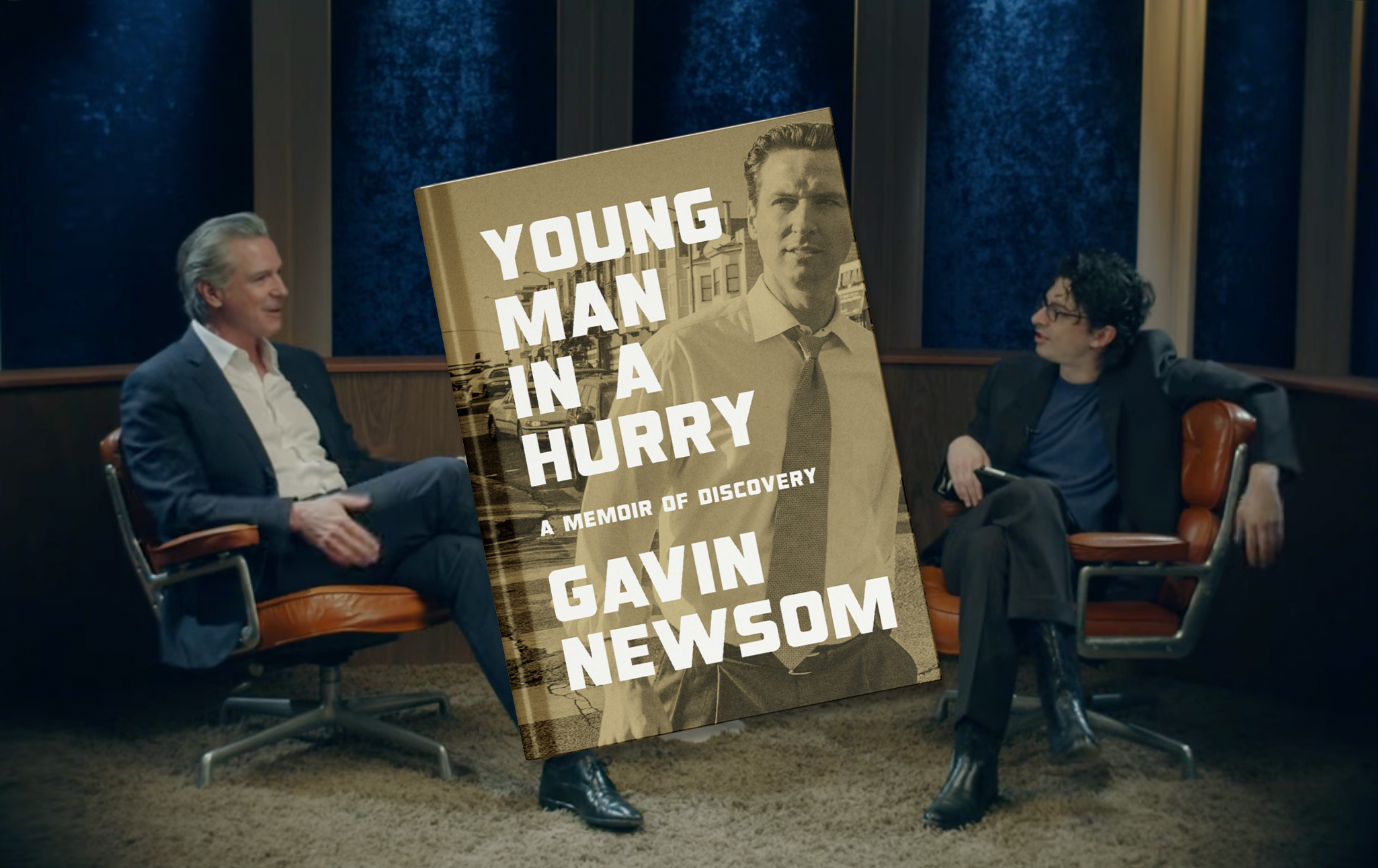
I feel like Newsom can’t connect in a genuine way, either. In his media tour to promote his book, one of the most telling appearances was on the offbeat Adam Friedland Show, where it seemed like he was forced to act like a human for once, and appeared uncomfortable when confronted with such a task. The disconnect was especially apparent when Friedland asked Newsom to defend California against accusations of being “a failed state.” Newsom rattled off a seemingly canned answer about the state being the fourth largest economy and having the third largest R&D center in the world. At that point, Friedland rightfully points out that regular people aren’t going to care about the stats he rattled off.
Newsom says something self-deprecating and almost reflective: “Why do I have political consultants? No, no, actually, no bullshit… I think I just got my ass kicked. I sound like a fucking politican.” He lands somewhat sarcastically on what he should say of California: “It’s mad nice, man. C’mon, bro, beautiful, man. Walk with me in Venice Beach.” Take away his carefully-rehearsed lines, and there’s no substance left behind.
By the end of the memoir one begins to suspect that the most revealing moment in the book is an offhand comment from Newsom’s wife. After seeing his apartment for the first time, she joked: “Did this guy take his interior design inspiration from American Psycho?”
With most politicians, the inclusion of that anecdote might be read as self-aware humor, since the comparison between Newsom and the notorious character has been made so many times. After finishing the memoir, it is difficult to be certain that he understood the joke at all.
Brooke Adams is a writer who graduated from Allegheny College with a bachelor’s degree in Political Science and English. Her work has appeared in The BayNet and CinemaBlend.

%20(crop).jpg?width=352&name=wile-e-coyote%20(resize)%20(crop).jpg)