
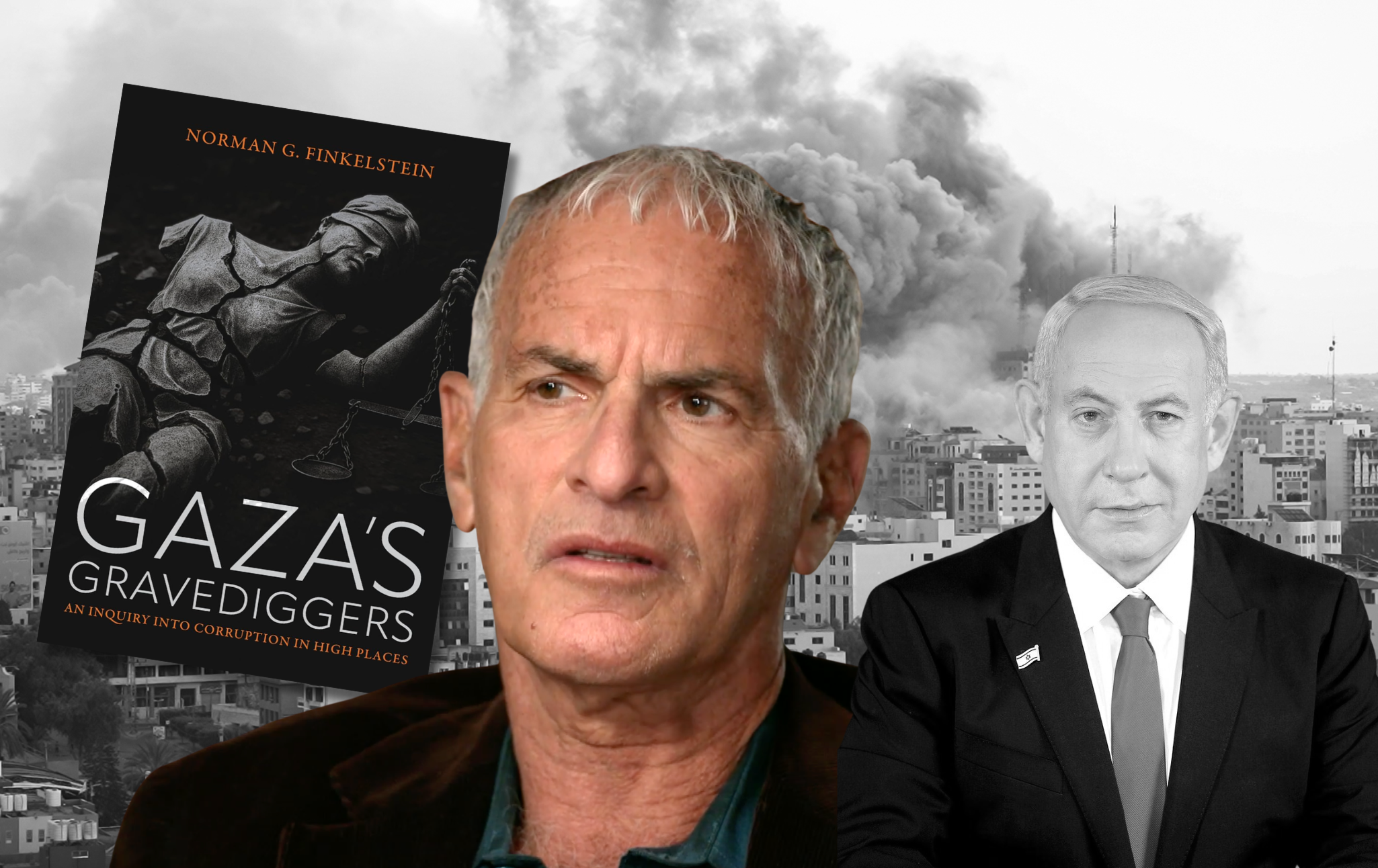
The Israel-Palestine scholar on Gaza and the justifications wielded by oppressors throughout history.
Dr. Norman Finkelstein is a political scientist, author, and one of the world's foremost scholars on Israel and Palestine. Born in New York City to Jewish Holocaust-survivor parents, Finkelstein says that it would "betray the memory of [his] parents' suffering" to abide Israel's crimes—a decades-long position that has led to academic blacklisting, censorship, and international travel bans.
Finkelstein sat down with Current Affairs to discuss what has changed since October 7, and how the sadism of Israeli officials differs from those who came before them.
Nathan J. Robinson
Let me start with what Benjamin Netanyahu recently said. Speaking recently at a conference hosted by a pre-military academy in the West Bank, Netanyahu said that Israel now has in its grip 60 percent of Gaza. Members of the audience then shouted that Israel should take 100 percent, and he said, "First off, 70; let's start with that." Some people may have been surprised at this blunt admission.
Let me ask you, Dr. Finkelstein, was this the plan all along, and how do we know if so?
Norman Finkelstein
The Israelis made clear their objectives in the first week after the Hamas operation on October 7. That objective was stated with as much clarity as one could expect. In fact, as compared to other genocides, the clarity of the public statements was on an altogether different level. Most genocidal regimes don't announce that they are executing a genocide, even if you take the case of the Hitler regime.
Hitler would give speeches in which he said, "In 1939 I warned the Jews that if they started the war, they would regret it." And so around 1943, he quotes that statement, and now he says, "They see I wasn't joking, that I get the last laugh"—I don't recall the exact words. But there were never any explicit public statements by the Hitler regime or the Nazi regime that they were committing a genocide. The most famous near admission was the speech by Himmler at Posen, and that's often quoted, where he says, "Poor us, poor Germans, that we have to carry out this horrible task of exterminating the Jews, that it was imposed on us, and it's obviously a sordid task that we have to carry out, but we have been appointed by history to be the executioners."
The reason it's so widely quoted is that it was the closest thing there was to a public admission by the Nazis that they were carrying out a genocide. That's not the case with Israel. Within the first couple of weeks, or I should say, within the first month, Prime Minister Netanyahu was saying, "Remember Amalek." Now, as the Israeli human rights organization B'Tselem put it, every schoolchild in Israel knows what it means when you say "remember Amalek." They said it means you kill every man, woman, child, and also oxen, and so forth. It was very clear; he said it twice. Defense Minister Gallant—he was the Defense Minister at the time—said, "We are going to prohibit any food, fuel, water, or electricity from entering Gaza." That was about October 14 or 15, roughly around that. You'll forgive me for not remembering the exact dates. Well, if a hermetically sealed parcel of land is prevented from receiving any food, fuel, water, or electricity, I think the consequences are pretty straightforward. That's a genocidal order. The President of Israel, Herzog, said, "There are no innocents in Gaza." This notion of civilians in Gaza, he says, is a misnomer. They are all Hamas.
Now, of course, Israel has a defense for each statement I've quoted, but when the International Court of Justice delivered its first statement on January 29, when they stated that Israel was plausibly committing a genocide, they had reviewed each of these statements. They were very careful. As you can imagine, if you're going to claim that Israel is plausibly committing genocide, you don't want to make any missteps because of the fallout. They said they independently reviewed each of these statements. The statements, as they reproduce them—it's not a decision, but in their provisional measures—said these were the statements. So now, after those statements were made, how did Israel's defenders try to extricate themselves from these incriminating statements? What they said was it was all in the spur of the moment—the shock. They were so shocked by what happened on October 7 that they made statements that were, yes, genocidal, but they didn't really mean them.
But the problem was the statements kept coming forth, and not just the statements. It was the actions. What was most striking when I started to read the subsequent UN reports that came out one to two years after October 7, or after the first month, was that what they said they would do was exactly what they did. They started as every UN official and also EU official said: they were using starvation as a weapon of war. The Human Rights Watch said they were using deprivation of water in Gaza; they said that it was an act of extermination and an act of genocide. So the point is that everything that happened in the first weeks was prefigured exactly by what Israel was intending to do. I do not believe—it's my opinion—that Israel was intending to commit a genocide. Israel wanted to commit a massive ethnic cleansing. However, in order to achieve that massive ethnic cleansing, they used genocidal means. The genocide was a means to the end of ethnic cleansing.
And on top of that, Israel was to this day—and when I say Israel, I mean the entire society; I don't mean just a handful of officials—determined to exact a blood revenge. It was thirsty for revenge, and so shocked were they by what happened on October 7 that revenge was limitless.
Robinson
I want to understand a little better what your interpretation of what the Israeli goal was. Beyond exacting revenge, is it to seize a certain percentage of the Gaza Strip and confine people to smaller and smaller areas? Is it to create the conditions for ultimately expelling all the surviving Palestinians? I think there was a quote where Netanyahu, at one point, said he wanted to "thin out" the population.
What is your understanding of what, to the extent there is a long-term plan beyond sort of blood lust and vengeance, that plan was and is?
Finkelstein
It's useful to clarify that, and actually, Israel coined the phrase that clarified what its goals were before October 7. Israel carried out periodically these high-tech killing sprees in Gaza, which it called its operations. The best-known ones are Operation Cast Lead in 2008-09, Operation Pillar of Defense in 2012, Operation Protective Edge in July-August 2014. And the purpose of these operations was very clear. It was called "mowing the lawn." That is, periodically you have to remind the Palestinians in Gaza who are in charge, and so they launched these high-tech killing sprees.
After October 7, Israel changed its goal. Its goal was now to, for once and for all, solve the Gaza question. We're not having any more "mowings of the lawn." What did solving the Gaza question mean? Well, to preserve the image—the metaphor of "mowing the lawn"—now it was no longer cutting the blades of grass. Now it was extirpating, pulling out by the roots, every blade of grass in Gaza. They were going to empty it out. That was their goal. And you perhaps remember, in the first month or so, there was all this speculation, including by people like Antony Blinken, that they would reach some sort of agreement with Egypt and expel the entire population of Gaza into the northern Sinai, and that seemed like a realistic proposition. As it turned out, the Arab states vetoed it, and now Israel could not expect regional cooperation in its goal of emptying out Gaza.
Its goal was very clear. There's not just one statement or two statements. You could probably fill a book now with the number of statements by unofficial and official government sources saying their goal was to make Gaza uninhabitable, unlivable. And this is still the Israeli plan. Nothing has changed whatsoever in terms of the objective. The goal still is to make Gaza unlivable, in the hope and expectation—which I admit there's no clear plan, that's true—but the hope and expectation is that conditions will become so unbearable, so unlivable, that the Gazans, by hook or by crook, will figure out a way to leave. Chaim Weizmann was the first president of the state of Israel, and also the main architect of the Zionist movement, in the period before Israel was founded and was their international diplomat. When the ethnic cleansing occurred during the first Arab-Israeli war in 1948, he called it—now I'm quoting him—"the miraculous clearing of the land."
Now, of course, it wasn't miraculous. What happened was, as the first Prime Minister David Ben-Gurion said, there are certain things you can do in what he called "revolutionary times"—that's his expression—that you can't do in ordinary times. And what that meant as a practical matter was, come to the 1948 war, it's a war, and there are things you can get away with in a war situation that you can't get away with in a non-war situation. And so there was the war, and there was the "miraculous clearing of the land." So to fast forward to the present, the goal of the Israelis right now is to make it unlivable, uninhabitable, and maybe some miracle will occur that we can clear out the land. What that miracle will be, I don't know, and I don't think they know.
But what you certainly understand, it doesn't require knowledge of rocket physics, is Gaza was, prior to October 7, among the most densely populated places on God's earth. Now it's been reduced; that density has now been, not exponentially but massively, increased because they're now going to leave Palestinian Gazans in 30 percent of the land. That's literally a suffocating goal. It's not unlike, incidentally, if they took the walls of the Warsaw ghetto and contracted them and contracted them and contracted them. You suffocate the people in a tinier and tinier parcel of land.
My mother didn't talk much about the concentration camp—she was in Majdanek—but she talked about what it was like walking in the ghetto. Everybody was dying of typhus and dysentery. Now, as I said, I'm not sure why she didn't talk about Majdanek, the concentration camp here, but she talked about the hunger in the ghetto and all the dead bodies with the flies above them to her left and to her right. And now that's what they're doing; they're gradually squeezing them tighter and tighter and laughing about it. Laughing. "We want 100 percent!" Like it's an auction. "Let's start with 70 percent." No, these are Nazis! Actually, Nazis did not carry on that way. A lot of the Nazi phenomenon, I think, is not well understood. In the case of the Nazi ideology, you were not allowed to carry out the genocide with enthusiasm. I know it's going to sound contradictory, and of course it is contradictory. You couldn't carry it out with sadism. In fact, there were a significant number of Nazis who were prosecuted because of the sadism with which they carried out their tasks. You are supposed to be objective and scientific, and as Himmler put it, it's supposed to be a burden imposed on you. And the Israelis adopted that.
Robinson
They cry when they shoot. You cry and shoot.
Finkelstein
You know what's new about the new Israel? They don't cry anymore. No, it's an interesting phenomenon. They've dropped the crying routine. Now they do it with relish, and they do it with glee, and they post it on social media. That's something new. I don't want to say—it's hard. Look, you're a bright young man. It's hard to say morally which is worse. Or to just do it gleefully and happily. But as a factual matter, it's something new. The Nazis didn't carry on like that. They did not. "We're supposed to see to this terrible burden that was imposed on us by history." The Israelis are in a class all their own. It has to be stressed.
The problem is not a genocidal regime; that's not correct. The problem is not a genocidal state; that's not correct. The problem is a genocidal society. And that's a real problem. Because I know you're a student of history, it's really not unlike the American South after the Civil War. The lynchings were popular community events. It wasn't like in the dark of night they came out in their sheets and the torches. No, when you had a lynching, you let out the factories early. Schoolchildren were dismissed from class early. The mothers packed a picnic basket. They went down to the campgrounds, and the person was incinerated. Everybody is cheering. They then auction off the body parts, and the body parts are then part of a photograph that's made for a postcard. So the culture, I think, is quite similar to the culture of the American South after the Civil War.
Robinson
There was just a profile of a young influencer, Andrey X, who moved from Russia to Israel and does a lot of profiling of the oppression of Palestinians. He said one of those striking things about moving to Israel as a Jew from Russia was he couldn't believe just how casual the racism was. It really sort of struck him immediately that when he was going to rent an apartment, someone would say, "Oh, this is a good building, because the landlord doesn't let Arabs in." And he said the openness of the racism was quite striking.
One of the things that you've pointed out a lot is that the recent public polling of Israelis, Israeli Jews specifically—obviously it differs among Israeli Arabs—said, I think, that the majority of at least religious Israeli Jews affirmed the statement that when you capture an enemy town, you should slaughter everyone in it.
Finkelstein
Now the openness is not really a new thing. I'll give you an example from David Remnick, the editor of the New Yorker magazine. This is when the New Yorker magazine is beginning to make its shift, blowing with the wind and seeing what's now tolerable to say, and not losing your readership and influence. So, as he's making the shift, he recalls a conversation he had with Prime Minister Netanyahu and Netanyahu's father.
Netanyahu's father taught history at Cornell University, and his area of specialty was the Spanish Inquisition and the condition of Jews, where they were called conversos, I think, in Spanish during those years in Spain. In any event, and you could find the quote if you do the research, David Remnick says he was absolutely shocked at the racism around the dinner table—the casual racism of Netanyahu senior. These were dyed-in-the-wool racist bigots, and now that's become all of Israeli society. There used to be some liberal enclaves in Tel Aviv, but otherwise, no. The racism is at this point at least as deeply entrenched as it was in the American South.
Now, as to the poll, there have been several. Obviously, Israel is the most polled place on God's earth because the Jews are so important that when they get up in the morning, whether they want to have cereal or eggs, it's a very important polling question. And whether you want to egg sunny side up or sunny side down, we have to poll you, because we're so important, and everything we do is so important. So, they were constantly being polled, and to the extent that polling shows that, we have a decent indication of public opinion. Polling doesn't capture everything.
So, there was a series of polls. Let's start with the most basic. The most basic poll was every few weeks Israelis were asked the following question: After October 7, do you believe Israel is using too little force in Gaza, just the right amount of force in Gaza, or too much force in Gaza? Consistently, only five percent of Israeli Jews said too much force. Ninety-five percent said either "too little force" or "just the right amount of force." Of that 95 percent, 40 percent consistently said "too little force." In the midst of a genocide. This notion that they didn't know what's going on is completely crazy.
They say all the media is biased. Really. Israel has the highest per capita percentage use of the internet. If they want to know what's going on, they know what's going on. During the Vietnam War, people were saying the United States was not committing any atrocities in Vietnam, and there was a large number of people who said that, even though on the nightly news, you were privy to the fact that something horrible was happening there. My mother used to say, "Those who want to know know; those who don't want to know will never know," and the Israelis will never know, because they don't want to know.
But of course, they do know. Another poll asked a very simple question. It couldn't have been put more precisely, the one that you alluded to. The question was, when the Israeli army enters a city, should it kill everybody in the city? That was the question. When the IDF enters a city, should it kill everybody in the city? Of Israeli Jews, nearly half said yes. A few months later, there was another poll. The poll was, "Do you believe there are any innocents in Gaza?" Now, remember, for the sake of your viewers, half of Gaza's population are children. Half of Gaza's population is 17 and under. Are there any innocents in Gaza? That was asked of the whole Israeli population, including non-Jews. The answer was 64 percent said "no innocents in Gaza." If you factor away the 20 percent who are not Jewish, 70 to 75 percent of Israelis believe that the population in Gaza that's half children, there are no innocents. That's Israeli society.
Robinson
And when you talk about the roots of it, I was just reading an account from the 1920s by the American journalist Vincent Sheean, who went to what was then Palestine. He went with a Zionist newspaper, and then he started talking to Zionists, and what struck him immediately was that the Zionists in Palestine referred to Arabs the way Americans would refer to Indians. They thought of them as savages. The first thing that struck him was that he said, "This is clearly an Arab country; I don't really know how you're going to build a Jewish state in this Arab country."
And then when he started talking to Zionists, he thought they had no real conception of what the problem of that would be. They talked to him about their glorious standards of living, and he said when he would bring up "What's going to happen when you impose your Jewish state here?" they would say to him things like, "Well, Arabs will do anything for money, so we'll just buy them off, and then they'll leave." They didn't have any conception that they would have national feelings for Palestine. He just thought that the dehumanization—the lack of understanding that the people of Palestine were people—and that they would object to being ruled was setting them up for a century of conflict, and here we are. He was writing that in about 1935, and here we are in 2026.
Finkelstein
I mentioned earlier the attitudes of the Israelis resembled those of the American South after the Civil War. I would also say what you just said about the comparison with the Native Americans. It was very striking to me. I was recently reading the writings of the abolitionists, people like Charles Sumner, William Lloyd Garrison, and others. And Charles Sumner was really quite an extraordinary figure. He was titanic. No exaggeration, he delivered speeches in the Senate that lasted five hours. They were filled, replete with references to Latin—the ancients: the Romans, the Greeks, all in the original language. And brace yourself for this: he memorized the speeches. There was no reading. Forget a teleprompter. There was no reading from anything. Now these are extraordinary figures, and you cannot in any way minimize the sheer courage and commitment. The commitment of these people is breathtaking, and the decency. The decency.
Why do I mention it? If you read Sumner, if you read Frederick Douglass, they are always very disparaging of the Native Americans. Always very disparaging. Frederick Douglass was terrible. Same thing with Sumner. I wouldn't say Sumner was terrible, but he was definitely bad, and there wasn't a word uttered in their defense. Not a word uttered. There were obviously some like Helen Hunt Jackson, who wrote this wonderful book, A Century of Dishonor, but in general they were terrible. And you might ask the question, why were they terrible about Native Americans when, when it came to African Americans, they were sublime? Sumner and Garrison risked their lives. I repeat the famous story for the audience, not for you. Sumner was totally vicious in his attacks on the South, comparing them to rapists, and the Southern senators were so offended that one of them—he wasn't a senator, he was a House of Representatives congressman—went over in the senate and beat him and beat him with a club. Beat him and beat him and beat him just shy of death, and all the Southern congressmen and senators to the last one supported him beating Sumner. Sumner came back. It took him many months to recover, but he came back, and he fought the good fight. So, you might ask the question, how could somebody with such deep-seated moral probity when it came to the African Americans not see it with the Native Americans? Why didn't he see it?
And the only conclusion I can reach is that emancipating African Americans wouldn't fundamentally undermine the American project. Respecting the rights of Native Americans would significantly restrict your territorial goals, objectives, and aims. They did stand in the way. Teddy Roosevelt, in his five-volume work called The Winning of the West, had to address that problem, that the Native population was wiped out. And his answer was, "Would you have preferred that this vast land be preserved as a game preserve for squalid savages?" Would you have preferred that? Now you might smile at that, but you know what? That's really a tough question. He thought we were bringing civilization to this continent. It wasn't "the dark continent," it was another, as it were, "dark continent." And he said, "Had we not progressed, we would not have progressed." As in, had we not progressed all the way across the continent.
I always remember the phrase, even though I read it 20 or 30 years ago: "Would you have preferred that this be a game preserve for squalid savages?" And often I ask my students, who are very woke and progressive, how do you feel about that? Let us say it's true. The alternative is the New York skyline or teepees across the continent. Which do you prefer? And it gives pause. It gives pause. I suspect the Israelis think the same thing.
I remember once, if you'll forgive a tiny digression, but it's relevant, my late mother testified at a trial for guards from the Majdanek concentration camp in 1979, and I accompanied. It was in Düsseldorf, Germany. And before the trial began, we met with some of the Jewish community in Dusseldorf, and there was one Jewish guy; his name was, believe it or not, Karl Marx. That was his name, Karl Marx. And one night we're talking, and the Israel-Palestine conflict came up. I don't recall in what context. This is 1979, so it's a while ago. And he said, "What did the Arabs ever invent except camel shit?" That's what he said. And I remember I turned to my mother and our eyes connected, but we weren't going to be the skunk at the garden party. Now, of course, I would say something. I was a kid. But that's the Israeli other.
"We Israelis won; we're at the cutting edge of technology," this and that, and "what have the Arabs done, except invent camel shit?" And that was Theodore Roosevelt's "squalid savages." To make my own point of view clear, I'm going to just give you two examples. So, you've looked at the manuscript of my forthcoming book, Gaza's Grave Diggers, and in chapter three I have a very long chapter. It runs to about 100 pages on the Vice President of the International Court of Justice, Julia Sebutinde, in which I argue that she's either in the pay of, or being blackmailed by, the Israelis.
So when I was reading her submissions to the court during the genocide case, and also another case, it was obvious to me that there's plagiarism going on here, but I didn't know the magnitude. I couldn't figure out the magnitude. So I post something on my Twitter website—on my Twitter, whatever it is. I don't know anything about Twitter. I have a web manager. I post something. I said, "If you're a techie and you can help me track down something, please help." And about 20 people came forward, and I explained the task: Can you find the plagiarism in these submissions by Vice President of the International Court of Justice, Julia Sebutinde? So one person sends me five examples, another person sends me six or seven examples, and then there's this fellow from Gaza, and he sends me back 30 pages. Thirty pages. He said one-third of her submissions are plagiarized. I'm thinking to myself, here's this guy from Gaza who's in a, so to speak, competition with all these top computer people who volunteer to help do this for me, and he completely outshines them.

Robinson
Well, can I give you another example that's striking to me? Israel and the United States often frame themselves as being in a war of Western civilization against barbarism, and if you go and you watch the lectures on English literature by Refaat Alareer, who was assassinated by Israel, he was an expert on English poetry. He did a dissertation on John Donne. He has lectures on Keats and Wordsworth and Shelley, and he has a dissection of the Shakespeare's sonnets, as well as Palestinian poets and cross-cultural analysis between them. And it's the same with Edward Said, who I mentioned earlier. He was such a deep scholar of Western literature.
And you think: could Trump or Netanyahu cite a single line from any of these poets of the supposed Western civilization that they are defending? And Refaat Alareer, in the ghetto of Gaza, is teaching these Palestinians who have so little, introducing them to these treasures of Western culture. It's rather extraordinary. The people like that racist Karl Marx just have no understanding of the people that they're talking about.
Finkelstein
A couple of weeks ago, I was speaking in Minneapolis, and I was introduced to two young women from Gaza. They just came over a few months ago, and we were talking about the situation there, and they asked me, "What do you think will happen?" and "What will Trump do?" And I said, "Look, Trump only respects power; if you're powerless, he doesn't care. You're just human refuse; they don't care."
I said, "Look at Trump when he went to China. You saw a different Trump. He was very humble when he was in China. He was very humble." And then one of the young women said to the group, "Was he humble or was he humbled?" And I thought to myself, "Hmm, fresh out of Gaza, and she knows that distinction in language." I studied French for many, many years. If you asked me whether I was capable of such a subtle distinction in language between "was he humble" or "was he humbled," no, I wouldn't be able. So I recognize, obviously, that what they're saying is disgusting, but also, I can understand how that dilemma posed itself to people like Charles Sumner, because it's still the middle of the 19th century and the US is still expanding to the west and across the continent, and he did not want to stand in the way of it.
Robinson
I keep thinking about the British parallel, which I think the obvious one would be John Stuart Mill and India. Another champion of equality and freedom who totally loses his ability to analyze these things when it comes to empire. And so you have lots of great British thinkers who are racist when it comes to India, but champions of equality domestically. And so, as you say, there are situations where it's asked, what kinds of liberation can we tolerate, and what challenges are we comfortable with?
But I wanted to ask you, what do you think it is about oppressors, whether it is the Southerners in the Antebellum period or Israelis today, where they think of themselves as the victims? There's this very strange thing where the more you're victimizing someone else, the more you think that you're the one who's being threatened, you're the one who's being imposed upon. This seems very, very common across these cultures.
Finkelstein
I can't claim to be familiar with all the literature across cultures, but I don't find a parallel in the American South. They felt they were victims after the Civil War because their Southern way of life was snatched from them, and they believed that they had their right, to use contemporary current language, to self-determination. And in fact, when legal scholars look at that situation, there has been the argument made that they had the right to secede as an act of self-determination, but I don't think I can find a parallel with this kind of solipsistic self-pitying by the Israelis: that they are always the victims when they're carrying out these genocides, these acts of extermination, these massacres.
Well, it is true that when the European Americans were crossing the continent, they always claimed—this is true, I have to be clear—they were acting in self-defense. You're significantly younger than me, maybe even close to half my age. When I was growing up, I had a regular diet of cowboy and Indian movies and television programs, and I was always rooting for the cowboys to not just beat the Indians; I was rooting for them to incinerate the Native Americans. I'm serious, and I'm not proud of it. On the other hand, I should try to be accurate. We saw them as savages that were standing in the way of Daniel Boone, Davy Crockett, Jim Bowie, and all the other great heroes of our youth, and all of them ended up in the Alamo. But before the Alamo, which was still Mexican land, it was the frontiersmen, as they were called.
You would be surprised, I think, to learn what the first Hollywood movie sympathetic to Native Americans was. Do you know what it was?
Robinson
Is it "Little Big Man" with Dustin Hoffman?
Finkelstein
Correct.
Robinson
Got it.
Finkelstein
"Little Big Man" with Dustin Hoffman. And the 1960s, as Professor Chomsky often pointed out, was a cultural revolution, and not in the sense of the Chinese cultural revolution, but it was a cultural revolution, and aspects of our society that had lain hidden—not just dormant, hidden—suddenly came to the surface.
For people of my generation, it was a real awakening to suddenly see the world through the eyes of Native Americans and be sympathetic to what happened. As I said, there are a few books here and there, like by people like Helen Hunt Jackson, A Century of Dishonor, but they were few and far between, and I'll tell you, for sure, I was not aware of it.
I was rooting for the cowboys against those savages straight through.
Robinson
We were privileged enough to reprint an essay of yours that is in your book, The Rise and Fall of Palestine, as part of the conclusion. And when I read it, it was so striking, even though it's 30 years old, and I asked you if we could put it in our magazine, and we did. A lot of people read it.
But it is about this research that you did in the 1990s: you just went through everything that was said about the Cherokee in the 19th century. Sometimes you explicitly compare it to things that are said by Israel, but sometimes the comparison is just implicit. It's astonishing when you pile up all of these quotes that are often from now out-of-print books, and the only places people can find these quotes are in your essay. But it really is striking when you look at how American politicians talk about the Cherokee; they talk about them as a nation destined to disappear. They use all this dehumanizing rhetoric. They use these same constructions, where whatever we do is self-defense, even as you're confining these people to smaller and smaller territories. Even objective observers like Alexis de Tocqueville are going, "This is the most horrifying thing I've ever seen people do to other people."
Finkelstein
Yes, that's absolutely correct. I didn't keep saying, "And this is what's happening to the Palestinians." I didn't say, because it was so obvious. I'm writing in the 1990s, and already people have some awareness of what's going on, so I felt that stylistically it would hurt if I kept saying that. It would sound like a leading question, or in this case, a leading commentary. I figured, okay, you get what's going on here.
The Cherokee were an interesting example for the following reason: they became as American as you could be. They had private property. They had the written language, which was unusual for a Native population. They had a written alphabet. And they became so American that they became slaveholders. They supported the South during the Civil War, but it didn't save them. It didn't save them. They thought by becoming so Americanized they would be able to assimilate to our culture, but that didn't happen. They met the same fate as everybody else. It was like, if in the concentration camps, there were—well, first, the assimilationist Jews in Germany looked down on the Eastern European Jews, and the Eastern European Jews hated the German Jews. They were called the yekke. The Eastern European Jews hated the German Jews, and the German Jews thought they were Germans. They were Germans, and so they could understand exterminating the Eastern European Jews, but they thought they would survive. I remember stories during the war when the German planes flew over the concentration camps, and the German Jews in the camps would say, "We're winning." And so here were the Cherokee who thought they had completely assimilated to the point of becoming slaveholders, but it didn't save them in the end.

Robinson
And then you conclude your piece with something that is an obvious parallel, which is this quote from a Georgia congressman who said, "What is history but the obituary of nations." Basically saying, well, some nations are destined to go extinct.
Finkelstein
Frederick Douglass said the same thing,
Robinson
And then the 1948 Israeli Foreign Ministry said, "What's going to happen to the Arabs? Well, they're going to scatter to the wind like so many pieces of human dust."
And so that gets us back to the present day and what's happening in Gaza. I do think that one of the misconceptions about the "Israel-Palestine conflict" is a lack of understanding that there has been a 100-year project to bit by bit, slowly, goat by goat, or whatever the phrase is, just keep taking more and more of Palestine. You see it so explicitly in Netanyahu's quote there, where he says, "Okay, hang on, hang on, we'll get 100 precent. We just have to wait; we just have to be patient. We'll move the yellow line"—which is the line that if a Gazan crosses into the wrong part of Gaza to try and go back to where their house was, they get killed immediately.
"We'll move the yellow line two feet tomorrow, and then we'll move it another two feet." You don't really understand the conflict unless you understand that there's been this long project of sort of slowly moving walls and fences piece by piece, and that they're quite open about that and have been for many decades.
Finkelstein
It was called "dunam by dunam, goat by goat." The only thing I could comment on is— everything you say is obviously accurate.
But there's something about the—I don't want to be a tone police. But you're in the midst of having visited such horrors on those people, and half of them are children, and when you listen to the screaming, he said, "We've taken over 60%," and then they start chanting, "100 percent! 100 percent! 100 percent!" And then he smiles and says, "Well, let's get to 70 percent" like an auction. There's something so sick, so demented, you know. I never refuse to talk to Israelis; I never did. But now I live in an old Jewish neighborhood, and there are a large number of Sephardic Jews, as they're called. Iraqi and Syrian Jews. It's a very large number, and there are Russian Jews, and there are Israeli Jews. And now, if I'm walking in the street and by accident I meet an Israeli, under whatever circumstance, I can't help myself. When he or she says I'm Israeli, I say, "Nope," and I walk away. I can't talk to them anymore. It's crossed a line.
As I said in my introduction to the book, which I know you've read, they don't even have the excuse that they don't know. I believe most of the Germans claiming that "we didn't know" are false. They knew enough to know something horrible was happening. Fifty percent of the Jews were not killed in the concentration camps; they were killed in the killing fields in the course of the war. You lined up tens of thousands of Jews and shot them dead in the ditch. Of course, they knew! They may not have known about the gas chambers. Okay, maybe not. I don't know. But as my late mother said, "Those who want to know, know, and those who don't want to know will never know." So, in the case of the Israelis, there's not even a pretext of you not knowing. There's not even an alibi that you didn't know. They know.
So I can't talk to them. You might recall that about a year or two ago, Harvard put out this report on antisemitism at Harvard. It was 300 and something pages. I read it. I don't see any evidence of antisemitism that they have adduced. So I think "maybe I missed something," so I sit down, as is my want, and I reread it. How does Harvard describe antisemitism? It's when, in particular—in particular—when you ostracize Israeli students at Harvard. They're not part of the crowd. So Harvard says at the end, "We have to be inclusive; we have to be pluralistic." That's their exhortation, that we have to be inclusive and pluralistic of Israeli Jews, in particular. Because American Jews didn't seem to make that complaint as much as Israeli Jews. And I once had a public presentation with Nadine Strossen, the former head of the ACLU—very impressive person—and Dr. Cornel West, who I like very much and consider a personal friend. And I said, "I'm not being inclusive of child killers; that's not going to happen.
I won't be inclusive of child killers, and I'm not going to be pluralistic with child killers." That, to me, is a bridge too far.
ROBINSON
Do you think that something about that conflicts with the principle that we have to give everyone a chance, that we can't judge people by their nationality alone, and everyone has to be judged by what they actually believe? There's Gideon Levy, there's Amira Haas.
You may say it's 95 percent of Israelis, but 95 percent isn't all. And I think in a society like that, it actually takes quite a lot of individual integrity and courage to be able to break with 95 percent of the people around you. Do you think there is something where we should at least wait until we know what someone's position is before we determine to ostracize them?
You could say the same about soldiers coming back from Vietnam: "I'm not going to associate with child killers, because I know what the Vietnam War is," but of course, there were Vietnam veterans against the war.
FINKELSTEIN
Okay, first of all, it's the nature of social sciences to make generalizations. You couldn't participate in fields like sociology in the absence of generalizations. Now, generalizations that you don't like—you know what a generalization that you don't like is called? It's called a stereotype. But a generalization, what is a generalization? Something that's generally true.
Now, in the case of Israelis, I see your point, but let's be clear about two things: Gideon Levy and Amira Haas will be the first persons to tell you they represent absolutely nobody.
They do. You hear them. They say we represent absolutely nobody in Israel. That the number of people who share our opinion could fit in a breadbasket. Number two, saying what you said, of course, if there's an exception, I have to honor the exception. Of course. But I also think it's true in this case—because you yourself said it could be as many as 95 percent—I think it's fair to say guilty until proven innocent.
I have no problem saying that. Remember, Israel is unusual. It has a citizen army, and in general, I think a citizen army is a very positive thing. It means everybody has a responsibility to protect their country up to the point of death in order to preserve that country's independence and freedom. I think that's correct. We all recognize that during the Vietnam War it was wrong that we got the student deferments, so it meant that only poor people went over to fight in Vietnam. That was wrong that we got those student deferments. And that's why it made criticizing the soldiers very difficult, because therefore the grace of God goes, oh, in this case, it wasn't the grace of God, it was the grace of the student deferment.
Israel doesn't have that. It's a citizen army, and being as it is a citizen army, it's representative of Israeli society. That's what it means to be a citizen army. Everybody in that army has passed through serving in the West Bank, serving in Gaza, serving in Lebanon, for decades now, and they're all committing war crimes. Now, you can differentiate the magnitude of the war crimes, but routinely every soldier in that army has broken into a home at night—everyone—and terrorized the population, terrorized the children.
Just as an anecdote, yesterday, I was speaking at an event for a friend of mine. She runs an organization called Eyewitness Palestine. She brings groups over. She asked me to speak at the anniversary celebration, and we were in the restaurant before the event. She has a daughter, seven years old. Her name is Nancy Mansour. She won't object to me mentioning her name, and she's the person I went for. Nancy's daughter is with her, and Nancy at one point mentioned—Nancy is very courageous in principle—"I don't care if they imprison me, I don't care if they kill me," and I know with her it's true. Why do I bring it up here? Her daughter, seven years old, hears this and becomes hysterical and is crying. Hysterical crying, gripping her mother, holding her, and her mother said, "I was just talking, don't worry. I was just talking."
Every single Israeli does that every day in the West Bank. They're breaking into homes, they're grabbing kids, and they're grabbing the father from the child. They're doing that. You see it in the videos every day. They're grabbing the father, grabbing the mother, pinning them to the floor, and the kids are crying hysterically. I'm sorry. That is Israeli society. Everybody is implicated at this point in those crimes. It's a citizen army. Everybody has served there four years, or however many years it is now. I'm not sure. They've all done it, and I can't in good conscience—when I hear the President of Harvard say "inclusive," I think to myself, are you telling me after World War Two that I was supposed to be inclusive of concentration camp guards? Most of them got away with nothing! They got a slap on the wrist, because if you were to indict everybody who was implicated in the Final Solution down to the guards, well, there goes about half of German society, I'm sorry to say!
So then I'm supposed to be inclusive of them? I'm supposed to betray the memory of my parents' suffering by being inclusive of them? And I'm not going to have a double standard. I'm now not going to be inclusive of those Israelis who were targeting the heads, the skulls, and the chests of Palestinian children. I'm not being inclusive of them. I can't do that. It would be for me to be the ultimate hypocrite to suddenly become inclusive and pluralistic of child killers. That's just not going to happen on my watch, and I made that very clear to Cornell. I said, "What would you do?" Would you be inclusive of somebody who burned your father in a lynching? Inclusive? Well, you might think that's an extreme example. Well, guess what, it's not in the case of Gaza. That was happening every day. Has been. And now, the ghetto walls are closer and closer, suffocating, suffocating, and starving the children. Inclusive of them? May they burn in hell!
Part two of Current Affairs' conversation with Norman Finkelstein will be published soon.
Transcript edited by Patrick Farnsworth.