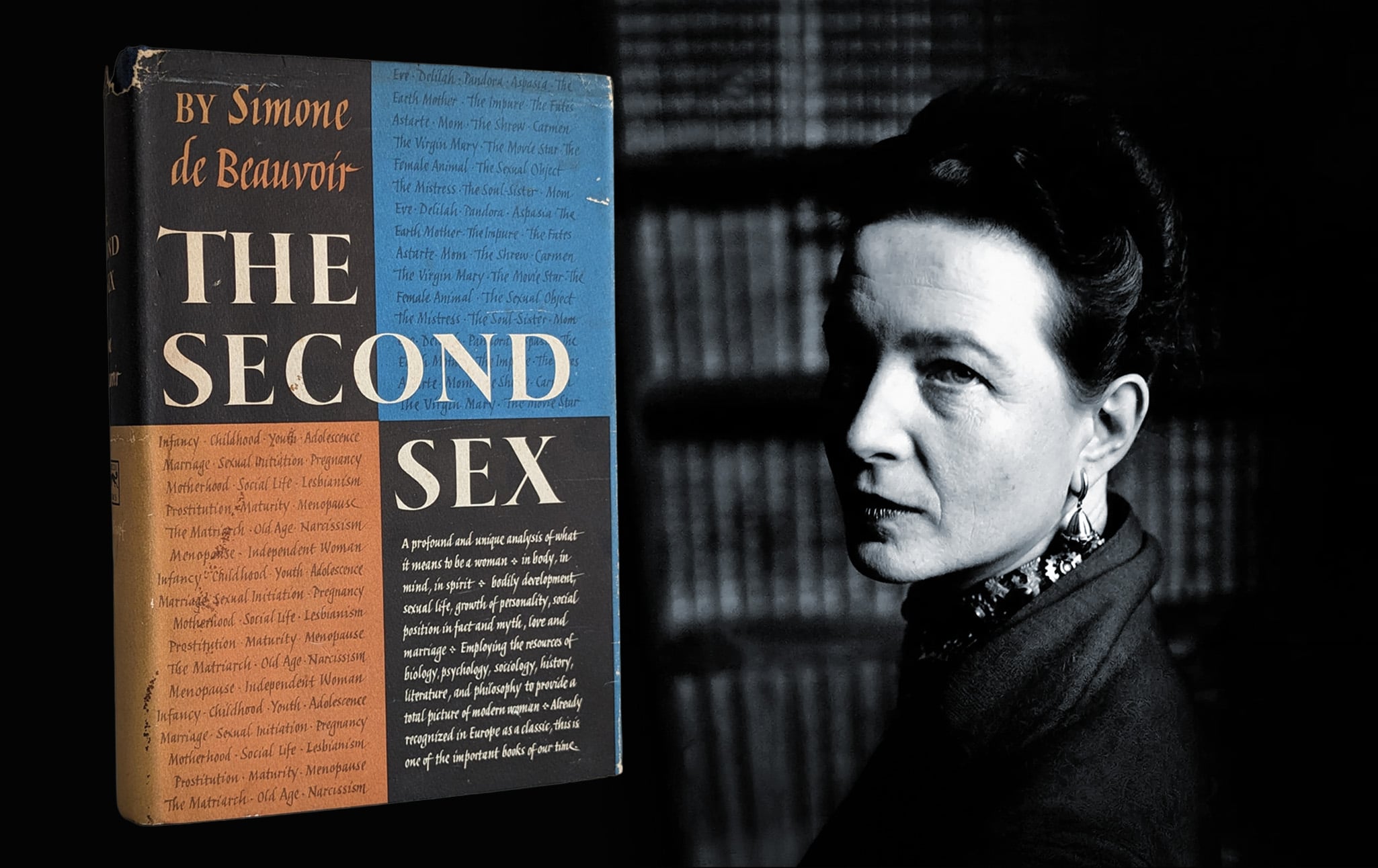
Written in 1949, “The Second Sex” still has vital insights for feminists in today's world.
When I first heard the term “girl math” online a couple of years ago, my first thought, as a mathematics student applying for Ph. D. programs, was “This is great! Maybe people are finally coming around to the idea of women being mathematicians!” Imagine my surprise, then, when I learned that rather than being a phrase to highlight women’s mathematical accomplishments, it was being used by women in order to justify buying a coffee or getting their nails done. “If I pay with cash, but my bank balance stays the same, it’s basically like it’s free! Girl math!” It’s used as a rationalization for the stereotype of women spending too much money on things that, for one reason or another, society thinks they don’t need. Rather than try to eloquently defend themselves, women have decided to make themselves the butt of the joke. Again.
I did end up getting accepted into grad school at Boston University, where I’ve just finished up my first year, and I know plenty of women who do actual girl math. I know women across the department who are doing research in differential equations, stochastic processes, number theory, and a host of other disciplines. But STEM, and mathematics in particular, has historically been a man’s world, and while women are almost even with men in the physical sciences, in less “nurturing” fields, like mathematics and computer science, they are grossly underrepresented. In 2024, the year before I was accepted, just 11 percent of the students accepted into the BU mathematics grad program were women. And while I don’t expect all women to start doing my version of girl math, I think the term, and the connotations it carries, are becoming detrimental to the ways the world sees women, and the way young girls feel about themselves.
Am I the only one who feels like feminism is falling apart? Whether thanks to the rise of the “trad wife” lifestyle or this ludicrous invention of “girl math,” the last several years have felt like we may be taking steps backwards in terms of feminine empowerment and personal self-worth. At the height of the #MeToo movement in 2017 it felt like we were progressing towards the next big landmark of fourth-wave feminism, but in the decade since it’s dwindled to the point of nonexistence. I became even more acutely aware of the shift as I made my way through the entirety of The Second Sex by Simone de Beauvoir last year, and the farther I made it into the book, the more struck I was by how poignant it felt, despite being written nearly 80 years ago. It’s the kind of book that’s hard to recommend to someone unless they’re already predisposed to be interested, especially at almost 800 pages long, but the things it says are important, especially when looking at what may have changed, but ultimately what’s stayed the same.

Despite its length, I found myself wanting to sit people down to make them read this book. The Second Sex sits at the intersection of pivotal feminist literature and existential philosophy. De Beauvoir herself was one of the leading existentialists in France when the latter movement was at its peak, sharing the spotlight most notably with her collaborator (and sometimes lover) Jean-Paul Sartre, as well as other philosophers and writers like Maurice Merleau-Ponty, Albert Camus, and Samuel Beckett. Existentialism, as a philosophy, deals not only with our existence but also our authenticity. It asks whether we are living our lives faithfully to the essence of who we are, and tries to explain what that essence might be. By choosing to evaluate the feminine condition through the existentialist lens, de Beauvoir forces the reader to come to terms with one of the fundamental challenges women face in their daily lives: grappling with the question of where they belong and what it really means to be a woman. And as the only woman in a very male-dominated field (especially in the 1940s), her perspective is both unique and yet universal.
Women are “the second sex,” not from any choice of their own, but from the world in which they are forced to exist. We speak of decentering men, but it’s hard to decenter anything that is the center of the entire structure of the society they exist in. Typically, women are praised for their achievements when directly compared to men, something de Beauvoir would be familiar with, as her own father praised her for having “a man’s brain” and “thinking like a man.” Women are the second sex because they are an afterthought; they are an adjective to put in front of a profession to patronizingly pat them on the back for getting to play with the boys. There are doctors, and there are woman doctors; CEOs, and female CEOs; bands, and girl bands.
Women have been led to believe (either consciously or not) that we’re alone, or we’re crazy, or any other way the patriarchy is reinforced little by little in daily life. When asked about the choice to undertake such an endeavor in writing her book, de Beauvoir writes in the introduction: “One day I wanted to explain myself to myself[…] And it struck me with a sort of surprise that the first thing I had to say was ‘I am a woman.’” In the act of reaching into her personal experiences in order to better understand her own psyche, de Beauvoir manages to speak on some of the most fundamental yet taboo aspects of womanhood. I found comradery in this book in a way that wasn’t preachy in the way philosophy tends to be. She takes the confusing and agonizing parts of being a woman and puts them in extremely level and rational language. No one could accuse her of being hysterical, yet the aspects of life she describes are some of the most terrifying and vulnerable parts of being a woman. Anyone who has ever sought that fellowship, I believe, would appreciate simply this aspect of feeling seen without being made to feel insane.
One of the most powerful devices de Beauvoir uses is her commitment to coherency throughout. She is thorough (did I mention that my copy is 756 pages?), but more than that, each passage has a purpose. She paints the picture of feminine life as fundamentally as she can while leaving no stone unturned, and no matter who you are, there is likely something in it you can find yourself in. She gives an honest description of what it’s like to grow up as a girl, even despite being a young girl over 100 years ago. She writes of the constant reminders little girls face when they, like any other child, imagine themselves conquering the world: “In women[...], there is from the beginning a conflict between her autonomous existence and her objective self, her “being-the-other”; she is taught that to please she must try to please, she must make herself object; she should therefore renounce her autonomy.” “Because she is a woman, the little girl knows that she is forbidden the sea and the polar regions, a thousand adventures, a thousand joys: she was born on the wrong side of the line.”
The fact that so much of what she writes still manages to ring true in the 21st century speaks both to how straightforward her rhetoric is, and to how much farther there is to go in order to achieve full autonomy and transcendence, a word that crops constantly in both de Beauvoir’s and Sartre’s writing as the hallmark of their brand of existentialism. In the introduction, de Beauvoir writes:
In particular those who are condemned to stagnation are often pronounced happy on the pretext that happiness consists in being at rest. This notion we reject, for our perspective is that of existentialist ethics. Every subject plays his part as such specifically through exploits or projects that serve as a mode of transcendence; he achieves liberty only through a continual reaching out towards other liberties.
It is with this notion of transcendence as a higher, more “faithful” state of being that we can better to understand gender today. Even in a century where young girls are encouraged to reach for whatever dreams they desire, the fact that such intense encouragement is needed is a testament to how the cards are stacked against them from the beginning.
The caveat is, of course, that it’s certainly going to be easier for me to relate to this than some other women; de Beauvoir was a relatively comfortable white woman in France, and I’m a relatively comfortable white woman in the United States. There is less in here for women of other ethnicities and economic statuses, but I feel like it’s our job as the comparatively well-off women of the world to fully understand our place in it and how we may transcend that, because if we cannot, then how could anyone else?
One of the most visceral, real, truthfully grotesque sections comes when de Beauvoir discusses menstruation and sex. It’s a topic that is still taboo today, so you can only imagine the stones (no pun intended) she must have needed to write so prolifically on the subject in 1949. It’s raw, honest and most importantly, treated with the seriousness it deserves. Often, and I’m guilty of this as well, we’ll say “oh I’m just feeling crazy because I’m about to start my period” or “no I’m fine it’s just hormones.” And while we go through it once a month for 40 years of our lives, that doesn’t change the fact that we go through it once a month for 40 years of our lives. We are literally shedding away pieces of our body, pieces which are uniquely feminine. De Beauvoir treats it accordingly when she writes “It is during her periods that she feels her body most painfully as an obscure alien thing […] each month constructs and then tears down a cradle within [her womb].” There is no analogous experience for men, and by minimizing its effect we only perpetuate the taboo of the subject all together.
This taboo is harmful, and has clouded the judgement of medical professionals for thousands of years. Though it has since been retracted, in 2013, an article by a team of Italian research doctors published in the peer-reviewed medical journal Fertility and Sterility, entitled “Attractiveness of women with rectovaginal endometriosis: a case-control study,” sought to study the effects of endometriosis not on the women who had it, but on how other people perceived them. Rather than funding research on how to alleviate some of the pain women who have endometriosis have to endure, we’re trying to see whether they’re hotter than women without it. Perhaps the reason women are seen as so mysterious is because we seem to refuse to try to uncover any of the supposed mysteries. And I’m not saying men get a pass, but it’s almost unfair to ask them to find the clitoris when it was only medically mapped out for the first time this year in 2026. It’s no wonder “Man finds it repugnant to come upon the dreaded essence of the mother [menstrual blood] in the woman he possesses; he is determined to dissociate these two aspects of humanity.”

If you don’t feel like committing to a nearly 800-page long book I would recommend, above all else, the third section on the “myth of femininity.” Especially for anyone who is curious about this book in the first place, this is the place where you can break down some of the more harmful constructions of women you may have built in your head. It deals with this false idea of feminism, where women are raised up on a pedestal and praised by their men. Really, this is just another version of objectification disguised as worship. Men often think that the deification of women equals feminism, and women can easily fall prey to believing that being revered as a “goddess” is what they deserve as a woman. Dating advice blogs now regularly advise female audiences on how to market themselves as “high-value women”: a term meaning expensive and hard-to-get—precious commodities to be sought after and earned by men. After all, we are taught, objectification isn’t so bad if the object goes for a high price; then, it might even be empowering. A key aspect to being a “high value woman” is letting the man do the chasing. It’s supply-and-demand economics applied to the dating pool: if you’re too easy to get, your value plummets. According to Sami Wunder, a Forbes-featured dating coach, men must be the ones to “lead, initiate, plan, pursue,” because “the minute you start getting into this ‘giving’ masculine energy mode, it lowers your value in his eyes. He sub-consciously feels that you don't consider yourself worthy of his pursuit. And who wants a low-value, unworthy object?"
There you have it: women are either low-value objects or feminine deities, with no space in between for complicated, multi-layered, capable-yet-fallible human beings. Another place this language is prevalent is in dating profiles, with men filling out a prompt with “Looking for a goddess.” While both scenarios may not be explicitly harmful, the underlying message of a woman being otherworldly remains. Nevermind that many women find it at best a little cringey and at worst creepy and weird. Whether you’re presenting yourself as submissive or as a goddess, you are still presenting yourself as Other. Women are regularly advised to tone themselves down or act less “masculine,” by which they mean assertive, in order to be seen as a “high value woman.” Women are made to seem “other,” or “second” as de Beauvoir would say, by being told they have an innate feminine divine energy that men have no access to, which we’re told to couple with submissiveness and docility to create the perfect woman. It calls to mind the story of the goddess Persephone, whose calming and gentle demeanor soothed the wrath of Hades. You can imagine de Beauvoir rolling her eyes as she writes,
[Woman] is an idol, a servant, the source of life, a power of darkness; she is the elemental silence of truth, she is artifice, gossip, and falsehood; she is healing presence and sorceress; she is man’s prey, his downfall, she is everything he is not and that he longs for, his negation and his raison d’être.
But the only things put on pedestals, no matter how high, are still objects. I’d rather be loved at eye level than objectified from up high. Even gods and goddesses are objects in the eyes of believers, because they represent an absolute. But the experience of being a human is that of transience and change. Being worshipped as an absolute closes off that door to transcendence no matter how alluring the prospect. We cannot forget that the hubris of being thought a god is what melted the wings of Icarus and sent him plummeting to his death. The feminine myth is where I think a lot of men who are trying to be feminists get it wrong, and it’s easy for women to fall into the trap of helping them out. As de Beauvoir says, “The man who ‘does not understand’ a woman is happy to substitute an objective resistance for a subjective deficiency of mind; instead of admitting his ignorance, he perceives the presence of a ‘mystery’ outside himself: an alibi, indeed, that flatters laziness and vanity all at once.” We let them get away with saying “I don’t understand women” and even flatter ourselves by imagining ourselves unintelligible. But by refusing to understand us and not insisting on being understood, a level of human connection actualization is kept from us.
We also must remember that, in de Beauvoir’s own words, “No man would consent to be a woman, but every man wants women to exist.” We allow this duplicity on the part of men, but the only way to true emotional equality is by demanding a type of kindred nature that we are barred from. One of the most powerful lines of philosophy from de Beauvoir comes in this section, where she applies the lessons of existentialism to gender:
An existent is nothing other than what he does; the possible does not extend beyond the real, essence does not precede existence: in pure subjectivity, the human being is not anything. He is to be measured by his acts. […] For a great many women the roads to transcendence are blocked: because they do nothing they fail to make themselves anything.
I want to take this one step further, and ask not only that we do in order to be, but that our actions are also treated with the gravity and power which a man’s are. “The men of today [1949] show a certain duplicity of attitude which is painfully lacerating to women; they are willing on the whole to accept woman as a fellow being, an equal; but they still require her to remain the inessential.” The hypocrisy of man in this statement is just as truthful in men today as it was in 1949, and I believe it is the ground which women must next take in order to get closer to our own transcendence. And unlearning these myths we build around ourselves and allow to be built around us is essential to that endeavor. Recognizing what those myths are is crucial, and de Beauvoir spells them out beautifully here. And the section is only 128 pages long, so I think it’s not too much to ask.
As mentioned, this book isn’t necessarily as universal as the title suggests. However, there is one other component which, unfortunately, took me out of whatever trance de Beauvoir put me in, and that bothered me. For those of you who don’t know about the family tree of existentialism, de Beauvoir and Jean-Paul Sartre were, in the 1940s and ’50s, the monarchy of the movement. While they by no means were sexually monogamous (Sartre, from the way he wrote about it in his own existential works Being and Nothingness and Nausea, notoriously thought the stickiness and sliminess of sex was gross, which gives the quote about men finding the “dreaded essence of the mother” disgusting a whole new meaning), they were intellectually monogamous, and were frequent collaborators. De Beauvoir read everything Sartre wrote before it was published, and that influence comes across in her own writing. Any mention of “bad faith” can automatically be associated with Sartre’s own philosophy. And this is not necessarily a bad thing, if in his work you could find clear evidence of her impact on him. It is there, but not nearly as blatantly as the other way around. It’s a little disheartening to be reading a quintessential piece of second-wave feminist literature and so easily pick out the influence of a man in the work. In a lot of ways, in noticing this I was reminded of instances in my own life where a creative partnership tended to be off-balance, and as the woman I was expected to cede ground more readily than the man I was working with. As a mathematics graduate student, it’s an experience I know much too well. That isn’t to say that de Beauvoir and Sartre had a wholly unequal intellectual relationship, but every mention of “bad faith,” a concept from Sartre, was striking to me. It was an unfortunate reminder of the innate power imbalances we allow in our everyday life just by virtue of living in a patriarchal society.
The argument de Beauvoir comes back to repeatedly is the issue of women’s financial independence, which was only just starting to gain ground in the ’40s and had historically been women’s highest barrier to entry into equality in society. I believe, in a lot of ways, she would be happy to see that we can now open our own credit cards, get our own mortgages, and have our own bank accounts. A lot of what she was calling for was economic freedom for women, because she believed we would stay in bondage until we had our own means of survival. In a capitalist world, whether we like it or not, that means economic freedom. We do now have that, for the most part, and women can live on their own, and have their own jobs and sustain themselves without the need for a man to provide. Whether women are taking advantage of that or are falling back into the habit of dependence (re: the ever growing “trad wife” movement), remains to be seen. But I mean, for Christ’s sake, my grandmother couldn’t get her own credit card until 1974. And now I’m allowed to take out whatever loans I want to get an education in order to get a job where I can fully provide for myself. So why doesn’t it feel like we’re that much better off? Why does so much of the book still ring true today?
A lot of it comes from the way men have conceded economic freedom to women. Yes, we can be independent, but it’s at the cost of being treated, at best, as second-class citizens emotionally. Whether we’re pummeled into submission by being told we’re not feminine enough, or given debilitating imposter syndrome by being “man-splained” topics of our own expertise back to us, men have still been able to find ways to treat us like dirt. I want to make it clear, I am not in the camp of “all men are trash,” or trying to belittle men by saying “men used to go to war,” or any other ways women try to level the playing field themselves. It’s an easy reflex to try to give that treatment back, and one that is very hard to condition yourself away from, especially if you’ve lived through a long series of disappointments from the men in your life. But I also feel as though there is still a very real resistance toward independent and interesting women. There are certainly plenty of confident women in my life who I know often feel undesirable because of their success, and it’s reflected in their seemingly perpetual single status. Of course, romantic fulfillment is not the end-all-be-all of life, but it’s frustrating to constantly feel as though you need to rein yourself in in order to be wanted. And if you lose some of that confidence, you are even farther from being seen as an equal. Your feelings and actions can be belittled with “oh it’s fine, you’re just a girl.” You become the perpetrator of your own insignificance, and it only reinforces the things men want to think about women to begin with.
Women have been finding ways to make themselves seem small in the eyes of men for ages, with social media and viral culture only managing to exacerbate the problem. Ladies, please, for the love of God, you’ve got to stop using the phrase “I’m just a girl.” Since it entered the modern lexicon it’s bothered me. Saying it is to internalize it, and internalizing that sentiment is detrimental to any of the ground women have managed to make in the past several decades regarding having emotional equality with men. It makes the job of belittling us easier for men, because if we see ourselves as just girls, how do you think men see us? It doesn’t matter how feminist he seems (and they’re always less feminist than you want to believe), growing up in a society built around the patriarchy is bound to leave a scar, and by saying “I’m just a girl” you’re simply opening old wounds.

The “I’m just a girl” trend, like “girl math,” is yet another way for women to justify and rationalize their actions to the world by chalking it up to just a byproduct of being a silly, stupid woman. One search on Tiktok of “I’m just a girl” yields countless examples of women saying things like “Me when I hit the curb in my car but I’m literally just a girl,” or “There’s so much stuff I want to buy I’m just a girl xoxo.” Or, god forbid, calling yourself a “23 year old teenager.” The list goes on. In fact, a lot of the videos revolve around not knowing how their cars work (maybe I can help: if the check engine light is on, that’s a bad thing!) And all of this is to a soundtrack of “I’m Just a Girl” by No Doubt. If we just play the song for a few more seconds it would get us to “I’m just a girl living in captivity;” de Beauvoir would be proud of Gwen Stefani, but I’m going to go out on a limb and say probably not of the trend.
Saying “I’m just a girl” not only infantilizes women, but it perpetuates this myth that we cannot do anything without help. I know very smart women who will say “oops well I’m just a girl” when they make a mistake, and every time, it makes me want to shake some goddamn sense into them. Are you guys out of your mind? Every woman I know is brilliant and has the capacity for so much, and when I hear “I’m just a girl” all I see is her reinforcing her own glass ceiling rather than working to break through it. Have some self-respect, I ask, and don’t trivialize your own actions and abilities with negatively gendered language. No matter how much of a joke you claim it is, the more you say it the more your subconscious will believe it. And I know, for a fact, that I have never been just anything, and I ask every woman to have the same belief in yourself. Being a woman (not a girl) is just one aspect of what I am. In fact, being a woman is critical to who I am; it’s a point of strength and of power, and it certainly does not mean that I cannot do things. Just learn how to change your tire, or replace a door knob, or god forbid, do your taxes. I promise you it is not that hard. You can just buy yourself something nice, or do something that makes you happy, without some lame external justification which only perpetuates this wimpy and helpless myth of femininity. Actions that don’t have adverse consequences don’t need to be justified, and they absolutely don’t need to be justified by being a woman. It’s as bad as the self-delusion found in the phrase “I’m only human,” although worse in its connotations by putting down womankind as a whole when you say it. To be just or only anything is to impose limitations on yourself, and we have a hard enough time as it is being taken seriously and treated with respect.
I, as well as many other successful and independent women, can find a voice in de Beauvoir which can be hard at times to find in literature, both fiction and non-fiction. It’s often hard to feel seen in books written by women, because the strong characters tend to be overly harsh and masculine, while the women who are more “feminine” tend to be just insipid and dull. De Beauvoir paints herself, and therefore the feminine condition as she knows it, as a mixture of these strong desires for success and independence and a softer disposition which still craves a kind of validation that simple independence cannot provide. While we still live in a civilization which is dominated by a patriarchal caste system, we must continue to strive ever further for a transcendence which remains out of reach. Embracing and understanding this part of you, which yearns for a type of validation that is near impossible to come by even now, is an important first step in acknowledging what we can next do to climb further and further towards a transcendence which has previously been available only to men. It’s a testament to de Beauvoir that she managed to put so succinctly and rationally the plight of the woman, while never at any point truly disparaging the women and men who perpetuate it. Rather than spend 800 pages pointing blame, she instead simply details how our innate patriarchal actions and reactions harm women’s chances of transcendence. By acknowledging them, she gives us a blueprint for what we can recognize in ourselves and how we can ultimately change our perceptions and predispositions for the better.
Sarah Racile is a second year mathematics PhD student at Boston University, with mathematical interests in algebraic geometry and non-mathematical interests in feminism, literature and music.