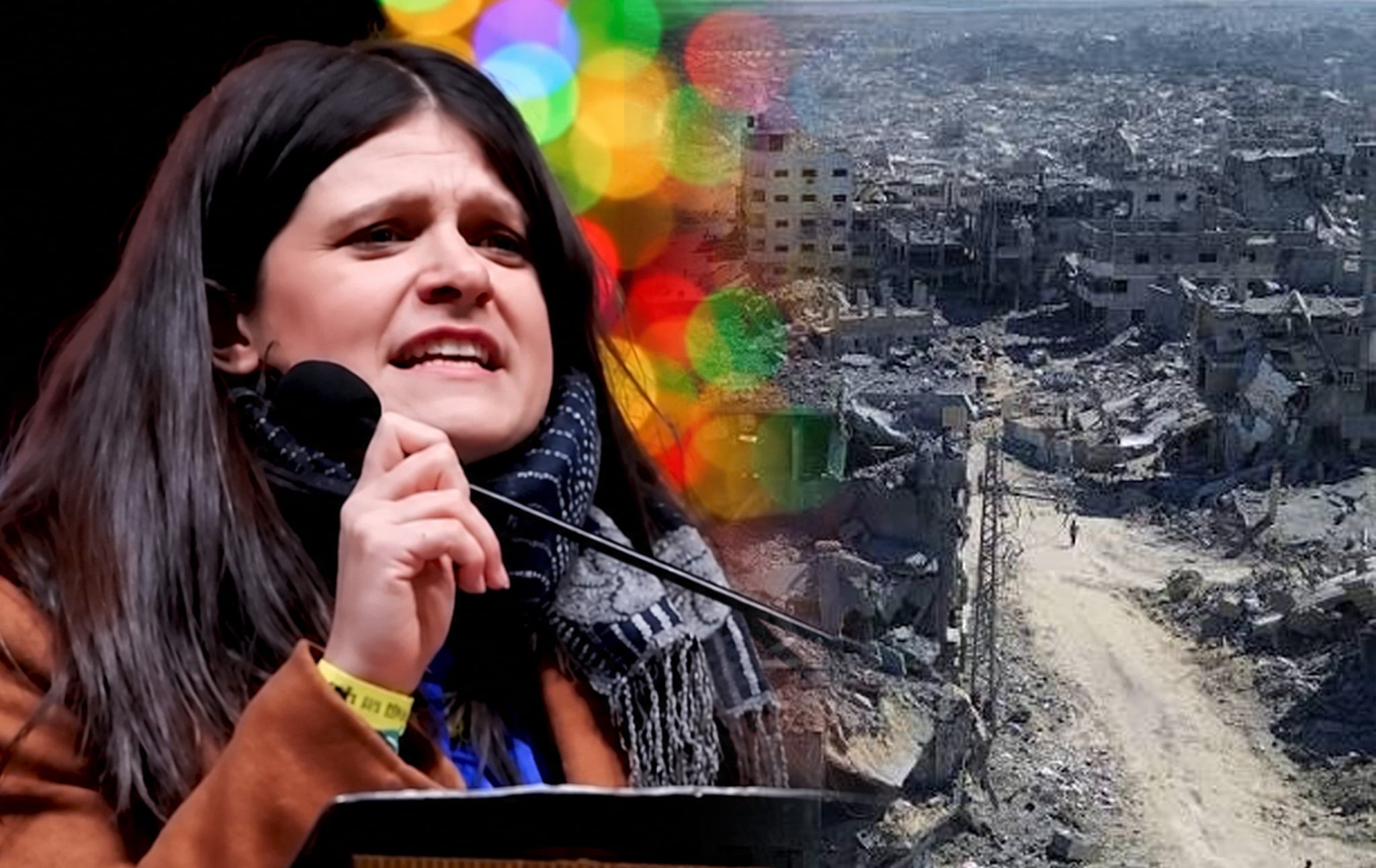
Stevens takes the radical position that U.S. support for Israel should “go unquestioned.” If never questioning support for a genocidal state is “moderate,” then our definition of “moderate” needs to change.
No two years are ever the same. 2026 is certainly not 2024. Two years ago, the Democratic primary for the U.S. Senate in Michigan was a bore. Then-Congresswoman (and ex-CIA agent) Elissa Slotkin was widely expected to triumph over little-known challenger Hill Harper, and so she did. The only excitement in the affair came when Harper—and withdrawn candidate Nasser Beydoun—claimed to have been offered $20 million in campaign contributions from a pro-Israel group to drop out of the race and primary Palestinian-American Congresswoman Rashida Tlaib.
By contrast, 2026’s Democratic primary in the Wolverine State has developed into a fierce contest between left-leaning 2018 gubernatorial candidate and former Wayne County health department director Dr. Abdul El-Sayed and my own centrist congresswoman Haley Stevens after State Senator Mallory McMorrow, who attempted to split the difference between the two, dropped out of the race.
I have been a constituent of Stevens since 2023, and have had ample opportunity to observe her conduct in office. That tenure has brought me endless amounts of frustration, not just because of her views, which differ from those of myself and most people I know in the district, but also due to her tendency to stridently repeat the same overused talking points and her inability to respond to criticism.

El-Sayed and Stevens differ on multiple issues. In 2020, El-Sayed campaigned for democratic socialist Bernie Sanders. Stevens, on the other hand, endorsed billionaire Michael Bloomberg for president. El-Sayed supports Medicare for All. Stevens does not. He supports abolishing ICE. She does not. Last year, Stevens voted for a Republican-backed resolution expressing “gratitude” towards ICE for “protecting the homeland.” In fact, Stevens seemed impressed by ICE girlbosses at an immigrant processing center she visited this February, saying “Of note, there is female leadership here, and there are women who walked with us today and explained, on the intake process, how important it is to treat people with humanity.” (Also of note, this took place after the killings of Keith Porter, Renee Nicole Good, and Alex Pretti by armed ICE agents.)
Although differences on domestic questions like these separate the two, it has been Stevens and Uncle Sam’s support of Israel that has come to define the two candidates. Stevens is the obvious favorite of the pro-Israel lobby. She has been endorsed by Democratic Majority for Israel, the American Israel Public Affairs Committee (AIPAC) and the Joint Action Council for Political Affairs, which despite its neutral-sounding name solely boosts candidates who favor a strong U.S.-Israel relationship.
Stevens has furthermore been endorsed by Michigan attorney general Dana Nessel, whose picture would appear in a hypothetical political dictionary under the heading “Progressive Except for Palestine.” Nessel was recruited by the University of Michigan to criminally charge pro-Palestine protesters and worked with Kash Patel’s FBI to raid the domiciles of pro-Palestine activists. In the conservative Detroit News’ endorsement of Stevens, the paper swiped at the “socialist” policies of El-Sayed before taking care to note AIPAC’s support for Stevens. El-Sayed was denounced as “another voice speaking against” Israel.
El-Sayed, on the other hand, has echoed Amnesty International and Human Rights Watch in accusing Israel of committing acts of genocide against the Palestinians. He has been endorsed by Jewish Voice for Peace, Peace Action, and the U.S. Campaign for Palestinian Rights. The United Auto Workers, who recently announced their divestment from Israeli bonds, have additionally endorsed El-Sayed. The El-Sayed campaign has gone so far as to create a website that loops a soundbite widely memed on social media of Stevens exclaiming “Israel comes to me in my dreams!” as a fundraising tool. Visitors to the site can halt the loop by donating to the campaign.
Much of the commentary by professional chatterers and pundits has cast Stevens and El-Sayed into the kinds of familiar roles voters who were around for the 2016 matchup between Hillary Clinton and Bernie Sanders remember: Stevens is the sensible moderate, whereas El-Sayed is a fringe candidate. Bari Weiss’ Free Press, for one, describes El-Sayed as the “hard-left” and “radical” candidate. But after a careful study of the congresswoman’s record on the critical issues of war and peace, including U.S. aid for and participation in Israel’s wars, it is Stevens who comes across as the extremist out of touch with Democratic voters.
Stevens’ support for the state of Israel goes back to the start of her career in electoral politics, when she first ran for Congress eight years ago. Under the heading “Veterans and Defense,” her 2018 campaign website stated “I believe in a strong U.S.-Israel relationship[...]This is a relationship that must thrive and go unquestioned [my emphasis]—and most importantly cannot become a partisan issue.” This is the most extreme stance imaginable. Here, Stevens is showing complete contempt for voters’ capacity to think critically. She thinks they shouldn’t even ask questions about the U.S. relationship with Israel. It’s an authoritarian sentiment that no politician would ever express about the relationship with any other country.
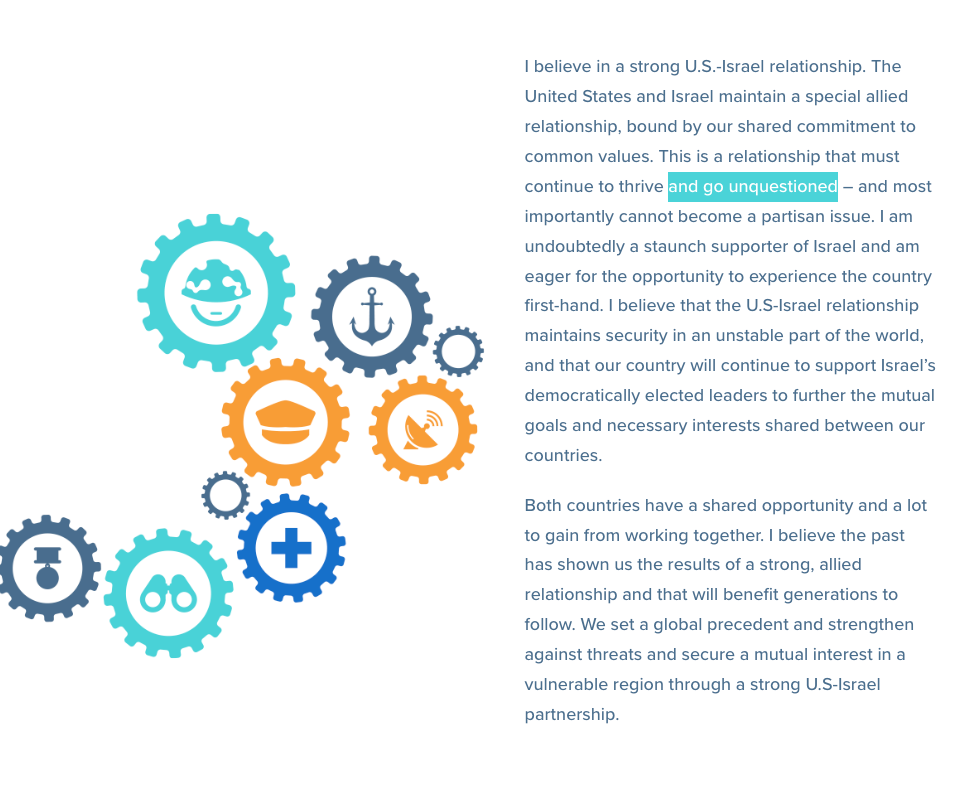
An excerpt from Haley Stevens' 2018 campaign webpage
The website continues: “I believe that the U.S.-Israel relationship maintains security in an unstable part of the world, and that our country will continue to support Israel’s democratically elected leaders to further the mutual goals and necessary interests shared between our countries.” Notably, Stevens’ 2018 website devoted two whole paragraphs to her support for Israel, while the sections Advocating for Equality and Standing Up to Donald Trump merited only one.
In office, Stevens has regularly parroted the AIPAC script. When Amnesty International released a 2022 report accusing Israel of apartheid, Stevens denounced “accusations put out by groups like Amnesty International” branding Israel an apartheid state. She has taken multiple AIPAC-sponsored trips to Israel, beginning in 2019. On a 2023 AIPAC-sponsored tour of Israel she said “We are in the beautiful country of Israel, learning about her democracy, learning about our shared commitment to national defense, economic development, and trade. It’s a great day to be in Israel!”
Stevens’ talking points will be familiar to readers with a cursory knowledge of history and experience discussing foreign affairs. For example, a form email sent out to constituents who contacted her after October 7, 2023 refers to “our great ally” Israel, that country’s “undeniable right to defend herself,” and the “devastating impact of extremist ideologies and the threat they pose to democracies like Israel.” I am intimately familiar with the contents of this email, and its Mad Libs quality, having received it several times from the Congresswoman. That she never bothered to change its wording shows how much she valued the views of her constituents.
Anyone not a resident of Gore Vidal’s “United States of Amnesia” could ask several probing questions about the premises of this letter. For example, if Israel is such a great ally, what about the unprovoked 1967 attack on the USS Liberty, or the case of spy Jonathan Pollard, who passed along US state secrets to Israel in the 1980s? Or, for that matter, the historically unpopular, not to say incredibly expensive, U.S. strikes on Iran which Marco Rubio stated occurred because Israel was already planning to bomb them? How can Israel be classed as a democracy when its Palestinian citizens, to say nothing of people in the occupied Palestinian territories, are given a second-class status? Is supporting a government that includes people like Bezalel Smotrich and Itmar Ben-Gvir not itself an example of extremist ideology?
The Congresswoman cannot be classed as one of those politicians who says one thing and does another. Here, though, that typical virtue has transformed into a vice. Her voting record hardly differs from her pro-Israel statements. In her first year in office, she voted to condemn the Boycott, Divestment, and Sanctions movement that uses the same tactics against Israel that were once used against apartheid South Africa. Also in 2019, she bragged about her “key role” in passing a $3.3 million military aid package to Israel. In 2022 she signed a letter drafted by Congressman Josh Gottheimer threatening to scuttle any Biden nuclear deal with Iran.
Nor have Israel’s actions since 2023 had any appreciable effect on her beliefs. Stevens was one of a dozen Democrats to defy party leadership to vote for a 2023 bill that cut funding from the Internal Revenue Service to give an additional $14.3 billion in aid to Israel. In 2025, Stevens voted with 44 other Democrats to sanction the International Criminal Court in protest of the arrest warrants it issued for Israeli Prime Minister Benjamin Netanyahu. Stevens voted in 2024 to bar the Sate Department from using statistics on the Gaza death toll from the Gaza health ministry, an act described by the Council on American Islamic Relations as “genocide denial.” Rashida Tlaib’s recent war powers measure to withdraw U.S. forces from Lebanon garnered 91 Democratic votes. Haley Stevens was not among them, although she belatedly voted in favor of a similar resolution.
Stevens maintains that her “beliefs on Israel[...] will never be bought and paid for.” Nevertheless, a politician who can so assiduously follow the AIPAC party line need never worry where their next campaign check is coming from. Such was the case in 2022 when Stevens squared up against Congressman Andy Levin. Redistricting after the 2020 census placed the two incumbents in the same district. Levin was already facing an uphill battle given that more of the new district had been represented by Stevens than by himself. He was not helped by the torrent of AIPAC money that flooded into the race.
Although Levin was Jewish, the former president of his synagogue, and a self-described liberal Zionist, he had a problem: because he opposed Israel’s illegal settlements and supported the establishment of a Palestinian state, including introducing the Two State Solution Act in Congress, AIPAC deemed him insufficiently supportive of Israel and deserving of defeat. A letter from AIPAC to supporters stated that “Defeating Andy Levin would remove one hostile voice, but as important, ensuring Haley Stevens wins would cement a pro-Israel champion in the Democratic party.”
AIPAC ultimately spent over $4 million to unseat Levin through its political action committee the United Democracy Project (UDP). In 2022, Stevens received more funding from AIPAC than anywhere else, and was the second-largest recipient of money from the organization that year. Stevens recorded a video warmly thanking AIPAC for their role in her victory. Yet the ads run by the UDP didn’t mention Israel or AIPAC at all, suggesting they were aware of the growing toxicity of their brand of politics. The defeat of Levin became a proving ground for the strategy used in AIPAC-backed efforts to defeat Jamaal Bowman and Cori Bush in 2024.
Looking at Stevens’ career, one can observe the sorry state of what the New Left called corporate liberalism: a mixture of corporate-oriented reforms at home and imperial aggression abroad. It is a worldview that sees an obligation to guarantee aid to Israel, but not an obligation to guarantee healthcare as a human right; that seeks to protect Israel from accountability, but not to hold the rich and powerful to account; that can provide arms for foreign regimes, but not homes for the homeless and jobs for the jobless. As activist Carl Oglesby said of corporate liberalism during the Vietnam War, it “performs for the corporate state a function quite like what the Church once performed for the feudal state. It seeks to justify its burdens and protect it from change.”
The loyalty Stevens has shown to the Israel lobby has led to a backlash from both her own constituents and organized Democrats. In 2024, her office called the police on a constituent who threatened to protest outside her Michigan office over her claims that pro-Palestinian activists on college campuses were motivated by antisemitism. Last year, the anti-war group CODEPINK actually did protest outside that office, denouncing her support from AIPAC and her votes placing the interests of Israel “above the interests of her constituents.” During the 2026 Michigan Democratic Convention in Detroit, Stevens was booed throughout her remarks when she addressed delegates. “Loyalty is a fine quality,” U.K. Labour Party leader Neil Kinnock noted, “but in excess it fills political graveyards.” Today, excess loyalty to the Israel lobby may still send one more career to its final resting place.

Public support for Israel has cratered since 2023, for reasons that should be obvious. A poll from March of this year showed 80 percent of Democrats and Democratic-leaning independents had an unfavorable view of the state of Israel. Israel has about as much support among Democrats as banning legal abortion. This unpopularity has become particularly apparent in Michigan. The Uncommitted Movement, which began in the state and was endorsed by El-Sayed, got over 100,000 voters to vote “uncommitted,” meaning to vote for “none of the above” in the 2024 presidential primary, in protest of the Biden administration’s support for Israel’s destruction of Gaza.
Given rank-and-file Democrats’ hostility to Israeli conduct, and Stevens’ longstanding support of it, how is she explaining that record to voters during her Senate run? Quite simply, she isn’t. Stevens would rather talk about anything than her foreign policy record. She has recently pivoted to condemning Israeli PM Benjamin Netenyahu personally, after amiably chatting with him in 2019, saying he has “made us less safe”—but not unsafe enough to face justice at the ICC!—and touting her opposition to Donald Trump’s war on Iran. This is less of a road to Damascus conversion, than a realization of the electorate’s antiwar mood. The war hawk is trying to metamorphose into a dove.
Instead of addressing this record, Stevens and the forces supporting her are instead blanketing the state with false and misleading ads. These ads praise Stevens for standing up to ICE, despite her votes to fund the agency. Millions of dollars are being spent to give voters the impression that President Obama has endorsed Stevens (he hasn’t) and that El-Sayed is a misogynist member of the He-Man Woman Haters Club (he isn’t). Who is behind these attacks? None other than AIPAC, running the same playbook in 2026 as they used in 2022.
One of the most important assets in politics is a long memory. The outcome of the Democratic primary in Michigan depends on which version of the candidates voters remember when they mark their ballots. If the monied interests around Stevens are successful in rewriting the recent past, it will be an illustration that money talks, and the people walk.
Hank Kennedy is a Michigan-based writer whose work has appeared in the Progressive, Responsible Statecraft, and Fairness and Accuracy in Reporting, and others. He is keenly interested in comics and cartoons and has written about them for the Comics Journal, Solrad, Shelfdust, and others.