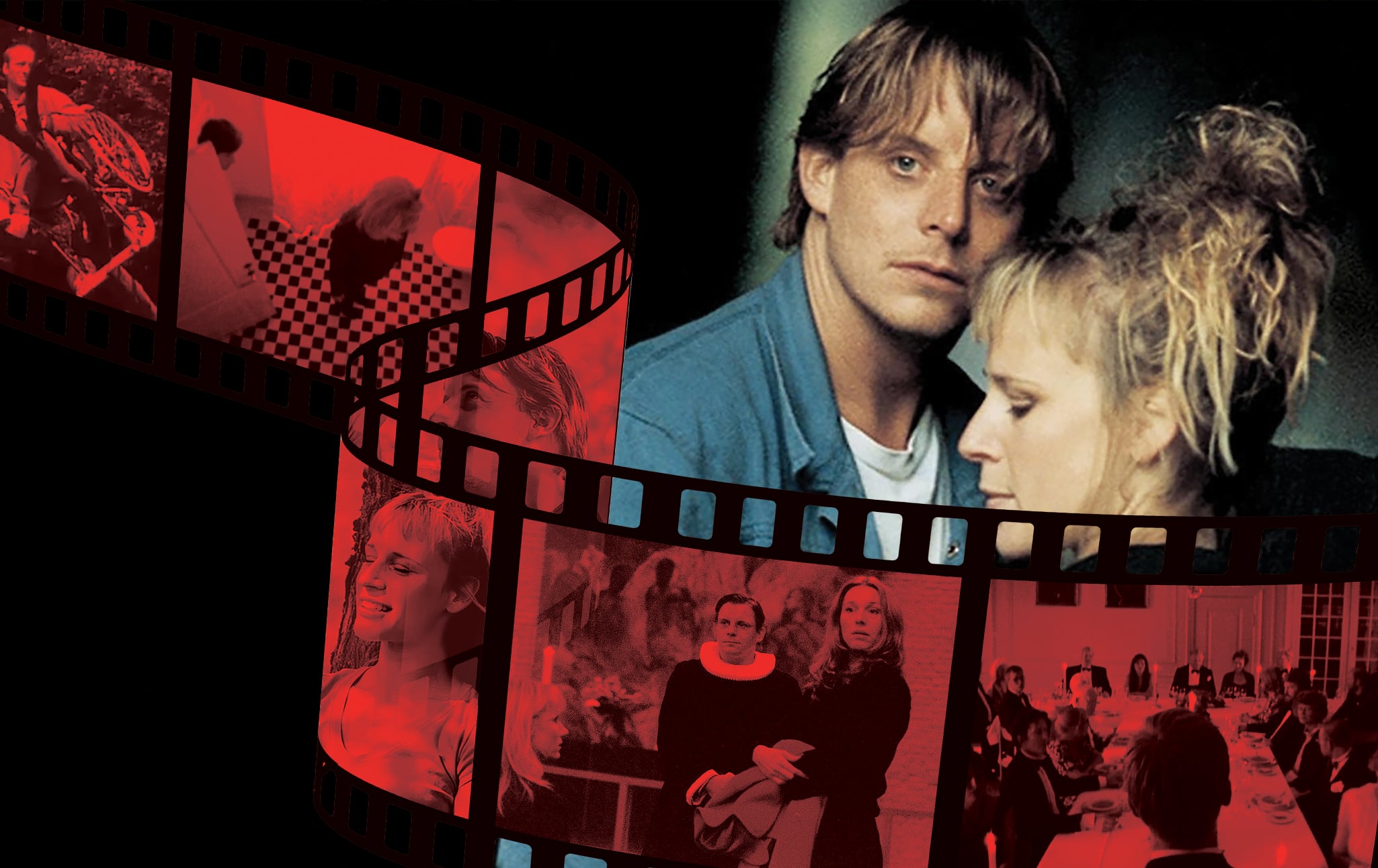
Shot with handheld cameras and no lighting, music, or special effects, “Dogme” films are the exact opposite of today’s blockbusters. That’s what makes them great.
On March 13, 1995, at a celebration of the centenary of cinema in Paris, Danish filmmakers Lars von Trier and Thomas Vinterberg announced their intention to launch a new film movement. They distributed a manifesto and an accompanying Vow of Chastity, and didn’t take any questions. Most film movements—Italian neorealism, say, or new queer cinema—happen organically and are blurrily defined, getting a name as filmmakers, critics and audiences happen to notice features which seem to link certain films together. Not this one. Dogme 95 (Danish for, as you might have guessed, “dogma 95”) consists of exactly 35 films, each numbered and given a certificate.
Making a Dogme 95 film meant swearing “to submit to the following set of rules,” as outlined in the Vow of Chastity:
Shooting must be done on location. Props and sets must not be brought in (if a particular prop is necessary for the story, a location must be chosen where this prop is to be found).
The sound must never be produced apart from the images or vice versa. (Music must not be used unless it occurs where the scene is being shot.)
The camera must be hand-held. Any movement or immobility attainable in the hand is permitted.
The film must be in color. Special lighting is not acceptable. (If there is too little light for exposure the scene must be cut or a single lamp be attached to the camera.)
Optical work and filters are forbidden.
The film must not contain superficial action. (Murders, weapons, etc. must not occur.)
Temporal and geographical alienation are forbidden. (That is to say that the film takes place here and now.)
Genre movies are not acceptable.
The film format must be Academy 35 mm.
The director must not be credited.
Conceptually, Dogme 95 was an attempt to radically democratize filmmaking and resist the rise of the modern blockbuster, transforming low budgets and limited technical skill from obstacles into virtues. But it was also, unmistakably, a troll. The manifesto was allegedly written in 45 minutes. A lot of great art comes from restrictions, but the Dogme rules are a hilarious combination of arbitrary and exacting. (It’s one thing to ban setting up an elaborate camera rig, but you can’t set the camera on a table?) It is, as much as anything, a funny bit. Dogme 95 resolved this duality within itself—caught between sincere reinvention of the cinematic form and sticking its tongue out to blow a raspberry—through total commitment to that bit. The Dogme rules sound hard to follow, harder to follow and make a good movie, and harder still to make one that isn’t the same as every other Dogme movie. Nobody made a film attempting to follow the rules for another three years after the announcement—Vinterberg’s Festen and Von Trier’s The Idiots were released in 1998—and both of those broke some of the rules. It’s hard not to break any. “You can break one of the rules” is basically one of the rules. Julien Donkey-Boy (Dogme #12) breaks six of them and still got a certificate. What makes Dogme 95 a funny troll and what makes it an important film movement are the same thing: that it managed to produce films so rich, diverse and fascinating that they can fundamentally change the way you think about cinema.

Dogme #1: Festen (1998) and Dogme #2: The Idiots (1998)
Festen—also known in English as The Celebration—is set at the 60th birthday party of a wealthy businessman (Henning Moritzen). The hotel he owns hosts a formal banquet attended by various friends, family, and business associates, including his adult children. His eldest son (Ulrich Thomsen) stands to, apparently, give a toast. Instead, he announces that his father sexually abused him and his twin sister, who has recently taken her own life. There’s a brief, shocked silence. And then the party continues as before. In a manner that feels surreal, but reflects the all-too-real pattern of societal inaction on sexual abuse, the guests ignore it. Some of them disbelieve the accusation; some are more motivated by fear of social awkwardness than horror of child abuse. The father denies it, of course. How the rest of the family react to the public accusation, and how much they knew about the abuse, is peeled back throughout the rest of the film. The son’s greatest supporters are the hotel kitchen staff, who hide the guests’ car keys to prevent them from leaving.
The film is obviously a masterpiece. It is blackly funny but never flippant, carefully unspooling the effects of sex abuse within a family. As Roger Ebert writes, Festen “mixes farce and tragedy so completely that it challenges us to respond at all.” This is not because Vinterberg lacks control over the material, but because he has such skill that can evoke an incredibly specific tragicomic tone in this highest-stakes emotional context. It’s like the most messed-up episode of Succession never made. Festen singlehandedly justifies the Dogme 95 concept: nothing about following those restrictions feels gimmicky. Rather, the natural lighting, handheld cameras, and only diegetic sound make the film seem intimate and authentic and real, like you would never consider telling this story any other way. The Dogme style effectively undercuts the story’s potential for melodrama. Don’t get me wrong, I love melodrama, but it is so much more effective that Festen’s shocks, twists and revelations don’t play in the emotional major keys. It feels true to life. Like you’re just another guest trapped at this damn party.
Festen is so good that it feels fated to be the exception that proves the rule, casting the failures of other Dogme movies into sharper relief.
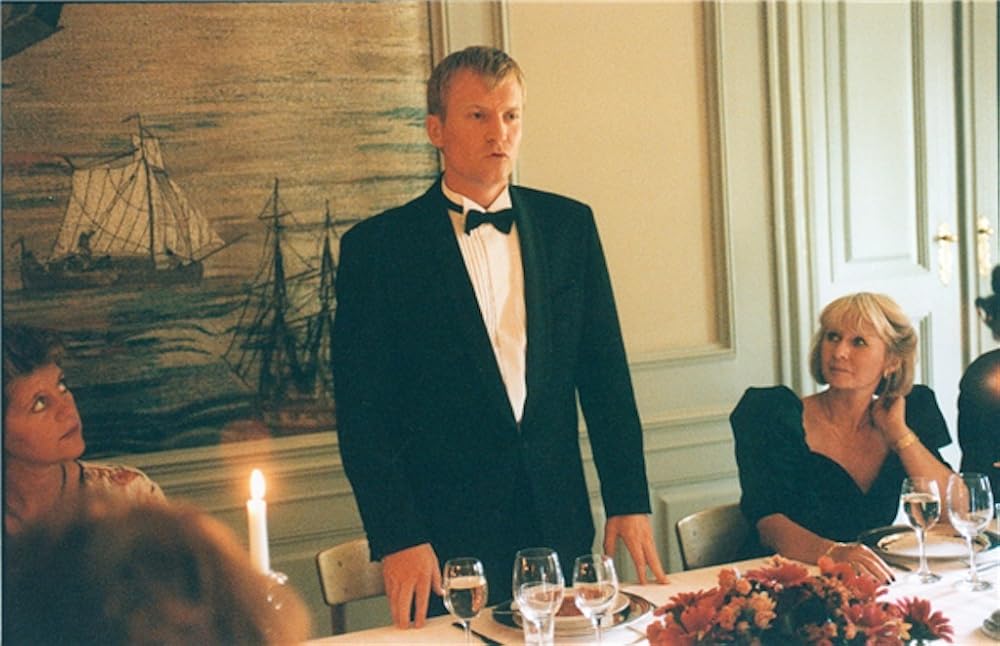
Ulrich Thomsen delivers the inciting revelation in "Festen" (1998)
The Idiots, in contrast, is easy to hate. When it premiered at Cannes, Mark Kermode shouted “Il est merde! Il est merde!” (“it is shit,” in not-good French) until he was kicked out of the screening. AO Scott accused the film of “contemptible emotional brutality.” It is visually ugly and narratively disjointed, with retrospective talking-head interviews mixed in among the scenes, though they aren’t part of a larger mockumentary approach. It has an unsimulated orgy in the middle for no real reason. It is viscerally distressing and morally queasy. It is also beautiful and moving. I love it unreservedly.
Karen (Bodil Jørgensen) is alone at a restaurant. A group of adults with intellectual disabilities arrive at the restaurant with their carer: the group interfere with and embarrass other diners, whose anger and disgust are no less obvious for being swallowed out of politeness. But Karen—quiet in ways that could be shyness or something sadder—is kind and sympathetic. One of the group holds her hand and takes her with them. They reveal that they are not, in fact, disabled: they are bohemians who publicly pretend to be mentally disabled—their word for this pretending is translated in subtitles as “spazzing”—as some kind of anti-bourgeois protest. They intend to shock middle-class sensibilities. Stoffer (Jens Albinus), their philosopher-in-chief, talks grandly about how “idiots” are the people of the future, the only ones who are truly free, and that it is vital to find one’s “inner idiot” to resist the system. The group take Karen to stay with them at a big suburban house which Stoffer is supposed to be selling for his uncle. Instead, he is using it as the base of operations for his strange, vague revolution.
There are whole sequences in The Idiots that play like a bad-taste hidden-camera prank show. The gang “spaz” in swimming pools and biker bars—twitching, jerking, drooling, saying and doing whatever is socially inappropriate. As in a prank show, the humor comes from the people around them not knowing how to deal with a situation which they perceive as real. But if this was a prank show, it would be reprehensible: ableism in its purest, unreconstructed form. In The Idiots, these scenes are integrated seamlessly into a sad drama—one that is shamelessly provocative on disability issues, but ultimately pulls apart assumptions about disability and propriety, whether held by either a scandalized audience member or the film’s characters.
Despite its gleeful outrageousness, The Idiots never really indulges Stoffer’s radical posturing. His claims about whatever grander point “spazzing” achieves are incoherent and empty. He’s a posh boy who doesn’t think the rules should apply to him, that’s all. When another member of the group brings some people with Down’s Syndrome to the house for tea, he’s angry. For all his talk of “idiots” being the people of the future, he seems as uncomfortable around actually disabled people as the squares he loves to scandalize. (More so: the squares suffer their discomfort politely.) This is one of several events that cause the group to unravel. Another is that Josephine’s (Louise Mieritz) father shows up, chastising her for going off her medication and insisting she return home.
If the visit of the characters with Down’s Syndrome exposes the shallow sham of “spazzing” by contrasting it with genuine disability, the reveal of Josephine’s mental illness re-blurs the lines. To pretend to be disabled—to “spaz”—is a conceit that relies on the stable definition of the non-disabled mind and body, a norm to which one returns. But that stability is illusory. The boundaries between the disabled and “normal” body or mind are unfixed—perhaps even more so than other socially constructed categories, due to the number and variety of conditions that may or may not be classed as disabilities. Josephine, like her friends, was pretending to have a brain that worked differently from the norm, in a way that would require care. At the same time, she was pretending something that was also true, and the act of pretending made her seem “normal,” both to the group and to the audience. Her experience of disability is a lack of autonomy, subject to her authoritative father’s demands, but her experience of pretending disability is blissful freedom.
This ambiguity along the borders of disability and not, and between being and pretending to be, is the center of The Idiots. This tension comes to a head in the final, excruciating ten minutes, when Karen, the newcomer, is the only person to accept Stoffer’s challenge to “spaz” in front of your family and loved ones. Though Karen was initially sceptical and only joined the group not long before it began to dissolve, it quickly seems especially meaningful for her. She is unwilling to let go or move on. She returns home with one other group member, and all at once we learn Karen’s story. Her mother is shocked to see her after her disappearance. It turns out that two weeks earlier, Karen’s newborn baby died. She left home before the funeral. The narrative “has the structure of a joke in that the point at the end endows the rest of it with meaning,” Ove Christensen writes. “Only at the end does it become clear that Karen’s vulnerability (also) has an external explanation.” Christensen is right that this is a structure typical in comedy, which makes the scene all the more effective as tragedy: you are coiled for the expected surprise of delight, and instead get a much more surprising punch in the face. For the whole film we were watching, Karen was carrying around an unspoken, unspeakable trauma. It’s difficult to process, but “spazzing” seems to have been especially meaningful to her in part due to that grief. She starts to dribble her food, fulfilling the stupid, pointless dare, and just remembering it makes my stomach knot with anxiety. Christensen describes this as a kind of involuntary compulsion—“spazzing” made real—but to me, it’s a deliberate action resulting from a terrible miscalculation of what matters, of who one wants to be and how to be part of a community, by a woman whose foundation has crumbled beneath her. It’s the saddest dribble in film history.
Dogme #3: Mifune (1999)
There’s nothing in the Dogme 95 rules mandating certain themes, yet it seems natural enough that several Dogme films carry through the interest in communities of outcasts and self-exiles and the porousness of disability initiated in The Idiots. The Dogme manifesto is a declaration of an outcast filmmaking community, and the Dogme rules function as a kind of disability metaphor, reframing assumed deficits as positive values to cultivate a different kind of gaze. This is most directly evidenced in Harmony Korine’s Julien Donkey-Boy, where the scuzzy visuals parallel the vision impairments of many of the film’s characters. But my favorite examples are those films that reconsider those themes in tones totally unlike The Idiots’ blend of shock humor and painful tragedy.
Søren Kragh-Jacobsen’s Mifune is, for all intents and purposes, a romantic comedy and a sentimental found-family drama. But it is a loose-limbed and freewheeling one, whose adherence to genre conventions is less cookie-cutter repetition and more that, freed from all expectation, you realize those conventions are actually a really great way to tell a story.
Mifune opens at a wedding. Kresten (Anders W. Berthelsen) marries a girl whose father owns the firm where he works. The next morning, he gets a call telling him that his father has died, and he must come home to the family farm to look after his brother. His new bride is confused. He never mentioned where he grew up—on the rural Danish island of Lolland—and she calls him “peasant ass” when he tells her. He never mentioned having a brother, or a father, for that matter. He never told her that his mother hanged herself when he was a child. He reassures her that he will be back in Copenhagen in two days’ time.
When Kresten arrives in his BMW at the ramshackle farm where he grew up, the house has severe water damage to the walls and fixtures, the stench is bad enough that he vomits, and his brother is hiding under the table where their father’s corpse is laid out. Rud (Jesper Asholt) is noticeably older than Kresten, the scruffy emotional counterbalance to his suave polish. He’s also intellectually disabled. In the decade since Kresten last visited, their father was ostensibly Rud’s carer, but it sounds like the direction of caring responsibilities became complex as time wore on: the animals died, and their father burned all their furniture and rarely left the farm. Kresten assumes Rud will be put in a home, one of a dozen things to tidy away neatly before he goes back to Copenhagen. “I have a home!” Rud insists. Kresten doesn’t seem inclined to listen to him. Rud is, more than anything, an inconvenience. A stubborn obstacle in his way back to his carefully sculpted life as a yuppie newlywed. When he asks the man who notified him of his father’s death about putting Rud in a home, he’s told that they don’t usually do much if there’s family around, and that it would take many months out here in the country. Or he could hire a maid to take care of him.
Enter Liva (Iben Hjejle), a sex worker trying to pay for her little brother’s boarding school. She fabricates an employment history and takes the job, in part to escape the stream of abusive phone calls she’s been receiving. Rud is instantly smitten: before she arrives, he is appalled at the notion he should wash himself, but once he sees her, he decides to put on his good suit and comb his hair. He tells her about aliens, and she smiles gently, threading the line of finding Rud funny without being mean. When she meets Kresten, he has a bucket on his head, shouting in mock-Japanese. When they were younger, he and Rud would play a game where they pretended that legendary Japanese screen actor Toshiro Mifune, or more accurately, his character in Seven Samurai, lived in their basement, and Kresten would act the part for Rud’s amusement. Despite the façade he’s put on in Copenhagen, he hasn’t been home for long before he goes back to playing Mifune. Much like Tom Cruise in Rain Man, reconnecting with his disabled brother helps him, bit by bit, reconnect with his authentic self.
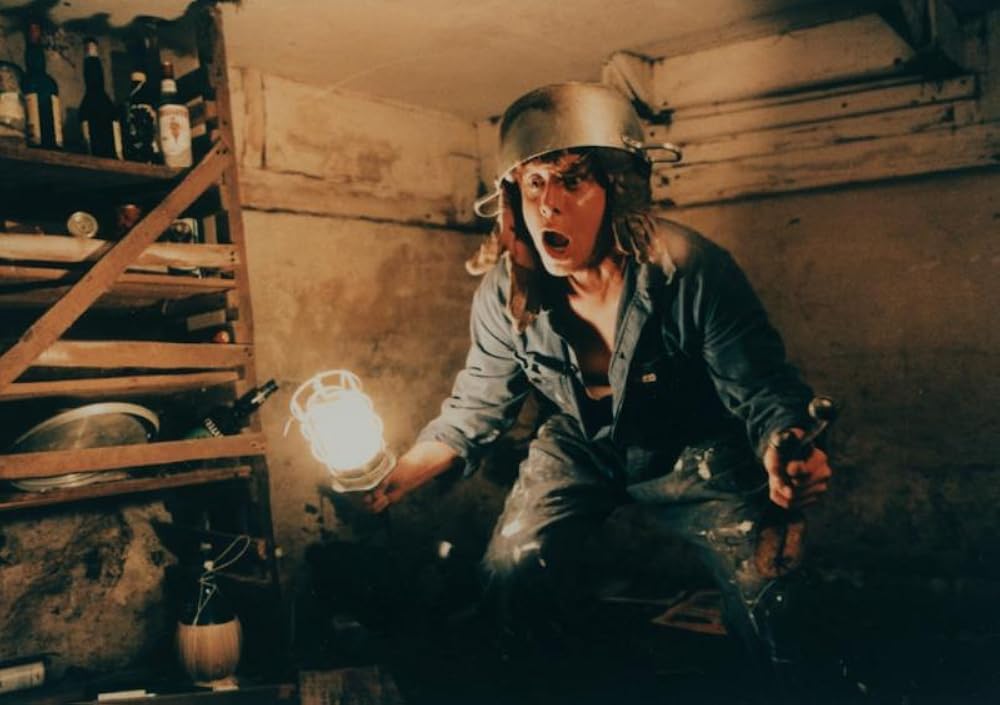
Kresten (Anders W. Berthelsen) puts on his best samurai impression in "mifune" (1999)
It is obvious to anyone who has seen a movie that by the end Kresten and Liva will fall in love, and will live with Rud on the farm, as his dearest friends and fiercest allies. They’ll also be joined by Liva’s kid brother Bjarke (Emil Tarding), after he gets kicked out of boarding school. I want to say it’s darker than it sounds, but that’s not quite it. I could describe it with emphasis on different details—Rud’s fixation on the tree their mother hanged herself from, say, or the reveal of who exactly was making the abusive phone calls to Liva—and it would sound hideous and unsettling, but it is, on the whole, lovely, its painful moments like salt to the caramel. It’s a Dogme movie, so you don’t have the kind of reassurance that is built into similar Hollywood fare—you know how stories like this go, that all secrets will out and hearts of stone will soften, but you don’t know that this story won’t still take a sharp left turn. Bjarke convinces Rud to get into the water to retrieve a stone he tells him is special, and when Rud can’t swim at all it feels like the end of the world. But, after a beat or two too long, Bjarke dives in to save him—and pulls Rud out clutching the special stone in his hand, happy as a clam.
It is a film about making a family out of these bits and pieces that come into your life. About the wonder and glory of happenstance. There are biological relationships here—two pairs of siblings—but it doesn’t feel like that’s what binds them together. Kresten and Rud were still “brothers” when he was spending a decade in Copenhagen pretending to be somebody else. They were brothers when Kresten griped about how annoying it was that he couldn’t dump Rud in an institution. But they are brothers in a different, truer way when Kresten wanders through a wheatfield, crying out, putting on Rud’s clothes as he finds them strewn about. Rud’s intellectual disability goes from being perceived as a burden to being just an aspect of his personality, as ineffable and loveable as anyone else’s. At one point, Kresten calls them all idiots, and Bjarke corrects him: “Not Rud.”
When we first meet him, Rud says he already has a home. It just takes a while for the rest of the characters to catch up.
Dogme #12: Italian for Beginners (2000)
For all its pretense of experimentalism, the Dogme style turns out to be extremely well-suited to romcoms, a genre well-disposed to people talking in rooms without period setting or special effects. Italian for Beginners, adapted from a novel by Irish “chick lit” queen Maeve Binchy, follows the intersecting romance plots of characters attending an evening class in Italian. By the end of the film, none of them have learned Italian, but it doesn’t matter, because Giulia has finally told Jorgan Mortensen she’s in love with him, despite continuing to call him exclusively by his full name. Italian for Beginners is funny and chatty and moving in the manner of a Nora Ephron script. It is the only film that truly dares to ask, “What if Love Actually was good?”—a question Love Actually fails to answer every Christmas.
It seems pretty extraordinary that a film like Italian for Beginners could conceivably be part of the same film movement as The Idiots. One I would happily recommend to my mother, and one I assume will get me put on a list for publicly praising. Yet even at this fluffiest end of the spectrum, that interest in disability remains. Italian for Beginners is an ensemble piece, but if it has a protagonist, it’s Olympia (Anette Støvelbæk): a woman who is described both within the film and in writing about it as “clumsy,” but whose lack of coordination goes beyond everyday clumsiness. She clearly has pretty severe dyspraxia (AKA developmental coordination disorder), a neurodevelopmental difference that affects a person’s fine and gross motor skills. This could show up in daily activities like tying your shoes, writing by hand, and balance, although it affects different people in different ways. Olympia has been fired from dozens of jobs for dropping things, bumping into things, and knocking things over, and looks likely to be fired from her current job at the bakery. Though she acts as a carer for her elderly father, he berates her for supposed stupidity in doing everyday tasks that require coordination. Again, the line between disabled and not is blurry. On paper, Olympia’s father is disabled and she is his non-disabled carer, but in practice, his abuse of her—which likely far precedes his own disability—is centered in no small part on her invisible and unnamed neurodivergence. Her dyspraxia is recognized by those around her, but instead of being labelled as such it’s chalked up to stupidity, laziness, lack of attention or concern.

Dogme 95 aimed to spur the democratization of filmmaking. In the short-to-medium term, it seemed to work. People whose films would otherwise never be seen got their shiny Dogme certificate and some kind of audience. More importantly, it showed how little is actually needed to make a film—even a good one. There is a clear throughline from Dogme 95 to American mumblecore films of the 2000s like Funny Ha Ha and Hannah Takes the Stairs, with their low budgets and ultra-naturalistic dialogue. If Dogme revisited and revised the porous boundaries of disability, mumblecore cultivated a distinctly neurodivergent perspective on the world, exemplified by the performances of ADHDer Greta Gerwig (who was an actor before she turned to directing). But that was twenty years ago. Today, filmmaking is at once more accessible than ever—we all carry a high-definition camera and editing suite in our pocket—but doesn’t feel particularly democratized. It is easier than ever to make a film, but harder than ever to get your film seen. It’s like we leapfrogged from democratization to atomization: not the equality of each person in the collective, but the isolation of each individual in their own bubble of algorithmically generated reality.
If it sounds like I’m building up to saying we need a new Dogme movement, a group of Danish filmmakers beat me to it last year at Cannes. The Dogme 25 rules are somehow even more stupid and arbitrary than the originals:
The script must be original and handwritten by the director.
At least half the film must be without dialogue.
The internet is off limits in all creative processes.
We’ll only accept funding with no content-altering conditions attached.
No more than 10 people behind the camera.
The film must be shot where the narrative takes place.
We’re not allowed to use make-up or manipulate faces and bodies unless it’s part of the narrative.
Everything relating to the film’s production must be rented, borrowed, found or used.
The film must be made in no more than one year.
Create the film as if it were your last.
Maybe, like the original Dogme 95 rules, they’ll produce a stunning variety of horrific and delightful films against all the odds. But Dogme 95 was responding to distinct trends in the cinematic ecosystem of the 1990s, as blockbusters were becoming more and more dominant. Dogme 25’s manifesto states that they wish to “preserve the originality of cinema” and criticize how “experimental practice is stifled by fear of risk-taking.” But it’s hard not to think that in an era of endless media franchises, they might be just another nostalgia-driven reboot.