
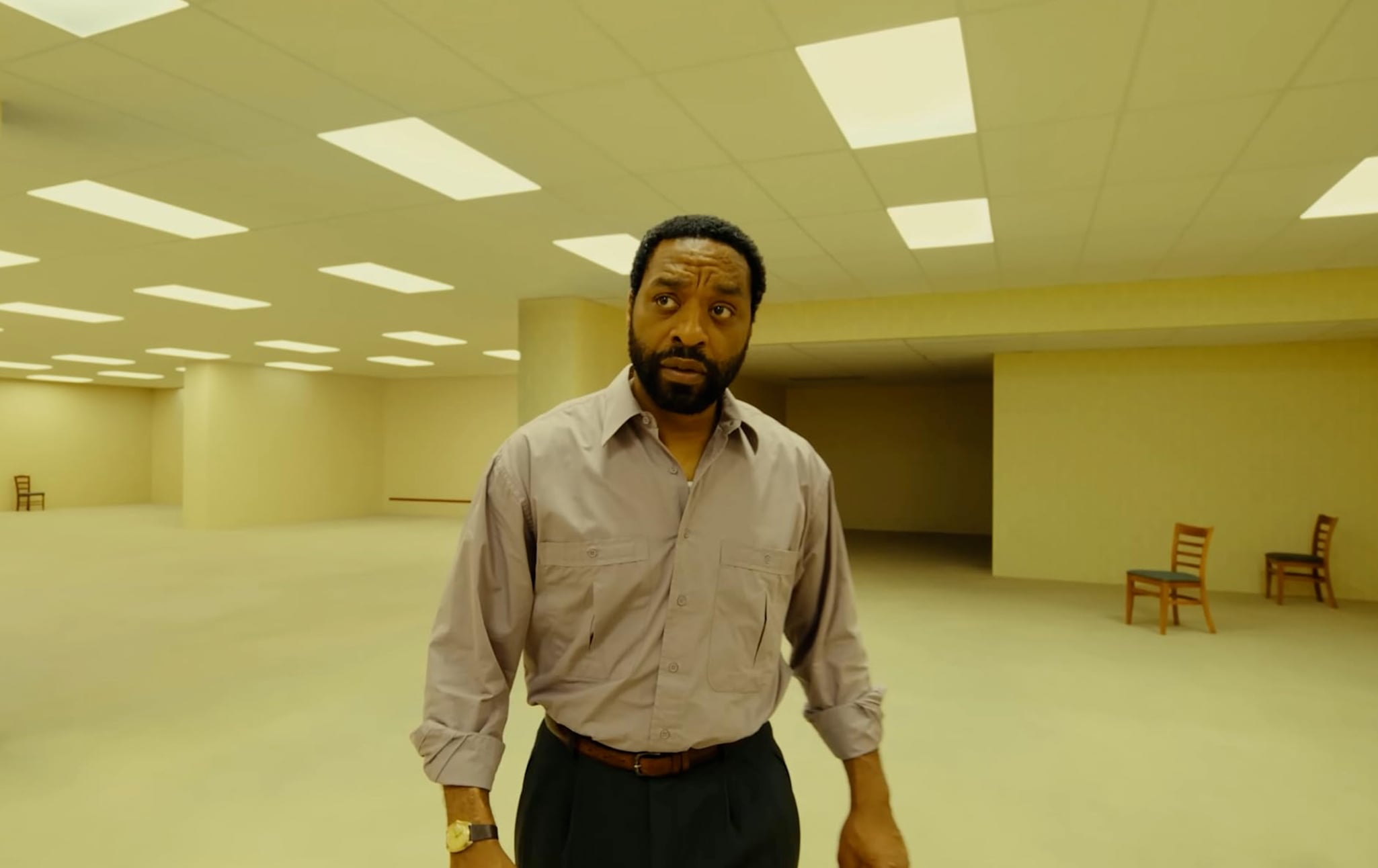
An internet urban legend, now a hit horror movie, shows the vast, meaningless maze behind modern life.
Modern horror media is always a revelation about the world that produced it, but few of our contemporary myths feel as precisely calibrated to the present moment as the Backrooms. The Backrooms are not a haunted house, nor an abandoned ruin, a cursed forest, or any of the traditional thresholds through which the uncanny once entered human life. Instead, they are a vision of horror stripped of enchantment: an endless, fluorescent purgatory assembled from the leftover materials of capitalism. In the Backrooms, the mystery is not supernatural but infrastructural: a place where the hidden architecture of modern life, from its storage spaces to its industrial offices, swallows the individual whole. It is a nightmare born from the aesthetics of contemporary capitalism’s logistics, a world in which even our terrors have been flattened into endlessly repeatable, industrial modularity.
For those unfamiliar with the idea, some context might be useful. Back in 2019, a bland, boxy image of an empty, sickly yellow room was posted in a paranormal thread on the internet forum 4chan. The walls are jaundiced and vaguely off-putting, the lighting coming only from some fluorescent panels in the ceiling. The space is clearly not domestic, but is also abandoned. However, given the angle the picture was taken from, there is the suggestion that something could be hiding, just out of sight. Alongside the picture, the original poster added a short piece of text:
If you’re not careful and you noclip out of reality in the wrong areas, you’ll end up in the Backrooms, where it’s nothing but the stink of old, moist carpet, the madness of mono-yellow, the endless background noise of fluorescent lights at maximum hum-buzz, and approximately six hundred million square miles of randomly segmented empty rooms to be trapped in.
God save you if you hear something wandering around nearby, because it sure as hell has heard you.
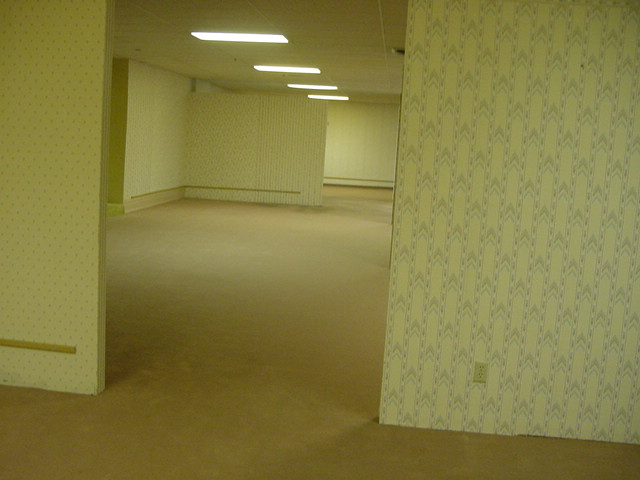
The original Backrooms photo
“Noclip” is a term taken from video game exploits, in which a playable character can make it out of bounds (or “OOB”) and find areas of the game the player was never meant to see—areas that are, in some ways, ontologically incomplete, vague half-finished assets or designs that are incongruous with the geography and geometry of the finished levels, clearly designed in some way but somehow just plain wrong. The original Backrooms image simply asks: what if that were true of existence? What if your world contained areas that you were never supposed to get to? In the image and the short piece of accompanying text, there is something narratively compelling that leaves plenty of space for the reader and the power of suggestion. And so, unsurprisingly, the Backrooms were quickly taken up by decentralized narrative communities, becoming part of the creepypasta and urban legends of the Internet. It’s not hard to see why: whereas some creepypasta stories have a very fixed structure, the Backrooms as an idea are architecturally open, representing a kind of blank canvas upon which one can build. Imagery, short-form video, and fan communities proliferated across the web, and now, Backrooms as a movie has arrived.
The film is directed by Kane Parsons, who was also behind the wildly successful viral series of short films set in the same location. Like Curry Barker, whose recent supernatural horror film Obsession has similarly been a box-office hit on a minimal budget, Parsons got his start on YouTube. His “Backrooms” shorts, uploaded under the name “Kane Pixels,” have been viewed hundreds of millions of times and make the most of a 1990s, retro VHS-inspired aesthetic. The feature film continues this visual motif. Set in the same time period, it follows Clark (Chiwetel Ejiofor), a deeply unhappy furniture salesman. He originally trained to be an architect, but has been reduced to running “Cap’n Clark’s Ottoman Empire,” a shabby big-box store where he must dress up as “Cap’n Clark,” a pantomime pirate with a peg leg, for humiliating TV ads. He is also estranged from his wife, and now sleeps in the massive, always empty store he manages. The store is struggling, on the verge of closure, and the only real social connection Clark seems to have is with his therapist Mary (played by Renate Reinsve). The rest of his life is made up of nothing but work, with the monotony dulled through a serious drinking problem. One evening, after the lights flicker one more time, he finds his way into a seemingly endless series of liminal industrial halls and rooms, cluttered with detritus and accessed by walking through the wall in the basement of the store.
There is nothing new about this idea, in itself. Accessing the unseen and unknown parts of existence through a magic or uncanny doorway has a long cultural history. In the 19th-century fairy stories of George MacDonald, a young man might find a fairy in a desk and be led out of the humdrum reality of his existence into a new strange world. A few decades later and there came two writers who took this idea of an enchanted “outside” to existence and gave it a horrifying twist. For H.P Lovecraft, that which was beyond the day-to-day was terrifying because it was laden with too much meaning, too much alien intelligence, in the face of which human subjectivity could only collapse into insanity. As Lovecraft wrote in his most famous short story, The Call of Cthulhu:
The most merciful thing in the world, I think, is the inability of the human mind to correlate all its contents. We live on a placid island of ignorance in the midst of black seas of infinity, and it was not meant that we should voyage far.
Then, across the ocean in Prague, there was Franz Kafka. For Kafka, in novels like The Castle, the outside was not some terrifying alien intelligence, but rather a system of bureaucracy and punishment that was both terrifyingly close to us, and at the same time, so distant as to be essentially ungraspable.
Backrooms combines the two, and what’s striking about it is the lack of mystery. In capitalist modernity there is no fairy-kingdom or strange new world left. When Clark finds his way through the wall, the only things he finds are simply the junk produced by endless work, stretching on into infinity. In Backrooms, the “beyond” is not too full of meaning, but too empty. Whatever monsters there may be in those endless halls are the ones which Clark brings with him. The horror is not some supernatural creature but the revelation that there is nothing behind the basement, except more basement.
The great Marxist literary critic Fredric Jameson once argued that capitalism produces spaces so vast, abstract, and systemically interconnected that individuals can no longer form what he called a “cognitive map” of the world they inhabit. We try to make sense of our present condition by situating ourselves within it, but the world in which we exist is marked by constant change, globalization, and the erosion of all traditional structures, leading to an existential and political sense of dislocation. This mapping is not simply about navigating a changing world, but allows for both the exercise of agency and the development of politics. After all, in previous generations we might find the world easier to navigate, or make sense of—you might live in a particular community, shop at the store you could afford to go to, and work in a specific location.
So a good example to understand the importance of cognitive mapping can be through the simple question: where do you work? In an era of gig-economy employment, insecure housing, and a 24/7 “just in time” economy, the answer to that question for many of us might as well be, everywhere and nowhere. So many of us are just like Clark, living and working in the same place—a place which isn’t really suited to either of those things. In the era of Slack and Microsoft Teams, work doesn’t stay “at work,” but follows us wherever we go. For Jameson, culture and art that was conducive to cognitive mapping was an essential part of any socialist or leftist politics, because it allows people to collectively grasp the truth of their political, economic and social situation. As he put it in his famous book Postmodernism, or, the Cultural Logic of Late Capitalism: “‘Cognitive mapping’ was nothing but a code word for ‘class consciousness.’” In other words, you can’t participate in a class struggle if you can’t even see the dimensions of the battlefield.
Therefore, Clark’s role as a frustrated architect becomes much more important, as it literalizes the cognitive mapping that Jameson wrote about. Throughout the film, he is obsessively drawing maps of the Backrooms, first on a tattered scrap of paper, then on a sprawling whiteboard. As shown in his therapy sessions, Clark wants to be able to understand himself, too. He wants to be able to situate himself and his relationships within a wider framework. But this isn’t just an interpersonal, existential, or emotional problem that Clark is dealing with—his problems are inescapably political. His thwarted creative and professional life are the symptoms of capitalist alienation: literally, the job market won’t allow him to do the kind of architectural work where he might find fulfillment, leaving him cut off from that aspect of himself. His work at the furniture store, which so depresses him, is driven by need and economic exploitation, and his social isolation isn’t just an immutable fact of his character but is, in large part, because of this economic situation. As he recounts to Mary, one of the reasons he was often late home to his wife was because he was working late at his job counting inventory.
Sadly, one of the weakest elements of the film is in how it presents this political problem within the individualized framework of therapy, reinforcing what Mark Fisher would call responsibilization. Mary herself has an epiphany when she finds her own way into the Backrooms. She comes to believe that she can’t help Clark—he has to help himself. What this does is cut Clark off from properly comprehending the larger structures that shape and condition our world: shitty jobs, the indignities of work, and the social alienation baked into capitalism, to name just a few.
Ultimately, it seems that the forces that shape our lives—such as global supply chains, financial networks, corporate bureaucracies, the hollowing out of the social world into endlessly anonymized corporate space—are all too dispersed and opaque to be comprehended as a whole. Clark’s time in the Backrooms gives this condition a visual form. Their endless corridors and repeating rooms are not merely disorienting; they are unmappable by design, a spatial analogue to the economic and social systems that exceed any individual’s capacity to comprehend them. Just think of the endless, alienating horrors of the American health insurance system, or the infinite soul-sapping indignities of trying to find a job. On a wider level, think of the vast network of anonymous logistic hubs and near-identical fulfillment centers that stretch across continents. Within them are workers who cannot map the dimensions of where they spend their shifts, but can bring whatever minor trifle you desire to your door in 24 hours. The film brings home that Clark’s wandering is not just a horror‑movie predicament. Rather, the film shows us a political nightmare: he is trapped in a world whose underlying logic he cannot perceive, condemned to navigate an environment that offers no vantage point from which to understand the forces that produced it.
In the end, Backrooms is frightening because it shows us the world we already inhabit. The world is stripped of illusion, stripped of narrative, stripped of any place to stand, and reduced to what the anthropologist Marc Augé would call a non-place, in which human beings are essentially anonymous, interchangeable, and alone. In its endless yellow corridors we see the architecture of a capitalist society that has dismantled the capacity for the very cognitive mapping Jameson insisted was necessary for political action.
Clark’s nightmare is ours: like him, we wander through the detritus of a system that shapes every corner of life while remaining impossible to grasp as a whole. Just as that original 4chan poster warned, capitalism leaves us with nothing but fluorescent light, buzzing overhead: an inescapable nightmare with no map by which to find our exit.
Jon Greenaway is a writer from the North of England. He is the author of Capitalism: A Horror Story and the co-host of the leftist media podcast Horror Vanguard.


%20(crop).jpg?width=352&name=wile-e-coyote%20(resize)%20(crop).jpg)


.jpg)