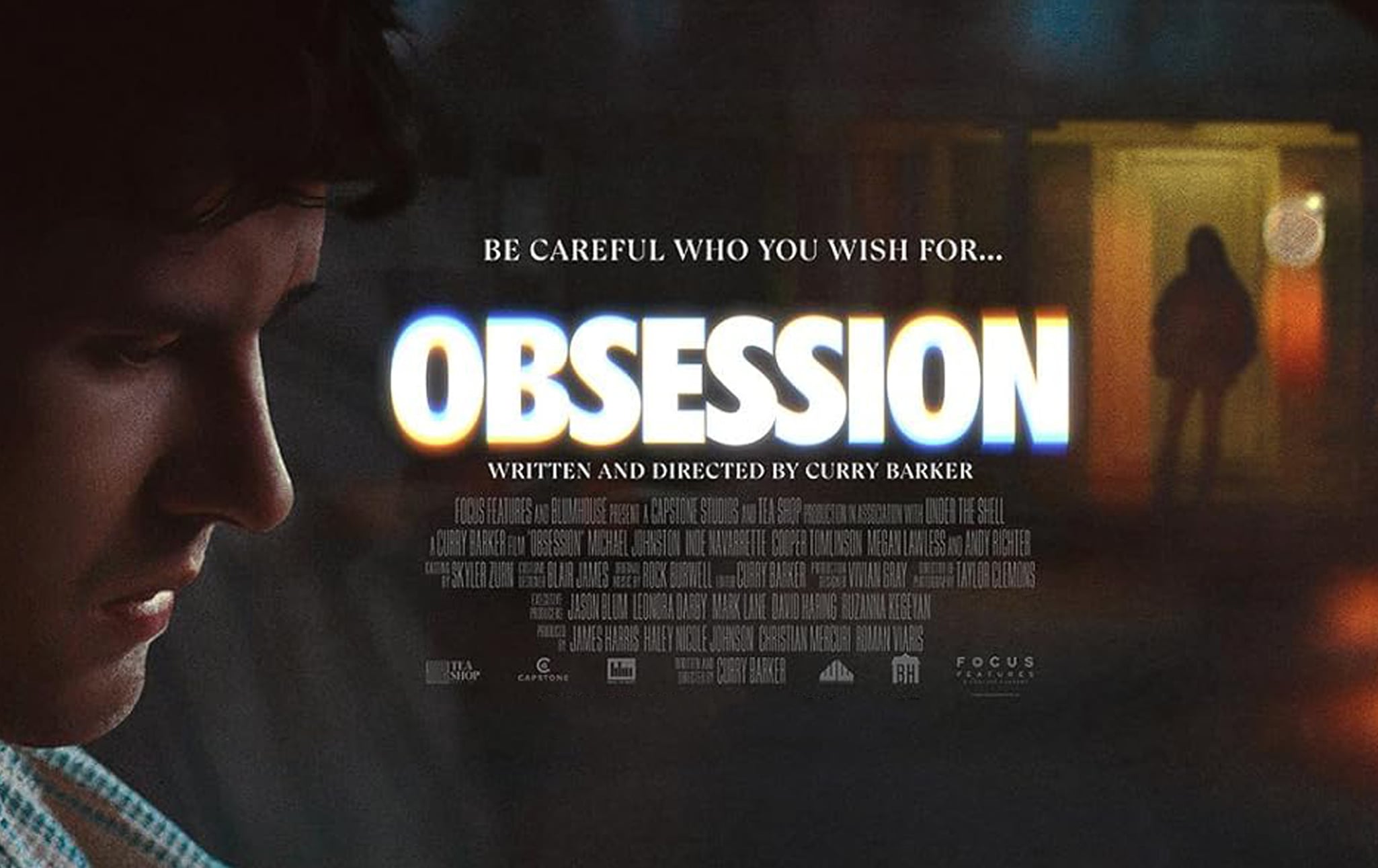
In director Curry Barker’s hit indie horror film, we can see the fundamental ghastliness of consumer society.
What would you do if you could get anything that you ever wanted? Not through some act of blood-soaked violence, but simply through the force of your desire. What if you could manifest it, just make a wish for that thing you really wanted more than anything else? What if all you needed to do was tap a button on a screen and any product you could think of would be with you in just a day? What would you rationalize and excuse away? You could do everything and anything you wanted, able to outsource your sense of responsibility or justice to an abstract and impersonal force, able to be a monumental coward and still indulge your own desire.
We’re all so good at this. After all, capitalism trains us to treat other people like things. It’s a process which goes by different terms. It might be “manifesting,” “self‑actualizing,” “getting what you deserve,” but the underlying logic is fairly consistent: your desires are central, and the world—plus everyone in it—are simply means to achieve the end you want.
This is the premise behind Curry Barker’s new horror film Obsession. A follow-up to his enormously successful 62-minute horror movie, Milk and Serial, it was made for a budget of around $1 million, and has, at time of writing, made approximately $209 million worldwide, wildly outperforming megabudget movies like the latest Star Wars slop, The Mandalorian and Grogu.

In times of capitalist crisis, horror film as a genre regularly sees a resurgence of critical and commercial success. They are, as Obsession proves, cheap to make, and even if a film is a critical pan they tend to offer a reliable return on investment. But they aren’t solely commercial vehicles. Horror films are also expressions of the inchoate and unarticulated anxieties and fears floating around in the collective cultural imagination. This isn’t to say that all horror films are just about one thing, or that interpretation boils down to getting the correct answer, but that horror films can be powerful, allegorizing forces. What we’re shown as something to fear is inevitably bound up within the social, historical and material context that the film comes from.
For all the discussion about the film as an example of indie or low-budget success, Obsession is also a horror film about the misogynist transformation of other people into objects. It literalizes the fantasy at the heart of contemporary capitalist individualism, namely, the belief that one’s desires are sovereign, that other people are not really people but instruments. For the good capitalist subject, all other people are simply objects in the most literal sense of the word.
The Hungarian philosopher Gyorgy Lukács, writing a little over a century ago, talked of workers subject to the power of the commodity form. For Lukács, what was horrifying was not just the total dominance of commodity exchange, but that market logic has sunk its way deep into our sense of self. Workers had to sell themselves, their labor power, as if it were a commodity like any other. As Lukács wrote in 1923’s History and Class Consciousness: “[Our] fate is typical of society as a whole in that this self-objectification, this transformation of a human function into a commodity reveals in all its starkness the dehumanised and dehumanising function of the commodity relation.” If that were true in the 1920s, Obsession shows the horror of that commodity relation expanding into every aspect of human social life, and the structural violence of entitlement to which it gives rise.
Obsession follows Baron “Bear” Bailey (Michael Johnston). He works a crappy job at the local music store with his friends, Ian and Sarah (Cooper Tomlinson and Megan Lawless). All three of them work with Nikki (Inde Navarrette, in the film's standout role). Bear harbours unspoken, romantic feelings for Nikki, spending his time stalking her social media and refusing to address his growing attraction, despite the urging of his friend Ian to stop making things “weird”. So far, so familiar—a tale of the pathetic misogyny hiding behind the veneer of the “nice guy,” who prefers an object of obsession to a reciprocal social relationship.
The twist is that Bear goes to the local occult store, ostensibly to find a gift for Nikki, and stumbles across the “One Wish Willow”—a little novelty toy that is supposed to grant you a wish. Selfishly, Bear decides to use it for himself. He wishes that Nikki would love him more than anyone else in the world. It’s an old story: the finger on the monkey’s paw curls, the wish is granted. It’s a good metaphor for capitalism, too: a machine, the workings of which are completely opaque but gives you more of what you want without ever requiring you to confront the humanity of the people affected. The problem is that Nikki doesn’t become what Bear wants. Her entire personality is rewritten through this occult magic, and to Bear, she appears as a terrifying, violent stalker.
Bear’s entitlementment and obsessive objectification are quite literal here. Both Lukács and his predecessor, Karl Marx, described the process by which social relations between people appear as relations between things. When the One Wish Willow is snapped, Nikki ceases to be a person with interiority, and so Bear doesn’t end up with the relationship he said he wanted. Instead, he finds her unsettling and difficult, needy and frightening. (At one point, she covers his front door in layers of duct tape to stop him leaving her side to go to work, for instance.) Post-wish, Bear treats Nikki as something closer to a malfunctioning product—something Bear “activated” and now wants to return because it’s not behaving as expected.
There’s a moment when he calls the customer service line (one of the best dark comedic beats in the film). Bear, well aware of the horrific exploitation he’s perpetrated, asks not if the wish can be cancelled or ended, but if it can be altered. The bored, almost deadpan voice on the end of the line tells him that the wish will persist until either he or Nikki are dead. Before the call ends, we hear Nikki screaming down the phone. In one of the bleakest scenes of the film, she gets a moment of lucidity and her “real” self comes to the surface. She begs Bear to kill her. Becoming a thing in someone else’s consumer lifestyle is a slow death, a literal stripping away of humanity and unmaking of self. Her horror is not that she becomes monstrous (in fact, some of the weakest moments of the film are the ones where she’s framed as nothing more than a horror movie monster, for example the admittedly stomach-churning scene with the cat), but that she becomes a mirror of Bear’s own objectifying desire.
After all, Bear never really knew anything about her. What he wanted was an object for his obsession, and so that’s precisely what she becomes, a funhouse reflection of his own toxic possessiveness—even to the point that Nikki, too, snaps a One Wish Willow to try and get Bear to become obsessed with her in turn. Bear doesn’t know very much about Nikki, and neither do we as an audience, given that the film is concerned mostly with Bear’s perspective.
However, it simply isn’t enough to say that Bear is a villain (though that is absolutely the case). His actions are a subjective reflection of a structural problem. Bear willingly makes Nikki into an object, not just with the magic of the One Wish Willow, but through a social logic that is incapable of understanding subjectivity outside of the idea of a means to an end. The toy doesn’t give him the idea to wish for her as a kind of possession; he comes up with that himself. For the post-irony fascist reactionaries like Andrew Tate and Nick Fuentes, who are resurgent with the second Trump presidential term, this kind of power and possession over women in particular is not only natural, it’s necessary and good and should be violently enforced. (“Your body, my choice,” as Fuentes nauseatingly puts it.) If they could make a wish to ensure it happens they absolutely would, precisely because they do not believe the women they encounter to be real people in the same way they are. The mainstreaming of the demand to revoke the 19th amendment and end women’s suffrage goes hand-in-hand with a broader reactionary turn in culture that Obsession brings into stark relief.

The film’s bleak insight is that the horror does not begin with the wish. In interviews, the film’s director has said it’s perfectly possible that someone might come up with a wish that doesn’t have negative consequences. Bear’s wish is simply the moment when the ideology structures at work become visible. Bear’s inability to imagine Nikki as a real person precedes the supernatural mechanism; the magic only strips away the polite fictions of his “niceness” that normally conceal this kind of thinking.
This is why the story resonates far beyond its occult premise. The entitlement that drives Bear is not simply an individual pathology but a political one. It is the same logic that animates patriarchal, reactionary capitalism, which openly celebrates hierarchy, domination, and the reduction of others to instruments. Obsession shows the horror of that worldview not through polemic—its characters don’t talk about politics at all—but through its consequences.
Perhaps this is the real value of horror at a moment like this. Collectively, we all inhabit a world in which we’re told that you are the only real person, that consuming things (and by extension people) is the highest good, and that ideas of interdependence are a political trick. Billionaire tech reactionary Marc Andreessen even thinks introspection about one’s own subjectivity is a waste of time, and right-wing Christian influencers will write whole books arguing that trying to think of others is an occult trick and mechanism for the left to politically disempower people. Ultimately, Obsession is a social horror for a world in which everyone else is disposable, leaving those who survive screaming among the blood and corpses utterly alone.
Jon Greenaway is a writer from the North of England. He is the author of Capitalism: A Horror Story and the co-host of the leftist media podcast Horror Vanguard.