
By not taking down a fake, predatory Alzheimer's cure, the company seems to have switched to the motto “Do be evil.”
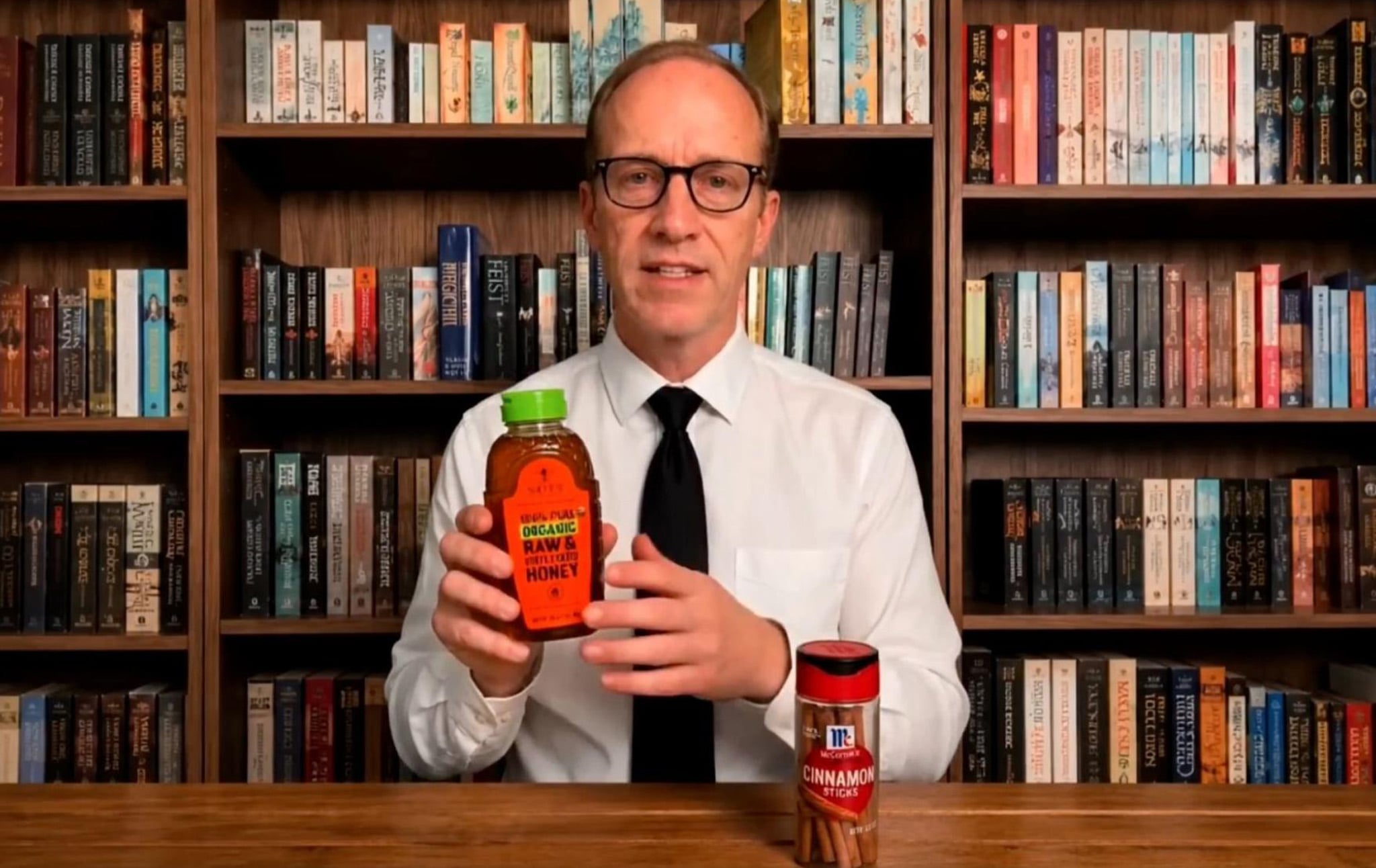
I’ve heard some wild claims in YouTube ads, but “The Pantry Find” still managed to make me do a double take. “If you’re a Christian, and you don’t know that the cure for Alzheimer’s and dementia is in the Bible, you should read the Scriptures again.” A bespectacled man in a white shirt and tie, looking something like a Mormon missionary, is sitting behind a desk with a bottle of honey and a pack of cinnamon sticks. Behind him are respectability-enhancing bookcases, although if you look closely the titles are garbled and AI-generated. The man goes on:
This drink, mentioned 27 times in the Bible, is said to be the reason why Israel is the only country in the world without a single case of Alzheimer's. I had no idea until I visited the Middle East, where some scenes from The Passion of the Christ were filmed. That's when I realized just how completely corrupted by greed the American Alzheimer's industry is. Why don't doctors tell you that Alzheimer's is one hundred percent reversible? They'd rather let people die than reveal this biblical drink that eliminates memory loss in less than seventy two hours. It contains three household ingredients that, when mixed the right way, put an end to brain fog and memory loss. There's a free video showing how to prepare this drink at home. If you're interested, just click the Learn More button.
He goes on about how Israel has totally eliminated Alzheimer’s with the “biblical drink.” (It hasn’t. There are reportedly around 180,000 people with Alzheimer’s in Israel.) He says that the pharmaceutical industry has conspired to conceal the secret. But fortunately “at least one honest man in this country is doing everything he can to make this solution known to Americans.” Who is the one honest man? Well:
His first name is Bill, and I'm sure you already know his last name. However, I can't mention it here because this video has already been taken down more than three times for that exact reason. He's the founder of the largest tech company in the world, and has been building foundations that are helping tens of millions of people[...] In a free video below, he shows step by step how to prepare this biblical drink. Do this every night before going to bed and see how your memory feels[...] I prepared this biblical drink for my mother, who was in stage seven of Alzheimer's. And today her memory is better than mine.
At this point I was curious: what do these people say the “biblical drink” is made of? Who is “Bill”? Is he really going to show me how to prepare the drink? How is this scam actually going to work? What’s the swindle?
And so I clicked. ThePantryFind.com has a landing page that promises a “a simple homemade honey ritual that may support memory and mental clarity.” The bottom of the page lists the company as MARKET AUTO EXPORT LLC, a used car dealership in Miami, which is also the company that Google’s ad transparency center lists for the ad. (Who knows if they’re really behind it, though.) If you click “Watch Now,” The Pantry Find takes you to a fake CNN news page, where a video begins to play showing an AI deepfake of Denzel Washington holding a jar of honey:
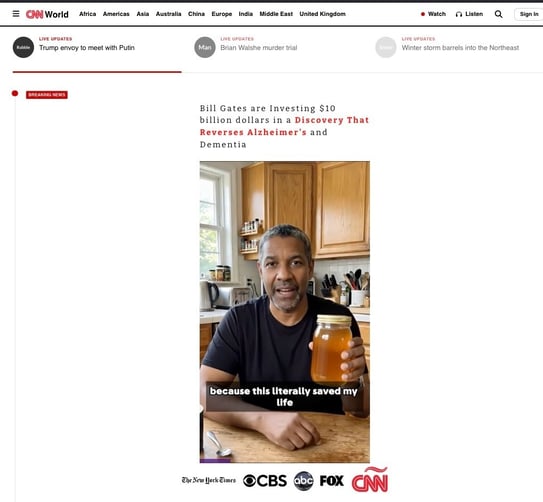
Deepfake Denzel explains that in 2025, he began suffering memory loss, which became more frequent until “I reached the point of turning down the lead role in the new Equalizer movie because I simply couldn't memorize a single line of the script anymore.” Doctors “said I'd be confined to a wheelchair, rotting away in a corner without even remembering my name.” But “at that moment of despair, after the news of my condition leaked to the media[…] Bill Gates reached out to me.” Gates told him that his foundation had “discovered that neurological diseases like Alzheimer's are in fact completely reversible” by "clearing away brain rust, a toxic crust that builds up on your neurons and blocks your memories.” The Gates Foundation researchers “identified a specific medicinal honey” that could “dissolve that crust and reconnect the lost links in the brain.” Deepfake Denzel says he started taking the honey, and voilà, he was once again a “completely lucid man.” He goes on for six minutes about how Bill Gates cured his Alzheimer’s with medicinal honey.
Now, at this point, you’re probably thinking what I was thinking: who falls for this rubbish? Most of us would have clicked the skip button when we saw Mormon Bob with his bottle of honey and his cinnamon sticks. The claims are so extreme. Alzheimer’s is “100 percent reversible” using three household ingredients? Drinking a special drink will cure it in 72 hours? It’s mentioned in the Bible 27 times and yet somehow nobody knows about this? But that raised the question: okay, if this is so laughably stupid, then why am I seeing it? Why is someone paying to show me this?
The pieces of the scam only fully fit together after I finished the full 54 minute video that starts with Deepfake Denzel. After Denzel goes on for six minutes about how he can finally remember his childhood thanks to Bill Gates, a (much less realistic) Deepfake Samuel L. Jackson comes on to make similar assertions, followed by a Deepfake Chris Hemsworth, followed by a Deepfake News Anchor Lady, who explains Bill Gates has been doing cutting-edge research (cue deepfake footage of Bill Gates looking at jars of honey in a lab). Then after ten minutes we’re on to the main act: Deepfake Bill Gates himself comes on and lectures for over 40 minutes, using a bunch of scientific-sounding jargon, about how he came to discover the cure for Alzheimer’s. Then at last, at the end, the pitch: if you click the button below and buy “Memocept” pills, you can have your mind back. It will be, Deepfake Bill says, the “most important step of your life.”
Imagine waking up and feeling clarity, a light, sharp, present mind. Picture yourself at the next family dinner, not just present but leading the conversation, telling a story from your youth with details that shock everyone. See the pride replace the pity in your children's eyes. Imagine your doctor's surprise when your cognitive tests improve after he said it was impossible. Life back in your hands, freedom, dignity. These two futures are real. They already exist. And what decides which one will be yours is the click you make or don't make at this very moment. And to show how much I believe in Memocept, what you're deciding is not a purchase; it's a rescue, a rescue of your identity, your dignity, your place in the world.
Now, Memocept is a real supplement, made with cheap, common ingredients (although not honey or cinnamon). It does not cure Alzheimer’s. There is no existing cure for Alzheimer’s. And Bill Gates’ staff has confirmed he has nothing to do with this. (The first landing page does have a disclaimer saying that they don’t promise the product will do anything, but the long video itself says directly and explicitly that your brain will be fixed within three days of taking Bill’s cure.)
Let’s dwell on what we have here, then, because I think it’s easy for those of us who are savvy enough to effortlessly skip through this kind of crap to miss the full implications of what’s going on. The scam is targeted at elderly, cognitively impaired people. It contains cues specifically designed to hook Black and religious viewers (Washington, Jackson, the “biblical drink” fakery). It has singled out people suffering from the horrific, debilitating experience of memory loss as its targeted demographic, and it has manipulated them through a cascading sequence of brazen lies and hoaxes into handing over their money in the desperate false hope that if they give this company their money, they will be able to remember their children’s names again. If they don’t give the company their money, Deepfake Bill warns:
If you let this page slip away, you already know the script that awaits you. It's the panic of forgetting your grandchild's face. It's the shame of getting lost on your own street, it's the look of exhaustion and sadness on your spouse's face.
This ad, this corny-looking piece of YouTube slop, is evil. They are finding the most vulnerable victims, exploiting their hope for a cure to their illness, and taking their money.
And they are being very clever about it. You may think this ad is “obviously” a scam. The fake CNN page is even headlined “Bill Gates are Investing $10 billion dollars in a Discovery That Reverses Alzheimer's and Dementia.” Not exactly professional-quality work. But remember: this ad is targeted at old people suffering cognitive decline.
And the whole thing is actually structured very skillfully. Remember, at the outset you were promised that “Bill” would be showing you how to mix up a “biblical drink” using household ingredients. Once you click through, he does not do that. He goes on for the better part of an hour with a bunch of pseudoscientific terms, and then tells you to buy some pills. But by that point, Bill has told you that unless you buy the pills, you’re going to bring shame to your family. You’ve forgotten the “biblical drink” and the honey. Interestingly, the link to buy the pills does not even come up until the end of the 54-minute video. Only the people most desperate for anything that will cure their Alzheimer’s will finish it. And the “conversion rate” of people who complete the video is surely very high.
When you watch the video closely, you’ll realize that there is a level of sophistication to it. Real footage of Denzel Washington is interwoven with the AI deepfake footage. There are a ton of heartstring-tugging clips of old people becoming confused, and hardworking scientists trying to discover a cure. (Wait, I thought the scientists were conspiring to keep the cure from us and the real solution was in the Bible? Ah, never mind!) Deepfake Bill sounds realistic enough to convince the kind of person who is a target for this. (Remember, Baby Boomers may be especially easy to fool when it comes to AI slop.)
That brings me to Google and YouTube. This is a criminal scam. Impersonating Bill Gates and telling people you have a cure for Alzheimer’s is fraud. The people who produced this should be in prison. And yet if you go to Google’s Ad Transparency center, you’ll find that this ad is being served up in hundreds of iterations. The video of it I found says it’s been watched 14 million times. (Who knows if that’s a real number?) Google is being paid by these people, meaning that Google is profiting directly off of the defrauding of the elderly.

Google/YouTube have been criticized before for allowing deepfake celebrity scam ads to proliferate across their platforms, with fake Joe Rogans and Taylor Swifts telling people about life-changing supplements or free money from the government. After external pressure, the company took down many of these ads. What’s interesting about the “Pantry Find” ad is that the YouTube video itself does not contain a celebrity deepfake. In fact, Mormon Bob says outright that he can’t say “Bill’s” last name “because this video has already been taken down more than three times for that exact reason.” But when you click through to the site, there’s a new video, not hosted by YouTube, containing a realistically-faked Bill Gates telling you that the only way to preserve what’s left of your mind is to send the contents of your wallet to “MARKET AUTO EXPORT LLC” (or whoever is claiming to be them). YouTube may have minimized the use of AI deepfake celebrities on the platform, but it’s clear that there are loopholes.
YouTube has resisted calls for it to vet ads before they go up, rather than in response to user complaints. When the Liberal Democrats in the U.K. said the platform should have to conform to the same advertising standards as traditional broadcasters, the company said "YouTube is not a broadcaster and should not be regulated like one” promising that “we have strict policies that govern the ads on our platform which we enforce rigorously." Nevertheless, the U.K. is planning to require platforms to block scam ads, which will hopefully at least help in Britain.
I think it’s clear that vetting is not being done by hand. The Pantry Find would never have gotten “on the air” if someone had manually clicked through to the site, where they would have immediately seen it was a deepfake scam. I do not know how many YouTube ads are scams, or dubious products, but Help Net Security says YouTube is riddled with fraud, in both the paid ads and the ordinary videos. Sandeep Abraham, a business security consultant, confirmed to WBUR last year that “scam ads on social media and YouTube [have] really surged in the past couple of years.” Meta has had the same problem, with scam ads targeting seniors reportedly netting Meta millions of dollars in ad revenue, and being successfully reposted even after takedown.
Of course Google could stop this if they wanted to. They could have an employee review every ad before it’s posted to ensure it’s not a scam, or at least every ad containing certain keywords (Alzheimer’s, for instance). Variations on the celebrities-endorsing-honey-for-dementia scam have been circulating since last year across platforms, so it would be easy to spot if ads were pre-screened before being shown to people. But that would be time-consuming and costly. Google has a financial incentive to be lax about this stuff. Policing it is resource-intensive, and they get a cut of the scammers’ profits. Of course, ideally the federal government would step in, but since the president himself is a con man who has gutted consumer protections, this is very unlikely to happen. Hopefully crackdowns in Europe will result in some better practices filtering over into the U.S. Perhaps left-leaning younger workers at the big tech companies could exert internal pressure on their employers to reform. I’m sure many of them are uncomfortable with the fact that even a fraction of their salaries are paid by scamming dementia patients. They need to step up and demand a genuine crackdown on predatory advertising and bogus claims on the platform.
The Pantry Find scam makes my skin crawl. When I think about the type of person this is meant to go after, I am saddened and enraged. I don’t know who is responsible, but I know they should be prosecuted. I also know that the scammers themselves are only part of the problem. These schemes proliferate in part because of tech companies that don’t even exert the bare minimum responsibility of keeping elderly and cognitively impaired people safe from online predators.