
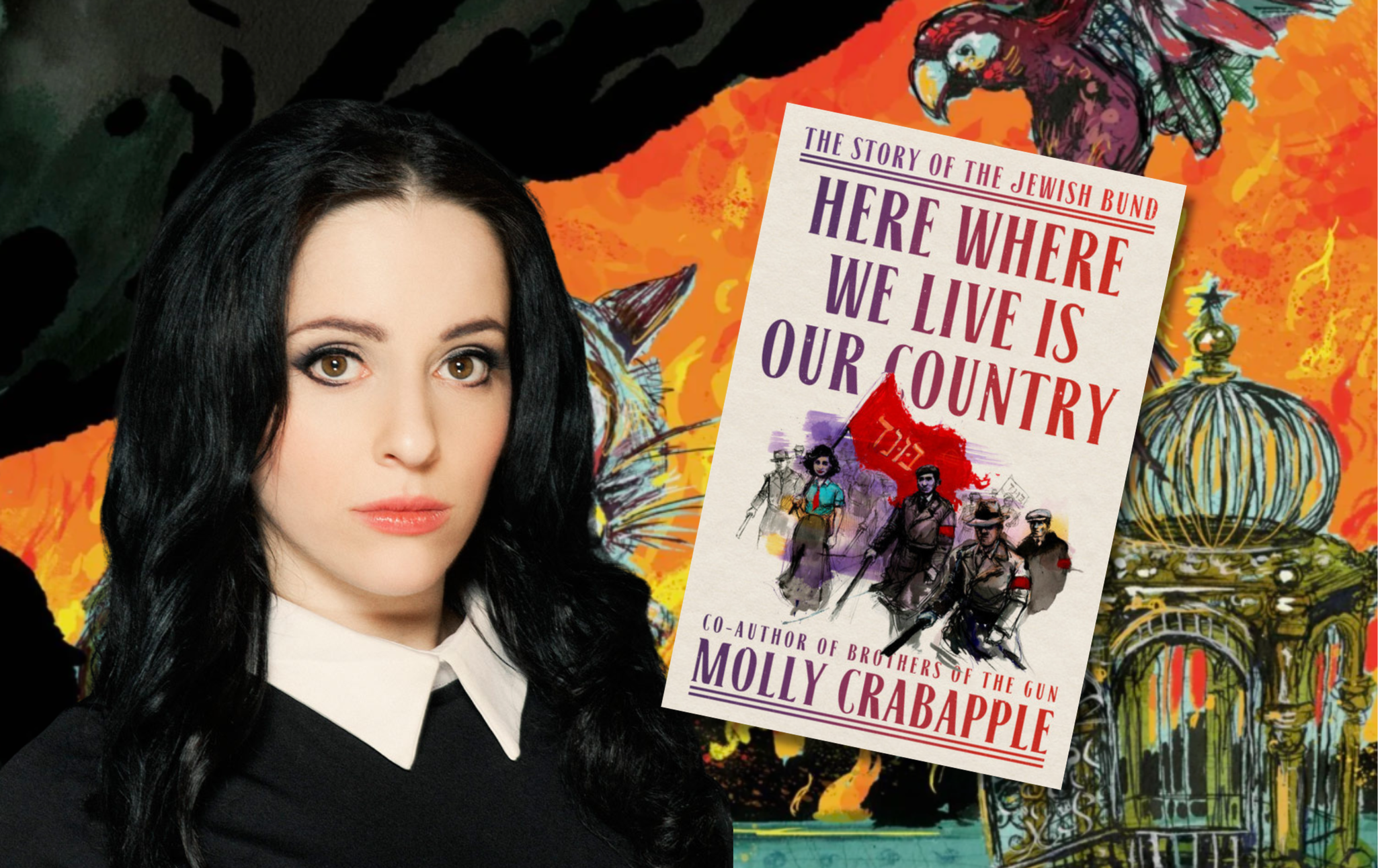
Molly Crabapple on the Jewish Left that History Forgot
The NYT best-selling author explains why a century-old socialist movement offers a powerful alternative to Zionism.
A
ward-winning illustrator and journalist Molly Crabapple has spent her career documenting revolutions and political upheavals around the world—or, as she puts it, "extremes from nightclubs to war zones." Her latest book explores a different kind of history: the story of the Jewish Labor Bund, the mass socialist movement that organized millions of Eastern European Jews around labor rights and cultural autonomy, alongside fierce opposition to both Zionism and antisemitism. Here Where We Live Is Our Country is now a national bestseller, resonating with readers in search of a forgotten tradition of Jewish politics. Current Affairs spoke with Crabapple about why the Bund's history feels newly relevant today, and why excavating this neglected past has become, for many readers, a source of hope.
Nathan J. Robinson
Okay, Molly, we're going to talk about this book. People might wonder: how did a history of a long dead early 20th century Jewish socialist movement make the New York Times bestseller list, and why? Usually historical tomes about such movements do not capture public popular attention like that. So, to start, you say in the book that you realize that as you were digging into this past that it was relevant to our present. What made you dive into the history of the Bund?
Molly Crabapple
Man, I have been working on this book for the past seven years. It has been my sick obsession, and even before I was working on the book, I was working on an epic piece for the New York Review of Books that was the most popular thing I've ever written. And I suppose there were two things.
The first is more personal. I grew up completely obsessed with my great grandfather, Sam Rothbort. He was a painter. He taught my mom how to paint. My mom taught me how to paint. I always thought the very fact that I could exist as an artist was a gift that I had inherited from him. And in addition, he was a character. He was a bohemian. He was a moral vegetarian in the 1930s who went bankrupt keeping roosters alive at his no-kill egg farm in the Catskills. He was someone who took back his paintings from the Brooklyn Museum because he didn't like where they hung them. And it was from him and his story that I learned about the Bund, because it turned out the reason that he was so different from the sort of man that his upbringing, where he was born, would have suggested. When he was in his late teens, he joined a Jewish revolutionary party called the Jewish Labor Bund, and I discovered the Bund because he documented this party in a series of watercolors that he called memory paintings, including one that enraptured me. It showed a young woman throwing a rock through a window with her boyfriend holding more rocks.
So that was the personal thing that set me on this. But the more political catalyst—the reason that this went from an obscure family interest to the subject, first, of this big New York Review of Books piece, and then of my life's work for seven years—was that I went to Palestine in 2015 as a guest of the Palestine Festival of Literature. And on that same trip I went to Gaza and reported from there in 2015 for Vice. I don't think any person who's been to Gaza who has heard the drones, felt the prison-like claustrophobia of the place, seen the neighborhoods that Israel vindictively, sadistically destroyed block by block can feel anything but rage and contempt for the Israeli state and for Zionism, the ruling ideology of the state. And so I had come back from Gaza, and I was doing one of my vices, which was getting drunk and going down Wikipedia rabbit holes. I'm sure no one recording this podcast has ever been guilty of this. And I learned that the Bund, in addition to being an underground anti-Tsarist organization, socialist, and the sort of organization that led pretty young women to throw rocks through windows at night, was also an anti-Zionist organization, and that struck me as interesting. That I think was the key that launched this from drunk Wikipedia rabbit holeing to getting really, really obsessed and making this the object of my love and research and madness for so many years.
Robinson
Because obviously we hear a lot today from Israel's defenders that anti-Zionism and antisemitism are, if not the same thing, at least very closely related. That criticism of Israel's right to exist as a Jewish state is the denial of the Jewish right to self-determination. But one of the things that's interesting about the Bund is that they have a very different conception of what it means to have Jewish self-determination, and it isn't the establishment of an apartheid state in Palestine, but it is nevertheless still proudly grounded in Jewish culture and identity. So tell us a little more about the Bund's vision for how you could live as a proudly Jewish community without committing yourself to the Zionist project.
Crabapple
The Bund comes out of the Tzarist Empire, which was probably the most wretched and miserable place to be Jewish in the world in 1897, the year that the Bund is born. It's a place where being Jewish is not just a matter of private belief. You are a racialized minority; it's on your passport. It determines where you can live, what jobs you can do, how long your term of military conscription is, and whether you can go to university. There's a whole straitjacket of laws that are meant to smother your life if you're Jewish. And in addition, it's a place where your fellow subjects of the Tzar, your Russian or Polish citizens, there's a lot of racism against you. You are viewed not just as someone who happens to have different religious beliefs, but as a fundamentally different and alien ethnic group that doesn't belong there.
And so the young Jewish Marxists that formed the Bund had three things that they wanted: they wanted to overthrow the Tzar—get rid of the hemophiliac autocracy; they wanted democratic socialism; and they also wanted their own specific liberation as Jews—their right to live dignified, proud lives in the land where they had lived for a thousand years, and their right to do that in their native language, which was Yiddish. And a lot of this was reacting to the fact that the Bund came up in one of these ultra diverse, multi-ethnic empires that was common at the time, just like the Habsburg Empire or the Ottoman Empire. These were places where you had these super mixed cities and towns, where you had people who spoke a bazillion different languages had many different religions, cultures, and ethnicities. And the Bund looked at that and were like, if you try to untangle this, if you try to have a bunch of wars of independence, this is just going to be partition and mass ethnic cleansing—this is going to be mass bloodshed because everyone is living next to everyone else.
So instead they were like, what if instead everyone has the right to have schools and print newspapers in their own language, study, go to university, have theaters, and represent themselves in court? All the things that I, as a New Yorker, have the right to do now. The Bund was like, what if everyone had that, but no one has to leave and go to an ethnostate, whether that ethnostate is in Poland or in Palestine? And this is an idea that is so basic and speaks so much to how people live now in New York City, my hometown, that it should not have been as wildly radical as it was, but unfortunately it was an extremely radical idea at the time.
Robinson
Yes. Well, of course, in the United States, there was a small kind of Back to Africa movement, but then there was a civil rights movement that was the mainstream that said, “Well, excuse me, we have the right to live here; we're part of this polity, and we demand to be to have our culture and liberties respected.” And that seems to be the kind of approach that the Bund took.
Tell us a little bit more about what their critique of Zionism was, because obviously you can clearly understand the appeal of Zionism in early 20th century Eastern Europe. So why was it that the Bundists ended up so fiercely opposed to it?
Crabapple
Well, they had a few reasons. The first one was that before the Balfour Declaration, Zionism sounds like a crackhead fever dream. This is the idea that millions of people are going to leave their homes to move to the Levant, which at this point is a territory run by the Ottoman Sultan, and they're going to become collective farmers. This is a very batshit idea. There are many reasons why this is a very batshit idea, and in fact, they thought this idea was so batshit that they were like, “This isn't even a serious idea; this is an idea that is being proposed by the Jewish bourgeoisie to make up for the fact that they're paying us shit wages—starvation wages—over here.” You know the way that really rich people now will set up some like little NGO charity to launder their reputations to hide from the fact that their own workers are paid so little that they all have to be on Medicaid and pee in plastic bottles? It's the same dynamic. Philanthropy laundering is an old tradition among the wealthy. So that was one reason.
But a stronger reason, and a moral reason, was that the Bund came up in a society where very powerful forces said that Jews were malignant, swarthy oriental foreigners who ought to dick off to somewhere else, whether that was hell or Palestine, whatever. And so they look at Zionists who are saying, “Jews are foreigners! Jews should dick off to somewhere else!” and they see in them allies of European antisemites and bigots. There's this line—I always remember it. It's in a Bundist pamphlet in 1901 where they say, “We are not strangers here and not guests, even though the Russian government considers us as such. This land is soaked through with our blood, and we will stay, and we will fight for that which belongs to us, for our human, civil, and political rights.”
And when I hear that, I hear the words of the great Paul Robeson, when he was being forced to testify before the House of Un-American Activities Committee, where he said, “I am not a stranger here. My ancestors' land built this country, and this is my country.” They rejected the idea that because of their race or ethnicity that they were foreigners. And furthermore, I would say, like with the movement for Liberia in America, the biggest supporters for Liberia were always white supremacists; they were always people who could not imagine living alongside free Black people. And I think that you would see the same thing. There was just this real history of Zionists of all stripes working with incredibly antisemitic figures and governments in Europe.
Robinson
Yes, it's a fascinating and kind of under-discussed point that in the core Zionist idea of leaving and building a Jewish state in Palestine, there is an implicit acceptance of certain antisemitic assumptions about what Jews are and where they belong, and a sort of agreement with, yes, we are an alien presence, and as you say, we should leave. There's always been in Zionist and then Israeli culture of this kind of contempt for diaspora Jews.
Crabapple
Absolutely. There's a term for that in Hebrew. I'm not going to try to pronounce the Hebrew, but it means “negation of the diaspora.” You read stuff by Vladimir Jabotinsky—he was the founder of Revisionist Zionism, a fascist, and the ideological granddaddy of today's Likud party—he has this famous paragraph where he's talking about the Yid, to use a slur, that was used for Jews in Europe and the Hebrew, and he's like, “The Yid is cringing and disgusting and is afraid of everyone and is cowardly and crawling, whereas the Hebrew is beloved by everyone and big and strong.” And you see that the creation of the Zionist man—a man, usually—is always put in direct contrast with the weak, effeminate diaspora Jew,
Robinson
Yes, Eli Valley does these great comics, “Israel Man and Diaspora Boy,” where he makes this contrast in these images. We've interviewed him about that. Tell us a little bit more about how the Bund went about organizing. You told us a little bit about where they stood ideologically: for democratic socialism against Zionism for this principle that you fight for your rights in your place. So they're faced with this hostile political landscape, but they're organizers. So, what do they do?
Crabapple
They are a very intensely practical group, and I want to talk about where they came out of. So, the people who founded the Bund are people like Pati and Arkadi Kremer, John Mill, and Liuba Levinson. These are young Russian-speaking Jewish Marxist intellectuals, and at first, before they found the Bund, they do the same strategy that all the other Russian revolutionary groups are trying to do, which is—and tell me if this sounds familiar—found book clubs, and if you found enough book clubs and study circles, the theory went, and you could get the workers to go to the study circles, then the workers, when they were educated enough, would form their own book clubs, and then more workers would go to the book clubs and study circles, and then eventually… revolution. That was how the theory went in the early 1890s. The Bund tried that for a few years, and they had very popular study circles and very popular book clubs in Vilna.
But they realized, I think, the way that most would-be revolutionaries realize now. That the book-club-to-revolution trajectory is not a straight line. So, what they started doing was, they started looking at what Jewish workers were already doing, and it turns out that Jewish workers—I'm sorry, it turns out workers, full stop, don't need revolutionaries to tell them that their hours are too long and their pay is too little. It turns out that this is a very basic realization. And so workers were already organizing rudiments of a trade union movement in the Pale of Settlements. And so what the people who founded the Bund would do was they were like, how about instead of book clubs, we start using the resources we have—our fundraiser networks, our international connections, our literacy, our ability to have printing presses, and our knowledge of law—and we start organizing alongside these workers for the things that they want, like an eight hour day, for instance, or better wages.
And the idea was that in a country as savagely oppressive as Russia, you don't need to tell workers about freedom of speech or free association or those rights. The mere fact of organizing a union and then being oppressed for organizing a union would teach you experientially that you need free speech and free association. The idea was that workers would build their power through organizing, unionization, and strikes like a muscle, and that this would be where sort of the revolutionary class was forged through labor organizing. And that was really where the Bund comes from. They are hardcore labor organizers. They are also people who are not segregationists; they're not people who believe in separating themselves out from the larger Russian or Polish world. The Bund was formed in 1897 not to be an independent party, but to be an autonomous part of a group that's formed later that year, which is the Russian Social Democratic Labor Party. They saw themselves as part of a larger revolutionary movement that would encompass everyone. And the reason that they thought they needed an independent Jewish movement is that as a small minority they needed to look out for their own rights, because larger society might ignore them, sell them out, and just forget about them.
And in terms of what they did, in Tzarist Russia, they organized libraries and underground schools. They had illegal pamphlets. I have a character in the book who smuggled pamphlets taped to her body to look like a pregnant belly. They tried to organize military mutinies. They set up soup kitchens and mutual aid. They would take over synagogues and have speeches and debates. And especially they would organize self-defense, because whenever a government targets a minority, that gives permission for all sorts of freelance bigotry and violence and racism. You see this now with these fucking pogroms that are happening in Belfast. These are the results of Islamophobic incitement by people in power.
So the Bund excelled in anti-pogrim self-defense, and just this mere act of Jews defending themselves was such a break from the traditional submissiveness—from the traditional matter that we're like Jewish authorities with bribes to Russian government authorities to avoid violence. This was an assertion that we deserve to be here. We are equals. And when the revolution of 1905 kicks off, and when it sweeps over great cities like Łódź, which was the Polish version of Manchester, or like Odessa, which is famous because of the battleship Potemkin, the Bund was on the front lines. They were the people who were leading barricade fights, their street orators were inciting crowds, and they were organizing alongside Russian, Polish, Ukrainian, and German workers for the overthrow of the Tzar and for socialism.
Robinson
Now that militant self-defense that you're talking about is another refutation of a kind of core piece of Zionist and Israeli mythology about history that has been used to justify Israel's brutality, which is the idea that the Jews of Eastern Europe in the years leading up to the Holocaust went like “sheep to the slaughter” is the famous phrase, and that now Israel represents a kind of Jewishness that defends itself against external aggressors. But what you point out is that by excavating the history of the Bund, we can see how you can have Jewish self-defense and pride without having the kind of fascist ideology and mythology that was encapsulated in Israel.
Crabapple
Absolutely. Especially when, after the 1917 revolution, the Bund is basically booted out of Soviet Russia, like so many other socialists who oppose the Soviet project, and they really reached their height in independent Poland. And in those years they have a legendary militia that defends their community in Warsaw, led by this scar-faced bruiser named Bernard Goldstein, who I wrote about a lot in the book, and they are doing physical defense with guns and with brass knuckles of their communities. They're also using strikes, including general strikes, to defend their community. They are an utter refutation of this disgusting idea that diaspora Jews, Eastern European Jews, were weak, and that's why they were murdered. And I just want to say, also, talk about victim blaming: this idea that because people were murdered, they were weak, is really brainbroken and disgusting.
But no, the Bund believed that you could fight for your rights while also fighting for what they called the better and more beautiful world, alongside other people who were different from you—that your self-defense was not in contradiction with the human demand of solidarity.
Robinson
But you have your critiques of choices that were made at various points. One of the things that you do is you treat people in your story as human beings who made decisions and who had flaws and virtues. You say, “The Bund had accomplished many things in the area of mutual aid, cultural production, and armed self-defense, but there was one thing they'd neglected: the necessity of taking power.”
As you look back on the Bund's story, which is in many ways inspiring, are there points at which you think, but they should have done X differently?
Crabapple
Oh yes, of course, especially in the early years. So the Bund is the largest part of the Russian Social Democratic Labor party, which is the party which, through various twists and turns, will eventually become the Communist Party of the Soviet Union, though without the Bund. And in 1903 Vladimir Lenin, who is a longtime OG Bund antagonist, successfully bullies the Bund out of a party that they helped create, despite the fact that the Bund has 30,000 members and the rest of the party has 5,000 members, but he's able to do this through various parliamentary skullduggery.
And there's this real moment where the Bund has an opportunity to stay in a room where their position is compromised, where they're dealing with someone that they loathe, where it sucks in a lot of ways, but they still have the opportunity to wield power if they stay in that room. But instead they leave because of principle, and they cede their power, and they clear the floor for Lenin's faction to take over, and to, in fact, take the term “majorityite Bolshevik” for themselves. And they do the same thing in 1917 when the Bundist Henryk Ehrlich leads a protest march out of a Smolny Institute after the Bolshevik seizes the Winter Palace. They have a real tendency at certain moments to cede power based on principle, and in some ways I respect that. I think that's also why they've remained quite a morally pure group, but in other ways, it's fucking suicidal.
And the more I wrote this book, and the more that I also lived—this took seven extremely tumultuous years—the more I became convinced that we on the left have to take power, because if we don't take power, then our enemies take power, and then they shoot us in the face like they shot Alex Pretti and Renée Good. It's not a principled thing to avoid taking power. That's the thing: it's not a principled thing, because you have to defend your people, and you have to hold back fascists. So that's my view.
Robinson
Well, that gets me to what I think is a very important debate that is had over your book. You have successfully inspired a lot of young anti-Zionist Jews. You have also irritated a lot of Zionists with this book on the internet. And what I noticed in reading these comments is that most of them articulate some variation on one single point, which is, they say, But the Zionists were proven right by history. What they say is, Look, there was an argument in the earlier 20th century. Bundists were saying, 'Here where we live is our country.' Zionists were saying, 'No, they're going to kill you all. You need to leave and to find some place. We found Palestine. Yes, okay, there's a few people there, but we'll get rid of those people.'
Which, of course, is monstrous, but they say it's in the service of the greater good, that is to say, the survival of the Jewish people, and they have their arguments. And they say, Well, now we're going to look back over history and we were correct. The Holocaust happened, the Bund was destroyed. It was a horrific tragedy, but if the Bundists had listened to the Zionists, some of that tragedy could be averted. That's what I see over and over in the responses to your book. So, I'm sure you've thought about this a great deal. How do you respond when people say that?
Crabapple
So that's a very steelman version of that argument.
Robinson
Yes, they're usually not as articulate as that.
Crabapple
No, they should be so lucky as to be as articulate as that! So there's two things. Is Eastern Europe too fucking racist for Jews to live in the early half of the 20th century? That's one thing. And there's, should we create an ethnostate in Palestine where we ethnically cleanse 750,000 Palestinians, burn villages, and do massacres? Those are two different things. There's different ways that I would pick that apart.
The first thing is that often what they say to me is, “Bundists died; Zionists lived.” But the truth is that hundreds of thousands of Zionists were also murdered in the Holocaust. In the Holocaust, six million Jews were murdered with every single kind of politics and no politics. It had nothing to do with your politics. The second thing that I would say would be that the reason that the Yeshuv, as they call the Jewish community in Palestine, survived the Holocaust is not because of their military prowess. In fact, they contributed far less to the war effort against the Nazis than the Jews of either the Soviet Union or America: 550,000 American Jews fought the Nazis, 500,000 Jews from Soviet Union, and 30,000 Jews from Palestine.
So it wasn't because of anything they did. The reason that they were safe was because it was a British colony, and the British—not the Yeshuv; the British—stopped Rommel at El Alamein in Egypt. And if they hadn't stopped Rommel at El Alamein in Egypt, then the Holocaust would have taken place in Palestine as well, and they would have all been murdered. There was no plan to avert that. So, I think that's a very important thing. It's something that's absolute contingency, and I also think it's important to note that if there had—well, there couldn't have been in Israel for various structural reasons. There couldn't have been in Israel before the Holocaust.
But let's say a wand is waved and magically it's granted. That Israel would not have been able to defend itself against Nazi Germany any more than Poland or France was. The Nazis were the greatest war machine that the world knew up until that point. They fought the Red Army back to the suburbs of Moscow. The idea that a tiny little country filled with Jews could have protected itself from the Nazis is inane. It's goes against everything that we know, and I don't even know how such an idiotic thing is believed. The thing is that what actually happened is the Nazis needed to be defeated, and that took the efforts of the entire world. It took millions of men from the British colonies, 20 million dead Soviet citizens, and the entire industrial might of America. Zionists had a pretty developed power state in Palestine by the time the Holocaust kicked off, and they didn't prevent the Holocaust.
So I think that there's a little bit of misunderstanding of history and of projecting inevitability onto what's really contingency. But in terms of, “Was Poland too racist for Jews to build a future in?” Polish nationalists murdered 1,000 Jews after the war. The Polish interwar government by the end of the '30s was savagely racist. After Marshal Józef Piłsudski, who founded modern Poland, died, his government was taken over by empty-headed military men who were using racism as a rallying principle to get over the fact that they had no idea how to fix the economy—something we would never see today; something that has no modern relevance. And they spent the four years that they were in power before the Nazis invaded trying to convince England and France to let them deport 3.3 million Polish Jews to Madagascar or to Palestine. This is the level of psychopathic racism. They funded terrorist youth paramilitaries and introduced racial segregation to universities. So in that sense, do I think that Eastern Europe was extremely racist? Yes. Anyone who looks at the history of the early 20th century knows that. But it's more that I don't blame people for fighting for their existence in an extremely racist society. I don't blame them for fighting for their civil rights. I blame the racists. I blame the murderers.
Robinson
Yes, and I think what you're saying about historical contingency is a really important point here because it means that just because you lost does not mean that you were wrong. If Hitler had successfully invaded Britain and slaughtered every Social Democrat, every member of the Labor Party, in Britain, you could say afterward, “Well, we should have all become fascists. We should have all joined Oswald Mosley because then maybe he wouldn't have killed us.” But that doesn't prove that you should have become fascist. It just proves that you lost.
Crabapple
Exactly.
Robinson
The right thing to do was still the right thing to do, even if you were facing an overwhelming force that you couldn't ultimately defeat.
Crabapple
Absolutely! And also victory and loss are temporary. There was a moment where the Soviet Union was a fact; it no longer is. Empires fall, governments crumble. And it's always been a project of authoritarians and fascists to pretend that their rule is both inevitable and eternal, but it's not. And then when you judge and look at it, you're like, “Were they right? Were they wrong?
Robinson
But I like that you separated these two questions. You can have the argument about if Eastern Europe too racist to accommodate Jews, and then they can argue that the Bund was wrong about that. We could say, well, Hitler wasn't necessarily going to rise for power, etc. But, as you say, it's an entirely separate question that gets conflated. The Bundists were clearly right about what ultimately became Israel.
Crabapple
Exactly! They saw that it was fascist immediately! One question would be if it would have been better individually for Jews if they moved to New York. Yes, my family lived because they moved to New York. Obviously. That's true. But that's totally different from, “Should we make a genocidal ethnostate built on our racial supremacy and mass ethnic cleansing?” Those are different questions!
And Bundists saw from the very start that if you built a Jewish state in Palestine—I'm going to quote Henryk Ehrlich here, who's the leader of the Bund in interwar Poland. He has this line where he's like, “A Jewish state in Palestine would find itself in a state of eternal war with the external enemy (Arabs), of eternal struggle for every scrap of ground and land and work with the internal enemy (Arabs), and an eternal battle for the destruction of the language and culture of the non-Hebraized Jews of Palestine.” And he asks, “Is this a climate in which freedom and democracy will grow, or is this a climate in which reaction and chauvinism flourish?” And look at it! Look at a fucking place where ministers are having birthday cakes with nooses on it to celebrate their racially exclusive death penalty law. Look at that and say, was Ehrlich right or wrong?
Robinson
And ultimately, was that project good for the future of Jews? Israel claims to be a haven for Jews, but the way Zionism is constructed has guaranteed this eternal fight, this moral depravity. I was just reading the memoirs of this journalist who went to Palestine in the 1920s as a Zionist, met Zionists, and then saw it unfolding. He said, “Nobody who cares about the future of Jews could believe that this is a good idea.”
Crabapple
No, and also ethnic cleansing was built into it. That's the thing. There was no way to get a Jewish majority state in Palestine, a place that was in vast majority Palestinian Arab, without ethnic cleansing. The ethnic cleansing was inevitable, and that is a foundational crime. And everything that happened after comes from these attempts to basically cover up and deal with that foundational horrific ethnic cleansing. That was built into Zionism. It's something that Ben-Gurion always wanted. I think the real thing is that the Western world—and I don't just say America. There's plenty of countries in the West that rejected Jews. Canada took 3,000 Jewish immigrants during the war. Canada is nothing but fucking empty space. There's no reason. Brazil, Mexico, Argentina, Australia—all sorts of countries around the world severely failed at their basic obligation of solidarity towards refugees.
But I often think, what if the energies had gone into lobbying for the lifting of these immigration quotas? What if that's where all of this passion, all of this sacrifice, all of even this money, and all this heroism even, had gone to pressuring America to let in refugees. It would have been something entirely different. And in my book, I quote David Ben-Gurion, who, in the year of the foundation of the state of Israel, says that "if America had opened its doors to Jewish refugees after the war, the vast majority would have gone to America.”
Robinson
There was a disturbing way in which, again, these points at which the interests of Zionism and antisemitism coincide, where the Zionist movement could say to the United States, “Well, don't worry, you won't have to take any Jews; just help them come to come here to Palestine, where we want them.” Regardless of what people actually wanted to do themselves.
Now your book has clearly resonated with a lot of people. When you did your event here, even though it was a pretty nasty day, the whole place was packed with space in the receiving room only. And so obviously people, like you, are also are interested in the subject. What do you think it is about this movement and excavating this history that has so resonated with people?
Crabapple
I think that for a lot of Jewish people, they're rejecting Zionism because it is a disgusting ideology that is based on supremacism and is doing a genocide right now, but they have not been taught about actual Jewish history. For the vast majority of Jews in America, that means Eastern European Jewish history. And so they have a sort of hole in them. I've had so many people write to me and tell me that they felt, because of this genocide, they couldn't even be Jewish because they were so ashamed of it. And they've told me that my book healed something in them because it showed them that they had ancestors they could be proud of. I think that there's such hunger to know about Jewish history that is liberatory, solidaristic, righteous, and tough. I think that's one thing.
But I also think that so many non-Jewish people also find themselves obviously repelled by this genocide, but they also have been so influenced by Jewish thinkers and writers. Certainly on the left, I think about the amount of people who were radicalized by reading Howard Zinn's A People's History of the United States, or the SDS (Students for a Democratic Society), or Karl Marx, or Emma Goldman, or the million things. So they also have this hunger to learn about Jewish history that is not tied up with a genocidal ethnostate. So yes, I've gotten angry articles in Tablet and The Free Press. Whatever.
Robinson
Well done.
Crabapple
Yes. And I've had all sorts of very angry social media posts saying I should cut off various body parts for Hamas. Well done. And people writing angry letters to venues. Whatever. I have not actually gotten any pushback that I consider threatening. So, the last group of people I made very angry were fans of Bashar al-Assad, and these people would come to my events and they would scream in my face and put my home address online. My door got broken down. Some pretty bad stuff happened. And so I was expecting something similar from Zionists, and nothing like that. It's been fine, actually.
And I say this because I want to say that this is very different from what my Palestinian friends have gone through. I've had so many Palestinian friends and loved ones who just, for the mere fact that they exist as a Palestinian, let alone what they say—just their existence—makes them a target for the most sadistic fuckery and cruelty, loss of career being one of the lightest things. And so I say this because if you are Jewish, you really can speak up on this. You're going to be okay. And the forces that support genocide are losing. Seriously take heart and speak up. That's what I want to say.
Robinson
Well, that's a good note to conclude on here. This book is quite extraordinary, not just for the depth of the archival research that you did. As you say, seven years and not leaving the library much for a lot of it, although you did travel a great deal and learned Yiddish for the project. But also just because—sometimes you spell it out explicitly, sometimes you don't—of the parallels with our present moment, and the ways in which you put us in the shoes of people who faced often many similar dilemmas in their time to what we face in our time, and you show us what they did and how they responded, and we get to think about how we would respond and act in the face of these circumstances. It's an extraordinary piece of work, and we thank you very much, Molly Crabapple. Thank you for joining us at Current Affairs.
Crabapple
Thank you so much for having me, Nathan. My pleasure.
Transcript edited by Patrick Farnsworth.

%20(crop).jpg?width=352&name=wile-e-coyote%20(resize)%20(crop).jpg)