
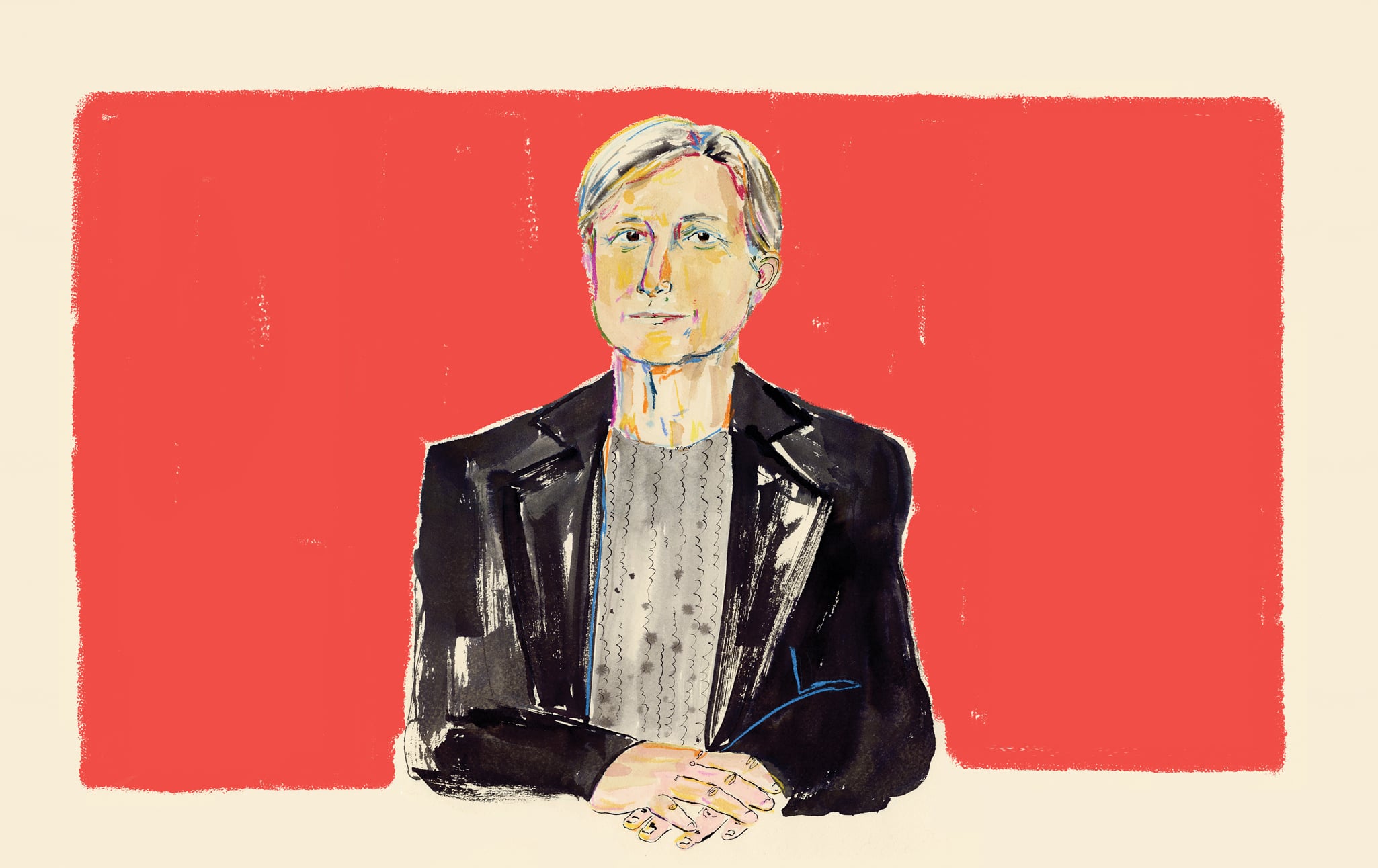
The leading scholar and philosopher responds to critics of “gender ideology,” both from the right and left.
Judith Butler is one of the world’s leading scholars and philosophers on issues of gender, sexuality, and the cultural phenomena that surround them. They are the author of the landmark 1990 book Gender Trouble: Feminism and the Subversion of Identity, and more recently the 2024 follow-up work Who’s Afraid of Gender? Butler joined Current Affairs editor-in-chief Nathan J. Robinson to discuss the way people around the world—mostly conservatives, but some who consider themselves leftists, too—have become fearful and angry about what they call “gender ideology,” why they’re mistaken, and what might be done about it.
Nathan J. Robinson
I want to start with a quote from your newest book, Who’s Afraid of Gender?, where you say,
In the United States, at least, gender is no longer a mundane box to be checked on official forms, and surely not one of those obscure academic disciplines with no effect in the broader world. On the contrary: it has become a phantasm with destructive powers, one way of collecting and escalating multitudes of modern panics.
Could you elaborate on what you mean by that?
Butler
Yes. Well, first of all, let me just say that I don’t consider myself the leading philosopher of gender, nor do I hold myself or my work responsible for what the popular discourse calls “gender ideology.” My sense is that gender ideology does not exist. It’s a way of abbreviating a complex field, a set of social policies and legal decisions. It’s a shorthand that fails to really explicate what is at stake but also produces something like an imaginary enemy, or a fictional unity of sorts that attracts a lot of anxiety and fear—some fascination and confusion. And if I track the way gender is being referred to in the media and in public discourse, it seems to stand for a whole host of issues, including reproductive rights, transgender or women’s equality, how to work with sports, questions of equality, inclusion, and DEI, and psychological understandings of what happens to boys and girls as they grow up and come to understand themselves.
There are so many different issues that get grouped together, and I suppose the word “phantasm” suggests that there’s a kind of dream image or a phantasmatic construct that has taken hold in people’s minds, and it’s called gender. But actually, gender is very complex. People have been studying it for a very long time, and there are conflicting views. And if we took a more sober and intellectual approach—a scholarly approach—to the issue, we would find many different strands and conflicts and interesting items there.
Robinson
I’m sure you’re familiar with the case that happened recently after the publication of your book, of the professor [Martin Peterson of Texas A&M University] who was prohibited from teaching a portion of Plato’s The Symposium because it violated the rule in Texas against teaching “gender ideology.” And I think there’s a very interesting example of the way that the right has seemed very clear on what it means, or has felt to itself like it is very clear on what it means, by prohibiting gender ideology. But then when it comes down to actually enforcing it, I’m not sure that a lot of them know, themselves, precisely what they mean by “gender ideology.” When you were writing this book, did you get a clearer understanding of what is meant by the effort to prohibit “gender ideology”?
Butler
Well, I think, unfortunately, when the right uses the term “ideology” they tend to think of a dogmatic position that’s being imposed by some people in positions of power, by teachers or by social policies, and they attribute to gender an ideological function, by which they mean both dogmatic and falsifying. So against the dogmatic, they say we should have an open and free discussion, including conservative views, on family and gender. Against the falsification, they think, well, we should be grounding all of our views on biological facts, although sometimes they say we should be grounding all of our views on Christian doctrine. So there’s a little bit of a tension there. And there are different variants of the anti-gender ideology movement throughout the world. So what we find in Taiwan is not the same as what we find in Uganda, for instance. However, in the case of the Plato censorship, what they’re actually doing is making a doctrinaire decision. They’re imposing a doctrine that says you should not have an open discussion on love and homosexuality, which is a feature of Socrates’ relationship with some of his interlocutors, and not an explicitly sexual representation, but certainly a representation of love between men. Now, in classical Greece, we accept that’s part of what was happening. We don’t need to negate that. We don’t need to deny that. And if we do negate or deny it, we are the ones, or they are the ones, who are acting in a dogmatic and doctrinaire fashion. So the irony is that gender is understood as a dogmatic doctrine, and the way in which it’s prohibited certainly suggests that those who are doing the prohibition are acting in a dogmatic and doctrinaire way.
Robinson
Now, much of your book is concerned with excavating or trying to understand the reasons why gender, or “gender ideology,” has come to loom large for these people and the reason for the fear. But I think many of them, if you asked them, would start with, “Well, before you can pose that question, you have to prove that we are wrong and that our arguments are false.” And certainly, I was reading Kathleen Stock’s very critical review of your book, and what she said was essentially, how dare you psychoanalyze us instead of refuting us? If we try and articulate what their position would be, [your critics] would say, “We are making the case that there is a view of gender as subjective that leads to all kinds of harms, and to the belief that anyone can change their gender at will.” She cited cases of children being given puberty blockers, trans women competing in women’s sports, and trans women being allowed to share prison cells with cisgender women, etc.—all the result of a view that essentially sees gender as subjective, a view that is wrong and a denial of reality. So, how do you respond first to that assertion?
Butler
Well, first of all, gender is not subjective, so her attribution is incorrect. Now, if I were to answer that question, I would have to allow for her attribution to be true, but I can’t do that without falsifying my position. So, first, gender is a framework that’s been developed through the social sciences. A framework is not subjective. A framework is a way of framing knowledge and a mode of inquiry. To the degree that we talk about gender norms in the world, we ask how labor is divided by gender—what are women making, as opposed to what men are making? We’re talking about gender as a differential of power. And I think we can say, yes, there’s lots of good sociological and economic analysis that has suggested gender is a factor in the distribution of wealth or the division of labor. Those are not subjective dimensions of gender. She seems to conflate gender, which is a much broader concept, with gender identity, which is the way in which different people identify. But she also makes a further mistake, which is to say that identifying with a specific gender is a merely subjective or volitional, freely chosen kind of act, like, “Oh, I think I’ll be this gender today; I think I’ll be that gender today.”
Now, the reason why psychoanalysis remains interesting to us in the year 2026 is that we often think we are choosing things deliberately, and we’re actually motivated by some other kinds of issues; we think we’re speaking rationally, but actually we’re maybe in a panic, or we have some wishes we wish to fulfill. And Freud was one of those thinkers who did ask us to reflect on the fact that much of what we think we are doing in a voluntary way is affected by other kinds of passions or anxieties or even unconscious elements that influence human motivation.
So I’m not a voluntarist. I don’t think people get up in the morning and decide what gender they’re going to be today, but I do think that we’ve been naive about how deep-seated certain notions of gender are. So, for instance, when a man says to me, as they have, and says, “Look, my gender is part of who I am. This is basic to me. Don’t tell me this is changeable. This is absolutely who I am.” You know what? The last thing I’m going to say is, “You can change that if you want.” No. I’m going to respect that person. He’s telling me something that is deep-seated. He doesn’t know all the reasons why, but that’s his passionate, fierce understanding of himself. And it’s like, go forth. It’s good. You know who you are, and you’re living in the world. But the trans person says, this is deep-seated—
Robinson
This is true for me.
Butler
This is so deep-seated. And I don’t know all the reasons for this, but this is who I am. I’m going to say, I respect you. Go forth.
Robinson
This is related to what is perhaps the most common misunderstanding of your own work, because you’ve become so associated with the term “performative.” People sometimes interpret that to mean that if gender is created by a series of actions, I could take different actions tomorrow, and my gender would change immediately. You talk a lot about J.K. Rowling in the book, and she makes the argument, well, what if a man felt himself to be a man for 40 years, and then tomorrow he decides he’s been a woman the whole time? And this is sort of based on a misconstrual of your own work, but you’re saying there it just doesn’t work like that. And this idea that you could change your gender by flipping some kind of switch in your head is just not how it works.
Butler
You can, maybe, in Hollywood; you can if you’re a performance artist. But look, performative is not radical free choice. It’s like I can be anything I want at any time. Hardly. I’m formed by culture, family, and religion. Oh, I’m so formed, but I’m not fully determined. Yes, I come out of this family and out of this background; this is what I was taught, this is how I’ve lived, and I’m deeply crafted and formed by social norms and historical circumstances and all kinds of psychic material I didn’t get to choose. At the same time, I live this life, make decisions about it, and decide what my existence should be like based on my deepest understanding of who I am or how I want to be in the world. So I don’t think we’re totally voluntaristic, like I can be anything, nor do I think we’re totally determined. And performativity is a way of naming that space between philosophical determinism and voluntarism. In other words, you’re affected by culture, and yet you also are remaking it. You’re making some changes in it, and it’s hard, and there are countercurrents, and what we call choice there is not radically free. It’s a struggle with an existing formation. And people struggle in different ways to revise their history—not make up a new history, but to find new ways of living in the midst of having been formed. That’s performativity.
Robinson
Do you detect in the anti-gender movement a kind of frustration with, or an unwillingness to grapple with, the possibility that reality is complicated and that common-sense categories and plain language don’t get us a true description of reality? There’s this documentary from a couple of years ago by one of these anti-gender people, Matt Walsh, called What is a Woman? His whole frustration was that people won’t accept the simple answer to “What is a woman?” He says it has a simple answer: “It’s an adult human female.” He goes around posing this question, and if you don’t answer it with a simple answer, he suggests you’re part of this terrible, destructive gender ideology. Could you respond to this idea that a question like “What is a woman?” should have, or needs to have, a simple, common-sense answer?
Butler
Yes. Well, I’m going to answer your question directly, I promise you, but I can’t help noting that the people who pound the table with “It’s a simple fact; we should have a simple answer!” are angry, insistent, and frustrated. Just look at what the emotional aura of that claim is, that we need a simple truth. Why are we so angry about that? Why do we need a simple truth? Well, complexity is frightening. Look at human endocrinology. Look at how testosterone is distributed among people assigned female or male at birth. You look at the complex interactions, as developmental biology does, between genetic and epigenetic factors and the different forms of masculinity and femininity that emerge, and then cultural differences—oh, my goodness. People who are very clearly women in one culture are absolutely not in another. Why is it we have different frameworks culturally for understanding that? Or, why is it that medical professionals also have to think about how to name people with mixed sexual attributes, intersex people, who make up a certain small but significant percentage of the population?
We are interested in that complexity because it is kind of interesting—we take for granted certain ideas, and other people are taking for granted totally different ones. How do we translate between those or come up with a more comprehensive understanding? How do we think about developmental biology in relationship to cultural anthropology and the humanities? I don’t know; I find that interesting. It doesn’t scare me, but for some people—[they want] no complexity. But human life is complex, and we are a complexity of factors that go into making who we are. So even if we’re unequivocally a man or a woman, how we live that gender, how we experience it, how we present it, and how we understand it will be complex. It’s why sometimes we don’t understand each other or make expectations of one another. It’s like, oh, but you’re a man; I thought you would like X. It’s like, well, I don’t like X. You’re a woman; you’re supposed to—well, I don’t like that.

Robinson
If a right-wing provocateur like Walsh poses the question, “What is a woman?”, do you think the right response is to dispute the question, or is there a satisfactory answer to that question?
Butler
Well, look, I asked the same question: what is a woman? Freud asked the question, what does a woman want? But you could also say, what is a woman? My own sensibility is to say it’s a great question. It’s wondrous. Let’s keep that question open, because you know what? There will be many different ways of answering, and those will give us access to human complexity. We’ll want to know more about the world, and we’ll be able to affirm the human in its complexity, rather than putting it into fixed boxes and smashing in those nails. So for me, “What is a woman?” is a great question, but I would just keep it open.
Robinson
When I saw the title of the documentary, I thought, you know where you should start if you really want to investigate that question is with Simone de Beauvoir, who was fascinated by this question of, how does one become a woman? What does it mean to be a woman? But one of the things you point out in here is that there is a very aggressive unwillingness to do the reading among many of these critics, a real hostility. In fact, you recount an anecdote about someone you met who came up to you after a talk and said they prayed for you. And then you asked if she read your work, and she said, “No, I would never read such a book.”
Butler
Well, it’s true. I think we have to think about book banning. We have to think about censorship, the new constraints being imposed on universities, the defunding or renaming of gender studies, sexuality studies, feminist studies, ethnic studies, Africana and African American Studies—all of this censorship and increased authoritarian incursion into educational systems, K through 12 and higher ed. This is of a piece with the anti-gender ideology movement. This is a movement that seeks to control knowledge, to suppress knowledge, to stop us from questioning, to attack Socrates, who taught us the absolute importance of open inquiry. All of higher education, we might say, is dedicated to Socrates and his way of opening questions and asking people to reexamine their assumptions about what is justice, what is beauty, and what is truth—not to become radical relativists, but to allow for a complex understanding and, quite frankly, a better set of judgments based on knowledge. But the anti-gender ideology movement is an attack on knowledge and an attack on open inquiry.
Robinson
It comes up repeatedly in this book that you can’t separate the attacks on gender from rising authoritarianism and fascism. You cite the right-wing pundit Michael Knowles in your conclusion, who said, “Transgenderism is false, and therefore it must be eradicated from public life.” And you hone in on that language of eradication, that if you don’t accept our definition of common sense and then speak in our defined plain language and accept biblical or biological truths as we define them, then you have no place in public life.
Butler
Well, I think that’s true. The Lemkin Institute, which is dedicated to genocide studies, has recently put out a statement saying that the attack on transgender people—their legal rights, their very existence—indicates a potentially genocidal project. They’re not saying that people are committing genocide against trans people, but they’re saying that the minute you deny the legal standing of a minority and refuse to acknowledge that they exist within legal and public discourse, you nullify their legal and public existence and withdraw social recognition. They fall into a kind of legal unreality, or nonexistence, that allows for their rights to be taken away, including the right to life. So I do think that there are those who would eliminate the category of transgender altogether, which, of course, abandons all transgender people to living lives that are unlivable and not being recognized according to the language and legal categories that allow for them to have rights in this world pertaining to their gender. So it is, for me, a very terrifying thing. To deprive people of health, rights of passage from one country to another, and legal recognition is to deprive them of all the rights that follow from being legally recognized as the person that you are.
Robinson
Now, I would like to ask you briefly about the category of critics who are often called trans-exclusionary radical feminists. People like Germaine Greer, for instance, would say, “I am a leftist. I am not a fascist. I am someone whose sympathies are with liberation movements, and my argument against trans people is that they deny the true nature of womanhood. They undermine the women’s rights movement by reinforcing a stereotyped notion of what it means to be a certain gender.” And they would argue this is a good faith and feminist criticism—it’s not a Viktor Orbán or Vladimir Putin criticism. You’ve been, obviously, deeply critical and suggested that movement, that posture, ends up aligning itself with these very hardcore authoritarians. How do you respond to their criticism?
Butler
Well, I think there’s just no question in my mind that Germaine Greer has been a great leftist and a great feminist. You would never hear me object to that. I think what puzzles me is why leftist feminists, in part, not in whole, have taken positions that do ally with right-wing authoritarianism, the same forms of authoritarianism that have denied reproductive freedom and legal protections for women. I think that trans women have always been part of the feminist movement. Most trans women I know are also feminists, and the category of women has been an expansive one. One question for me, especially for second-wave feminists, is, didn’t we learn that definitions of what a woman is have been far too narrow and sometimes biologically reductive? For example, women reproduce. Well, not all women reproduce. Not all women can. Not all women want to. Or, women have these kinds of values. Well, not all kinds of women have those values. Or, women belong in the private sphere. No, they don’t believe that.
So there are all these restrictive definitions of what a woman is. And my sense is that the exhilarating part of feminism is that it was and remains a freedom movement. That is to say, women can be all kinds of things, and we need to allow the category of women to be expansive. Now, that doesn’t mean it can include all things. I don’t mean to be silly about this, but trans people, and more broadly non-binary people, are subject to harassment, discrimination, and the restriction of rights that makes them potential and actual political allies with feminists. And we’ve always been allies. We’ve always been in favor of equality, against discrimination, trying to figure out how to live freely and how to live and breathe in the street, in the workplace, and in the home without fear of violence. That brings us all together. Why wouldn’t that just be the most compelling affiliation and alliance? We know too many stories about trans people who are assaulted on the street. We know too many stories about women who are assaulted on the street. The same people are doing those assaults. We need to band together to oppose femicide and the killing of trans, non-binary, or non-gender-conforming people. And throughout Latin America, the feminist movements have those alliances. And it’s been very surprising to me, especially in the British context, to see that those alliances have severed. There’s no good reason for it.
Robinson
We had Shon Faye on the program a couple of years ago and talked about how remarkable the anti-trans tendency in British feminism specifically is. And you have a chapter on Britain.
Butler
It is. And I agree with Shon Faye. We’ve actually spoken about this, that the British anti-trans movement within feminism is singular. I know no country in which it is as fierce as it is there.
Robinson
I’m sure this is a question that could have a book-length answer, but it intrigues me that briefly in your book, you discuss your own previous work in gender theory, and you say that you now find it “questionable in several ways, especially in light of trans and materialist criticisms.” I wonder if you could just briefly tell us a little bit about how your own views have evolved over the decades.
Butler
Well, 37 years ago, when I was actually writing Gender Trouble, I was deeply influenced by French post-structuralism and feminist theory. I was a bit lost in that academic world. And it’s still very interesting material, and I teach it and write about it, and it’s all fine, but it’s a narrow framework. Oddly, when the book started to get translated into other languages, I started to become aware of what’s happening in other parts of the world. So the translation of Gender Trouble made me much more worldly and exposed me to different kinds of scholarly work, feminist work, and activist work as well. That gave me a sense of how gender needed to be thought of in terms of the economy and geopolitical power relations—why the word sometimes works in certain parts of the world and sometimes cannot possibly work in other parts. So I think that I have much more of a transnational perspective. I think I needed to think more clearly about developmental biology and questions of materialism. Some of those early criticisms did incite me to rethink my position. I think that drag was a big moment in Gender Trouble. Many people took off from that, but it’s not the same as trans. That needs to be made clear. There’s a lot of work in trans studies that has been extremely interesting for me, also in law and in medicine. So yes, I’ve learned a lot. I think I’m a more interdisciplinary and transnational thinker than I was 37 years ago.

Robinson
Readers might be surprised when they open this book that it is not focused singularly or primarily on the United States Republican Party. Your first chapter is “the global scene.” You discuss Hungary, Taiwan, Uganda, and the Vatican.
I want to just conclude here by going beyond gender, because you do say that one of the problems with this anti-gender movement is a heightened focus on gender by the right deflects from the various social and political forces that are destroying the world as we know it. And you discuss in your conclusion the importance of the anti-capitalist struggle and broader freedom movements around the world. You yourself have been involved in pro-Palestinian activism, and I mentioned your involvement in Occupy with anti-capitalist work. Could you discuss the way in which that singular focus on gender takes us away from some of these other crucial areas of struggle?
Butler
Yes. One argument of the anti-gender ideology movement has been that gender is a destructive force and that it will destroy family, the environment, civilization, man, and all kinds of values that we hold dear. And I think making that argument appeals to people who are living with a fair amount of fear about what the future holds, whether their lives will be able to continue. They’re aware of ways in which their lives are torn apart or their economic well-being has been challenged, if not destroyed. Now, you could say “gender,” or “woke,” or “DEI”—that these are the things that are destroying our lives. But what’s destroying our lives is the decimation of the environment, and the ecological catastrophe that goes along with climate destruction and climate catastrophe, I guess we could call it. And what’s destroying our lives is the destruction of democracy, of basic public goods that allow people to feel that they’re going to have shelter, healthcare, and education. Without those basic goods and without a sense that what they need in life is affordable, they’re going to live with a great deal of anxiety and fear.
Now you could say, okay, how are we organizing healthcare? What are we doing to save the planet? What are we doing to create more social and economic equality and affordability? We could ask those larger questions, which I think are asked by social democratic and socialist perspectives, and try to address people’s fundamental fears that way. But instead, the right is engaging in a form of hyper-capitalism, the full marketization and destruction of democracy. We’re seeing the rise of authoritarian regimes. We’re seeing the increase in the number of poor people in the world and the intensification of wealth among the very wealthiest. These are the matters we should be thinking about in a systematic way so that we can live in a world in which people are free to work and live with some sense of security and hope. We know antisemitism works that way. Racism works that way. We find the scapegoat; we produce the monster in people’s minds that is the destructive force making their lives feel so insecure, but actually there are some structural reasons that are making a lot of people feel that their lives are unmanageably precarious. So we should be addressing those and perhaps reorienting ourselves and retrieving our humanity in some way.
Robinson
Yes, both your introduction and your conclusion contain that phrase, “the fear of destruction.” The fear of destruction being legitimate and grounded in real forces. But those forces do not include troubling the gender binary, which is not responsible for most of the major ills that threaten the potential downfall of human civilization. We thank you, Professor Butler, for joining us here today at Current Affairs.
Butler
Thank you very much.
Transcript edited by Patrick Farnsworth.