
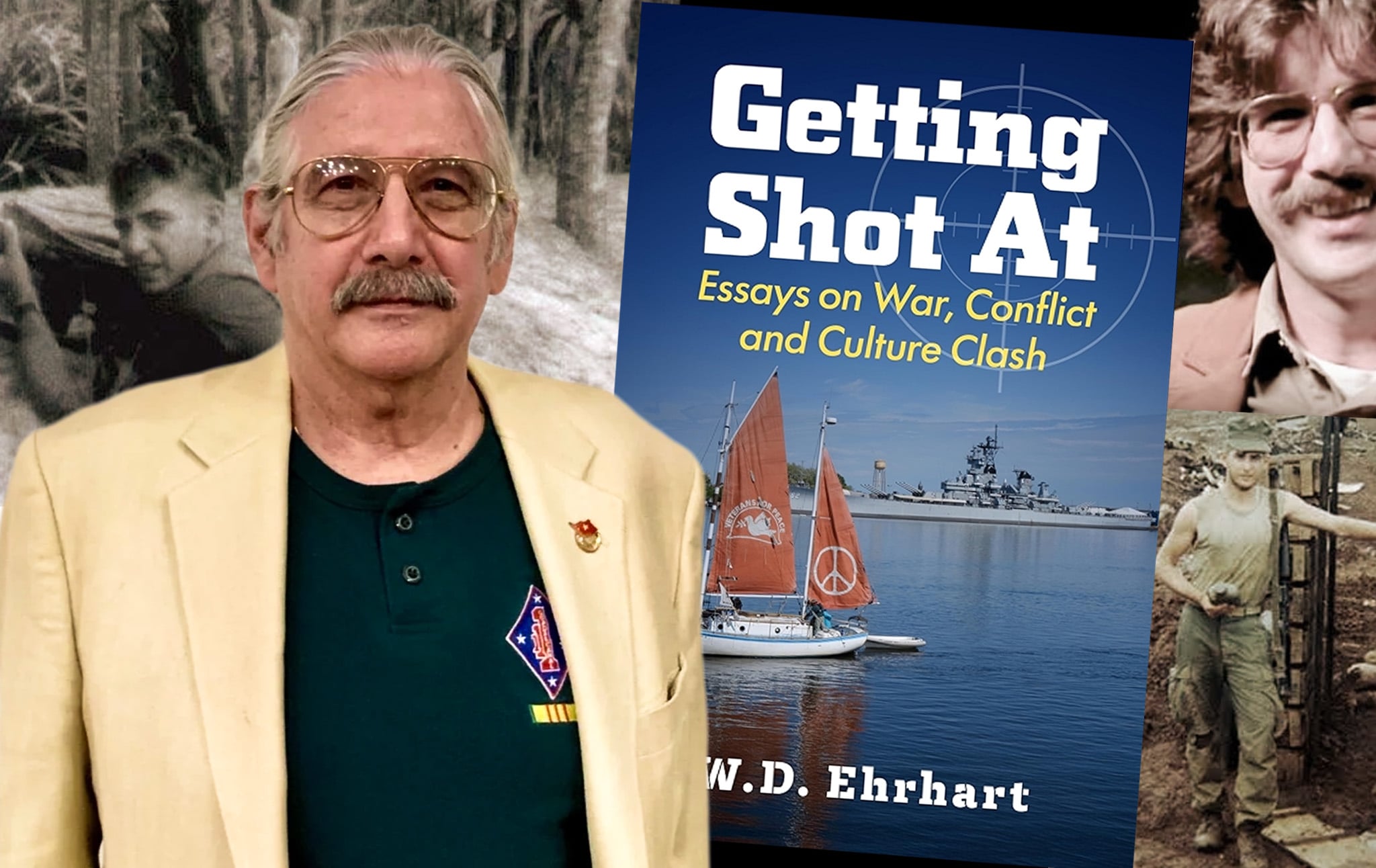
The poet, essayist, and anti-war activist breaks down his new book, “Getting Shot At: Essays on War, Conflict, and Culture Clash.”
Long-time readers of Current Affairs will remember W.D. Ehrhart as the first poet to be published in the magazine, and as the writer of several great essays, including a reflection on the political uses of the American flag and a comparison of today’s Palestine protests to those he attended during the Vietnam War. This year, he’s published a new essay collection: Getting Shot At: Essays on War, Conflict and Culture Clash, available from McFarland Books, which compiles the last few years of his nonfiction work. He joined Current Affairs associate editor Alex Skopic to discuss the book, his influences as a poet, the ongoing war in Iran, and the worrying state of free speech and dissent in America.
Alex Skopic
I’ve just finished your new book. It’s great. People should look into it. A couple of the articles in there ran in Current Affairs originally, and you’ve got other stuff from newspapers around the country. You mentioned in your introduction that a lot of your public profile has come as a veteran of the Vietnam War, and as an anti-war activist for some decades now. But you also mentioned that you don’t want to be defined by the Vietnam War, and that only a few of your articles in here are actually about it. So I want to start with poetry. You’ve contributed some great poems to our magazine, and you’ve published several books of poetry. The late Daniel Ellsberg, in one of these articles, compared you to Wilfred Owen, the great English war poet. And I wanted to know, how was it that you originally got into poetry, and who would you say your influences are?
W.D. Ehrhart
Well, okay—actually, how much time do we have? I started writing poetry when I was 15. I was not going to be the quarterback of the football team. I was not particularly exceptional at anything, but I had reached a point in my life where I wanted to be noticed by girls, and so if I’d write a poem and stick it into Ann Broderick’s locker in the morning, and then I saw her at lunch and asked her if she wanted to go to the movies with me that weekend, I would have a much better chance of getting a “yes” for an answer. It was a way to be noticed, something I could do to be noticed. I also was very lucky. In my junior and senior years of high school, I had two male English teachers, both of whom were veterans, and both of whom together made it safe for a boy to love poetry. We were also reading good poetry back in 1964 and ’65. We mostly read dead white guys, but they were good writers, and in my dim little teenage brain, I realized that, well, yes, they were dead, but they weren’t dead—there they were on the printed page. You could at least imagine you knew what they thought, what they felt. They had cheated the Reaper. They had made themselves immortal. And to a 16-year-old kid, this was really cool. Plus, I couldn’t play musical instruments, and I couldn’t sing, and so I really started writing poetry steadily through my last couple years of high school. I took a little hiatus when I was in Vietnam, when the war started getting so freaking crazy that I didn’t want to think. And if you don’t think, you can’t write, because writing is not a mechanical process; it’s a thought process. But even before I got out of the Marines, I was writing poetry again, and I’ve been writing my entire life since then. So, why poetry? I don’t know. Probably that has to do with what shaped my personality by my mother before I was five years old. But I’ve been doing it all my life.
Skopic
And your more recent stuff responds in a lot of ways to the experience you had in the war, to newer wars, and to things in the news. How do you feel about that comparison Ellsberg made to Wilfred Owen? Do you feel like your work is in that tradition with him and Siegfried Sassoon, and the rest of them, or do you feel like you’re doing your own thing?
Ehrhart
Well, it actually was rather an amazing thing for me to find that in the last decade of Dan Ellsberg’s life, we became very close friends, and he was a real fan of my poetry. It’s sort of like a rookie hockey player finding himself on a starting line with Gordie Howe. What is this? Because Ellsberg’s been a hero of mine since 1971, when the Pentagon Papers first came out. The big difference between me and Wilfred Owen is that Wilfred Owen didn’t survive his war. I did not like being thought of as a Vietnam War poet. It bothered me badly for many years. The fact is, if you pull up my collected poems, there are 308 poems in that book, and maybe 20 percent of them deal with war in any way, shape, or form. I am not a war poet. I’m a poet who went to war. But I also began to realize in my 40s I was not getting invited, and have never been invited, to the Geraldine R. Dodge Poetry Festival or the Bread Loaf Writers’ Conference. But I was getting invited to conferences called Tet Plus 20 and Vietnam and America: from War to Peace to Reconciliation. I’m getting recognized as a Vietnam War poet whether I like it or not, and I realized if I weren’t recognized for my connection to the Vietnam War, I wouldn’t be recognized at all. I wouldn’t be getting invited to anything. So, I came to accept it. It is what it is, but it does bother me.
The Vietnam War is part of my life. I spent 13 months in Vietnam. I’m 77 years old. There’s a whole lot more to my life than that experience or the aftermath of that experience. It is true that I come back to it periodically, as you notice from this essay collection. There’s two essays out of 81 that address the Vietnam War directly, but there’s a lot of stuff about other wars. One of the consequences for me personally of my experience in Vietnam is when people talk about—let’s take one of the most terrible recent examples, when the U.S. military literally murdered 154 schoolgirls with their goddamn drone missiles, and people read about that, they’re horrified. But I know what that looks like. I know what that smells like. Dead bodies have an odor to them. Human insides, when you turn them inside out, have an odor to them. When they talk about an apartment building being bombed by the Israeli Defense Forces and flattened, I can almost taste what that means. I can’t ignore that stuff. The wars that are going on today around the world are real to me. They’re alive to me, and it’s because of that connection. But in terms of my writing, it’s not like I say, “I’m going to write a poem about a war today.” I write about my life, and this is stuff that’s part of my life. I’ve got a poem about eggplants and Brussels sprouts. I’ve got a poem about fishing for winter flounder. I write about my life. That’s what I do. And these things are part and parcel of my life. The wars that are going on are just—they’re there. I can’t ignore them. So that’s a long-winded answer to your question, but I’m not very good at sound bites.
Skopic
Oh, that’s all right. We’ve got all the time we need here. We’re a long-form magazine. But it’s very true. People should know that of the poetry that you’ve done for us, I think maybe one of them touched on Vietnam. You had a great one called “Smart Fish Don’t Bite.” It’s about the rich. You had one called “Thirteen Reasons to Doubt the Existence of God.” That’s great. So there’s a lot more going on in your work. But I wonder, who are the poets that you are reading today and that you’re liking?
Ehrhart
Well, it’s fascinating. When I was a high school kid, I was very familiar with Wilfred Owen’s poetry. I obviously didn’t quite understand what he was trying to say, or I wouldn’t have volunteered for the Marines when I was 17 years old. And I missed the fact that he was killed before his war ended, because I really did go off to Vietnam thinking I was going to be the Wilfred Owen of the Vietnam War. Owen is a wonderful poet, very technically skilled. But much later in life, really, the guy that I really connect with is Siegfried Sassoon. He was not as good a poet technically, but he had an attitude that was just spot on. There’s that image of the Vietnam veterans throwing their medals back at the Capitol back in 1971; I guess that was when it was. Siegfried Sassoon threw his medal, the highest medal awarded by the British government, like their Medal of Honor—he took his military cross and threw it in the Thames and wrote a protest letter to Parliament that he sent to the newspaper. This guy had an attitude. I just love it.
But there are others. There’s a guy named Isaac Rosenberg. His poem “Break of Day in the Trenches” is probably the most beautiful poem of the war, if you can call it that. But it’s a beautiful poem. Rosenberg was actually unusual in that he was an enlisted man, not an officer, and he was a Jew. All those other guys were aristocratic, well-educated officers. There are a number of really good poets. I discovered there are good American poets from the Second World War. You think of the World War I trench poets as a group, the British poets in particular. We don’t think of a group of poets like that from the Second World War, but in fact, they exist. It’s just that most of them survived the war, and their war poems are scattered throughout a lifetime of successful poetry. Howard Nemerov wrote beautiful poems about the Second World War. Louis Simpson, John Ciardi—all these guys were veterans of the Second World War. There were even a handful of really interesting poets to come out of the Korean War. And of course, the Vietnam War has produced a handful of really first-rate poets. I particularly admire a guy named Dale Ritterbush. And Doug Rawlings. John Balaban—Balaban’s interesting because he wasn’t a soldier; he was actually over there as a conscientious objector, but he’s got some beautiful poems. There are a lot of good poems. David Brown’s wonderful. He publishes under D. F. Brown. Who am I reading now? Interestingly enough, right at this moment, I am reading a new book by a guy named Gary Metras. Did anybody ever send you a copy of Smart Fish Don’t Bite?
Skopic
Yes, that’s Gary on the cover, isn’t it? With the fish.

Ehrhart
Yes, that’s Gary Metras on the cover. He was my publisher at Adastra Press for, I don’t know, 30 years. But he is also a wonderful poet, and he just published a new book called Counting Bricks and sent it to me a week ago. And so I’ve been slowly working my way through that one. I mentioned D. F. Brown published a new book not too long ago, Ghost of a Person Passing in Front of the Flag. I think David Brown is good. There’s a woman named Nathalie Anderson, who was a professor at Swarthmore for years—not while I was a student there because she’s my age, but she’s a wonderful poet. I’ve been reading one of her new books. I keep a book of poems by my nightstand and every night will read one to three poems, slowly working my way through. At the moment I’m pretty keen on Gary Metras and D. F. Brown—I call him Doc Brown because he was a medic during the Vietnam War.
Actually, there’s a very interesting woman whose name is Teresa Mei Chuc. She is of Vietnamese origin. She actually was born in Vietnam and came to this country with, I think, both parents or just her mother when she was literally a babe in arms. So she is American, but she’s Vietnamese American. She’s a wonderful poet who has published several books, and actually, she did a book together with the other guy I mentioned, Doug Rawlings. And the two of them essentially did a dialogue in poetry. I don’t have the book in front of me, so I can’t remember the name of it. But Teresa’s really good. There’s a woman who’s a bit younger than me named Lisa Coffman out on the West Coast; I don’t know whether she’s done a book recently or not. But there are good people writing poetry today. You just have to look around for them because there’s also a lot of dross out there.
Skopic
Yes, and I’ve written in the magazine about a few of my own favorites, like the great Brendan Joyce out of Cleveland, Kyle Carrero Lopez out of New Jersey, Darius Simpson, Noor Hindi, and people like that.
And of course, you’ve been a teacher of poetry too. Another of the real narrative throughlines in your book—you’ve got an essay called “Trusting Teachers to Teach” and a few others—is about how, in the schools where you are in Pennsylvania and across the country, political forces in the school boards are trying to make it harder to get hold of this really interesting literature, or anything that’s politically challenging. So since you’ve finished the book, how is the situation with your local school board, and what do you think of the state of free speech right now?
Ehrhart
Well, that’s—okay, where do I start? My teaching career was in private schools. I am not a certified teacher. I don’t have a piece of paper that says I’m qualified to do what I’ve been doing off and on for 40 years. I had a very spotty career teaching on and off, mostly off, between my early 30s and my late 40s, but then I got hired by the Haverford School for Boys in suburban Philadelphia by a headmaster who knew me through my writing. I had enormous academic freedom. I probably had more academic freedom than even most of the other teachers in that school. There were reasons for that not worth getting into. But I retired seven years ago. I was 70 years old. I was slowing down. I could feel it. Nobody noticed, but I wanted to go before somebody did notice. I am not sure how, even as late as 2019, I could still get away with what I was doing.
I know, for instance, that ever since October 7, 2023, and the assault by Hamas, you cannot—you cannot—say anything, even at the school where I taught, in defense of the Palestinians. And at another private school very near here that is right down the street from me, the headmaster was fired for posting something on a social media page that didn’t criticize Israel directly, but tried to express the idea that Palestinians are human beings that shouldn’t be treated like that. He was fired. I know that a teacher at the school where I was said something sympathetic about the Palestinians, and she was called in by the headmaster and warned that she’d better not do that again. Her job was at stake. And you don’t know me all that well, Alex, but I’m not easily muzzled. There’s no way you’re going to keep my mouth shut in the face of what’s been going on, and I’m sure I would have been fired by now.
And as far as this whole business of critical race theory, first of all, that’s only ever taught in law schools. What people call "critical race theory" is actually called history. It’s what happened, and that’s what I used to teach my kids. I’m not sure if I could still be doing that, seven years after I retired. As far as what I write about, mostly the essays in my book are based on actions of the school board in the community where I grew up and where I graduated. The essay might be in my book Getting Shot At—toward the end of it, there was an election that overturned a number of these right-wing Republican extremists. They were voted off the school board, and I’m not sure what impact that has had.
The area that I grew up in, Upper Bucks County, is not noted as a hotbed of progressive thinking. But it had gotten pretty bad, to the point where the school board was demanding that they take books off the shelf, like Heather Has Two Mommies. Because if it’s on the shelf, all the kids in the school will end up gay. Bullshit like that. How much of that has changed? I don’t know. I do know that for four years in a row, up until this past fall—so we’re talking ’24, ’23, ’22, and ’21—I was invited up to one of the middle schools where I grew up to speak to students. I did it four years in a row. I spoke about the Vietnam War. The eighth graders were reading a book that had some connection to the war. I was not invited to speak there in the fall of 2025 after our felon-in-chief was re-elected, and I suspect that’s because it became too dangerous to have someone like me speaking to the students. The teacher who invited me probably was worried about his position at the school. I don’t know if that’s true. I just know that I was there four years in a row, and then the fifth year I was not invited. So I don’t know what’s going on.
Free speech in general—good luck with that. I see that right up the street from me, Haverford College just settled a lawsuit that was brought by—I’m not sure who brought it, but it was that Haverford College is not doing enough to protect Jewish students from antisemitism. And Haverford College just made the news, probably in your newspaper down there. What is it? The Times-Picayune or something? Whatever your daily newspaper is. This was a national story that Haverford College has agreed that you can no longer refer to what’s going on in Palestine as a genocide. You can’t be critical of Zionism because if you’re critical of Zionism, then you don’t believe the state of Israel should exist, and therefore you’re antisemitic. And the college has actually agreed to this publicly and in writing, and if a student talks about being opposed to Zionism, that student will be censured and possibly expelled from the college. Free speech is really, really at risk these days.
Skopic
Well, in fact, you wrote a great essay for us, which is included in the book, “Protests, Then and Now.”
Ehrhart
Oh, yes.
Skopic
Which was all about how the same narratives that were used to try to crack down on dissent about Vietnam are now resurfacing. Back then the line was, if you’re against the war, you’re anti-American and support the Viet Cong. And now if you are against the killing in Gaza, you’re antisemitic and support Hamas.
Ehrhart
I was just looking through some of this stuff to refresh myself on what I actually said in my own book, and one of the things that they were doing is charging these students with trespassing by setting up an encampment on the campus of the school where they’re enrolled. How do you trespass on your own college campus? The campus is a public space for students to walk around on. If you go to the school, of course you have access to the campus, and yet they’re claiming this is trespassing? President Joe Biden, who is a much more decent person than the goon that we have in the White House now, but he’s a politician, said that these protests and blocking classes and stuff are violent protests. Well, no. Violence is when you stab somebody with a knife or punch them in the face or knock them over. A sit-in blocking an entrance to a classroom is not violence. It’s just not. The point is you are seeing the same kind of distortion of facts that we dealt with back in the ’60s and early ’70s. The day I walked on campus at Swarthmore College—I was out of the Marines at that time and started college—there was a Viet Cong flag flying from the main administration building. On the top two floors of that building were girls’ dormitories, and there’s a Viet Cong flag. Does that mean that everybody who was in the anti-war movement thinks that the Viet Cong walk on water? Of course not. And even if some people involved in protesting the genocide in Palestine say that the state of Israel has no right to exist, that’s taking one tiny segment and claiming that the entire resistance movement believes that, and it’s just not true. It’s not even close to true. It wasn’t true that everybody who protested the Vietnam War hated America. But it’s the same tactic, and it’s been successful. Why do they use these tactics? Because they work.
Skopic
No, that’s right. And we see more and more of it. Every time we put out something about Palestine, we get angry emails, but we’re going to keep doing it.
Ehrhart
Well, that’s good. Because genocide is genocide. The one thing that I really regret about this book is that there are a number of essays in it about Israel and Gaza, and almost every one of them says that the attack by Hamas on October 7 was inexcusable and was beyond the pale. I wish I hadn’t written that, because it’s become perfectly clear that the real terrorists here are the Israeli government and the IDF. And if you look at the way that Palestinians have been treated by—I hate to say it—the Zionists ever since the early 20th century, they’ve been abused and murdered and displaced constantly for 120 years. If I were a young Palestinian man, I’d be fucking pissed off too. I’m not going to say it’s okay what they did, because I don’t think that it’s okay to be killing anybody. I’m not exactly a pacifist, but I do not advocate violence as a solution, because it never works in the end. But I certainly understand why those Hamas people did what they did. If I were a young man in Vietnam in the 1960s, I hope I would have had the courage to be involved in the Viet Cong, and if I were a young Palestinian, I would be inclined to resist the state of Israel in any way I could. Most Americans, because it doesn’t get reported in this country, have no idea what the people of Palestine have been putting up with for 80 years. The utter humiliations and deprivations of freedoms. People refer to Israel as a democracy in the Middle East. That’s bullshit. It’s not a democracy. It’s an apartheid state. And if you’re Israeli, you get the vote. But otherwise, fuck you, go away. And if you want to talk terrorism, the so-called settlers on the West Bank, with the support, often active support, of the IDF, have now murdered more people than were killed by Hamas on October 7, 2023. Who are the terrorists here? Who are the goddamn terrorists?

Skopic
We have a great article coming out in our next print issue from a journalist named Jasper Nathaniel, who has been over in the West Bank for a while, and he’s got a firsthand report of what’s been going on over there. And you’re right. It’s absolutely horrifying. And I think what you say there about October 7 reminds me a lot of Professor Norman Finkelstein. He said something similar: that the killing of civilians is horrible, but at the same time there is a context for why that happened that we have to understand.
Ehrhart
Yes. Because the world keeps throwing stuff at me that I have to write about, I’ve now got 130 pages of new material since the manuscript for this book was sent off to the publisher. If I live long enough, I may have another collection of essays in a year or two, if they’re willing to publish it. But the things that I’ve been writing about the Middle East now no longer say, “Oh, Hamas was terrible; they shouldn’t have done that.” I haven’t said “Hooray for Hamas,” but I’m just not mentioning that, because the balance of terror here is very much on the side of the Israeli government and the IDF.
“Does Israel have a right to exist?” That question is irrelevant at this point. It’s there. It’s not going anywhere anytime soon. So it’s a fact, but it’s also a fact that the Palestinians are there and they’re not going anywhere either. So they can continue to fight like this until the cows come home, or as my dear and now dead friend Gloria Emerson observed 30 to 35 years ago, the Israelis have two choices: they can either kill everybody in Palestine, or they can make peace with them. And actually, there is a third choice that Gloria didn’t mention, and that’s they can just keep doing this forever. But one way or another, neither Israel nor Palestine will be removed from the table. They’re both there. So what are they going to do about it? I talk about this in a couple of my essays: there are organizations like Combatants for Peace and Peace Now and some other organizations that, although they’re very much the minority point of view at this point, are arguing for some kind of reconciliation. This isn’t working. It’s never going to work. There has to be some way to handle this without each party trying to kill the other party off because neither of those things is going to happen.
Skopic
Well, what I would say as well is that your writing on Israel and Palestine in this new book is very valuable. You have probably 10 or 15 essays in here that are about that, and they go from October 7 all the way up to the close of the book. And the thing that’s important about that is one of the big narratives that’s been used to justify the war is, people will say, “Well if you’re against the war or pro-Palestine, that’s just a fad among young people, and they don’t know what they’re talking about.” But we now have this book, and we can say, “No, here’s Bill Ehrhart, who has been doing this for decades, who was in Vietnam, and who knows this when he sees it.” And so the articles and the perspective you’ve got here are really valuable.
Ehrhart
Yes, I don’t qualify as a young person. I know I used to be young, but I can’t remember when that was. Actually, I think I do say some very useful things in these essays. Only almost every one of them in this book is prefaced with my basically disavowing, making some comment about Hamas and how unjustified they were, inhuman, barbaric, and beyond the pale. I wish I could remove those sentences, but the rest of those essays are all pretty solid. Which, by the way, while I’m thinking of it, most people don’t know this. You do. Back when the first Intifada began in 1987, Hamas didn’t even exist. How did Hamas get started? Part of their foundation was provided by financial assistance given by the Israeli government, which funded Hamas in its early stages, to create a counterweight to the PLO and the Palestinian Authority in the West Bank. They wanted to make sure that the PLO did not get control of both the West Bank and Gaza, and of course it succeeded. But then the Israelis create this monster and then are surprised when the monster turns around and attacks them. It’s like Osama bin Laden and the Mujahideen. We basically created friggin’ Al Qaeda. Here we’re supporting the freedom fighters in Afghanistan, the Mujahideen, and 20 years later they attack us, and we’re surprised. Well, that’s what’s going on with Hamas. Israel helped to create Hamas. Most people don’t know that.
Skopic
Well, and the same with Iran now, where we’re at war, where we toppled their original president, Mosaddegh.
Ehrhart
And that one’s even better. That one goes all the way back to 1923, when the Shah—that Shah had as much royal blood in him as I do. His father was a general who overthrew the hereditary king of Iran back in 1924 and declared himself “the Shah,” which is “the king” in Persian. He put himself on the throne by military coup d’état until the start of the Second World War. But the guy who was calling himself the Shah—do you know all this stuff? It’s pretty amazing. He was very fond of Adolf Hitler.
Skopic
Yes, I have read that.
Ehrhart
And the British and the Russians thought this was not really a good idea, so they got rid of him and placed his young son on the throne because the young son was much more malleable and was not so enamored of Adolf Hitler, but that’s Reza Pahlavi. That’s the guy that the Iranians overthrew 30 years later in ’79. What’s even more amazing, it turns out that my father-in-law, who’s now dead, was a Middle Eastern anthropologist, and he was working in Iran. He was there in about ’75, I think it was, and he was at the university in Isfahan, and his Iranian colleagues were telling him, “You’ve got to get your government to stop supporting this Shah! He’s a monster! He’s a tyrant! The Shah is locking up anybody who is protesting him, anybody who supports Western-style democracy. And if you keep supporting him, what’s going to end up happening is these extremist Islamists are going to take power. They’re going to overthrow the Shah. They’ll take power, and then you’re going to be screwed. We’ll have these radical Islamists in charge.” Well, three years later, that’s exactly what happens. Exactly what happens. So it really goes back before Mosaddegh and the overthrow of his government. And the irony of the current situation in Iran is that the Iranian people really don’t and have not supported the Islamic government. Most Iranians are well-educated, sophisticated, and secular. They’re not interested in this being an Islamic state. But by the U.S. attacking Iran, the Iranian people have rallied around their own government. It’s actually created massive support for the Iranian government because what are you going to do if you’re being attacked by some foreign power that’s killing your school kids and stuff? So we’ve actually made that government stronger.
Skopic
No, that’s right. From the reports I’ve seen, it seems as if they’ve had the same reaction that we did after 9/11. In fact, on Iran, there was one thing in the news recently that I just wanted to ask you about and get your reaction to. And I should probably apologize in advance, because I think I know what your reaction will be. But there’s a conservative commentator—I wrote an article about this—called Ben Shapiro. Are you familiar with him?
Ehrhart
I know the name.
Skopic
Well, he had this amazing quote. He said on his podcast about the war in Iran, which he’s been pushing for and supporting: “No one in America wants American casualties, but we do understand that war comes with casualties, and we are willing to undergo those casualties in pursuit of an end and a victory for America.” Now, keep in mind that Ben Shapiro has never served in the military himself; he’s only ever been a podcaster. So, what do you think of when you hear something like that?
Ehrhart
Well, the first thing I think of is you’re willing to sustain casualties because you’re not going to be one of them. Let’s ask the guys who are actually going to be coming home in body bags how they feel. Also, what does victory mean? This is a war of choice. Our felon-in-chief, our coward-in-chief, decided, “Oh gee, it was really easy kidnapping the head of state of Venezuela. We’ll just make the Iranians roll over and play dead. They’ll fold up.” And of course they turn out to be a hell of a lot tougher. They’re not rolling over. They’re not going to roll over. What does victory even mean? I don’t think the American people are willing to sustain casualties for a war that the majority of Americans, even some people that support Trump, I gather, are wondering what the hell is this about anyway? Why are we going to war with a country that never did anything to us? It’s simply a war of choice against Iran. So the end result is I’d like to see Ben Shapiro volunteer for the goddamn infantry. That’s my real bottom line. Let him sign up if he thinks it’s important.
Skopic
No, same here. I was kind of staggered by that when I heard it, and had to write something in response. But yes, we do seem to be, I think, six months now into the war with no end in sight.
Ehrhart
Oh yes. Well, it was pointless to begin with, and the fact of the matter is the Iranians have now discovered they can really screw things up by closing the Strait of Hormuz. It’s interesting that they never did this before. They’ve been in charge of Iran since 1979. Apparently, it never occurred to them that if they want to make some trouble, they can do this, and they’re willing to take whatever beating the American military wants to give them. They’re not going to roll over. These people are committed.
Moreover, if they get a nuclear bomb, let them have an atomic bomb. Let them have it. What the hell are they going to do with it? They think they’re going to nuke Jerusalem, and what do you think is going to happen if they ever did that? The U.S. really would blow Iran off the face of the earth. Let them have it. All these other countries have bombs. Pakistan has a bomb. India has a bomb. France has a bomb. Let them have a bomb. So what? I’m not afraid of them. They’re not going to use it.
Skopic
No, it doesn’t seem very likely, does it?
Ehrhart
Not very likely, no. Because if they did, if they used even one, between the Israelis and the Americans, the entire country would be mushroom clouds. They’re not stupid! We might not like them. I don’t particularly like the Ayatollahs, but they’re not stupid. They’re not suicidal.

Skopic
We’ve been talking about nuclear war. We’ve talked about genocide in Palestine. I want to end on a little more positive note.
Ehrhart
Oh. If you can find one, that’s terrific.
Skopic
Well, I think I can. Another of the narrative throughlines of your book, Getting Shot At, is a celebration of your personal heroes. You talk in here about the late Daniel Ellsberg, who, of course, blew the whistle on the war in Vietnam and released the Pentagon Papers. You talk about the historian H. Bruce Franklin, who was fired, I believe, from Stanford for his politics. You talk about the great Muhammad Ali, who refused the draft. What do you think is the unifying thread in all these people that you admire about them?
Ehrhart
Well, Ali is in a sort of a different category. I really admired—well, for one thing, he was an incredible athlete. When they stripped him of his title, he was a boxer with skills beyond anything anyone had ever seen in a ring, and he was smart enough that when he came back to boxing, he was able to compensate for the ravages of age with his brain, and so he still was able to box smart. I don’t put him in the same category, because I do think that he was badly conned by Elijah Muhammad. I think he was badly used. I don’t know that he ever understood that. But it was remarkable, I think, to see him. I also question, what, are you a pacifist? I don’t think he was a conscientious objector. But he had the courage to say, “I’m not fighting your war, white guy,” and he was willing to pay the consequences of that decision. And I admire him enormously for that. I wish he’d gotten out of the ring sooner. It was remarkable to see him light the Olympic torch in 1996. Basically all of America was cheering for him, and it was an amazing transformation.
Dan and Bruce both were willing to—well, like Ali—stand by their beliefs and pay a terrible price for those beliefs. In some ways, Bruce paid a higher price than Dan did. I was dismayed when Dan died, of course—every publication on the planet paid attention to the fact that Daniel Ellsberg was dead. I was, as I say in my article about Bruce Franklin, dismayed that so few, so little of the world, paid any attention to Bruce. Both men were truth tellers, dealing with the broader issues all across the spectrum: racial issues, cultural issues, issues of war and peace, and prison. Bruce was particularly a real advocate for prisoners. I just thought Bruce was worthy of more attention.
I especially was surprised there was so little on the left. Okay, maybe he’s ignored by the New York Times and the Los Angeles Times, but left-wing publications like the Progressive and the Nation and Harper’s—I don’t think they paid any attention to his death, and I think that was sad because Bruce was a brilliant man. You know the story of how he was accused of inciting students on the Stanford campus, to incite riot and violence. He was the first tenured professor to be fired since the the misnamed McCarthy era. He was a tenured professor at Stanford and was fired by the university because they claimed he had incited violence among the students, which was a stretch. He did get hired about a decade later by the Rutgers Newark campus. I’m not quite sure why they were willing to hire him, but he had a wonderful career there for, I don’t know, 30-some years, and in some ways it was a better fit for him than Stanford because Rutgers Newark was a working-class campus, a lot of immigrant kids, a lot of second-generation kids, and that’s where Bruce’s heart was. But I wish he had been more recognized by people who should have been supporting him.
And of course, I’m biased, as I say in the article. He was a great advocate of my writing and used it in his classroom all the time and used to find ways to stick me in his books, even in some books where I don’t belong. But he’d find a way to weasel in one of my poems or another. And of course, getting to be a friend of Dan Ellsberg in the last decade of Dan’s life was, as I said, sort of like finding yourself as a rookie baseball player in a starting lineup with Joe DiMaggio or something, because Ellsberg became a hero of mine back in the Pentagon Papers days, as I say in that article. Reading the Pentagon Papers truly and permanently changed the trajectory of my entire life. It simply had that impact. Actually, it was Bruce Franklin who first brought my writing to Ellsberg’s attention. It was Bruce that did that. Dan Ellsberg would call me up and want to talk about my poems. Really? Okay. That was pretty amazing.
Dan was lucky, in a way. Bruce was fired from his tenured job for his politics because he was very outspoken against the Vietnam War. Dan risked 135 years in prison or something like that. But because the Nixon administration was so stupid, so venal, so evil, they blew it. They blew his prosecution. He lost his entrée to the rich and powerful as an insider, and he knew that would happen—that he would be cut out entirely—and that was a price he was willing to pay. But he was a staunch advocate over the years of Julian Assange, of Chelsea Manning, and of Edward Snowden, and he kept trying to get people to see those men and women in the same light that he was seen: as a truth teller, as people who were trying to inform the American people of what their government was doing behind their backs. No one was willing to do that. I remember late in his life, he was interviewed by Christiane Amanpour. She’s supposed to be a real hotshot, first-rate journalist. And Dan kept trying to talk about Snowden and Manning and Assange, and Amanpour kept going, “But I want to return to the Pentagon.” She didn’t want to hear anything about what was going on today. She only wanted him to talk about what had happened 60 years ago.
Skopic
There’s a quote that I think about often, and I unfortunately don’t remember who said it originally. But it goes something like, “A liberal is someone who opposes every war except the current one and supports every movement except the one that’s happening now.”
Ehrhart
I’ve always defined a liberal as as a conservative who likes to pretend he has a conscience.
Skopic
Right.
Ehrhart
So anyway, I do admire Muhammad Ali for a number of things, but I put him in a different category from Dan and Bruce because Dan and Bruce were looking at the nation, and how this nation exists in the world, and how things could be very much better.
This is a new one. It’s going to be in my next book if I live that long. I had written something similar to this about Phil Caputo, who I had known for a number of years. He was another good guy. Did some things to really earn my respect. Not as prominent as Bruce and Dan, but a good guy. The thing is, you’re still pretty young. You and Nathan are both like kids. I’m at an age where everybody around me is dropping dead. As I said to another friend of mine, who’s not famous but was a good writer, “I hope I’m not the last one standing because I’m getting tired of saying goodbye to people.”
Skopic
Well, you certainly do a fine job of capturing these figures and immortalizing them in your book.
Ehrhart
Well, I don’t think Dan needs my help, but Bruce maybe did. I’m glad I got to write about him. I was able to track down one of his daughters. The publishers are really weird these days. You probably know this. To use a photograph, they want a written document for every photograph that you use, and they have to know that you have explicit permission to use this photograph. And boy, I had the devil of a time tracking down pictures for Bruce. He has three children, but by the time I got to know him in 1981-82, his kids were already out of the house. They were grown and gone, so I didn’t know the girls very well. And I, finally, after a merry chase, was finally able to locate one of the daughters, and of course she knew exactly who I am because her father’s been talking about me for 40 years. And so she gave me the pictures of Bruce that are in the book. So that was good to have those.
Skopic
I have to admit I didn’t really know anything about his story before reading this book, and it’s an incredible story.
Transcript edited by Patrick Farnsworth.


%20(1).jpg?width=352&name=Parrots_by_a_nest_in_the_Green-Wood_Cemetery_gate_(61841)%20(1).jpg)
