
The emergency measures needed to avoid billions of deaths now must be done in an increasingly violent environment, with very little time. The “good news?” We have no choice.
On June 23, 1988, climate scientist Dr. James Hansen publicly addressed the U.S. Senate Committee on Energy and Natural Resources, where he explicitly laid out the destabilizing progressive nature of fossil fuel-driven planetary warming. It was a time before financial markets had entirely devoured the notion of a “collective good,” so people responded the way humans used to before shareholder value replaced our survival instinct: they were alarmed.
Heck, the New York Times even dared to piss off automotive, travel, and banking advertisers by placing the story prominently on their front page the very next day (gasp!)
Yes, the science linking the burning of gas, oil, and coal to increased climate warming has been known since long before the ‘80s; in fact, since the early 20th century. Just take a look at this newspaper article from 1912 announcing “COAL CONSUMPTION AFFECTING CLIMATE,” and warning readers “the effect may be considerable in a few centuries”:
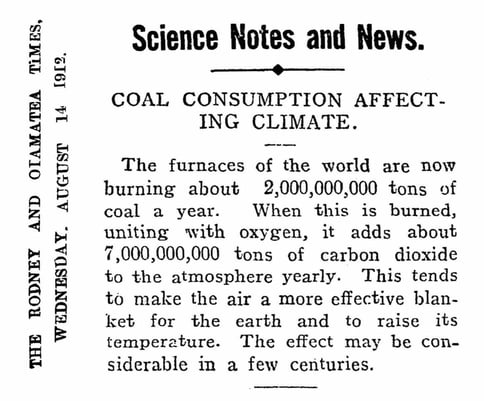
Sadly, the journalist who wrote that headline died several decades before getting the chance to be laid off from the Wall Street Journal.
But Dr. Hansen’s address was the first mainstream flashing red signal to the modern world that with hundreds of millions of cars, nearly 300,000 planes, and billions of cows and pigs churning out CO2 and methane 24/7, a great danger was, in fact, very close.
His testimony and the subsequent reaction led logically to the idea of a “window of time” for collective climate action whereby a host of critical, civilization saving actions would be taken with projected future warming thresholds as the ticking clock.
This figurative “window” was 50-to-100-years wide and featured sun-dappled floor-to-ceiling views of the West Village, Bill Evans playing on a crackling record player, and the smell of fresh bagels wafting from the kitchen. It even had a wonderful, soothing name: the Green Energy Transition. Doesn’t that sound heavenly? If the “Green Energy Transition” were a spa treatment at a fancy hotel, I’d schedule it along with that pedicure where fish nibble at your feet.
But after more than three leisurely decades of empty green pledges—with the past four years now officially averaging over 1.5° Celsius of warming for the first time in 200,000 years, the final ice shelf bracing Antarctica’s Thwaites “Doomsday” Glacier breaking apart any day now, recent satellite data showing the Atlantic Meridional Overturning Circulation weakening even faster than originally thought, and computer models projecting months at a time crossing the devastating 2°C threshold in 2027—our wonderful “Green Energy Transition” window has been smashed by rock-throwing oil company-owned politicians and captured news media.
We have, in the parlance of old-timey movie gangsters, “chosen the hard way over the easy way.”
How hard will it be, exactly? Some scientists and climate journalists have taken to using the term “climate doom loop.” Stay with me, it’s not as scary as it sounds.
A “climate doom loop” describes the point at which governments must devote all of their resources and focus on reacting to one climate disaster, famine or drought after another, rather than reducing emissions. This repeating, reactive “loop” all but guarantees increasing levels of global devastation. Okay, I lied. It’s exactly as terrifying as it sounds. And it’s here now.
In case you think “here now” is hyperbolic, ask yourself why 33 nations are now advising their citizens to stockpile food and water? Hint: crops around the globe are already faltering because of what scientists recently confirmed to be even faster global rates of heating than previously measured. Look at any earth data set and it’s clear: we are in a fuck-load of fast-moving trouble.
But. Here. Is. The. Thing.
There are still actions we can take to avoid moving permanently north of “agriculture collapses” two degrees Celsius Earth warming.
If I didn’t believe, and to a larger extent know, that these measures exist and can work, instead of writing this right now I’d be smoking opium on a plush sofa in New Orleans while getting a foot massage from Raul (who used to do the Green Energy Transitions at the Ritz Carlton).
Is the new and only window left narrower and more difficult to hit? Without question. I’d compare the level of difficulty to decorating a wedding cake in a sandstorm. And the stakes of failure can best be described as: everything. We’ve gone from a window full of promise, innovation, and the smell of West Village fresh bagels to a high overhead, small window you’d see at the end of Act I of a prison escape film.
However, we have two extremely powerful factors on our side.
Number One: we don’t have a choice. We either do this or billions die in horrific ways. And there’s tremendous power in that. Our children, family, friends, community, pets, dolphins, deer, tigers, giraffes, flowers, bumble bees, etc. will all certainly perish from famine, fires, floods, lack of clean water, extreme heat, or during a thousand-mile climate refugee march to the Canadian border if we don’t hit this “Escape from Alcatraz” window. We simply cannot and must not screw around with even the thought of failure.

Number Two: science, when freed from the constraints of “for profit” shareholder value bullshit, can do amazing and borderline magical things. Remember the moon landing? Or open heart surgery becoming routine? To this day, we have never fully funded a Manhattan Project-style array of global laboratories to innovate new technologies and potentially save the livable climate.
But first we must talk about time frame.
We are currently headed into 2027, when a climate super-charged El Niño, still months from its peak, is already pushing global temperatures to 1.8 Celsius above pre-industrial levels. We also now know that warming is accelerating from what was a rapid-but-predictable 0.2°C per decade to 0.35°C in the last ten years, a nearly 75 percent increase.
Next year will almost certainly be the hottest ever recorded, and it will likely feel like the “doom loop” has taken hold, with food shortages, deadly heat events, and flooding jumping to new levels. But because 2°C will have not fully been reached yet for multiple years, there should be a brief amount of time—as the El Niño weather pattern ends and hopefully a La Niña begins—where the near-constant climate shocks let up, at least a little, for a time. That is our “Harrison Ford sliding under a rapidly closing door in Star Wars or Indiana Jones” window for emergency collective action.
Odds are that some reprieve will come in the winter of 2028 or early 2029. Will this relative calm last for a few months? Maybe a year? There is no way to know for sure. We know that most of the El Niño warming doesn’t go away (that’s why they call CO2 a heat trapping gas). But this brief respite must be the time when what is left of functioning world governments, universities, international agencies, and the billions of people who don’t want to die or see their children, and in many ways planet, die must take immediate, uncompromising, coordinated actions.
First and foremost, we must stabilize the climate.
With warming accelerating and the cataclysmic 2°C threshold staring us in the face, as earth systems like the Atlantic current, the Amazon rainforest, and the west Antarctic ice shelf fast approach collapse, we must quickly get the Earth climate back to something resembling balance.
And one of the fairly fast ways to do this is methane.
Why CH4? Because methane only exists in the atmosphere for a relatively short time, roughly eight years. But ton for ton, it traps more than 80 times as much heat as CO2 over its first 20 years, and it is responsible for roughly 30 percent of the warming humanity has caused so far. Every year, hundreds of millions of tons of methane exits the air, but humankind keeps emitting more to replace it. The UN’s Global Methane Assessment found that slashing human methane emissions by 45 percent would cut nearly 0.3°C of warming.
There are dozens of relatively easy and quick short-term actions we can immediately take to achieve this. We can start by capping old oil wells and tapped out coal mines, and by dealing with data centers which are now being powered by methane gas—causing what clean energy researcher Michael Thomas calls “a crazy acceleration of emissions.” This is madness. These centers urgently need to be shut down.
Meanwhile, livestock produces more than a third of anthropogenic methane emissions. We need to scale up existing technology to limit livestock methane and ration meat consumption, while using the assets seized from criminal oil companies and their banks to pay subsidies to cattle, chicken and pig farmers.
The same approach applies to reducing CO2 from cars and planes. We can start by implementing every-other-day bans on driving. Versions of this policy already exist in places like Quito, Ecuador, where drivers—organized by last number of their license plate—are prohibited from driving during rush hour on certain days of the week, at risk of having their car impounded.
By eliminating non-essential flights and restricting car travel, we can prevent hundreds of millions of tons of heat-trapping carbon dioxide from warming the planet to the point of no return. (If you think having to carpool to the grocery store will be annoying, just imagine how irritating it will be when all of the shelves are empty because of global crop failure.)

One obstacle will be the culture of “no” that has developed over the last 40 years, in which pundits, elected officials, and the media explain why change “can’t happen” in order to protect entrenched wealth and the markets. This culture is exactly what has taken us to the precipice of environmental collapse and must be rejected. World War II, the global response to the Covid pandemic, the adoption of vaccines, and dozens of other historical instances prove that rapid societal change can happen when survival depends on it.
That is precisely why nations across the globe can, and must, deploy artificial albedo to compensate for ice, snow, and cloud loss caused by anthropogenic warming. Albedo is the percentage of incoming sunlight that is reflected back into space. It is a vital part of how our planet became livable. Because Earth is now reflecting less of the sun’s light (our planet’s reflectivity hit a record low in 2023), we need to paint and bleach as many roofs and roads as possible, while building large structures that can support weather-resilient reflective materials in order to lower regional warming.
And all of these actions to stabilize the climate must be greenhouse gas neutral or close to it—otherwise, there’s no point. Does this make efforts to stabilize Earth’s climate three times more difficult? Yes, it does.
Second, we must bolster and transform global infrastructure.
Human civilization is designed for a relatively stable climate, aka the Holocene, which no longer exists. Without it, food supply chains, water filtration and distribution, agriculture, transportation, shelter, energy, and communication all need to be “ruggedized”—to use a term created by climate futurist Alex Steffen—and transformed for our less predictable and higher-risk Earth.
It is imperative that we focus on planting weather resistant crops, increasing water storage for the already accelerating drought/flood cycle, rapidly switching over to renewable energy, and totally repurposing the world’s militaries in order to support this mission.
Yes, there will be nations that have descended too far into gangster-style corruption or religious and racial extremism to be of much help. Some may even fight collective efforts to save life as we know it. The U.S., Israel, Russia, the U.K., Saudi Arabia, North Korea, and another dozen or so countries may be too committed to the oil companies, big banks, and top-down rule to join the collective effort. However, don’t discount the power of a true survival-instinct-charged global awakening to throw corrupt hacks and dictators out of power.
And of course, those big oil companies—the ones that have taken us to the brink of civilization-wide collapse? They will have to be nationalized, or more likely internationalized, under the control of a world governing body (either under the purview of a freshly empowered U.N. or a brand new global organization) to oversee all rapid, critical missions.
Oil companies’ assets must be seized, workers compensated and retrained, and executives past and present put on trial. It is very important that a new, collective justice be established as a weight-bearing beam of our new “emergency footing” collective civilization.
Critically, we must also innovate new planet-saving scientific breakthroughs.
For years, oil companies and their marketing departments and advertising agencies have used the promise of nonsense future technologies to delay climate action. These hollow assurances have been made only so the rich and powerful could continue making trillions of dollars. But now we must actually do it, using dozens of heavily-funded and climate-fortified laboratories spread around the globe.
Existing technologies still in their infancy—like carbon-free concrete, solar-powered planes, the removal of carbon from the oceans, and on and on—must be developed and scaled up by the world’s great scientists and engineers. Many of these dozens of attempts will fail. But if even two or three succeed, it will save hundreds of millions, if not billions, of lives. And it will have all been worth it.
Finally, we must confront the possibility that saving the planet will require geoengineering the climate itself. Earlier, we discussed increasing Earth's albedo by installing heat reflective materials on the ground. But some scientists have proposed a far more ambitious, and potentially risky, approach: spraying reflective particles directly into the stratosphere using high-altitude jets or balloons.
It sounds like a rejected plotline from a Christopher Nolan movie, but it’s been done before. Just by volcanoes. According to the MIT Review:
Most famously, the massive eruption of Mt. Pinatubo in the summer of 1991 spewed some 20 million tons of sulfur dioxide into the sky. By reflecting sunlight back into space, the particles in the stratosphere helped push global temperatures down about 0.5 °C over the next two years.
There are significant risks involved, which is why the technology will need to be modeled heavily and real-word-tested before ever being put into practice. As James Temple from MIT explains:
The computer modeling consistently shows it would reduce global temperatures, sea-level rise, and certain other climate impacts. But some studies have found that high doses of certain particles might also damage the protective ozone layer, alter global precipitation patterns, and reduce crop growth in certain areas.
Other researchers have found that these risks can be reduced, if not eliminated, by using particles other than sulfur dioxide and by limiting the extent of geoengineering.
Not only would geoengineering directly slow rapid planetary warming by reflecting the sun’s heat back into space, but the resulting cooling could allow the planet to absorb more greenhouse gases naturally. Studies have shown the hotter Earth gets, the less CO2 plants absorb. There is even evidence suggesting that parts of the world's forests and tundra have already begun transitioning from “carbon sinks” to carbon emitters, releasing more greenhouse gases than they absorb. But with the cooling created by responsible, science-based geoengineering, the planet can create even more heat reduction.
And yes, for years, geoengineering—also known as climate intervention or climate engineering—has been proposed by surrogates of oil companies in an attempt to delay climate action. Now, because we are out of time, there is simply no choice.
But it is critical that “for profit” companies do not helm research and deployment. As Dr. Shuchi Talati, a climate technology governance expert and researcher, writes in Physics Today: “Without mechanisms for such research to succeed, geoengineering may develop in ways that are instead built for individual, company, or government profit or power rather than for society’s benefit.” If we have learned one thing from the past 40 years, it’s that the low cost/low quality business model used by publicly traded corporations to juice shareholder value is only a race to destruction.
Now obviously, any large-scale multi-pronged emergency global plan to stabilize the livable climate will involve thousands and thousands of moving parts too numerous to list here. A “climate bank” should be established, as well as a nonprofit real-time climate and weather communications system to make up for the epic failure of mainstream news to cover this crisis. Materials must be distributed where they are needed, involving an international supply-chain, the likes of which hasn’t been seen since World War II. The task is enormous, but far from impossible.
The men who escaped Alcatraz had to overcome near-constant surveillance, multiple razor-wired fences, armed guards, and frigid ocean waters with deadly currents to “hit their window.” How did they pull it off? Simple: life, for them, in their circumstances, was no longer an option.
They had no choice.
Over the past several decades, western society’s public discourse has become more and more influenced by financial markets, oligarchs, and transnational corporations. It has descended into hollow slogans, focus-grouped vagaries and action-free optics.
Rather than collectively deal with problems, our elected officials fundraise off them. Rather than confront climate collapse, some people gamble on it, while corporate news talking heads highlight symptoms over cause, all in the name of ratings and keeping their career on track. But as we move forward into this age of storms, fires, droughts, famine, wind, mudslides, and murderous heat, we have to get back to communicating in actionable terms.
This final perilous, narrow chance we have is going to require a culture of urgency and practicality, similar to what I’m guessing people fleeing the Great Fire of London or navigating a brutal storm in Drake’s Passage in the 16th century experienced.
Yes, the fires and floodwaters are already at our front doors.
We are out of time to enjoy the Green Energy Transition.
It’s deeply upsetting and can seem hopeless.
But we’re about to lose everything.
So, what choice do we have but to act?