The science hasn’t changed. The urgency only increases. The public wants action. So why are politicians sticking their heads in the sand?
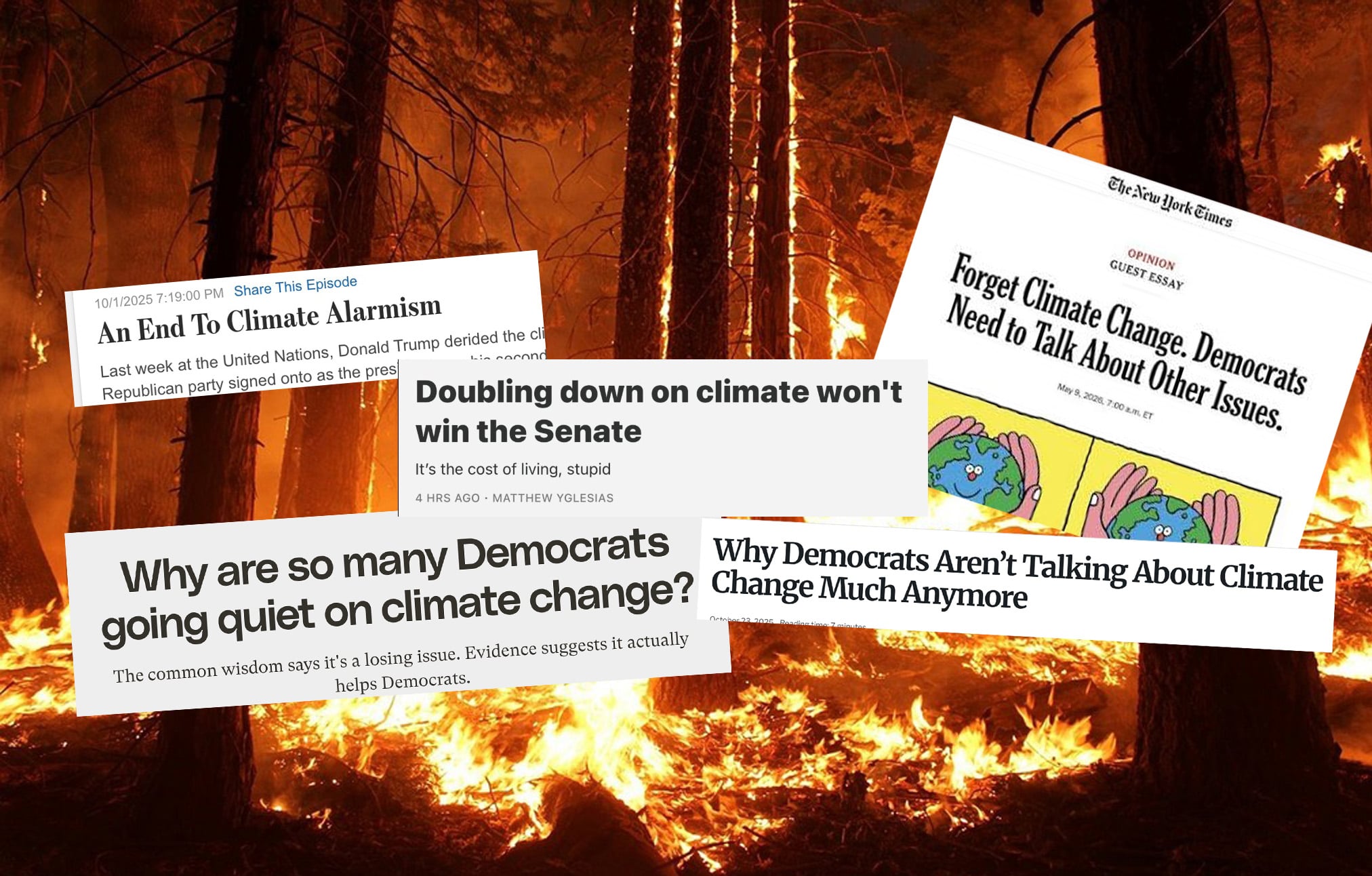
Something odd and disturbing has happened on the issue of climate change in the last few years. Even as the crisis has gotten worse, and the need to address it more urgent, elected officials have been talking about it less. This month, Vox’s Kate Yoder observes that “Democratic politicians who once talked about climate change as the defining crisis of our time now barely mention it at all” and “the phrase has begun disappearing from their speeches, social media posts, and podcast appearances.” (Republican politicians never pretended to care about it in the first place.) That includes some politicians who had previously been major climate advocates. And it’s not just among politicians. A recent Rockefeller Foundation report found “there has been a broad, persistent retreat in public language about climate,” with climate news coverage falling by nearly 40% and companies stopping discussing sustainability. Americans now “say they are hearing less about climate change in the news, on social media, and from people they know.”
I’m sorry to tell you that this silence is not because the climate crisis has been solved. On the contrary, the world is failing to meet its emissions targets and the consequences will be dire. By the middle of the century, a quarter of the U.S. could experience temperatures that exceed 125F, forming an “extreme heat belt” across the country. Hot days will be hotter, and there will be more of them, and 5 billion people—more than half of humanity—will be exposed to at least a month of health-threatening extreme heat every year. Those who work outdoors—construction workers, crop harvesters on farms, and so on—will disproportionately be killed. And the overall rate of warming may be accelerating. The world is now “on course to trigger tipping points that would lead to cascading consequences — from the melting of ice sheets to the death of the Amazon rainforest — that could not be reversed,” according to the Yale School of the Environment. Scientists keep warning us that “the planet’s future hangs in the balance,” and “which way it tips is down to our actions now and in the years to come.”
It can be overwhelming when you think about what’s coming, and it’s frightening, especially considering how much the globe has warmed already. But importantly, we can do something about it. We know the cause of the problem: it’s fossil fuels. As a “scientists’ warning” in Oxford Open Climate Change put it last year, we know that “fossil fuels and the fossil fuel industry are the root cause of the climate crisis, harm public health, worsen environmental injustice, accelerate biodiversity extinction, and fuel the petrochemical pollution crisis” even though “the fossil fuel industry has obscured and concealed this evidence through a decades-long, multi-billion-dollar disinformation campaign aimed at blocking action to phase out fossil fuels.” The task is straightforward: “phase out fossil fuel production and use, and make a rapid, just transition to clean, renewable energy and materials across the economy, while holding the fossil fuel industry accountable for its deception and damages.”
So that is the situation we are in: we face a very serious and terrifying problem, to which there are realistic solutions, which require a great deal of political will and effort. In that kind of moment, you’d expect that everyone who understands the nature of the problem and the solutions would be putting maximum effort into moving people to act. Yet reportedly, a kind of conventional wisdom has taken hold among Democrats that climate is simply not a “winning” issue electorally, and that therefore they should not discuss it. According to this narrative, in times when people are focused on the price of housing and groceries, talking about future planetary harms seems “out of touch.” People care about gas prices, and so you’re not going to win them over by telling them we have to get rid of the fossil fuel industry. A think tank called the Searchlight Institute said that the “first rule about solving climate change” was “don’t say climate change.” (No, it gave absolutely no evidence that not discussing problems is a good way to solve them.) The executive director of the Breakthrough Institutesays that activists stubbornly continue “to insist that, to be serious about climate action, ‘we need to talk about it,’” then asks “But do we?” Centrist blogger Matt Yglesias said Democrats need to embrace the fossil fuel industry, rather than explaining its crimes, forcing it to pay for the damage it has caused, and planning the transition to other energy sources. Even socialist writer Matt Huber, who wrote a book in 2022 arguing that it was imperative to frame the climate battle as part of the class struggle, recently took to the New York Times to say “When it comes to climate change, for now, it might be better to say nothing at all.”
There are many things wrong with this way of thinking. First, I have to stress that we are dealing with an issue of scientific reality, and the thing about facts is that, well, as a cool philosopher once said, they don’t care how you feel about them. They’re quite stubborn things. The climate crisis is happening regardless of how it polls. You can wish that it wasn’t. You can pretend that it isn’t. But you can’t stop it by not talking about it. That’s not how reality works. What we might call “Trumpian relativism,” the belief that “truth” is whatever you declare it to be, is a delusion. If we don’t talk about the crisis, we don’t deal with it, and if we don’t deal with the crisis, it gets worse. Talking about climate isn’t optional, it’s forced upon us by the facts of our situation. In the Don’t Look Up analogy: not looking at the comet doesn’t change the fact that it’s hurtling towards you.
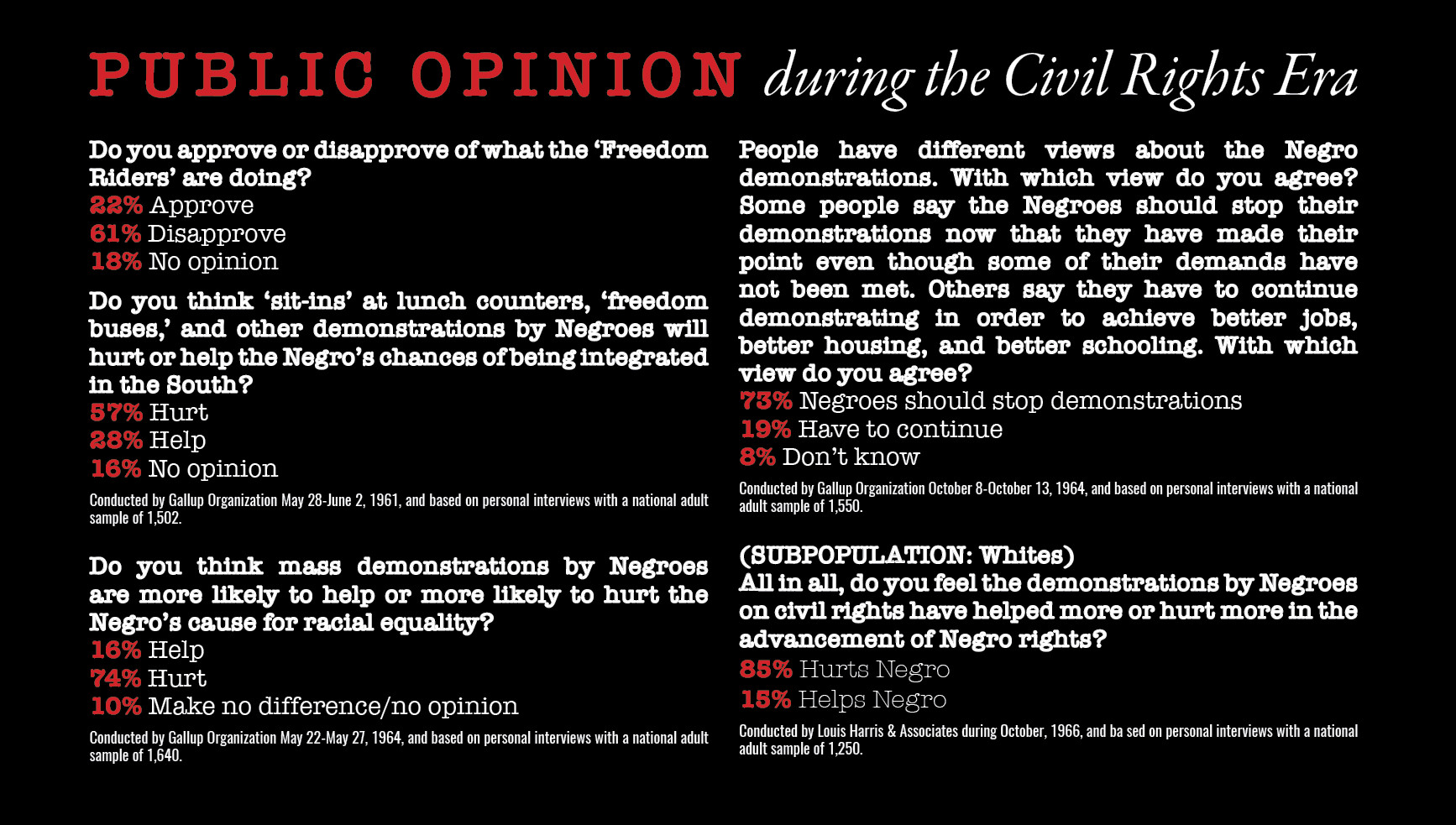
I am also getting sick and tired of this idea that the job of politicians is simply to check which way the political wind is blowing and adjust their messaging accordingly. This is how moral cowards act. Think about how this way of doing politics would encourage us to act during, say, the Civil Rights movement, or the Vietnam War. Instead of asking: Is Jim Crow unconscionable? Or Should the war be stopped? we would ask “how does the voting public rank the movement in terms of its core priorities?” And if it turned out that the majority of voters (who were white) didn’t care much about the Civil Rights movement, or actively disdained it (which was true), well, that would be reason enough not to talk about racial injustice. If Americans were indifferent to the war, there would be no responsibility to condemn it.
But when an issue threatens the future of the planet, we have a responsibility to try to shift public opinion. The task of a political leader becomes even more urgent if the public does not appreciate the level of danger they are in. Abandoning the issue is not optional when the fate of the planet is at stake.
I have so far spoken as if the premise of public indifference is true. But here’s the really crazy thing: it’s not even true. The public wants more climate action, not less! One poll found that 41 percent of Americans want to hear candidates talk more about climate, and only 22 percent want them to talk about it less. 57 percent of Americans think the U.S. should do more to address climate change, including 90 percent of Democrats. Pew polling last month revealed that Americans are increasingly pessimistic that enough will be done to avert the worst effects of climate change, and public concern about climate is reaching its highest point ever, with Gallup reporting in April “an increase in the percentage of Americans who think that the seriousness of global warming is generally underestimated in the news—44% now say this, compared with 38% a year ago.” Democrats who are silent on the issue are therefore defying their constituents. The Republican climate agenda is unpopular.
In fact, framed properly, the climate issue should be one on which Democrats are hugely politically successful. Why? Because the Republican position on this issue is “drill, baby, drill”—which in reality means We will destroy the chances of a livable future. If you don’t talk about climate, you’re setting aside the issue on which the other party’s position is We should hasten the worst natural disasters and lead your children to die from droughts and wildfires. I get very frustrated when Democrats won’t attack Republicans on climate, because this is an issue where the Republicans’ position is suicidally insane.
Some of this seems to be based on a huge misinterpretation of recent political history. The New York Times tells us:
Biden administration officials hoped their positions would not only help the planet, but also pay off with young and climate-minded voters. It didn’t work out that way. Young people, especially men, turned away from the Democrats in 2024[…] Almost immediately after the 2024 election, some strategists argued that Democrats should stop talking about the threat of global warming altogether. A growing number of Democratic politicians agree. Senator Ruben Gallego of Arizona said recently he and many others aren’t discussing climate change during the midterm election season because “we want to win.”
In this view, Biden prioritized a major climate policy (the Inflation Reduction Act), Americans weren’t impressed, and this showed Biden had picked the wrong issue. But, even leaving aside the question of whether the IRA was a particularly impressive piece of climate legislation, this ignores the crucial fact that Joe Biden was an absolutely terrible communicator whose presidency was doomed in large part by his own age-related decline. If Americans did not particularly understand the benefits of Biden’s policies, it is substantially because Biden had to hide from the public because he was so incapable of speaking in full sentences. And young people certainly did not turn away in 2024 because they thought Biden had done too much about climate change! The most significant blunder that Biden and Harris made was their support for a hugely unpopular genocide, which their administration continued to arm and fund even as young people expressed their disgust in droves. To say that the lesson of 2024 is that we should talk less about climate is like saying Hubert Humphrey’s loss in 1968 proved Democrats were wrong to pass the Civil Rights Act. (What about the massively unpopular war?)
Democrats who don’t talk about climate are actually leaving a potentially winning issue on the table. University of Wyoming economist Matt Burgess has researched the issue and found that “climate change as an issue overall helps the Democrats and hurts Republicans,” and believes Trump might have won in 2020 if the issue of climate change wasn’t discussed. Former NOAA chief scientist Craig McLean says “it befuddles me” why even some activists “have relinquished their traditional role of illuminating the damage Trump has done to scientific institutions and the climate.” Climate is “there on the table right in front of our noses,” but instead of mobilization there’s an eerie silence. Politico reports that “the climate system’s warning signs are blaring, but hardly anyone in Washington has noticed.” Senator Sheldon Whitehouse has condemned this “climate hushing,” saying that it is not only immoral but passes up an opportunity for Democrats to show themselves to be fighters on issues that count.

Indeed, the Rockefeller Foundation report finds that when climate isn’t a politically winning issue, it’s largely because it’s framed badly. (The public isn’t inspired by the phrase “net zero,” for instance.) However, “climate solutions continue to command broad, cross-ideological support” when the problem and solutions are stated clearly, intelligibly, and without vacuous jargon. Yoder’s Vox article concludes that Democrats’ climate silence is simply based on a myth: “Studies show that politicians and the public at large tend to vastly underestimate Americans’ appetite for taking action on climate change, from carbon taxes to expanding renewable energy.”
Of course, some Democrats may have self-interested reasons for believing that myth, such as California gubernatorial candidate Xavier Becerra, whose campaign was backed by the oil and gas industry, and who successfully defeated longtime climate activist Tom Steyer. But that doesn’t explain the actions of someone like Senator Ed Markey, who once made the Green New Deal his signature legislative proposal, before eliminating it entirely from his messaging. (Even Alexandria Ocasio-Cortez has diminished her Green New Deal advocacy.)
Climate silence is a gift to the fossil fuel industry. The deniers are elated. David Marcus of Fox News said that Huber’s New York Times op-ed telling Democrats to stop talking about climate marked the “end of the climate hoax.” “I agree with The New York Times. It is time for this madness to end. We do not need to saddle our children with the emotional and economic damage of make-believe climate disasters.” The Wall Street Journal opinion editors are taking a victory lap, and think it’s wonderful that climate change is being accepted as something we can live with rather than treated as a serious problem. The Trump administration’s war on renewable energy is meeting with far less opposition and comment than it would have back when the Green New Deal was among the top items on the progressive agenda.

I do understand the reasons why other issues have come to take precedence. When the rent is too damn high, I see why a democratic socialist like Zohran Mamdani would campaign almost singularly on affordability. When a genocide is unfolding, I see why a morally serious activist like Greta Thunberg would start spending more time talking about Gaza than climate. There is a great deal going on in the world, and climate seems like a long-term issue that can be dealt with secondarily. But that is an illusion. In fact, while something like fixing healthcare or raising the minimum wage would seem to deliver immediate benefits, climate is distinct in that there is very much a ticking clock. It has to be addressed now, because we are at a point in history where our carbon budget is being rapidly depleted. The transition to renewable energy has to occur now, not once we’ve dealt with other things that we want to rank higher on our to-do list.
I’ve remarked before that one of the most realistic aspects of Don’t Look Up was the way it portrayed the escalation of denial. You might have expected that the scientists warning of a comet hurtling to Earth would only be ignored until people could see the comet with their own eyes. But when it actually appeared in the sky, denial would no longer be possible. That’s not what happens in the film. Instead, the more obvious the comet becomes, the more denial intensifies, with “don’t look up” becoming a kind of anti-woke catchphrase. Climate change has been similar. You might have thought that as the effects really started to be felt (out-of-control wildfires from California to Britain, catastrophic flooding in Pakistan), people’s sense of urgency would finally match the warnings of scientists. Instead, the opposite has happened: after a moment where it seemed like we were making progress toward serious action, there has been a devastating backsliding, leading climate scientists to tear their hair out with frustration, as the fossil fuel industry looks to have totally won.
But those of us who still want to build a livable future cannot allow ourselves to be cowed. We must not shut up about climate change just because others are. As Genevieve Guenther and Michael E. Mann write in the Bulletin of the Atomic Scientists, “the need to drive emissions down to net zero and halt global heating remains as urgent today as ever.” We must demand that progressive politicians have a climate platform. If they don’t, we must demand they explain why they’re not taking the problem seriously. (Even some politicians I admire seem to have set climate aside.) We must aggressively fight the efforts by people like Yglesias to tell us to stop worrying and embrace fossil fuels. We must force climate change back into the discussion, because avoiding confronting the crisis head-on will only ensure that the worst possible outcome becomes inevitable.