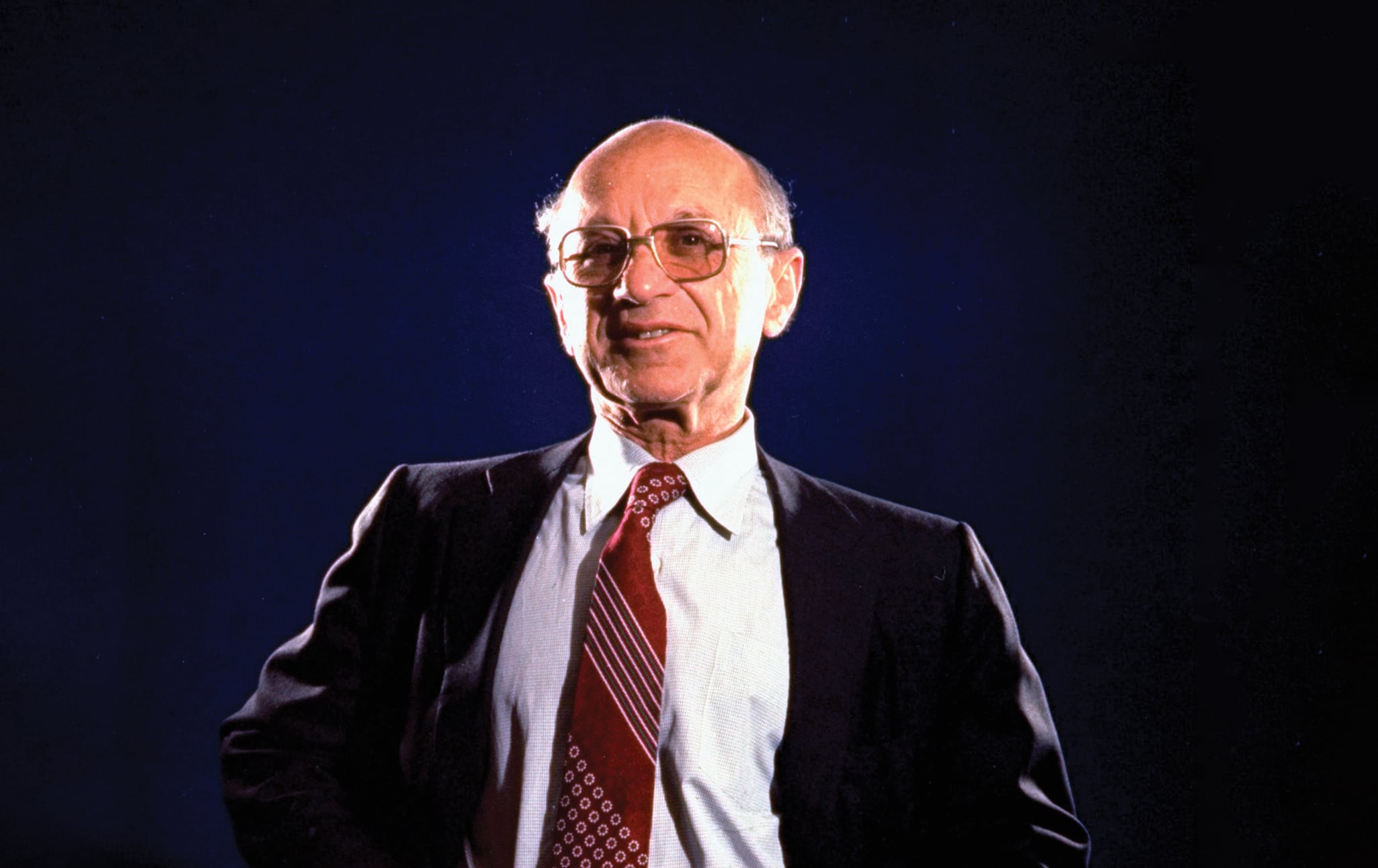
You can’t understand what’s wrong with the 21st century without confronting the High Priest of the Invisible Hand.
More than 20 years after his death, we’re still living in the neoliberal world Milton Friedman made.
The arc of neoliberalism begins in 1947, gathers steam in the 1970s, and reaches its zenith in the 1990s before breaking into a million pieces and forever out of the control of its progenitors. The story of Milton Friedman rises and falls along with it, and it’s a complicated one of ego, ambition and academic notoriety; a confluence of factors and foibles that came to define the modern economic age.
Much of what plagues our society today and fueled the rise of Donald Trump can be traced to the theories of two giants in the field of economics, the so-called “dismal science”—Friedrich Hayek and Milton Friedman. They actually didn’t refer to themselves as neoliberals, preferring the term “neoclassical liberals.” A difference without a distinction, perhaps.
It’s impossible to separate Friedman from his early mentor and supporter Hayek. Their early mentor-mentee relationship evolved over time to a respectful intellectual rivalry, but they would be forever linked through the economic society Hayek formed and Friedman later helmed.
Moreover, it’s equally impossible to separate either of them from their chosen antagonist, John Maynard Keynes—the man they supplanted in the halls of academia and power.
But Friedman’s penchant for media, outsized personality, and army of disciples have made him the avatar of neoliberalism, the economic theory that dominated U.S. politics for the past half century.
To wit, in a New York Times eulogy penned shortly after Friedman passed away, former Treasury Secretary Larry Summers famously offered this opening salvo:
If John Maynard Keynes was the most influential economist of the first half of the 20th century, then Milton Friedman was the most influential economist of the second half.
Not so long ago, we were all Keynesians. (“I am a Keynesian,” Richard Nixon famously said in 1971.) Equally, any honest Democrat will admit that we are now all Friedmanites.
For better or worse, truer words may never have been spoken.
The Boy From Rahway Takes Over Chicago
Born in Brooklyn on July 31, 1912, to Jenő and Sára Friedman—Jewish immigrants from Carpatho-Ruthenia who had arrived in America with little more than the clothes on their backs—Milton Friedman grew up in Rahway, New Jersey, in a household where financial hardship was not an abstraction. His father died in 1927 during Milton’s senior year of high school, leaving the family to navigate the Depression on a seamstress's income. (Friedman graduated high school at 16.)
It was clear from an early age that Friedman had a keen mind. He earned a competitive scholarship to Rutgers, intending to become an actuary before economics seduced him away from pure mathematics. He went to the University of Chicago in 1932, then to Columbia on a fellowship, then back to Chicago, where he would remain, intellectually if not always physically, for the rest of his career.
From the start, Chicago’s economics department had a chip on its shoulder the size of the Midwest. Harvard had its prestige. The London School of Economics had its lineage. Chicago had its ambition—and a foundational conviction that economics was not philosophy, not art, not politics. It was science. Hard, mathematical, empirically rigorous science. Johan Van Overtveldt, author of The Chicago School, describes the department’s governing characteristics as “a strong work ethic, an unshakable belief in economics as a true science, academic excellence as the sole criterion for advancement, an intense debating culture focused on sharpening the critical mind, and the University of Chicago’s two-dimensional isolation.”
Removed from the policy groupthink of Washington, insulated from the social pressure of the East Coast establishment, Chicago’s economists developed what amounted to a self-contained intellectual universe. They called their arguments “bullfights.” They encouraged dissent. And in that crucible, they forged a particular kind of certainty—the kind that comes not from comfort but from endless combat with every counterargument until only one truth remained standing.
That truth, increasingly, was Milton Friedman’s.
Get 20 percent off a print subscription to Current Affairs when you use the code UNFTR !

A (Very) Brief History of Economics
Before we go further, a brief but essential detour into the history of the economic discipline, and into terminology—because certain labels tend to be misconstrued when viewed through modern ideological lenses.
Classical economics is the foundation constructed by noted Enlightenment era political and economic theorists, such as Adam Smith, David Ricardo, Jeremy Bentham, and Cesare Beccaria, who provided foundational elements of market theories and economic measurements that persist to this day. One of the earliest convictions among the classical economists was that markets, left alone, allocate resources efficiently through price signals and competition. Thus the introduction of laissez-faire capitalism, a concept that is either celebrated or maligned depending upon one’s political lens.
Importantly, these early philosophers were observing pre-industrial, agrarian economies. Industrialization created new economic and political laboratories that became increasingly interconnected through transportation and trade, providing fertile ground for a new generation of economists to build on the classical theories. Chief among them, of course, is Karl Marx, who both observed and projected the dangers of industrialization on the capitalist system and how it would lead to the social stratification and economic dislocation of the working class.
Neoclassical economics is the methodological revolution that began around the 1870s, as figures such as William Jevons, Léon Walras and Alfred Marshall built on the work of their Classical predecessors. They formalized economics into mathematics—marginal utility, supply and demand curves, equilibrium theory.
As the Great Depression and the New Deal era unfolded, progressive economic policy began to revolve around John Maynard Keynes, who laid the foundation for the next era in his seminal work General Theory of Employment, Interest and Money, published in 1936. Keynes, the titan of the discipline for most of the 20th century, was working within a neoclassical framework even as he constantly challenged its policy conclusions. He believed capitalism could be reformed and integrated with features of social democracy and opened the door to the idea that government stimulus could alternately mitigate the impact of down cycles and cool periods of inflation.
It was Keynes who made the invisible hand visible, and argued that the hand belonged to the government—and it was this idea that Friedman would spend his life opposing.
What we know today as “neoliberalism” is where the clean academic narrative gets complicated. The term has been so relentlessly contested—including by Friedman himself, who rejected it—that its meaning has been deliberately obscured. But it has a precise historical definition: the post-World War II project of reconstructing market order through the active use of state power.
In an interview for the book Economics and the Left, Korean economist Ha-Joon Chang notes: “These days, Hayek is considered an eccentric European version of Milton Friedman, but Hayek’s theory—that is, Austrian economics—is very different from Friedman's neoclassical theory.” Friedman was a mathematician’s economist. His models demanded quantifiable inputs and produced quantifiable outputs. Hayek was something else entirely—a social philosopher whose economics were inseparable from a broader vision of Western civilization, culture, and what he believed to be the organic superiority of Christian liberal society.
It is Hayek’s framework, not Friedman’s, that directly nourishes the xenophobic, white nationalist strand of contemporary libertarianism. Quinn Slobodian’s recent book Hayek's Bastards traces precisely how those racial and civilizational anxieties became fused to free market doctrine—a lineage that runs from Mont Pèlerin through the Heritage Foundation through to the ideological infrastructure of the contemporary far right.
Friedman was not that. This distinction is critical, and this inquiry would be dishonest to collapse it. Milton Friedman was seemingly not a racist, although he was oblivious to the reality of how racial oppression works. He advocated for the abolition of the welfare state because he believed the free market would provide for the impoverished. He was, by all accounts, a devoted husband to Rose Director Friedman—an accomplished economist in her own right and the older sister of Aaron Director, one of Friedman’s closest collaborators at Chicago—and a generous intellectual sparring partner who made himself available to students and peers alike.
He was a small man, physically, who commanded a room through the sheer velocity of his mind. He was funny. He was warm. And he was, in the most complete sense of the word, wrong.
The Counter-Revolution Convenes
In April 1947, Friedrich Hayek convened 39 economists, philosophers, and historians at a hotel on Mont Pèlerin, a Swiss mountain overlooking Lake Geneva. Among them: Milton Friedman, Karl Popper, Ludwig von Mises, and George Stigler. The Mont Pèlerin Society, as they named it, was not a think tank. It was a counter-revolution in embryo—a network of ideological allies who shared a conviction that Western liberalism was under existential threat from collectivism, central planning, and the creeping influence of Keynesian thought.
Friedman later recalled that the inaugural meeting was “thrilling,” as it was his first time out of the country and meeting other economists from around the world. Over the following four decades, Mont Pèlerin alumni would seed their ideas into governments, universities, and media institutions across the globe—funding think tanks, training economists, and building the institutional infrastructure that would eventually deliver the Reagan Revolution, Thatcherism, and the structural adjustment programs of the IMF.
The Society’s self-described purpose was to defend “freedom.” But as Van Overtveldt notes, the foundational assumption beneath every Chicago model was already in place:
The basic assumption of neoclassical economic theory is the proposition that in a competitive market environment, individuals and corporations pursuing their own self interests necessarily promote the best interest of society as a whole.
This concept haunts us to this day.
Back at the University of Chicago, Friedman began his long collaboration with economic historian Anna Schwartz at the National Bureau of Economic Research. It was here that he worked out the ideas that would eventually reframe post-war economics: the permanent income hypothesis, the natural rate of unemployment, and above all, monetarism.
Permanent Income challenged the longheld Keynesian notion that the rate of consumption—literally, how much stuff people buy—was correlated to one’s current financial position. Friedman suggested, instead, that consumption was a reflection of expected future income. This may sound like a subtle distinction, but it’s one of the underpinnings of “trickle down” economics, because policymakers extrapolated this to mean that reducing taxes adds to future income expectations, thereby spurring consumer spending.
His concept of a “natural” rate of unemployment is worthy of its own treatise, and in fact has been the subject of debate in economic and policy circles since Friedman introduced it in his landmark 1968 presidential address to the American Economic Association.
The argument was devastating to the Keynesian consensus. According to Friedman, there is a “natural rate” of unemployment determined by real structural factors—labor market frictions, skills mismatches, information gaps, regulatory barriers—and monetary policy cannot push unemployment below that rate permanently. If you try, you won’t get lower unemployment; you get accelerating inflation. And because workers eventually figure out they’re being paid in dollars that are increasingly less valuable, they demand higher wages, thus wiping out any employment gains. Nearly six decades after Friedman’s address, this basic concept still drives Federal Reserve policy, which revolves around the so-called “dual mandate” of maximum employment and price stability.
Here’s how this translates into our everyday lives. The Federal Reserve and all government agencies with budgetary responsibility buy into the notion that there is a magic equilibrium of employment; that the perfect or “natural” rate is somewhere between 4.5 and 6 percent unemployment. In other words, both parties ascribe to the notion that a significant number of Americans who are considered “available” to work MUST be out of work for the economy to function properly. In the most generous reading of this (4.5 percent) that means that 7.6 million of the 170 million “available” American workers must be unemployed. By extension, our fiscal and monetary policies should therefore be oriented around this goal. These hypotheses became part of the modern economic belief system from the Alan Greenspan era forward.
The dogmatic devotion to Friedman’s principles helps explain why his broader framework of monetarism took hold with such devotion. At its core, monetarism exists in opposition to Keynes’ belief that governments are obligated to intervene with fiscal measures during times of crisis in particular. Friedman argued that monetary policy—interest rate guidance and changes to the money supply—are all that’s required to provide equilibrium in the markets.
This monetarist framework rests on a deceptively clean premise: “inflation is always and everywhere a monetary phenomenon.” The phrase anchors Friedman’s 1963 magnum opus, A Monetary History of the United States, 1867-1960, co-authored with Schwartz—a book that demonstrated with meticulous archival work that the Federal Reserve’s failure to expand the money supply during the early 1930s had turned a severe recession into the Great Depression.
It was a radical inversion of the then-dominant narrative, which blamed the Depression on speculative excess and structural failure. Moreover, it created a permission structure for future monetarists to downplay the role of fiscal interventions and social welfare programs—such as expanding unemployment benefits—during times of economic crisis. It also absolved those who participated in the culture of reckless speculation that always precedes these events.
Binyamin Appelbaum, in The Economists' Hour, describes the tension between Friedman and Keynes’ views as such:
Keynesians regarded inflation as a complex phenomenon with many potential causes and many potential remedies. The problem might be too much government spending, or a sharp drop in the oil supply, or unions pressing for higher wages. And each cause had its own cure. Friedman, by contrast, had a radically simple view: governments caused inflation by printing too much money—by expanding the quantity of money in circulation faster than the growth of the economy—and governments could reduce inflation only by printing less money.
In academic circles this distinction became known as the “normative” versus “positive” economics debate. The former is often associated with Keynes’ comprehensive and situational worldview, the latter with Friedman’s narrower monetarist convictions that were supposedly more empirical and universal.
But this reliance upon scientific methodology had a massive hole in it, as Friedman’s detractors would come to point out. As Friedman asserted in one of his most influential essays, The Methodology of Positive Economics, “Economics as a positive science is a body of tentatively accepted generalizations about economic phenomena that can be used to predict the consequences of changes in circumstances.” Essentially, Friedman was dismissing the importance of assumptions, arguing that they were too open to interpretation and therefore only the equations mattered in the explanation of economic phenomena.
This led critics to accuse Friedman and his acolytes of essentially bending formulas to justify outcomes no matter how absurd the premise. In economic circles this is described as the F-Twist: a methodological get-out-of-jail card.
Over the next few decades, the devotion to monetarism became an almost religious orthodoxy. The Chicago School and its adherents filled the ranks of think tanks, NGOs, and every administration from Reagan to Trump, armed with the confidence of men who believed they had put economics on the same footing as physics, and the incuriosity of men who had stopped checking whether the equations matched the world outside the window.

“TANSTAAFL”
Friedman didn't invent the phrase “there ain’t no such thing as a free lunch”—its traceable lineage runs to a fable in a 1938 Scripps-Howard newspaper editorial, and Robert Heinlein immortalized the acronym TANSTAAFL in his 1966 Hugo Award-winning novel The Moon Is a Harsh Mistress. But Friedman weaponized it. He deployed it as a rhetorical battering ram in lectures, columns, and television appearances for decades, and published a 1975 essay collection under that exact title. It became so associated with Friedman that even Bartlett's Familiar Quotations attributes the phrase to him.
Friedman co-opted the phrase by explaining it as “the belief that somehow or another, the government can spend money at no one’s expense.” In keeping with the more laissez-faire interpretations of Adam Smith, Friedman acknowledged certain government functions as legitimate and therefore worthy of taxation. In these limited cases, most notably the common defense of the nation, a transparent universal tax would apply. “The least bad form of taxation is a straight flat rate tax on all spending above a minimum charged on everybody and collected in such a way that people know they are paying it. The second least bad tax is a similar flat rate tax on all income above a minimum,” he wrote.
His view on taxation and the distribution of funds relied on his faith in the free market to deliver funds where they are needed. In need of a road? Charge a toll. Parks need upkeep? Charge an entrance fee. The market, in its infinite wisdom, would always know what to extract. Supply would always match demand if the government would simply leave it alone. Otherwise, surplus government taxation would come at the cost of this efficiency.
Bureaucracy was the enemy of the people, not the extractive nature of the corporate class. And in fact, Friedman believed that corporations should be exempt from all forms of taxation.
There is also a profound irony embedded in Friedman’s signature line. It’s perhaps true that there is no such thing as a free lunch. But there is also no such thing as a free market. In the purest sense, a market is a general term to describe a physical or virtual place where buyers and sellers come together to exchange goods and services. But the idea that a “pure” market exists is itself a fallacy that ignores the mechanisms and human interventions required to construct them.
The central object of Friedman’s creed—the free market—is, as author Bernard Harcourt demonstrates with irrefutable clarity in his book The Illusion of Free Markets, something that simply does not exist:
At the end of the day, the notion of a free market is a fiction. There is no such thing as a non-regulated market—a market that operates without legal, social and professional regulation. Those forms of regulation—including the criminal sanction—are precisely what distributes wealth and resources, what makes it possible for the CBOT [Chicago Board of Trade] to exclude nonmembers from the trading floor, for the Big Four accounting firms to effectively control accounting standards, and for large commercial banks to essentially coordinate lending practices. All these practices are regulated. The question is thus not whether to regulate. Instead the only question is how the existing and prospective kinds of regulation distribute wealth. That is the only important question and it is, crucially, masked by our faith in natural order and efficient markets.
The Chicago School’s foundational commitment was not to freedom per se. It was to a particular configuration of regulation—one that concentrates wealth upward while making that concentration appear natural, inevitable, and beyond political remedy.
If we think of the foundational elements of markets that are allowable under Friedman’s doctrine, the logic falls apart immediately upon inspection. Property rights are regulation. Contract law is regulation. The limited liability corporation—the legal structure that shields shareholders from accountability for the harms their companies produce—is regulation. The exclusion of non-members from institutions like the Chicago Board of Trade (CBOT), as Harcourt notes, is regulation. Moreover, every “free” market that has ever operated has been constituted by the state. The only question Friedman never allowed himself to ask—because the answer would have dismantled everything—was: regulated for whose benefit?
From Economic Theory to Doctrine of Faith
If Mont Pèlerin brought Friedman out of academia, the critical transition in Friedman's career was a political campaign that showed him how economics was a discipline capable of reshaping civilization.
In 1964, Barry Goldwater ran for president on the most uncompromising conservative platform in modern American history. Friedman signed on as an adviser. He would always bristle at being called a conservative—he considered himself a pure libertarian, untethered from the social traditionalism of the GOP’s dominant wing. But the Goldwater campaign was a marriage of convenience that suited both parties. Goldwater needed intellectual legitimacy. Friedman needed a political vehicle.
Goldwater was, as Appelbaum describes, “the beta version of Reagan.” Friedman’s first non-academic book, Capitalism and Freedom—based on a series of his lectures—was a sensation in conservative circles (and publicly lauded by both Reagan and Goldwater).
The candidate lost in a historic landslide. The ideas, however, took root in the minds of a generation of young conservative operatives who were paying attention.
Goldwater also gave Friedman’s politics their first public airing. His position on race and poverty was not the crude bigotry of the segregationist wing—but it was, in its own way, almost as structurally pernicious. He argued that it was government, not racism, that kept Black Americans poor. Minimum wage laws priced them out of the labor market. Inferior public schools—themselves a product of state mismanagement—left them underprepared.
The free market, he insisted, was colorblind. This argument conveniently absolved capital of any responsibility for centuries of enforced exclusion, redlining, and deliberate economic suppression.
The moment that crystallized Friedman’s transformation from economist to ideological warrior arrived shortly after in 1970, courtesy of Ralph Nader. Nader had already remade American consumer culture with Unsafe at Any Speed, his 1965 exposé of General Motors’ deliberate suppression of safety data on the Chevrolet Corvair. The book was a bestseller, triggered Senate hearings, and directly produced the Department of Transportation and the National Highway Traffic Safety Administration. When GM, rather than addressing Nader’s criticisms, hired private investigators to surveil and attempt to entrap him, the company’s president was forced to issue a public apology before Congress. Nader sued, won, and used the settlement to fund the modern consumer advocacy movement.
Friedman was not amused. Friedman’s response, published in the New York Times Magazine in September 1970, was one of the most consequential op-eds in American economic history.
Its central claim was this: the sole social responsibility of business is to increase its profits. Any executive who diverted corporate resources toward social ends—cleaner air, safer products, fairer wages—was guilty of a form of taxation without representation, spending shareholders' money on causes they hadn’t sanctioned.
The piece didn’t merely push back on Nader. It gave the shareholder primacy movement its founding scripture. This is the concept that the only responsibility of a corporation is to its shareholders. This may sound innocuous or even obvious to modern ears, but it was a revelation that hit corporate America like a thunderbolt. As Kurt Andersen writes in Evil Geniuses: “Starting in the 1970s, the Friedman Doctrine and its extrapolations freed and encouraged businesspeople and the rich to go ahead and conform to the left-wing caricatures of them, to be rapacious and amoral without shame.”
Friedman didn’t just describe how corporations behave—he gave them permission to behave badly. Of course, he wasn’t alone in this pursuit. Within a year of his New York Times broadside, the intellectual infrastructure for a full corporate counter-offensive was being assembled.
In August 1971, Lewis Powell—a corporate attorney who would be appointed to serve as an associate justice of the Supreme Court two months later—drafted a now infamous memorandum to the U.S. Chamber of Commerce that reads today like a founding document of the modern right. American free enterprise, Powell argued, was under systematic attack—from campuses, from consumer advocates like Nader, from the media, from the government. Business needed to fight back not issue by issue but institutionally: funding think tanks, placing economists in universities, cultivating the judiciary, and buying the credibility of the academy itself.
What followed was a social project of stunning scope. The Heritage Foundation (1973). The Cato Institute (1977). The Manhattan Institute (1977). The American Legislative Exchange Council (1973). A network of funded academic chairs, law school programs, and media outlets was designed to produce, amplify, and legitimize many of the ideas born at Mont Pèlerin, with Friedman emerging as a media-ready spokesperson of sorts.
The think tanks produced papers. The papers influenced legislation from Ronald Reagan’s tax cuts and deregulation and Bill Clinton’s destruction of the welfare state and criminalization of immigrants to the Trump era’s tax cuts and gutting of federal agencies.
The legislation was defended in courts staffed by judges trained in the law and economics movement pioneered at—where else—the University of Chicago.
By the time he debuted his ten-part Public Broadcasting System (PBS) series in 1980 to support Free to Choose, which he co-authored with his wife Rose, Friedman had crossed from economist to cultural phenomenon. It was a groundbreaking series, designed as a response to the rise of Nader’s consumer advocacy, that announced Friedman as a public intellectual. Yet one should note the deep irony in utilizing PBS—a non-profit organization supported in substantial part at the time by taxpayer dollars—as the vehicle for this same documentary.
Stagflation Opens the Gate
Free to Choose made Friedman somewhat of a cultural phenomenon. He frequently lectured around the country and became a regular on popular talk shows such as Phil Donahue. He was a master communicator and polemicist who honed his persona and debate skills over the years at the University of Chicago. But it was more than the vessel; it was also his message that resonated with a public hungry for answers when the stagflation crisis of the 1970s gripped the nation.
Stagflation—simultaneous high inflation and high unemployment—was supposed to be impossible. The Phillips Curve, the empirical relationship between inflation and unemployment identified by New Zealand economist A.W. Phillips in 1958, had become the backbone of Keynesian economic management. Its logic was intuitive: when unemployment was high and fewer people were earning and spending, inflation stayed low. When unemployment was low and workers were gainfully employed, consumer spending rose, demand outpaced supply, and prices followed in what economists call demand-pull inflation.
The curve implied a stable tradeoff—a policy menu governments could use to dial between the two evils depending on which was more politically tolerable. Stagflation blew that menu apart. High inflation and high unemployment were not supposed to coexist. The fact that they did—violently, across the entire Western world—discredited the framework that had ruled economic policy for a generation and left Keynesian policymakers without a coherent response.
Milton Friedman, who had predicted for years that the Phillips Curve relationship was unstable and would eventually break down, stepped forward with his diagnosis and his cure. Thus, the political opening for Friedman’s ideas came not from the strength of the theory but from the convenient collapse of its competitor.
The true causes of the 1970s stagflation crisis were complex and well documented—twin oil shocks, oil embargos, changes to the value of the Dollar and the inflationary pressure of an overheated war economy—but Friedman had a simpler, more digestible message: money supply.
Friedman’s monetarism did not explain stagflation. It simply had a pre-packaged answer ready when the old answers failed. In a crisis, whoever has the simplest message usually wins the narrative. And Friedman’s message—government causes inflation, the market cures it—was simple, authoritative, and delivered by a Nobel laureate.
The Reagan administration absorbed the Chicago creed wholesale. Cut taxes on the high earners. Deregulate industries. Break the unions. Shrink the government. And frame every one of these choices not as a political decision made by people with interests, but as the natural, inevitable, scientifically validated operation of the market. Grover Norquist’s famous formulation—“I don’t want to abolish government, I simply want to reduce it to the size where I can drag it into the bathroom and drown it in the bathtub”—was not a fringe position. It was the logical endpoint of the Chicago doctrine, applied without Friedman’s occasional squeamishness.
It was not only Republicans who capitulated. The Clinton administration delivered the most comprehensive Democratic embrace of neoliberal governance in American history: NAFTA, welfare reform, the crime bill that supercharged mass incarceration. Then there’s the repeal of the Glass-Steagall Act, Depression-era legislation designed to protect consumer depositors from Wall Street speculators. Many believe this was the true catalyst of the 2008 global financial crisis.
“The era of big government is over,” Clinton told Congress in 1996. He meant it.
The universal solvent of free market ideology worked on Democratic politicians for the same reason it worked on Republicans: it was not merely an economic argument. It was a moral one. It offered a framework in which every act of deregulation was reframed as liberation, every tax cut as freedom, every gutted social program as an act of respect for individual dignity.
Read generously, this is a coherent libertarian philosophy. Read honestly, it is a blueprint for the elimination of every public institution that stands between ordinary people and the raw coercive power of the market. It’s all in how you sell it. And that’s why we still talk about Milton Friedman to this day.
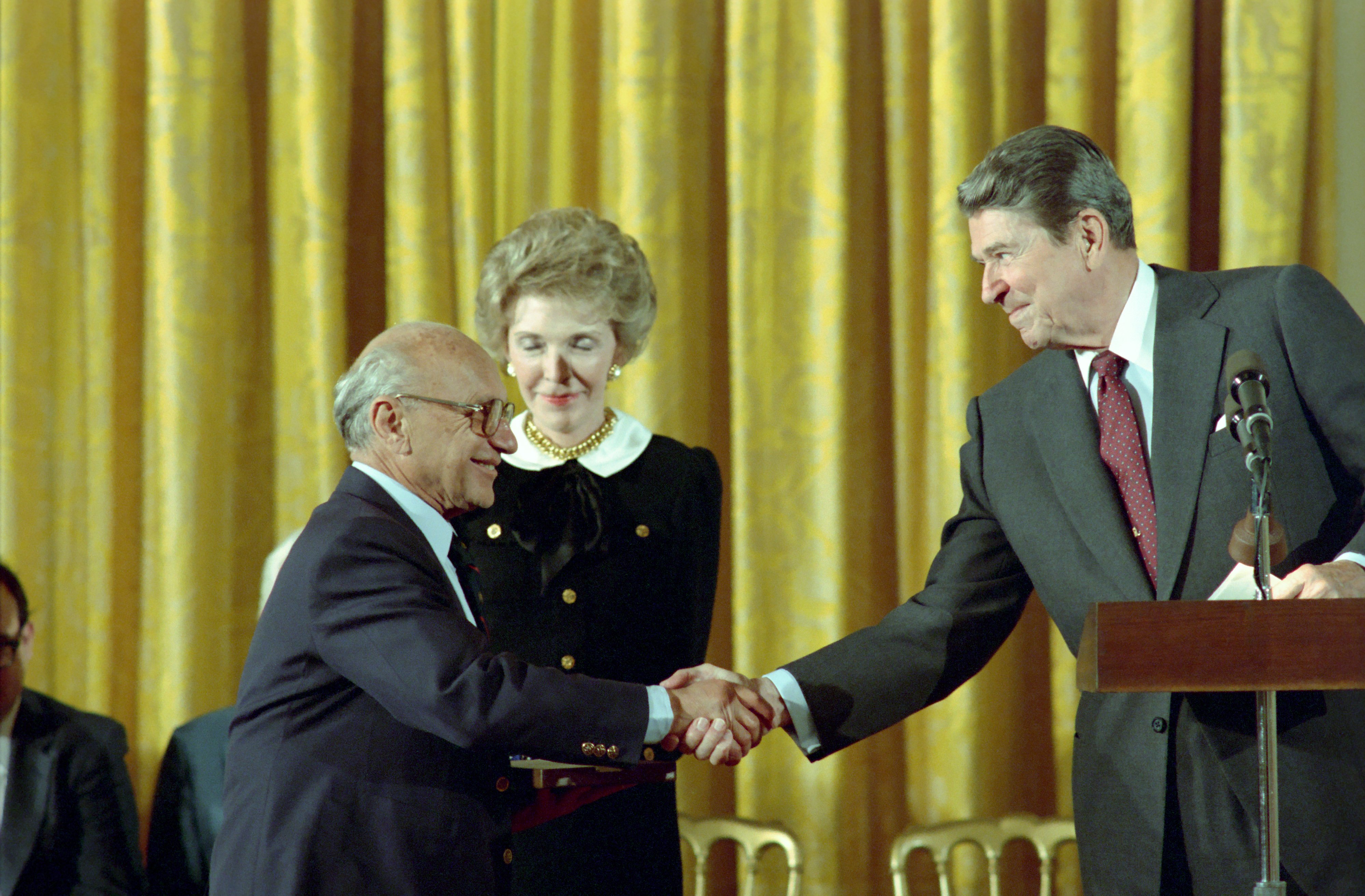
Friedman accepts the Presidential Medal of Freedom from Ronald Reagan, 1988. (Photo: Wikimedia Commons)
The Original 9/11
No discussion of Friedman’s legacy can avoid Chile.
The “Chicago Boys” were a cohort of Chilean economists who had trained at the University of Chicago under Friedman and his colleague Al Harberger. After the CIA-backed coup that overthrew Salvador Allende on September 11, 1973 and installed Augusto Pinochet, these economists became the architects of Chile’s radical economic restructuring—privatization of state industries, elimination of trade barriers, pension privatization, the gutting of labor protections. It was, in many respects, the most comprehensive real-world experiment in Chicago School economics ever conducted.
Friedman’s personal involvement was limited. He visited Chile in 1975, met briefly with Pinochet, and advised a rapid “shock treatment” approach to bring inflation under control. His contacts with the regime were few. In fact, Friedman took great pains to avoid speaking on foreign policy and interventions, though he was a fierce opponent of conscription. He was genuinely uncomfortable with ballooning defense budgets but believed them to be far less problematic than the size of social programs and regulations.
But the distinction between the theorist and the laboratory does not exculpate him. Friedman knew what was happening in Chile. He knew that the “economic freedom” being implemented was built on a foundation of political terror—the disappearance and murder of thousands of dissidents, the systematic destruction of organized labor by force. His response, when pressed, was that economic liberalization would eventually produce political liberalization. He was wrong about that too. And more importantly, the comfort with which he deployed his theories in the service of a murderous regime revealed something about the internal logic of Chicago economics: in a world where only market outcomes matter, everything else—including human beings—becomes an externality.
The Reckoning That Wasn’t
On October 23, 2008, Alan Greenspan—the Ayn Rand acolyte, the 18-year Federal Reserve chairman, the man known in the halls of power as “The Maestro”—appeared before the House Committee on Oversight and Government Reform. When pressed for what had gone wrong in the financial system that he presided over for decades, The Maestro meekly conceded: “I found a flaw. I have been very distressed by that fact.”
The flaw was greed. “I made a mistake,” Greenspan continued, “in presuming that the self-interests of organizations, specifically banks and others, were such that they were best capable of protecting their own shareholders and their equity in the firms.” The self-interest of banks and financial institutions—which the entire Chicago framework assumed would function as a self-correcting mechanism, protecting shareholders and the system—had instead produced systemic fraud, predatory lending, and a global financial collapse that wiped out trillions of dollars in household wealth and threw millions of people out of their homes.
The field of economics had not predicted the crisis. Had not understood it when it began. Could not agree on what to do about it. And as the dust settled, the economist whose framework proved most useful in diagnosing the damage and prescribing a capitalist response was the one Friedman and his disciples had spent 60 years trying to bury. As Gregory Mankiw—a conservative Harvard economist, not a Keynesian—wrote in the New York Times in the depths of the crisis: “If you were going to turn to only one economist to understand the problems facing the economy, there is little doubt that the economist would be John Maynard Keynes.”
The markets had done what Keynes always knew they would do, given the opportunity. They had followed human nature to its logical conclusion.

The Patsy
The neoliberal era was made possible by the economic theories and ideas hatched within the Mont Pèlerin Society. These ideas would have remained fringe concepts were it not for the stagflation crisis of the 1970s that perplexed the Keynesian economists of the day. It was this stretch of simultaneously high inflation and unemployment that opened the door to new schools of thought. It just so happened that the Mont Pèlerin economists were extremely prepared to offer one. But to lay the entirety of the neoliberal era at the feet of Milton Friedman and the Chicago School of Economics would be intellectually lazy and dishonest.
The dystopian libertarian vision of people like Charles Koch was an ideology in search of a framework, and Milton Friedman’s free market concept fit neatly within it. If all of society’s ills could be explained away by rules, regulations, bureaucracy and government spending—and explained away by legitimate economists, with peer-reviewed papers and Nobel Prizes and PBS series—then it made sense to shoehorn libertarian and racial grievance politics into the “free market” narrative.
It was the Southern Strategy in mathematical form. Don’t be overtly racist, just implement policies that produce racist outcomes and say the market will provide. Don’t fund welfare, let the corporations that provide jobs and innovation do the job. Don’t fund public schools equitably; instead, simply offer the freedom to “choose” a different one.
Milton Friedman was a megalomaniac with supreme ambitions to be taken seriously, a man who was seduced by the power and celebrity his ideas eventually brought him, and who became so blinded by his own fame and his rabid following at Chicago that he could never acknowledge the flaws in his own theories or genuinely consider other viewpoints. He believed—truly, in his bones—that his philosophy would make the world a better and more just place.
The true villains are always the same. The billionaires who funded the think tanks, the economics departments, the law schools and the endowed chairs. The ones who bought the newspapers and networks that amplified the work generated by their think tanks. The ones who turned a set of academic arguments into a political program and a political program into received wisdom. The ones who bought the entire political system.
Only now, many of the billionaires (and for a brief moment, the world’s first trillionaire) who enjoy the fruits of the seeds planted by the white Christian nationalist libertarians in the 1970s have personal wealth equivalent to the GDP of developed nations. They control the vast majority of levers in the American political system. They own our data and command our attention. They rarely pay taxes and have dismantled the regulatory apparatus that used to restrain them. They have campaigned to destroy social welfare programs and are building artificial intelligence systems designed to eliminate jobs. They have unfettered access to the U.S. Treasury and are re-ordering the global monetary system.
Worse yet, they admit to all of it—are even boastful of it—because they believe in it. That is Milton Friedman’s legacy.
Milton Friedman was a high priest who genuinely believed in his god. His gift—our curse—was in convincing those around them that his god was real.
Max is the publisher of UNFTR Media and host of the popular Unf*cking the Republic podcast and YouTube channel, where he covers current events, U.S. politics, and the economy from a progressive perspective. Prior to launching UNFTR in 2020, Max spent 15 years in the alternative weekly industry as a publisher and political columnist.