The independent journalist explains why settler violence is increasing, and what the outside world doesn't—or refuses to—see.
In terms of media coverage, the violence taking place in the occupied West Bank can sometimes be overshadowed by the widespread devastation in Gaza. But independent journalist Jasper Nathaniel, who has spent much of the last two years reporting from Palestinian communities, knows that the two are inextricably intertwined—and what is happening in the West Bank is far from a series of isolated attacks by rogue settlers. Instead, it is a coordinated campaign of dispossession, carried out with the full cooperation of the Israeli government and military.
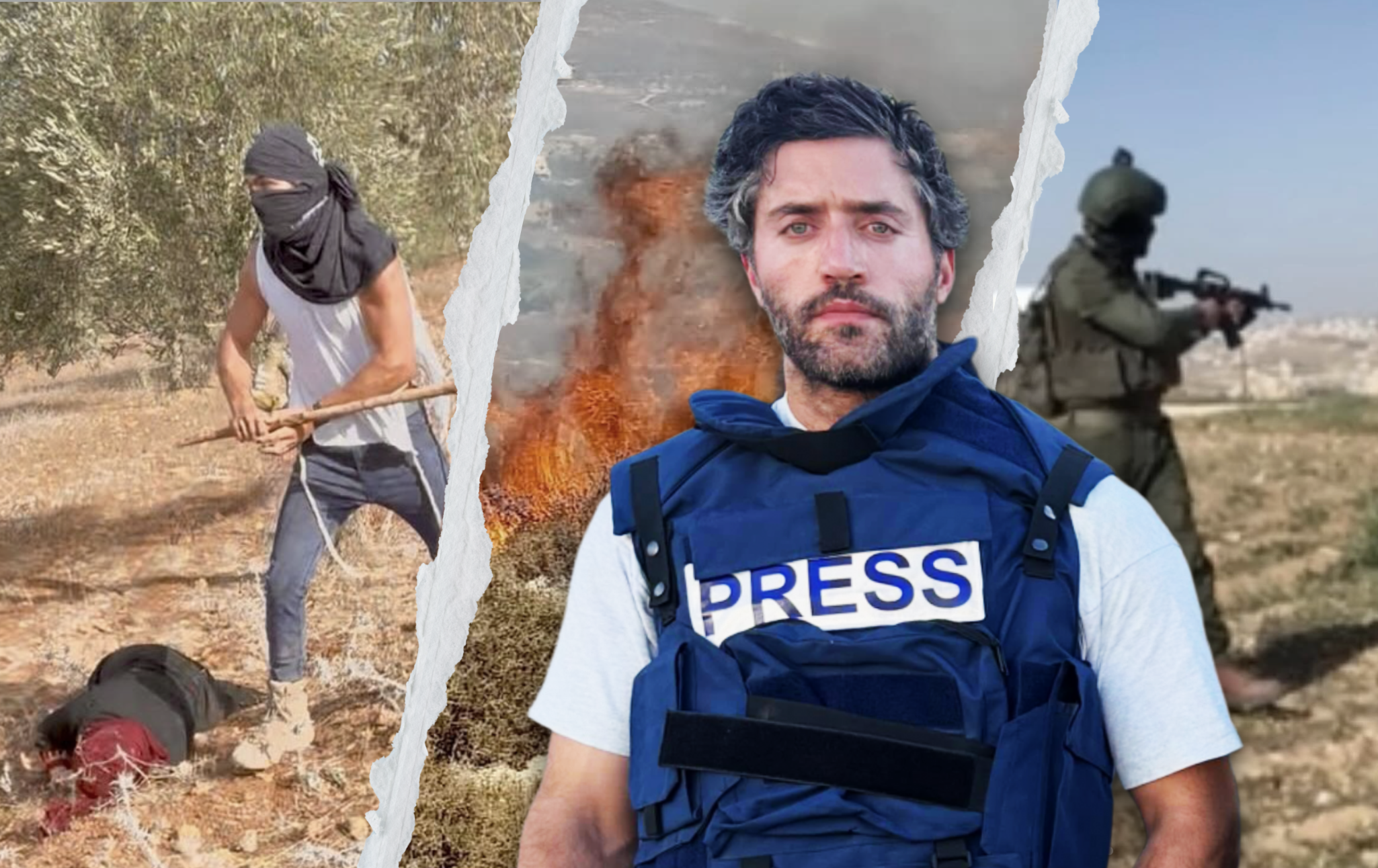
Nathaniel first traveled to the region in January 2024, during his winter break from New York University, and has since built a reputation as one of the most dogged independent journalists covering the occupation. His firsthand reporting has brought international attention to the brutality of settler violence, including footage of an Israeli settler brutally clubbing an elderly Palestinian woman during last year's olive harvest.
After spending another month in the West Bank this summer, Nathaniel sat down with Current Affairs to explain what he witnessed, from the increasingly brazen expansion of settlements to the near-total impunity enjoyed by settlers who terrorize, assault, and kill Palestinians. He offers a picture of a place where ordinary life is being made increasingly impossible, and of the people who continue to resist with remarkable courage and generosity.
Nathan J. Robinson
Obviously, so much of the focus tends to be quite justifiably and understandably on Gaza because of the degree of destruction there, but you report from the West Bank. I wondered if you could, before we get into some of the specific stories that you've reported on, just give us a sense of the big picture. You say at the beginning of your piece, every time you return to the West Bank, you tell yourself maybe it'll be calmer this time, and it isn't. So give us the the broad level overview of the situation in the occupied West Bank approaching the end of 2026.
Jasper Nathaniel
Sure. So the occupied West Bank, as I'm sure a lot of your listeners know, settlers and evangelicals and religious Zionists call it "Judea and Samaria." And they call it that because it refers to the ancient kingdoms of Israel: Judea in the south and some area in the north. I give this context because these settlers and these religious Zionists consider the West Bank to be a much more important, significant, biblically relevant territory than certainly Gaza—which has virtually no biblical significance to Jewish people, but even than most of Israel.
So you often hear settlers saying things like, "Well, if Israel was founded based on our claim to the land, then we have a much stronger claim here in Samaria, which is the northern West Bank, than we do in Tel Aviv." And they're right about that, actually and unfortunately.
Robinson
If you grant that premise.
Nathaniel
Right. That's not how we create borders or how international laws are enforced, et cetera. But the settlers don't care about that, obviously, and so they are essentially acting on their belief that all this land is Jewish land, and so they should take it over from the Palestinians who live there.
In terms of what's happened in the last couple of years and what has escalated in the last six months, even before October 7, early in 2023, there was a major bureaucratic change in the way the West Bank was governed. To make a long story short, what had been a military occupation, which is by international law, the military has to govern the West Bank. It cannot be governed by the same civilian law that governs Israel.
But Bezalel Smotrich, who was Israel's new finance minister and is a messianic settler himself, pulls off this sort of remarkable move where he just installs himself inside the defense ministry, even though he's a civilian, and he builds out what is essentially a shadow government of settlers to operate the machinery of the military occupation. So, all of this sort of red tape that had built up over the years, this cumbersome red tape of bureaucracy in the military—not to say it was ever benevolent to Palestinians, but it at least put some guardrails in place in terms of settlement expansion—Smotrich and his people just clear out all of this red tape. And they make it just remarkably easy to get approvals for things like building a new settlement, demolishing a Palestinian home, or making various types of claims to the land.
So all the violence that has happened since then, all the basically de facto annexation, which I'm sure we'll get into, follows from that. After October 7, obviously they have this security pretext now, and so the dials all turn up. But it's important to note that obviously this started back in 1967 when Israel occupied the West Bank. But this latest escalation of violence began in early 2023 before October 7.
In terms of what's happening right now, basically the level of collaboration between the military and the settlement movement and the government is unprecedented. They are working hand in glove to map out parts of the West Bank that are strategic points for Israel to claim because it connects two settlements and then unifies them into a single settlement bloc, or it cuts off one Palestinian village from another. Your audience may have heard of the E1 settlement project, which is significant because it basically severs the West Bank in two and cuts off the West Bank from East Jerusalem. So all the stuff that they're doing is not just about settling the West Bank but about burying the possibility of a Palestinian state. And with this election coming up in Israel in about a month and a half, I guess—October 27, I think—they're just moving at a sort of breakneck speed because they are afraid that if there's a change in government, it's going to slow them down.

And to be clear, a change in government, like if Gadi Eisenkot, for example, the "liberal" opposition candidate, were to come into power, I do think that he would put a little bit more restraint on the settlement movement. But to be clear, there is nothing in his politics, or frankly anywhere in the Israeli political landscape, that would really stop the settlement movement.
Robinson
Yes, I think you've written that there is no mainstream faction in Israeli politics that meaningfully opposes it or wants to. Really, as I understand it, it's a matter of the pace of expansion rather than any meaningful discussion of dismantling what are essentially—not even essentially, they just are, as a matter of fact—illegal outposts of a country that has no right to be in another country.
We should emphasize it's a totally illegitimate occupation. Unless you believe in that biblical claim to the land. If you don't believe that people get biblical claims to the land, the entire thing is totally illegitimate and should have been dismantled decades ago. But as you say, there's no part of Israeli politics that is talking about or interested in rolling it back at all.
Nathaniel
Yes, that is true. But just to be precise—because I think these nuances in Israeli politics do get sort of flattened out in the discourse a bit—one of the things that the Smotrich government has done is basically try to erase the lines from the Oslo Accords, which divided the West Bank into areas A, B, and C.
"A" being completely under Palestinian control (nominally under Palestinian control, I should say), "B" being a split, and "C" being entirely under Israeli control. Smotrich and his people have basically said those lines aren't real, and so they are going off and building anywhere they want across the West Bank. There are people in the Israeli political landscape who believe that they should be basically sticking to Area C, which, to be clear, is still over 60 percent of the West Bank.
And then the other thing is the outpost movement, where an outpost is a settlement that is not authorized evenby Israel. So basically, a band of settlers goes out violently, empties a Palestinian Bedouin community or something, plants a tent there, and decides this is a settlement now. Recently, in the last couple of years, the Israeli government has been very quick to come in and sort of retroactively authorize those outposts to turn them into actual settlements. Whereas I think there may be some more centrist parties in Israel who would not want those outposts going up, who would try to dismantle them, in fairness. But again, the fundamentals of the settlement movement are about settling—it's about expanding. It's not the settled movement; they are the settlement movement. There's nothing in Israeli politics that's going to stop that. So it's really a matter of degree, I think.
Robinson
In the issue of the magazine that your article appears in, we do print the map of the West Bank showing the various places that you talk about. Everyone who first encounters this map of Palestine is struck by the zones, the fact that Palestine is not a continuous entity but is broken up. It's an archipelago, essentially.
For those of us who haven't been there and seen these A, B, and C zones on the ground, you emphasize what the official legal sovereignty distinction is between areas that Palestinians normally control. But what is it actually like, these archipelagos? Help us understand what this feels like.
Nathaniel
The sort of clearest way that you can tell it's non-contiguous is that it's impossible to travel from one Palestinian village to another if you have to go across area C in some cases or just various checkpoints.
So, if I'm in Masafer Yatta in the south and I want to get up to Bethlehem, which is not that far north of it, it should be a short drive. I think it should probably take an hour or so, but it would take many hours because there are roads that Palestinians are not allowed to go on. They have to go through checkpoints. The Israeli military often puts down a gate and just decides to close off a road just because it wants to. So that's one of the most conspicuous things.
In particular, in villages in Area C, and this is again a lot of the shepherding communities, the Bedouin communities—if people have seen the the documentary "No Other Land," that's all in Area C—that's where you really feel the Israeli state closing in on these places. The military is coming in and demolishing homes all the time. They are expelling people from their homes. They're just seizing land. What's happening now, what is a big change, is that the settlers, like I said, have gotten more ambitious, and they are starting to go into places in areas A and B that had never seen a settler before.
In the last year, I went to a village that two years ago had basically never seen a settler before, or at least never seen a settler attack before. And now they're encircled by settler outposts. I'm talking about Qusra, actually, and this is a place that has some money. They had a relatively good life as far as one can live a good life under occupation for a while. They were cut off from so much of the West Bank, like every place is, but at least they were sort of left alone. Now their land is actively being stolen as we speak, and they're just being closed in on. And so the walls are closing in on even the more sort of protected, insulated Palestinian villages in the West Bank.
Robinson
One of the really harrowing things that comes across in your piece through your accounts of individuals' stories is that, as I understand what you've observed, it's essentially that there is almost total impunity for acts of murder and horrific violence. That whatever settlers want to do to Palestinians, the chances that anything will happen to them as a result are very low, and then they take advantage of that.
Nathaniel
Yes. I think the way to think about it is like this: occasionally there is enough of a PR issue for Israel that they will go out and make a token arrest. Qusra has been in the news over the last couple weeks, although I guess it's really faded in the last two weeks or so, but this is where an American citizen had his house just stolen out from under him by settlers, and then there was basically a joint military and settler siege on the home. People probably saw images of settlers rolling in on pickup trucks to attack them.
I believe last I heard, Israel had arrested three out of the hundreds of people who were part of that siege. To be clear, I don't think those people are going to do any real jail time. There's virtually no chance that there's going to be actual accountability. But Israel will, from time to time, make a sort of token arrest to show that they care. However, I think the important thing to note is that, again, these violent settlers may look on your screen when you're watching them in videos feral and rogue—Netanyahu likes to refer to them as juvenile delinquents or wayward youth or whatever—but the reality is these guys are the tip of the spear for one of the central projects of the Israeli state, which is to ethnically cleanse the West Bank. It is these violent settlers who are going in and doing the state's dirty work by terrorizing Palestinian communities to get them gradually, or in some cases abruptly, to pick up and leave their land, and then the state comes in. Maybe they would even arrest somebody if there were a really bad video.
But when nobody's paying attention, they then call it part of a neighborhood of a nearby settlement, or they just declare a new settlement in itself. And so, the point I'm making is that these violent settlers are assets of the state, and so to arrest them would be to go directly against a state's interest of seizing the whole West Bank.
Robinson
You point out specific incidents like the site of the school shooting that you went to, where a settler had pointed a rifle at at students and shot a kid in the back of the head. For an incident like that, you said you talked to the the school principal, who said the Israeli authorities didn't even want a statement from them.
Nathaniel
Yes, and this is actually a perfect example. You're talking about the town of Al-Mughayyir, where just [in early September] I think two teenagers were killed there, which people might have seen. The reason this town is under such a violent attack is because it happens to sit in between two big settlements, and the settlers would like nothing more than to get them out of there so they can connect the settlements and create just one giant block. And so that is why they're under such a brutal attack right now.
The incident you're talking about, a couple of settlers, including a reservist in the IDF, just came into the village where they have no reason to be and just started shooting. They shot directly into a crowd of students leaving a school. It's on video. There's almost— no, I wouldn't even say almost. There's no possible way that the Israeli authorities either don't already know who did it or couldn't easily figure it out, given their intelligence. And there was not even the artifice of an investigation. And so again, the impunity is there for a reason, not just because they like the settlers, but because they need the settlers to feel emboldened and impugned so that they can go out and steal the land.
Robinson
As I recited those facts, I recited them in a way that people could think this was just a crime committed by a settler. But what you're pointing out there is that there is a political context that, to my mind, turns this from an act of murder into what I think any fair observer would have to describe as an act of terrorism. That is to say, this is not just a wayward youth going wild with a gun; this is part of a campaign to essentially terrorize the population into hopefully leaving.
Nathaniel
And just to to put a fine point on that, the principal of the school, Bassam, told me that even before the shooting, the military had set up a checkpoint that was causing a huge rise in tardiness. So suddenly, kids couldn't get to school on time because they had to go through a checkpoint. That had been one of the biggest problems he'd faced in his decades of being the principal of a school. Suddenly, students couldn't get to the school on time.
After this shooting and all the attacks on the community, the principal said that his teachers and the parents of students are coming up to him and saying, "This is untenable. We can't be sending our kids here anymore." Which again, is exactly the goal. They want the parents to feel like, What kind of life is this for my kid if they can't even get to school anymore? We need to just leave. And so as you say, that is what terrorism is: terrorizing people into a particular behavior. In this case, it's to leave this area so that the settlements can be connected.
Robinson
And in Gaza, obviously, it's not necessary to murder every last person in Gaza directly, but to certainly make conditions there so unlivable that the people themselves are begging to move elsewhere because at a certain point life becomes unlivable, life becomes non-viable. And what you're saying here is, in the West Bank, they're basically trying to make ordinary life non-viable so that hopefully Palestinians themselves will uproot themselves, and then you can take their houses.

Nathaniel
Yes, that's exactly right, and what sort of drives me crazy about the coverage of the West Bank is that there's so much happening to make life non-viable that, given that there are about 10 of us who report full time on the West Bank, you can't cover all of it, and so people don't even know.
Right now, there is a massive gas crisis in the West Bank. It's a sort of technocratic thing, but basically, Israel has prevented the Palestinian Authority from being able to transfer a certain amount of money into Israeli banks, which has made it impossible for them to buy the gasoline that they need. So Israel has just manufactured a gas crisis in the West Bank. Again, this is one of just so many different ways that they are making life unlivable there. You see the occasional video of a settler attack, but what you don't see is all the ways it's making kids late to school and making gas prices and gas lines unbelievably long—you just don't see this stuff. But again, in my mind, these are the X's and O's of ethnic cleansing, basically.
Robinson
Yes, I think it's really important, and it comes through in your work, not just to see this as individual acts of violence by settlers who are not being held accountable, but as a part of a long-term, decades-long project. One can very well argue it's a project that had its roots fundamentally in the Zionist idea from the beginning of taking over all of Palestine.
Now, I mentioned terrorism, and people might see that by calling it terrorism, we apply our standards consistently. And one of the things that I wanted to talk to you about is the way in which, especially here in the United States, our language is used entirely inconsistently. Israelis are never described as terrorists. Israel is not described as a terrorist state; it's only Palestinians who can commit terrorism. And you also recently had a very valuable post on the concept of self-defense, where you point out how hypocritical the concept of self-defense applies in this discourse, and I wondered if you could elaborate on that a little bit.
Nathaniel
Yes. So to zoom in on a particular incident about a month ago, there was an incident in a village called Tal in the northern West Bank, where a group of settlers who were living in an illegal outpost, whose explicit goal there is to seize the land around there, went on what they call a "hike." A "hike" is a settler euphemism where they go into Palestinian villages explicitly looking to what they say "initiate friction" or provoke some sort of conflict.
Robinson
"Friction."
Nathaniel
Yes, "initiate friction" is what one of their one of the settler leaders, Elisha Yared, calls it. And so these settlers go off on a "hike." They go into the Palestinian village of Tal, which is a village that's in Area B, where the Israelis are not supposed to be—to be clear. They go for a "hike" into the village. Villagers come out to confront them. There's a scuffle. The settlers start beating the Palestinians with their guns. One of the Palestinians wrestles a gun away from one of the settlers who had been pointing it at him and shoots him dead—kills him. That guy was then summarily executed by soldiers who arrived at the scene; three of his cousins, who were unarmed on the ground, were then summarily executed, and another Israeli was killed by friendly fire, actually. The entire Israeli political establishment immediately labeled it a severe terror attack against Jews.
And so, just to parse out what we're talking about here, these settlers went into a village with machine guns, and the Palestinians there somehow committed a terror attack in their own village against these people, whom they had no interest in seeing in the first place, with the weapons that they had brought in, calling it a settler attack then. Of course, that led to not only a massive military response but also settler attacks across the West Bank in the name of revenge against this terrorist attack.
So in the Israeli discourse, any Palestinian kid who throws a rock at a tank that rolled into their village is a terrorist, and they can be shot dead. It happens all the time, obviously. I think here in America, perhaps the political discourse doesn't go into that granular detail because politicians just aren't paying attention to this stuff, to the daily killing in the West Bank. But I can't think of a time ever when an armed Palestinian took on an Israeli or waged an armed struggle of some kind, and they weren't just immediately labeled a terrorist.
And obviously, October 7 is what people like to point to, and that is so explosive in so many ways. But just for rhetorical purposes, you can just talk about what's happening in these West Bank communities. I think that it's about time that, in American political discourse, we're clear on who the terrorists are by the definition of terrorism—as you say, they're there to terrorize people into leaving the land—and who are literally just defending themselves and defending their village.
Robinson
Let's be clear: according to their rights under international law, Palestinians have a perfect right to launch offensive attacks against the Israeli military to try and end the occupation. They are under an illegitimate occupation. They have a right to defend themselves against an illegitimate occupation, and it's extraordinary that this sort of basic equality of rights, under which if Israel has a right to defend itself, then Palestine has a right to defend itself, is just so far from being conceivable to the American.
Even Rep. Ro Khanna, who went to the West Bank, a very sympathetic guy, when Jeremy Scahill pressed him on this, he could not bring himself to say that Palestinians had a right of armed self-defense, even though it's very easy for anyone to say that Israel has a right of armed self-defense. And recently, you had an exchange with the rather odious Matt Yglesias about this same thing. The way in which these people just can't conceive of the idea that Palestinians actually have a right to armed self-defense in the same way that Israel does.
Nathaniel
I always think about back when there were all those Israeli hostages in Gaza; a lot of them were prisoners of war, including a couple of the sorts of high-profile American hostages.
I'm blanking on his name, but one of the high-profile American hostages, who it later turned out was almost certainly killed on October 7, was a tank commander. He moved from America to Israel to join the IDF and become a tank commander. He was in combat on October 7. They went after a group of fighters. Their tank was hit by an RPG. He was dragged out of the tank in his full military fatigues. He was called a "hostage" for the entire time. There was never any distinction made that this guy was a soldier who was engaged in armed conflict. It's just the concept of considering one of these Israelis a hostage.
He was in the military engaging in armed conflict, not just a hostage—and there were some civilian hostages, to be clear. There certainly were, but a lot of them were not. And again, it's like we just don't have the ability in our country, apparently, or in a lot of the world, to talk in this kind of nuance that just treats the Palestinians like every other people in the world, basically. In the exchange with Matt Yglesias, he was responding to a video of me talking about Palestinians' right to self-defense, and he said, "What does it mean to support the Palestinian right to self-defense?" And what I kept saying to him basically was like, "What does it mean for Israel to have the right to self-defense? Just transfer that over. It's the same thing."
And he either didn't get it or he would not accept that, and he kept pushing me and pushing me. And finally, I just said to him, "You treat the Palestinians' right to self-defense like any other country in the world," and I laid out what you would do to support them. There would be sanctions. There would be potentially an FTO (Foreign Terrorist Organizations) designation for the IDF, and maybe eventually there would be armed support for the the civilians who are under attack. This concept should not be so difficult to understand if you can take Israel-Palestine off the pedestal and just consider what's happening there, which is that a belligerent country is trying to illegally annex a territory through violence.
Robinson
Not hard to understand in the case of Ukraine, for instance.
Nathaniel
Exactly.
Robinson
Now, you spoke earlier about how when there is the appearance of some vague thing resembling accountability, but which is not actual accountability, it is a PR effort by the Israeli state. I wondered if you could talk about PR efforts in the Western countries.
Britain has just made a big show of cutting off trade with settlements—I don't know how much trade there is between Britain and the West Bank settlements anyway. Oftentimes in the United States, even politicians who are pro-Israel make a big show of saying, "Well, I don't support the the settler violence. We sanctioned this," like the sanctions against settlers in the Biden administration. Can you talk a little bit about how Western governments posture as distancing themselves from the sort of ugliest aspects of this?
Nathaniel
Think back to the Israel Day parade in New York a couple of months ago when there was this huge fuss made about the fact that Mamdani was not going to go to the Israel Day parade, as if anybody there would want him there in the first place. But people were saying, "Oh, it's because he's antisemitic, blah blah blah." And then people were saying, "This is not a celebration of the Israeli government; it's a celebration of Israel." Sure enough, Smotrich is there. All these just completely odious Israeli leaders are there. And then you have people like Dan Goldman and Jessica Tisch coming out and trying to distance themselves from the actual Israeli officials who were at the parade. It's just a refusal to acknowledge that the people who are in charge of Israel, setting the policy, and have been put there democratically by the people of Israel—that's what Israel is, and you transfer that over to the settlement movement.
There is no settlement movement without the Israeli state. It is a state project. There is no settlement movement without the people of Israel supporting it. The majority supports it because they think that it keeps them safe. Even the ones who don't ideologically support it, a majority of them still believe that the settlements keep them safe. And so, my point is just that the British sanctions and the trade embargo or whatever it was, like you said, are completely sort of toothless things to cut off trade with the settlements in the West Bank. I can't imagine there's really that much happening.
But beyond that, what it does is, if you listen to UK Foreign Secretary Ed Miliband when he was announcing it, he spent the first half of the speech just giving his Jewish credentials, talking about how much he hated Hamas, condemned October 7, and how much he loves and supports Israel, and then he's like, "And this is why we need to cut off trade with the settlements." It just completely elides the fact that if you are supporting Israel in any way, shape, or form, you are supporting the settlement movement in a material way. There is no real estate between the two anymore.
Robinson
Also, you don't get any points with Israel for doing all of those "I love Israel and I love the Jewish people." They still viciously denounce you.
Nathaniel
Yes. They called him an antisemite. Mike Huckabee, who is famously not Jewish, called Miliband, who is Jewish, an antisemite for all of it. I think he did.
Robinson
And then they shut down the consulate.
Nathaniel
Yes, and then they shut down the British consulate. Exactly.
Robinson
I want to conclude here by asking you about Palestinian resilience. One of the remarkable things in reading your report is you talk to all of these people who've had horrendous things happen to them. You say it's a very common experience in the West Bank to have someone show you a photo of their dead child or family member.
At the same time, you even talk to people who thought there was going to be accountability, and you're sitting there going, "I'm not so sure about that." Just for them to not be cynical in a situation like that is really rather remarkable. So, can you tell us a little bit about the kind of people you meet in the West Bank?
Nathaniel
Yes. Listen, I don't think that it's in their DNA. I think it's a conditioned response. The people in the West Bank below the age of 60-something have lived under occupation their entire lives. They have had to try to live a life under occupation. So as much as they are tormented and terrorized and, in some cases, maimed or killed—I have so much fun when I go to the West Bank, I guess is what I'm saying. The Palestinians there love to have a good time. You go straight from settlers attacking a community, and you pick up the pieces, and hopefully, nobody was too wounded, and then immediately they're just sort of making fun of the settlers who came, or you're just joking or playing soccer or something.
And it should also be said that, listen, the Palestinians in the West Bank who I encounter without exception show way more generosity and warmth to me than they need to or than they should, given that I look like the people who are terrorizing them, and I share the religion of the people who are terrorizing them, and I come from the country that's funding the terror against them. They are so generous and just grateful to have people supporting them. There's sort of a running joke in my family.
The old adage is like, if things ever get really bad for Jews in America, we'll go to Israel, where we'll be protected. In my family, if things ever get really bad for Jews in America, we'll go to the West Bank, where we will be protected from the Jews who may be trying to kill us. And so, I don't know; I don't want to orientalize the Palestinian people because they have feelings of anger and vengeance and sadness and everything else, but just sort of collectively, they have a good time, and they do just show a sort of remarkable amount of resilience.
Robinson
We just spoke last week to Mohammed el-Kurd, who wrote an excellent book cautioning us to avoid trying to portray Palestinians as not having anger because a lot of them have anger. It's totally justified; they're human beings.
Nathaniel
Absolutely, but also I know lots of angry Palestinians, and for the most part, their anger is totally rational.
Robinson
Yes, I think I might be angry too, given some of what you document. In fact, I go so far as to say, certainly in the United States, if you're not angry reading this and understanding that you are personally paying for and supporting it, I question the working of your moral compass.
Anyway, Jasper Nathaniel, you are an independent journalist. You work for your readers and not for the New York Times, which means that you are funded by readers. So to the listeners and readers, if you value Jasper's work, you need to go to "Infinite Jaz" on Substack, and you need to become a paid subscriber to "Infinite Jaz" because otherwise, nobody, as Jasper said, is doing this reporting. It's him and a few other people. The mainstream media is not going to fund it. Places that have money will not fund it. Jasper is self-funded by readers. So please go read his work, and if you like it, enable him to continue doing it.
Sorry, Jasper, I just wanted to give a very aggressive plug there.
Nathaniel
I really appreciate it very much. I have nothing to add except that "Infinite Jaz" is just one "z." That's it.
Robinson
Oh yes, it's not an infinite amount of jazz music. It's of you, "Jaz" Nathaniel. Also, I should plug for Current Affairs. People should also subscribe to the magazine, where they can read your latest report. Although it is also free on your Substack.
Nathaniel
It looks very beautiful in print based on the proofs that I saw.
Robinson
Yes, our art designer Cali does a lovely job laying it out, but it is a very hard story to read. I will warn our readers about that. But I give the plug because a lot of people who come on here have institutional affiliations. They work for media outlets that are somewhat funded. But you're your own guy.
Nathaniel
Yes.
Robinson
So, please go to Jasper's site and read his pieces. Thanks, Jasper.
Nathaniel
Alright, take care.
Transcript edited by Patrick Farnsworth.