Raha Nik-Andish, an Iranian writer living in Tehran, has risked his life to give the world an account of survival under the U.S. and Israel’s bombs. We owe it to him to listen.
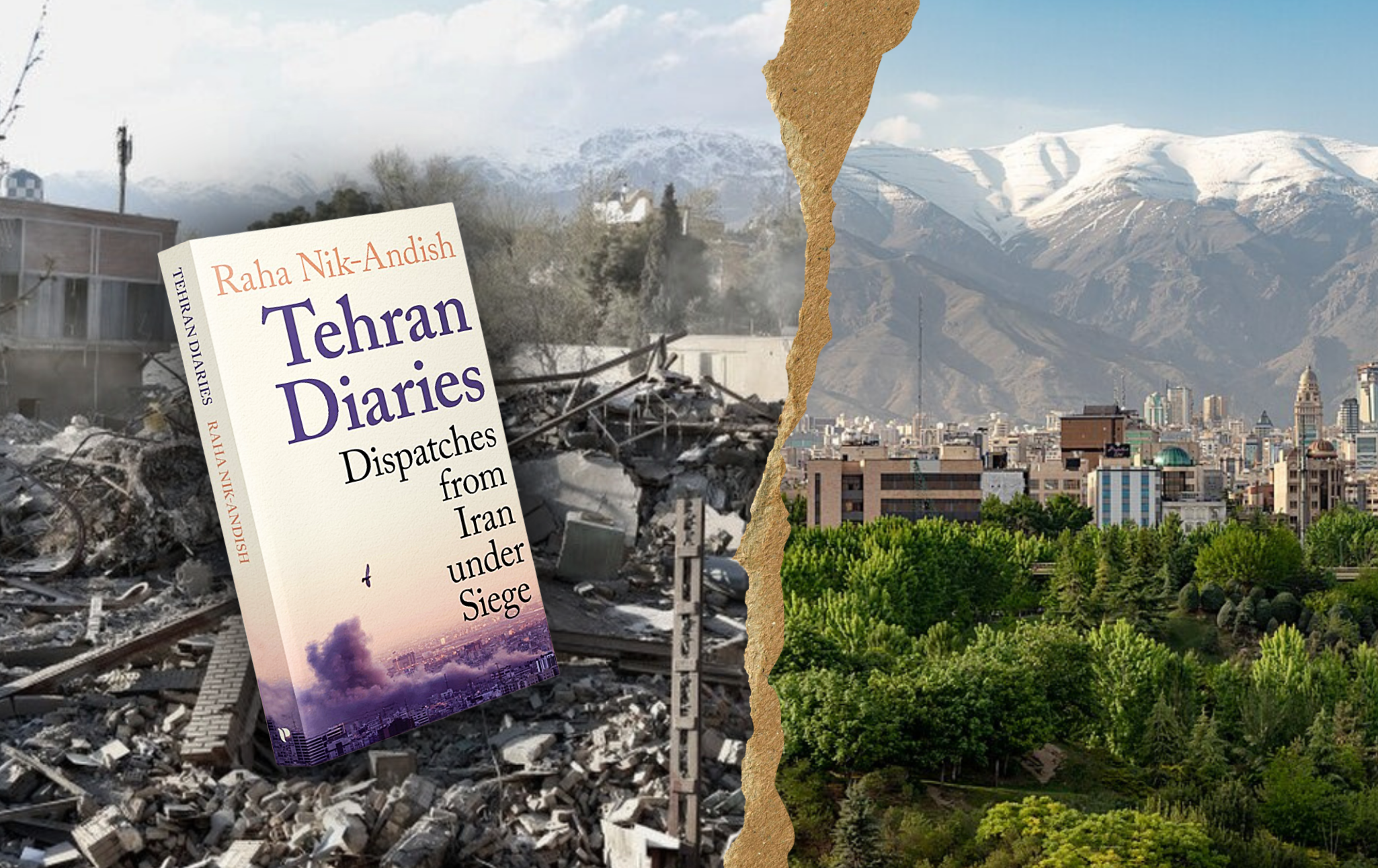
Tehran Diaries: Dispatches from Iran Under Siege, published this July by OR Books, carries weight disproportionate to its small size. The book itself is just 90 pages long, and they’re small pages; you can easily slip it into a jeans pocket, and you can read the whole volume in an afternoon. But there is a reason the author, Raha Nik-Andish, has chosen brevity: he knows that on any given day, he may be killed by a U.S. bomb or drone. For him, there is no time to waste.
Nik-Andish is an Iranian correspondent for the London Review of Books, where he has been writing a monthly diary of the unfolding war between Iran, the United States, and Israel. Working through intermittent power and internet blackouts, he has chosen to use what may be his final days on Earth to give the English-speaking world an account of life on the ground in Tehran, and the political realities Iranians are facing. For that reason alone, his account demands our attention. As readers in the U.S., we owe it to the people on the receiving end of our country’s well-funded war machine to listen to their testimony. Few books in the last decade have fulfilled that role better than Nik-Andish’s.
“Raha Nik-Andish,” in fact, is a pseudonym used to protect the author’s life. In Farsi, it translates roughly to “free thought,” and the choice is appropriate. Although he protects his anonymity, throughout these dispatches we get glimpses of the author’s personality: he’s a thwarted and downwardly-mobile academic, who studied in Paris and earned a Master’s degree in art with the hopes of teaching at an Iranian university. He returned home to Tehran in the spring of 2025—his timing about as bad as it possibly could be—only to find that Iranian universities, like American ones, are shifting from well-paid tenured staff to part-time adjuncts and “guest lecturers.” He can teach art, he’s told, but will only get 35,000 tomans (roughly 35 U.S. cents) per hour—“not even enough to cover transport costs. Essentially, I’d be working for free.” So he supplements his income by working as a rideshare driver for an Uber-like app called Snapp!, and that’s where we find him as the hell of war descends.

Nik-Andish writes about bloodshed and destruction with the numb, matter-of-fact tone of those for whom it has become a daily reality. Everything is conveyed in short, declarative sentences, with few adjectives, as seen when he describes a close scrape with death at his local bank:
I had gone to the bank to get cash when a sudden explosion shook the building. Windows shattered and people fell to the ground. Officials shouted for everyone to leave. Outside, the streets were shrouded in thick black smoke. The bomb had landed two hundred metres away, destroying a police station, which collapsed on a bus filled with passengers. Pedestrians on the pavement were killed instantly. Among the abandoned cars, broken glass and concrete, I could see dead bodies. There must have been fifty of them. Blood was everywhere.
He never uses the word, but it’s clear that living like this for months on end has left him with some form of PTSD, always jumping at some perceived threat:
The sounds of planes and drones are always in my ears. When I hear the roar of a motorcycle I think it’s a drone. Even the noise of the lift moving between the floors of my building makes me think the city is being bombed.
But even in the shadow of death, the rent is due. So Nik-Andish ventures out, day after day, to drive his rideshare. In both Tehran Diaries and his subsequent articles for the London Review of Books, one of the biggest surprises is how much of the text is dedicated not to war or politics, but the day-to-day difficulties of a somewhat disgruntled cab driver. Through his eyes, we encounter a cast of Iranians who are all traveling to different places, for reasons of their own, and carrying their own baggage with them. There’s the woman who needs a ride to the nearest intact pharmacy, so she can stock up on antidepressants—now available without a prescription—to cope with the stress of the bombing. There’s the middle-aged businessman who had lived in Dubai for 24 years, but got deported back to Tehran when the war broke out, and knows nobody there. Each appears for only a paragraph or two, but forms a vivid cameo portrait.
This is one of the most valuable aspects of Nik-Andish’s writing, because in the U.S. and Europe, we rarely get to hear directly from the citizens of countries our governments have designated as “bad.” More often, the Iranian people—or the Cubans, or the North Koreans, et cetera—are treated as interchangeable tokens in some huge game of Risk. To the MAGA right, of course, Iranians are either helpless captives who long for Pete Hegseth and Reza Pahlavi to come liberate them, or bloodthirsty jihadists who need to be eliminated. They’re not allowed to be anything else. But even among liberals, they’re often treated as what Palestinian writer Mohammed El-Kurd calls “perfect victims,” worthy of sympathy only to the extent that they remain morally uncomplicated and faultless. Nik-Andish allows them to simply be people, and claims the same right for himself.
We can see this nuance most clearly in his account of February 28, 2026, the day Ayatollah Ali Khamenei died. Early in the morning, he writes, “my mother calls me to turn on the satellite channels: the U.S. and Israel are attacking Iran.” The Ayatollah’s death is confirmed that night, and reactions run the full spectrum, from those who “shout and honk their horns” in celebration, to the “Basij militia, the volunteer paramilitaries,” who strike up dramatic displays of mourning for their fallen leader. For himself, though, Nik-Andish is conflicted and wary. Between Islamic fundamentalism and U.S. imperialism, he doesn’t particularly care for either, but worries that both will find a way to ruin his life. “To be honest, I don’t know which is worse, the sounds of the bombing or the Basijis’ pleas for God’s mercy,” he writes.
The passages remind me of nothing so much as my own hazy childhood memories of 9/11. But then, that’s appropriate, because the United States and Israel have inflicted something comparable to 9/11 on Iran—although even Al-Qaeda did not target a school full of young girls. It takes some effort to get morally lower than Osama bin Laden, but Trump and Netanyahu have managed it. And like in the aftermath of 9/11, Nik-Andish describes a national rallying effect in the streets of Tehran. People who once protested the government now refrain, and an atmosphere of defiant patriotism spreads. “Ever since he was killed, paintings of Khamenei have appeared in the city. Everywhere you look, you can see this kind of stencil-style graffiti. Under them, there are short phrases: ‘Superman of Iran,’ ‘Father of the Nation.’” Even “some of those who wanted the Americans and the Israelis to bomb Iran have changed their minds since the war started,” and the killing is no longer theoretical.
Nik-Andish, though, is not one of those who mourn Khamenei, and nobody can accuse him of being a regime loyalist. (Incidentally, notice how people with MAGA flags in their yards are never described as “regime loyalists?”) In a striking essay from January, he describes attending an anti-government protest in Qeytarieh, more curious than committed. There, he gets caught up in the police crackdown against demonstrations, and witnesses brutal violence from the state:
The sound of gunfire did not stop. Wounded protesters were being carried away by others. By the side of the road, a plainclothes agent was sitting on top of the body of a very young boy. The agent’s arm seemed to be moving up and down, yet he held no baton. I moved a little closer. He was stabbing the boy with a knife. I turned around and ran.
Despite this, though, Nik-Andish’s articles from January and February are full of signs that Iranians themselves are changing Iran for the better, regardless of what either the Ayatollah or Donald Trump has to say about it. The climate around “the gender issue,” he writes, is less repressive than it was: “Twenty years ago, young men and women had separate staircases. Now I saw women attending classes without their mandatory hijabs, and freely socializing with their male classmates.” In the cafés at night, people talk openly about political change. But this is the deeper tragedy, because this sense of forward movement is abruptly halted by the U.S. bombing campaign. The February 28 strikes are like a scar across Iran’s history; there is life before, and life after. Now, everyone is busy worrying how they’ll survive, Nik-Andish included, and nobody has the time or energy to think about reforms. Far from helping the Iranian people get any kind of political liberation, the war has set them back.
The saddest passages, though, are where you get glimpses of the life and career Nik-Andish should have had, if history and world events were different. It’s clear that he badly wanted to be a full-time art professor, and still thinks about it. In one dispatch, we get his thoughts on public statues of Arash the Archer, a figure from ancient Persian mythology, and the role they play in the government’s morale-boosting campaigns. Elsewhere, he gives us a tour through an exhibition of art by female Iranian artists, some of them previously banned or exiled. This is related as a sign of political change bubbling up, but also so he can wax enthusiastic about the exhibits themselves. It’s a common theme with writers from the Middle East. Edward Said wanted to be a poet, in his youth, and only found himself becoming a scholar of Orientalism and the oppression of Palestinians because events forced it on him. The late Dr. Refaat Alareer was trying to write a book on Shakespeare, before an Israeli airstrike canceled the project forever. There is an invisible library, like something out of a Borges story, of works the world would have had if not for U.S. and Israeli militarism.

This book belongs, too, to the venerable genre of samizdat literature: that which is written in secret and smuggled out, against the wishes of the people in power. In Iran, it’s a crime to document the war without official permission, and the government is moving to criminalize having any contact with foreign media outlets; if they knew who Raha Nik-Anish was and what he was saying, he likely wouldn’t remain free. But then, the U.S. government isn’t very fond of people spreading accounts of the war different from its own, either. Last month, federal agents seized the devices of Grayzone journalist Max Blumenthal after he traveled to Tehran to cover the Ayatollah’s funeral, otherwise known as doing journalism. As the war deepens, dissent becomes more dangerous, and the truth becomes heavy contraband. But Nik-Andish has voluntarily taken the danger on, because he thinks his message is that important.
What would you write, if you thought it might be the last message you could send? It’s a question Americans rarely have to think about—but people who happen to be born on the wrong side of the empire, from Iran and Palestine to Cuba and Venezuela, often do. Raha Nik-Andish has given us his answer. “You can’t imagine the effect of knowing that someone wants to kill you, and that everyone is waiting to die,” he writes. The first “you” in that sentence is the British and American audience. He’s telling us, vividly, what we should already know: that our governments are murderers. And yet, it’s remarkable that there isn’t the slightest trace of animus here for ordinary Americans, or for Israelis. Instead, Nik-Andish seems to want us to recognize what we share. The problems he faces in Tehran, from a shitty job in the “gig economy” to rising grocery prices, are utterly familiar to any American. The life he wants for himself is a modest one: a chance to do the work he finds meaningful, be paid well for it, have a quiet home to return to at the end of the day. There’s no reason on Earth he shouldn’t have it, and so should we. All it requires is for people in the U.S., like their counterparts in Iran, to realize that the menace hanging over us both comes from a small, unaccountable elite that cares nothing for our lives. To acknowledge to ourselves the possibility we still hesitate to name: that the powers that be should no longer be.
Isn’t it time we started ignoring the official narratives, and listening to each other?

%20(crop).jpg?width=352&name=wile-e-coyote%20(resize)%20(crop).jpg)