
The Radical Non-Binary Preacher Left Out of the History of America’s Founding
Nina Sankovitch’s new history of an idealistic rabble-rouser in the early republic undercuts anti-trans narratives and offers an example of proto-feminist community building on the American frontier.
Jemima Wilkinson was born in Rhode Island, that colonial hotbed of difficult women, in 1752. In 1776, a year best remembered for other crises, Wilkinson took to her bed with a high fever, in a medical crisis so intense that her family nearly despaired of the vigorous young woman’s life. And in a way, they did lose Jemima. The figure that rose from the sweaty bedsheets when the fever broke was, by their own account, a reborn entity using the physical form of the recovering girl. Announcing a new, genderless identity as the Public Universal Friend, they began a career as a preacher, building on the Quakerism of their youth to evangelize a new denomination, the Society of Universal Friends, to the people of the fledgling United States. That ministry would last until the Friend’s death in 1819.
By their very existence, the Friend shows that nonbinary people have been an integral part of the American republic since its beginning. The Friend made a point of expressing their identity as neither male nor female consistently from the 1776 resuscitation until the end of their life. Inspired by the Bible if anything, their identity was not the result of “trans propaganda,” “social contagion,” or any such modern buzzword, but how the Friend understood their own self and how they might best spread their new spiritual understanding. Dismissed by some but embraced by others, the Friend continued to lead their flock, making use of the opportunities offered by the young republic and the budding, self-reinforcing mythos of American individualism to build a refuge where they and theirs could live exactly as they wished. Now, in the United States’ 250th year, it’s an example that may inspire modern people facing an increasingly hollow and hostile government.
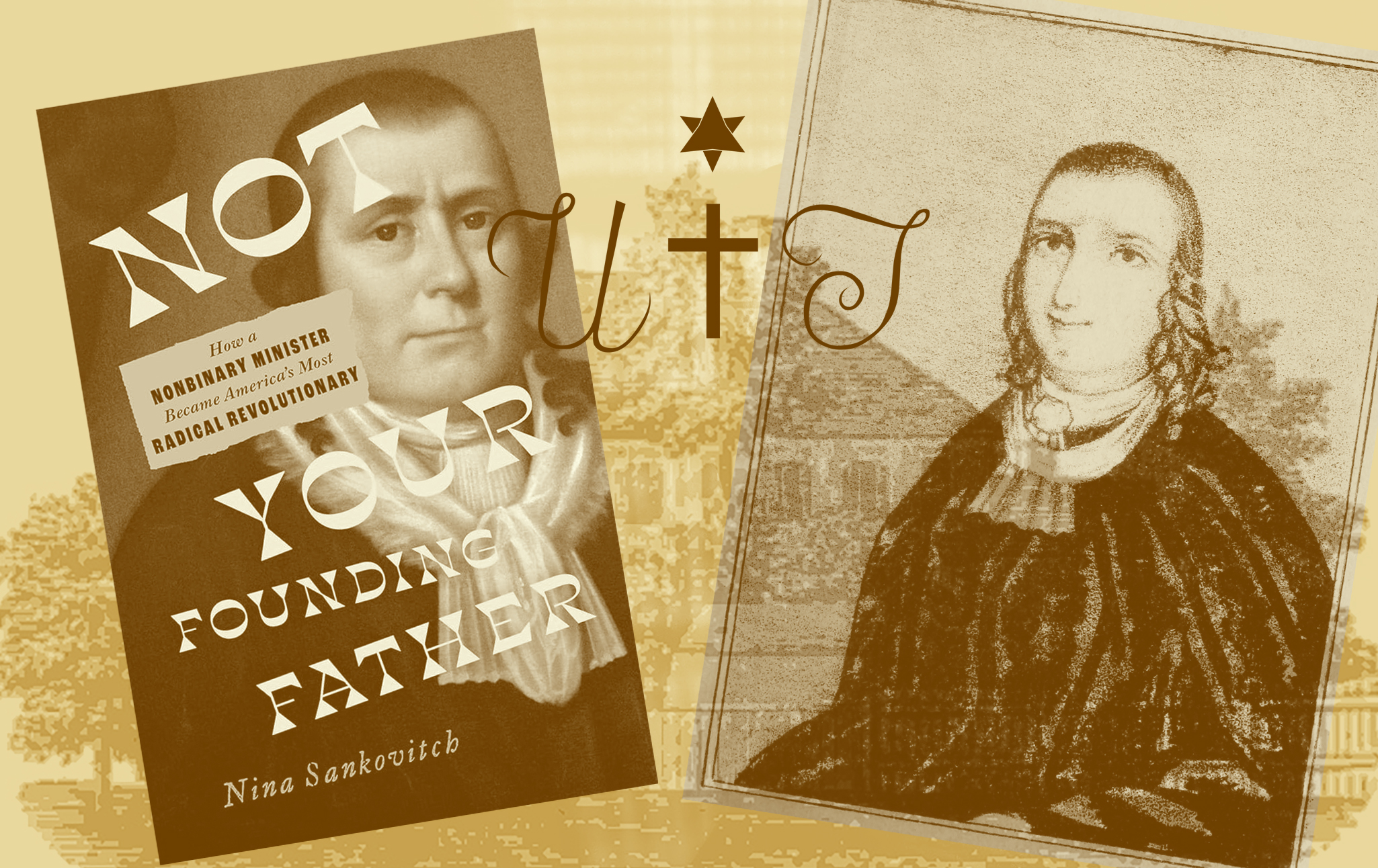
The Friend’s career is engagingly recounted and usefully contextualized in Nina Sankovitch’s new book, Not Your Founding Father: How a Nonbinary Minister Became America’s Most Radical Revolutionary. Sankovitch tells the story of the Friend’s life and ministry with a sympathetic but sufficiently critical eye, showing us the story of a person—eccentric, faithful, and wholly sui generis—who was one of the most intriguing figures of the independence generation.
After the sickbed conversion-transformation, the Friend began preaching around Rhode Island, ultimately expanding the circuit into other parts of New England and going on forays into Pennsylvania. They stuck by their nonbinary guns while doing so, eschewing pronouns altogether when possible. Their followers generally respected this decision, while other contemporaries, even sympathetic ones, continued to refer to the Friend as female.
As the Friend and their ministry matured around a core of devoted followers, the movement decided to create a permanent home in what is now Western New York and was then traditional Haudenosaunee land contested between Massachusetts and New York. There, they established a settlement called City Hill and, later, an even more remote township called (what else) Jerusalem. The Friend’s efforts to this end required long detours into politics, the complex relationships that emerged between even relatively well-intentioned white settlers and Native nations, and knives-out squabbling over land titles. The Friend and their followers weathered it all, and the Friend died of natural causes at 66 years old, in the care of devoted followers in the new Jerusalem the group had founded.
Sankovitch clearly admires her subject—and if you read the book, you will too—but that doesn’t keep her from acknowledging the Friend’s failures and missteps. This is no hagiography, but a portrait of a singular personality with a distinct vocation living at a time of national crisis. The Friend was bold, loyal, egalitarian, and kind; the Friend was also bossy, self-important, prone to talk a lot, and, critically, a naïve businessperson. Some readers will want a little more of the Friend’s personality to shine through, but what Sankovitch presents is incredible: defending their genderless dress, the Friend quotes God Himself, saying “I am that I am.” Similarly, an anecdotal story has the Friend traveling into British-occupied Newport to upbraid the British soldiers for the sin of making war. If it’s not true, then it was at least an action that jived with what people knew of how the Friend behaved toward people. The Friend repeatedly took in people who needed a place to stay (even after some of these strays turned to snap at them and their flock), but was no pushover; a contemporary wrote that the Friend felt “it [was] not her [sic] duty to be a Man pleaser.”
Sankovitch does critique aspects of what we might term the Friend’s social conscience: while the Friend’s ministry accepted people of color and seemed to have dealt generally respectfully with their Indigenous neighbors, the Friend’s scope was small on these issues. The Friend urged followers to manumit people they held in slavery and allowed Native groups to hunt in the area around Jerusalem, but did not advocate for abolition or just treatment of Natives beyond their ministry. While this narrow approach to “the right side of history” frustrates Sankovitch, reasonably, it also clearly rests on Quakerism and the Friend’s understanding of that legacy. A minister who advised their own followers to “shun[...] the conversation of the wicked world as much as possible” had limited opportunities to remonstrate with the sinful.
The Friend’s biggest revelation was the Friend’s own role as a divinely appointed messenger; otherwise, the Friend’s theology was not far from the Quakerism of the Wilkinson home. The Friend stressed the individual’s responsibility for seeking salvation, a noted distinction from the predetermination of the Friend’s Calvinist neighbors but not in itself a theological novelty. Furthermore, the prayer services the Friend led followed Quaker precedent, beginning with silence and including extemporaneous prayer. The title “Friend,” in itself, further places their ministry within the tradition of the Quakers, a pacifist denomination known formally as the Society of Friends that still counted some 55,000 U.S. members as of the 2020 census. Though the Friend’s ministry grew from their Quaker roots, that didn’t grant them automatic acceptance by other Quakers: Sankovitch notes that other Quakers regarded the preacher with polite horror, “[...]as a member of their faith who had broken with important practices of humility and community. And even worse, as a woman who grasped for power far beyond what gender dictated. And perhaps worst of all, a woman who had the appearance of a man and tried to act like one as well—and who just would not stop talking!”
This emphasis on the idea of friendship also underscores a key tenet of the Friend’s message: acceptance and help for all who trusted their ministry. (The Friend did believe in Hell, and that some of the people who beset the Society of Universal Friends would go there.) The Friend was accused of, and nearly tried for, blasphemy, based on allegations that they claimed to be divine, but this does not appear to be what the Friend actually said. The Friend prayed for healing of the sick and for signs, and sometimes these occurred, but within the bounds of what might be expected from loving care, good luck, and natural phenomena that were not yet easily explained. If the Friend’s followers were sometimes creepy in their praise—a longtime follower’s will includes the passage “I now resign my soul to rest in the divine love of God, and Christ my Savior and Universal Friend”—it’s nowhere near the extremes of more toxic cults.
Sankovitch’s work especially shines when she gives a broader historical context for the Friend’s life, showing a knack for getting her readers up to speed without either assuming too much background knowledge or detouring too broadly. Not Your Founding Father takes us through the terrain of New England and New York, showing us the cherry orchards the Friend grew up among and the stands of apple trees near Jerusalem. Sankovitch clearly explains the tumultuous legal and societal situation of Western New York, along with the various land dealings whose complexities drove the Society out of one homestead and nearly cost them another. She also has an excellent eye for the period-specific detail: We meet minor figures named Lament and Experience, savor the imagined flavors of the well-stocked Wilkinson table of the Friend’s youth, and grimace at the description of medicines for the edema that plagued the Friend’s final years. (Saltpeter in the morning and mustard and horseradish in stale apple cider in the evening; we might all be ready to return to our maker after such a regimen.)
The Friend’s gender identity, or perhaps most accurately refusal of a gender identity, is among the most interesting aspects of the story for a modern reader, and Sankovitch respects the Friend’s self-understanding and presentation while clearly demonstrating that, to much of the world outside her community, the Friend was still subject to the limitations that bound the life of a woman—or at least, someone who wasn’t a man. We also see how the Friend’s operation outside gender was rooted in Biblical and Quaker precedent: Quakers taught, based on the words of no less an authority than one Jesus Christ, that “the soul had no sex,” and unlike in many other Christian denominations of the era, Quaker women could speak and pray aloud in Quaker meetings. While the Friend’s spiritually-motivated choice to opt out of gender may not wholly rhyme with modern trans and nonbinary people’s experiences, one detail will: during the legal squabbles around the Jerusalem land that in the Friend’s life, they had to sign legal papers with their original name. Both then and in their final will, the Friend split the difference, signing with both the name society insisted upon and the one they had chosen and used for decades.
It’s important, here, to recognize the Friend’s genderless expression as a performative aspect of the preacher’s role. This is not to say it was disingenuous, but rather that the Friend understood that it was something that could also be manipulated theatrically. Although the image that comes to us of the Friend of a tall, attractive, androgynous person striding around in long dark robes over a white or violet silk shirt, with their natural and unpowdered hair pulled back in a simple ponytail, may not sound that exotic to a modern reader, it apparently clearly demonstrated to the Friend’s contemporaries that this person was not following the custom of the world. (Charmingly, purple was apparently the Friend’s favorite color.) Prophets, saints, and poets are at their most compelling when they look least workaday, and the Friend understood this. While the Friend’s nonbinary presentation was evidently a reflection of a genuine understanding of their personal truth, it also added to the mystique. Just imagine having the Gospel preached to you, volubly and without notes, by someone so comfortably positioning themself as an outsider. The fact that the Friend always rode sidesaddle, as they had learned during their girlhood, must have added to the panache.
To read about the Public Universal Friend in 2026 is depressing because of the missed opportunities the story emphasizes. The Friend represented the best of American potential in the first days of the republic: a place where square pegs could find a place to dig their own, custom-fit holes, and where different ways of life might flourish in the shade of the First Amendment and embark on the promised pursuit of happiness. The Society’s Jerusalem lived in general concord with the Native societies around them and, from its first days, the Friend’s group of followers included Black members, including some freed from slavery. Single women, both widows and the never married, participated and thrived in the little settlement. Men and women alike accepted women as local leaders and preachers and followed the guidance of an openly nonbinary person. Land was distributed to those with none, and the poor or aimless were given places to live, often in the Friend’s own house. Imagine what the anti-walkable-city, SNAP-cutting, phrenology-reviving, bathroom-policing, trad-wife, dog-in-the-manger goons ascendant in American society would call such a project: hippies, Commies, Canadians.
But the Friend might encourage us to take heart. The Friend, along with many of their contemporaries, believed the world was coming to an imminent end; today, when one can hardly sleep for the din of rattling sabers and whirring data centers, we can easily know how the Friend’s generation felt. Confronted with this specter of a dying world, unbraced for the whip end of God’s wrath that was about to descend, the Friend chose love. The Friend made friends and stood by them, preached the truth as they understood it, and built an arklike utopia to save as many people as they could from the wickedness of the world. And even though outside forces continued to threaten Jerusalem’s tranquility, the Friend created a secure and apparently cozy place to drink cider with their friends in their later years: “In Jerusalem, [the] Friend created a community where for both men and women self-reliance and deep personal faith existed side by side with the sharing of heavy burdens and everyday joys, and where the goal of repentance and redemption was tempered by living fully in the here and now. Just as Lucy Brown measured out and built the exact house she wanted, Rachel Malin treasured her walks in the fields, Elizabeth Kenyon wove her dreams of wool, and even [the] Universal Friend enjoyed the touch of silk underneath the dark ministerial robe and a glass of wine or beer at dinner, life on earth was to be treasured. A young Universal Friend had focused primarily on the hereafter; the mature minister understood the importance of appreciating life on earth.”
Anger is a reasonable and correct reaction to many of the horrors crowding the news, and evil and evildoers must be resisted—but, like the Friend, we must also build something worth defending against them. After a hard day’s work cursing the darkness, there must be somewhere to light a candle.


%20(crop).jpg?width=352&name=wile-e-coyote%20(resize)%20(crop).jpg)