
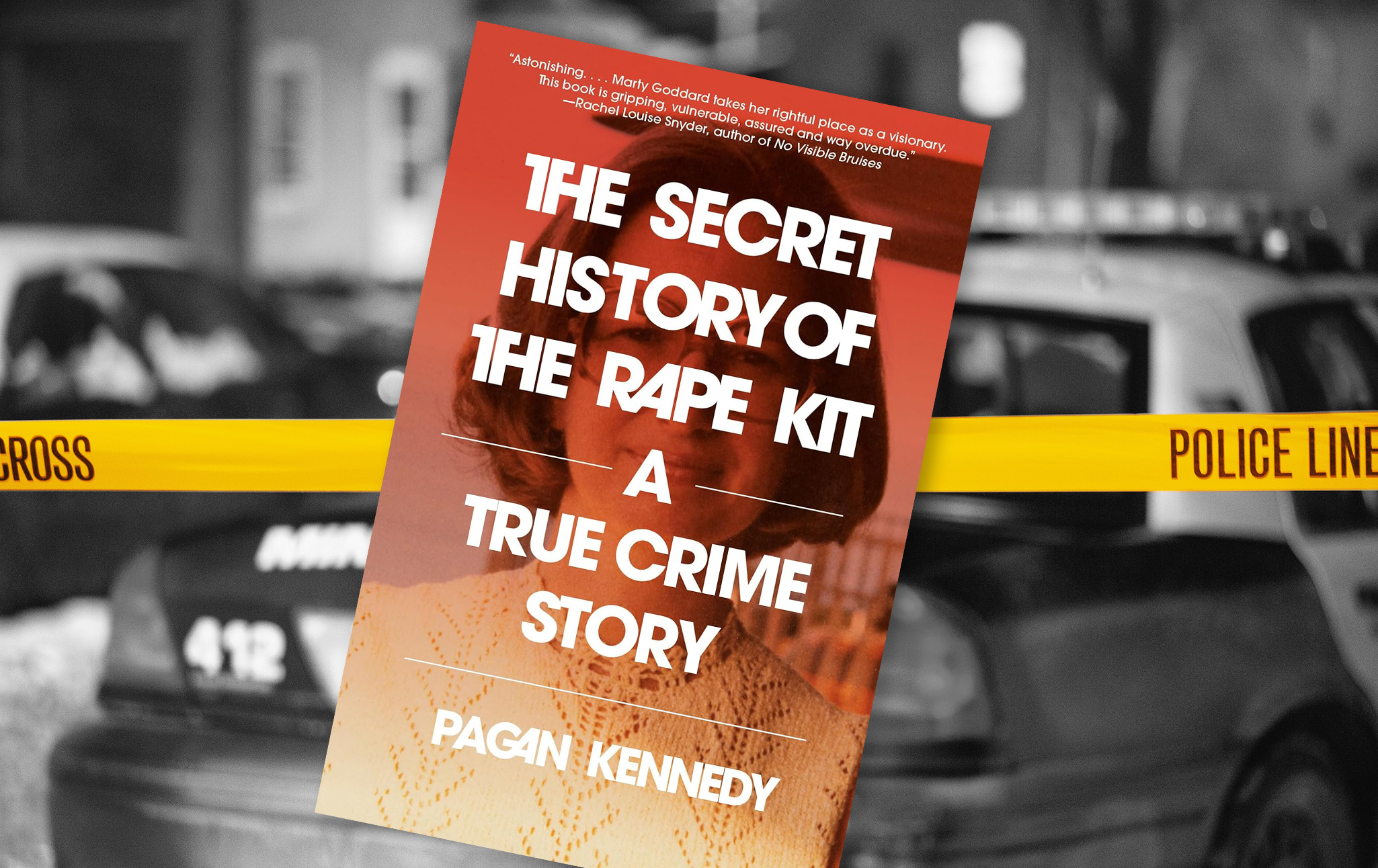
By honoring the woman behind the rape kit, Pagan Kennedy reimagines a genre too often dominated by voyeurism and heroized police. So are we ready to give up our favorite propaganda?
When watching the Brett Kavanaugh hearings in 2018, author Pagan Kennedy began reflecting on her own experience of sexual assault as a child, perpetrated by a neighborhood boy—one who grew up to become yet another high-powered man in Washington. With the memory in the forefront of her mind and Dr. Christine Blasey Ford on screen, she catalogued in her head the number of inventions that made sexual assault easier for perpetrators to commit: driver’s side car door locks, sedative drugs, and so on. As far as anything invented to defend targets of such violence, the first thing Kennedy could think of was the rape kit.
“The technology seemed so threatening to powerful men that I wondered how it ever came to be,” she writes. The mystery of how the device could have been made in a man’s world propelled her on a years-long journey of researching and writing The Secret History of the Rape Kit: A True Crime Story. Identifying the book as a “true crime story” may be apt for its deep dive into forensic history, but Kennedy’s yearslong research project, and the critical eye she casts on police and policing, run counter to the typical fare of “true crime” content—which tends to be dominated by lurid, surface-level retellings of crimes against women, with cops cast in the hero role, and little analysis of the deep injustices in the criminal punishment system that allow such violence to continue.

There’s indeed something compelling about listening to a true crime podcast. True implies we can both indulge salaciousness and nobly self-educate—all by simply tuning into a podcast while we work out, scroll social media, or fold laundry. Their popularity seems untouched by common critiques, such as their tendency to parade suffering, or their skewed focus on white women victims. There’s a whole spectrum of takes on the true crime podcast industrial complex—either yes, we like true crime, but that’s okay, or yes, we like it, but we should feel guilty about that, all the way to no one should like true crime and we need to stop. What I find interesting about the proliferation of this content, the social media backlash against it, and even the thoughtful cultural criticism that dissects our relationship to it, is that it’s rarely recommended to replace these podcasts with books. And yet, reading true crime books might be the best way to politically grapple with criminality, violence, and justice. It’s maybe our only option to raise both the standard for the people who report these stories and for ourselves in consuming them. Social media clips and podcasts are designed to be easily digested, but these topics demand depth.
The Secret History of the Rape Kit: A True Crime Story is best evidence I have to argue for this shift. Like Robert Caro in The Power Broker or Rebecca Skloot in The Immortal Life of Henrietta Lacks, Kennedy has uncovered a largely unknown facilitator of history—someone who changed the world, but whose name has been hidden. In this case, Kennedy introduces us to Martha “Marty” Goddard, the largely uncredited activist who piloted the modern rape kit. Not only does Kennedy introduce us to an unknown historic figure, she pushes the true crime genre beyond a hyperfocus on victims and perpetrators and instead calls authorities into question.
Kennedy’s narrative immerses readers in 1970s Chicago, when the Windy City had issues with crime and police corruption in equal measure. In 1973, an estimated 16,000 individuals were sexually assaulted in the Chicago metropolitan area. And yet, that year’s Chicago police training manual “instructed cadets that ‘many rape complaints are not legitimate[…] it is unfortunate that many women will claim they have been raped in order to get revenge against an unfaithful lover or boyfriend with a roving eye.’” With this being the official stance of law enforcement, it’s no wonder that fewer than 50 cases went to trial in 1973, and only a few led to convictions. This is the reality that Marty Goddard, a young divorcée who emerged from prior work in philanthropic organizations, was up against.
Goddard’s first documented activism began in 1972 while volunteering at a crisis center for homeless youth, whose stories left her horrified by the pervasiveness of sexual violence. By the following year, she was interviewing cops, nurses, and social workers about Chicago’s prevalent rape problem. Her findings convinced her that negligence and finger-pointing were conditions that misogyny thrived on: cops frequently blamed hospitals for not collecting useful evidence, and hospitals reasonably cited their lack of forensic training as the real impediment to justice. As a solution, Goddard began designing the first modern rape kit: “a cardboard box, packed with envelopes for storing biological evidence” along with “swabs, a doll sized comb, nail clippers, and an instruction booklet to guide the forensic nurse who performs the exam.” As Kennedy describes, “the kit was such a simple device,” but “when used as intended, it could reveal the hidden path of a predator.” Given the excuses that institutions claimed, an indisputable protocol and readily available forensic tools were Goddard’s best counter.
Detail by detail, Kennedy documents that Goddard’s work with the Chicago Police Department was anything but a wholesome collaboration. Instead, it’s more accurately described as a self-sacrifice for a greater cause, made possible by too few allies within the force. As Goddard worked with a handful of officers and detectives who were interested in her forensic ideas, she found herself simultaneously being followed and photographed around the city by men she didn’t recognize. This was likely the Chicago Police Department’s special “Red Squad.” Born of McCarthyism in the 1950s, it operated well into the 1970s as a covert force that infiltrated “neighborhood housing groups, the Black Panthers, the League of Women Voters[…] and anyone who complained about police brutality.” The cruelty of men in law enforcement being authorized to stalk a woman fighting against sexual and gender violence is a dark detail, even if it seemed to be more of an intimidation tactic than part of a greater plan. Certainly, the Red Squad was up to something—one of Goddard’s friends in the department showed her that the Chicago Police Department did keep a file on her. We’ll never know exactly what their intentions were for specifically spying on Goddard; after a 1975 court order to shut down the Red Squad, the members’ final move was to burn 100,000 of their files, including the ones on Goddard, and then blame their destruction on a warehouse fire. Regardless, her work wasn’t halted. Instead, it was co-opted.
While attempting to work with the Chicago Police Department, Goddard approached Sergeant Louis Vitullo in the mid-1970s with her rape kit blueprints, only to be screamed at and thrown out of his office. “He told her she had no business getting involved,” recalls one of Goddard’s colleagues and friends, Cynthia Gehrie. “She was wasting his time.” But within a few days, the sergeant called her back in to present a physical prototype of her written out plans. Not long after, Vitullo was credited for inventing the rape kit and the Chicago Police Department began to use it en masse, keeping Goddard around to train hospital staff.
Kennedy makes no attempt to spin Goddard’s steady work against the tides of misogyny and corruption into a feel-good story. She avoids what the true crime genre is frequently plagued by—a naive tendency to to cast the police as indisputable heroes. That cookie cutter approach goes something like this: dive into victims’ last moments without a second thought, broadcast perpetrators’ depravity without hesitation, and cast law enforcement officers as saviors with remarkably little detail to back it up. This narrative template is most prominent in podcasts like Crime Junkie, Morbid, My Favorite Murder, True Crime Obsessed, True Crime Garage, and more. With over 23,000 different podcasts in circulation as of 2024, a large swath of which update weekly, one could listen to this content 24/7 and only hear a small fraction of what’s available. Inundated by these options, it is quite easy for true crime “fans” to absorb the content of real stories without ever consuming original reporting, relying on the simplified summaries of podcast hosts who are tertiary sources at best. Beyond acting as a game of telephone, the delivery of these stories by entertainers rather than journalists indicates that something disturbing is driving consumers’ relationship to true crime material. More than a desensitization to violence—which has been written about so frequently that we’re all now desensitized to the desensitization of violence—it indicates that many of us are willing to sacrifice solid facts and political analysis for the dopamine hit of narrative resolution.

As someone with an MFA in creative writing, I know very well the importance of crafting a narrative. Storytellers often feel a pressure to conform to an audience and mimic whatever sells best—even if it means conceding to simplifying narratives into their most digestible form. But having taught several years of introductory English courses at the college level, I also know the type of literacy I want my students to have by the end of the semester: the ability to connect a story to broader themes, to analyze what it can tell us about society, and to evaluate the events with a strong grasp of cause and effect. True crime podcasts are one of the most popular ways to hear a story, and the fact that they cover real stories should make it easy to connect them to social themes. And yet, their structure is such that they tend to leave even less room for analysis than a Colleen Hoover novel. These podcasts operate on narrative 101: bad guy vs. good guy. If it’s a cold case and the bad guy has never been caught, you can simply click to the next episode, wherein the podcasts hosts will soothe you with the tale of a solved case—preferably one where the perpetrator gets a long prison sentence or even the death penalty at the end, so you can really relish in your illusion of safety.
I’m hardly the first person to present this critique. The strongest wave of disdain toward true crime podcasts came in 2020, during the Black Lives Matter movement that followed the murder of George Floyd by Minneapolis police. Many indictments against these podcasts, and their structural guarantee of heroizing the police, came in the form of tweets or long-expired blocks of texts on Instagram stories. The term “copaganda” is relevant here, used to describe media that glorifies the police—either directly, in shows like Law and Order, or indirectly, in the case of podcasts that hand-select stories where police save the day. Here’s the thing, though: I don’t think these podcasts are proof that the everyday, normal people who listen to them, or even the people who host them, harbor racist beliefs or wholeheartedly believe police violence is justified. I think they’re simply our best example that 54 percent of U.S. adults have below a sixth grade reading level, and simplistic, easy-to-consume media is now dominant. The entire concept of “copaganda” is founded on the premise that people don’t know they’re absorbing it.
The Secret History of the Rape Kit is a valuable pivot in true crime because it’s the opposite of the podcast formula. It doesn’t profile a case at all. Gone is the standard cast of the female victim, the loner villain, and the hero cop who saves the day. Unmoored from the normative narrative formula, Kennedy offers something rare—a true crime story that also incorporates political analysis, first and foremost emphasizing the reality of police misogyny as Goddard’s biggest barrier to introducing and mainstreaming rape kits.
Kennedy takes the time to explore why Sergeant Vitullo ended up in the publicly-credited role, revealing police departments’ proclivity to formulate their own PR. Vitullo had worked on the infamous Richard Speck case in 1966, wherein the 25-year-old Speck singlehandedly murdered eight nursing students, and raped one, in a women’s dormitory. This mass killing, specifically of women, was a horrifying example of how deadly male violence can be. But because the Chicago Police Department solved the case quickly—because a homeless man recognized Speck and called 911, it should be noted—its resolution became a chance to rebrand the department and lift them out of their public image problems. Due to a famous newspaper photo of Vitullo at the Speck crime scene, his public visibility provided a strategic opportunity to continually reaffirm his role as the departmental golden boy. And so, the rape kit became his invention, trademarked with his name in 1978. How’s that for copaganda? According to Cynthia Gehrie, Goddard agreed to not take credit “because she thought the only way forward was to present her vision as a collaboration[…] making it clear that men would be in charge.”
Critics of police have rightfully voiced accusations of racism for decades, but the public discourse has been quieter when it comes to police misogyny. Thus, Kennedy’s book is a particularly welcome evolution to true crime and the discourse it sparks. This is not to say that Kennedy’s work skims over an analysis of police racism. It emphasizes the connection between both kinds of oppression. While Kennedy doesn’t include descriptions of many specific crimes, trials, or convictions, her first chapter explains that rape kits are not just a tool of justice for victims, but a tool of justice for demographics that are often scapegoated. It’s been proven many times over that Black men are wrongfully over-incarcerated and over-accused of all types of crime, including rape. (The research and writing of Michelle Alexander, Nazgol Ghandnoosh, and others have done hugely important work to document and prove this). As Kennedy describes, “evidence could be as politically dangerous as a grenade,” capable of threatening “the authority of police departments” itself if it were to implicate one of their own or exonerate someone they’d publicly maligned as a criminal, simply because of their race.
Thus, it may have been the objectivity of evidence from rape kits that bothered the Chicago Police Department the most, to the point of intentionally intimidating Goddard. Rape kits were a challenge to the department’s power to write their own narratives. What I’m trying to emphasize here, with some English teacher energy, is that the danger of an oversimplified story isn’t to be underestimated. Neither is the risk of failing to realize that we’re being sold one. It’s no surprise that the same department that joined forces with the FBI to murder Black Panther Party organizer Fred Hampton while he slept, and that “electrocuted, framed, spied on, and burned people whom they perceived as threats,” would bristle at the advent of a tool that would allow truth to prevail over propaganda and prejudice. The sloppy, oversimplified narratives that these cops were so loath to lose are parallel to the ones that we now need to resist from half-baked true crime content if we’re ever going to stand a chance at properly engaging with the politics of violence, crime, and justice. What we really need is not a doomerist rejection of true crime as a genre, as some critics may suggest, but a serious overhaul of our standards for it, so that we neither project a fantasy onto the police nor ignore the hard questions of how a society ought to handle violence.
I’m not trying to overstate what longform writing can do, or claim that books like The Secret History of the Rape Kit, by themselves, are here to save us. Conservative pundits have plenty of books—and despite the fact that I was tempted to put that word in quotation marks, I concede they count as the real thing out of respect for whichever ghostwriter helps Kristi Noem form complete sentences. And when it comes to true crime, not every book is written with as much care as Kennedy’s. One of the most famous true crime stories of the last decade was the arrest of the Golden State Killer, Joseph DeAngelo. While podcasts about the serial killer spent very little time contending with the fact that DeAngelo had been a police officer for several years during his reign of terror, Paul Holes, the detective who eventually solved the case, wrote a New York Times bestseller, Unmasked: My Life Solving America’s Cold Cases. But just like Ann Rule’s true crime classic The Stranger Beside Me, written about the author’s personal encounters with Ted Bundy, Holes’s book bulked up credibility by citing his own past experience as law enforcement—when really, it might be more accurate to see former police turned crime journalists as parties with a flagrant conflict of interest. (In the first chapter of Kennedy’s book, she takes a moment to remind us that it was DNA from a rape kit that ultimately was most responsible for DeAngelo’s conviction). Beyond this, not every podcast is shallow or poorly researched—while yes, anyone of any background can buy a microphone and start releasing episodes, that isn’t to say that genuine journalists never take the helm. The New Yorker is the current producer of In The Dark, hosted by Madeleine Baran, a decorated journalist who explores high-profile cases and related police and prosecutorial conduct on the show. The difference here is the attention to detail, level of care, and fact-checking required to responsibly report on crimes that affect real-life people.
Some historic figures operate in secrecy to conceal their nefarious goals. Others accept forced anonymity as a sacrifice for something they believe in. That’s Marty Goddard. The second half of Kennedy’s account transforms quickly into the mystery of what happened to Goddard in the years after her invention debuted. For several decades, Goddard continued working behind the scenes, helping the rape kit grow out of Chicago into other cities and states. The stories of her trailblazing work for forensic science gradually began to mention frequent drinking, and a sexual assault she experienced that left her suffering with herpes. Soon after these mentions of declining health, she disappears from the press and her colleague’s memories. Whereas most podcasters would simply recite this into a microphone and leave it at that, Kennedy once again proves the value of true journalism by describing her years of research to reach family members who revealed Goddard’s tragic ending. She eventually left Chicago, enmeshed in alcoholism. In the last years of her life, Goddard lived with undiagnosed symptoms of paranoia and in poverty. Ultimately, she died in Arizona in 2015, just a few years before Kennedy began researching her.

Was Goddard’s descent into tragedy a twist ending for such a promising young woman, or the inevitable result of working for decades in such demeaning conditions? Paranoia doesn’t seem so far-fetched given her history of being surveilled by the Red Squad, and neither does self-medicating after a lifetime of begging for sexual assault to be properly investigated. Goddard didn’t just sacrifice getting credit for her work, she sacrificed her own well-being, and ultimately, her life. Though rape remains underreported and prejudices within police departments continue to fail many survivors, the rape kit created the possibility of tangible proof of sexual assault. It drastically increased a survivor’s chances of achieving justice. Goddard has an undeniable legacy, but ultimately received little besides suffering in return.
Perhaps Kennedy’s book should be categorized as a tragedy rather than a true crime or biography. But what makes it so powerful is that it not only introduces us to unreported history, it leaves us with troubling questions. Who suffers for progress? Are there alternatives to martyrdom? Whereas a podcast would simply autoplay the next episode or an advertisement for grocery delivery apps, Kennedy’s book leaves readers pondering these trade-offs, and demands our political thoughtfulness. Despite the fact that plenty of podcasts make feeble attempts to politically align themselves as progressive with slogans, it’s not the same as actually participating in political analysis—and it leads us no further toward a political reckoning with violence, crime, and the punishment and prison system, let alone a progressive one. Even if readers have drastically different thoughts about these trade-offs at the end of Kennedy’s book, it’s the book’s push for readers to really think after the final page that makes this book politically engaging and therefore an important precedent for true crime to recalibrate toward. That recalibration is a responsibility of both creators and consumers. Kennedy started with two questions: who invented the rape kit? What happened to the inventor after she invented it? Now we have to sit with these two: must Goddard have suffered for this? And most unnervingly, are we ultimately grateful that she did?


%20(crop).jpg?width=352&name=wile-e-coyote%20(resize)%20(crop).jpg)