After being a leading Democratic enabler of the genocide of Palestinians, Cory Booker now has the audacity to publish a book about moral virtue.
“If I forget thee, O Israel, may I cut off my right hand.” — Cory Booker (D, NJ)
Cory Booker, a Democratic U.S. Senator from New Jersey and likely 2028 presidential candidate, has written a book about taking moral stands. Last year, Booker delivered the longest floor speech in the history of the U.S. Senate, 25 hours and 5 minutes. (A full transcript and video are helpfully available on the Senator’s website.) The record for longest individual speech in Senate history was previously held by South Carolina Senator Strom Thurmond, who spoke for 24 hours and 18 minutes to oppose the Civil Rights Act of 1957.
Booker aimed to break this record—only this time, to protest the “grave and urgent” threats from the Trump administration. Booker’s speech was not actually a filibuster, since it wasn’t intended to block any particular piece of legislation. It was just an extremely long use of Senate time. Booker expands on the speech in Stand, already a New York Times bestseller. In it, he admits his 25 hour stand did not technically accomplish anything beyond attracting a great deal of attention. But the book adapts some of the themes of the speech into a manifesto for courageous activism.
Booker is unapologetic in his mawkish moralism, and one can see why at Oxford he earned the nickname “Mahatma Booker” thanks to “his habit of quoting Mohandas Gandhi and what his peers describe as his over-the-top, earnest optimism.” He writes:
“I can already hear someone objecting: Dear God, Booker, our country is in crisis and you want to talk about … virtue? Yes. Virtue is not a luxury or an end in itself. Virtue—the disciplined practice of our highest ideals—is the strategy through which we as a nation survive and prevail. It is how we fight. It is how we win. It is how we heal.”
Booker is certainly right that we have an obligation to consider what it means to be virtuous. In our time, we in the United States are all faced with stark moral choices. Among the most important: in the face of genocide, ethnic cleansing, and war crimes supported by our government, what will we do? Will we stay quiet and go about our day, ignoring the atrocities committed in our name? Or we will take a stand, even if it means losing social status or financial opportunities? That responsibility is even greater for someone in a position of power—a U.S. Senator, for instance.
The book centers around ten “virtues”—“agency, vulnerability, patriotism, truth, humility, community, creativity, perseverance, grace, and vision”—profiling individual Americans that Booker believes demonstrated each one. It tells “the stories of leaders from our past and present,” “from Abraham Lincoln to John Lewis,” and “from George Washington to Conan O’Brien” (I like Conan O’Brien but is he really best described as one of our country’s “leaders”?) But it is clearly also meant to also be about Booker himself, the stand he has taken. Figures whose stands Booker discusses include Washington, Frederick Douglass, the Suffragists, Cory Booker, Daniel Inouye, Bryan Stevenson, Cory Booker, John McCain, John McCain’s fellow prisoner Mike Christian who stitched an American flag in a Vietnamese prison using a bamboo needle, Cory Booker, Robert Smalls, George Henry White, AIDS activists, Ida B. Wells, Mamie Till-Mobley, Cory Booker, Alice Paul, Jennifer Keelan-Chaffins, Thomas Paine, John Lewis, Esther Salas, and Cory Booker. Chapter 2, “Vulnerability,” is almost entirely about how Booker’s 25-hour speech was an exercise in the demonstration of vulnerability. In a show of said vulnerability, Booker shared his biometric data with the Huffington Post, which published the April 4, 2025 piece: Cory Booker's Oura Ring Reveals What The 25-Hour Speech Did To His Body.
Booker has mastered the politician’s art of false modesty—telling stories that are ostensibly meant to be self-effacing but are in fact self-aggrandizing, as when Booker recounts the story of the time he gave a homeless man his French fries but Booker’s bodyguard gave the man his socks. It is supposedly about how noble the bodyguard is, but Booker makes sure we notice that he gave away his fries. Booker also includes an anecdote about a time when he was helping his Parkinsons-addled father go to the bathroom, and a fan approached him and said “Cory Booker! … I love you, you are great!” The story is a perfect humblebrag. He says it is a tale about his father’s amusement at seeing “his ‘big shot’ mayor son… brought to ground, squirming and awash in awkwardness.” The story just so happens to mention that Booker was a dutiful son to his ailing father and that people come up to him to tell him how much they love him. (But what is the story even doing in a book about taking moral stands?)
Perhaps my favorite example of Booker’s false modesty is his recounting of a conversation he had with Neil deGrasse Tyson. He emphasizes his comparative lack of academic credentials: “I have a degree in science too—a bachelor’s degree, in political science. With a minor in football.” The inclusion of the conversation with deGrasse Tyson seems to be included to prove that he knows Neil deGrasse Tyson. Astonishingly, this is in a chapter called Humility, and contains the god-tier humblebrag sentence: “I reached out to Neil deGrasse Tyson recently to let him know that I was writing about humility.” Booker concludes “By inviting me into his sense of awe before the universe, [Tyson] humbled me.” Did he, Cory? Did he?
Booker has an amazing way of making everything about himself. A story about Ketanji Brown Jackson’s confirmation is supposedly about how inspiring her story is, but ends up mostly being about the monologue that Booker himself delivered in her defense after Republicans grilled her—a monologue, Booker notes, that brought “a single tear” to the eye of Brown Jackson. It does not surprise me that Krystal Ball, recounting a wedding she attended that Booker officiated, recalls that Booker spent 20 minutes talking about his own “faith journey” rather than, say, the bride and groom. “Leave it to Cory Booker to make a wedding about himself,” she commented acidly. (Ball’s monologue on Booker’s “preening” and “grandstanding” is an excellent summary of his career, concluding that he is “just the fucking worst.”)
In fact, much of the content of Stand has nothing to do with “taking a stand.” The chapter on the virtue of “creativity” is about Conan, with whom Booker had a fake feud in 2009 after O’Brien made a crack about Newark, of which Booker was then mayor. Some of the “stands” taken are quite pitiful. For instance, Booker holds up as a paragon the late Senator John McCain, because after strenuously opposing the Affordable Care Act, McCain didn’t join fellow Republicans in trying to repeal it. (“John McCain demonstrated to all of us that real patriotism isn’t always loud, but it is always loyal.”)
Booker’s prose is so bland that it makes one wish he had turned to ChatGPT for assistance. “My seven-plus years as mayor of Newark were some of the hardest and most rewarding days of my life.” Some sentences do read as if ChatGPT had a helping hand, e.g., “Humility, especially in the context of oppression, is not passivity. It is power.” But since they are consistent with the way the senator talks generally, I assume they’re 100% authentic Booker.
Much of the book recites dull political cliches about how Good Things are good and Bad Things are bad. It is better when people are virtuous, and worse when they are cruel. Our politics should not be divisive and toxic. It is filled with passages like:
“We are more than a government. We are a nation, a people bound by shared bedrock virtues. These virtues are not irrelevant relics. They are disciplines of survival and instruments of triumph.”
Or:
“Hope gets knocked down, hope gets dashed. Hope carries scars and wounds. But still, despite it all, hope acts and never gives up.”
If Booker had just written another politician’s boring book about ending Division and Keeping Hope Alive, there might be little to say about it. But since this book, obviously intended to set him up for a run at the presidency, is about taking clear moral stands, it affords the opportunity to ask: What kinds of stands should Booker have taken, and what stands has he taken? Is he in fact a practitioner of the virtues he hails in the book? Certainly, Booker is known for standing up and making noise. He is prone to histrionics on the Senate floor, shouting things like “I demand justice! It’s time for Democrats to have a backbone! It’s time for us to fight! It’s time for us to draw lines!... Don’t question my integrity! Don’t question my motives! I’m standing for Jersey!... I’m standing for what’s right!”
And yet, for all the dramatics, Booker’s political career has been that of a standard corporate Democrat. Glen Ford of the Black Agenda Report warned in 2002 that “the millionaires of the Hard Right love this guy, their Chosen African American Under Forty” and foresaw that “Cory will be a blight on the political scene” for many years to come. (Ford was as prescient as Adolph Reed was when he warned in 1996 of the rise of a certain “smooth Harvard lawyer with impeccable do-good credentials and vacuous-to-repressive neoliberal politics.”) As mayor of Newark, Booker was prone to flashy stunts but made little lasting difference to the city, and was part of the wave of pro-school privatization (“education reform”) Democrats that presented teachers’ unions as the enemies of schoolchildren, rather than an important part of the working class. In Congress he has supported Bernie Sanders’ Medicare For All legislation but has also been a loyal servant of the pharmaceutical industry. In 2017, he “joined the bulk of the Republican caucus to kill a proposal aimed at lowering prescription drug prices,” a measure that actually had a chance of passing since it had some Republican support.
Astonishingly, during Barack Obama’s 2012 campaign, Booker condemned Obama’s criticism of private equity companies despite serving as Obama’s surrogate, saying it’s “nauseating to me. Enough is enough. Stop attacking private equity.” He long remained supportive of his hugely corrupt fellow New Jersey Democrat Bob Menendez, testifying in Menendez’s defense that Menendez was “profoundly honorable” and “trustworthy.” He expressed similarly warm sentiments about Theranos fraudster Elizabeth Holmes. (“I believe that Ms. Holmes has within her a sincere desire to help others,” he wrote in a letter of support.) Despite exhorting fellow Democrats to more aggressively resist Donald Trump, he was the only Senate Democrat to vote to confirm real estate tycoon (and, until a Trump pardon, convicted felon) Charles Kushner to an ambassadorship. Kushner had funded Booker’s first mayoral campaign in 2002. Jared Kushner (Charles’ son) and Ivanka Trump hosted a fundraiser for Booker’s U.S. Senate special election campaign, which Booker has said he doesn’t regret.
Then there is Israel. Booker has been, as +972 Magazine documents, “one of the most stridently pro-Israel voices in the Democratic Party, traveling to Israel and participating in AIPAC’s policy conference on multiple occasions, and even praising Israel on the Senate floor during the deadly 2014 invasion of Gaza.” In leaked records, as The Intercept documented in 2019, “Booker says he and [the] AIPAC President ‘text message back and forth like teenagers.’”
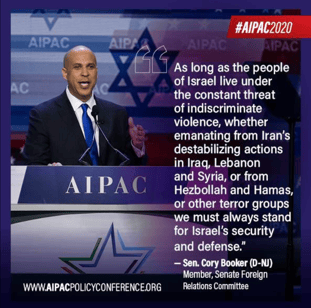
Posted by the official AIPAC account with the caption: "Thank you Senator Cory Booker for your leadership and for supporting a strong U.S.-Israel relationship. #AIPAC2020 #AIPACProud.”
He has supported legislation to stop the Boycott, Divestment, and Sanctions movement (BDS), an effort at nonviolent resistance to Israel’s violent ethnic supremacist state. Booker calls it an “anti-Jewish movement” and the legislation “would allow state and local governments the right to punish state or local contractors from engaging in boycotting Israel.” “We, right now, need voices in our country that are going to show the tribalism that is deepening in our country, that undermines obvious things to do like condemning the BDS movement,” he told AIPAC members in an off-the-record talk. In 2017, he supported a resolution celebrating the 50th anniversary of the illegal Israeli annexation of East Jerusalem.
Booker does not mention Israel in Stand, published after people around the world have taken a stand against Israel’s genocide in Gaza in tens of thousands of demonstrations. In fact, it's extraordinary, given that Booker's 25-hour speech was ostensibly devoted to opposing Trump's crackdowns on civil liberties and authoritarian tendencies, that his book manages not to mention how cracking down on Palestine protesters is a crucial part of Trump's agenda. You won't find Mahmoud Khalil or Rümeysa Öztürk mentioned in Stand.
Elsewhere, where he has been more honest about his convictions, it has become clearer what he means when he talks in lofty generalities about ending partisanship and tribalism: “We need leadership in both parties that is about uniting Americans around a common cause. And what greater tradition has there been in America, going back to the founding of Israel that we have common cause with the state of Israel. We have a common cause, and they are our allies.” (Note: This is not entirely grammatical, but it’s how the Jerusalem Post reported his words.)

Booker is not Jewish, but has been a staunch Zionist going back to his days at Oxford, when he was close friends with Rabbi Shmuley Boteach, one of Israel’s leading U.S. propagandists, who has accused human rights organizations of “blood libel” for documenting the genocide in Gaza. Boteach and Booker were like “brothers” in the early years, but the friendship fractured—Boteach says it was over Booker’s support for Barack Obama’s Iran nuclear deal, while Booker says it was because Boteach liked to tout private aspects of their friendship in public. But Booker’s convictions about Israel didn't change. “I was a supporter of Israel well before I was in the United States Senate,” he told AIPAC, reminding them that he attended their conferences long before he was a Senator. “I see it as my duty to protect the bipartisan nature of this relationship of Israel with the United States,” he said. “We must always as a matter of human values stand for Israel’s security and defense.”

Support for Israel, he said, is “not political to me,” a rather stunning statement given how extremely “political” the issue is. Booker has consistently voted, apolitically, to send weapons to a country that has been condemned by virtually all of the world’s major human rights organizations. The pro-Israel lobby has rewarded him financially for his loyalty, with hundreds of thousands of dollars flowing from pro-Israel groups into his campaign funds. (This year Booker said he would no longer accept funds from “single issue” PACs, which cuts off his increasingly toxic Israel lobby funding without forcing him to take a stance against AIPAC.)
This was abhorrent even before Israel’s genocide in Gaza. Israel has long maintained an aggressive system of ethnic apartheid, whereby it maintains control of the Palestinian territories while depriving Palestinians of the right to vote, keeping them in walled enclaves and slowly seizing their land and resources. Efforts like BDS were an attempt to peacefully pressure Israel to end this grotesque system.
But sending weapons to Israel became utterly morally depraved after the country began, in response to the Oct. 7, 2023 attacks, to systematically destroy Gaza. Israel attacked schools, hospitals, mosques, and colleges. It massacred aid workers as they tried to rescue survivors, and then tried to cover up its crimes. It used AI targeting to wipe out entire residential buildings filled with families. It used teams of armored bulldozers to erase whole neighborhoods from the map. It operates a “network of torture camps” for Palestinian prisoners.
As all of this was unfolding, it was the obvious moral responsibility of any decent person to do what they could to stop it. Aaron Bushnell, a U.S. serviceman who lit himself on fire in front of the Israeli embassy to protest these crimes, put it powerfully when he said:
“Many of us like to ask ourselves, ‘What would I do if I was alive during slavery? Or the Jim Crow South? Or apartheid? What would I do if my country was committing genocide? The answer is, you’re doing it. Right now.”
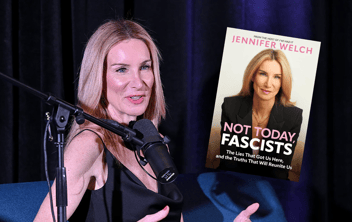
What did the author of Stand do during the unfolding atrocities in Gaza? When Bernie Sanders proposed to halt some weapons sales to Israel, Booker refused to go along, even though the majority of Senate Democrats supported Sanders’ measure. Israeli defense minister Yoav Gallant, who is wanted for war crimes by the International Criminal Court, thanked Booker for his “unprecedented support” for the country. When Booker was challenged, by I’ve Had It podcast host Jennifer Welch, to affirm the basic, incontrovertible point that Benjamin Netanyahu has committed war crimes, he squirmed and offered meaningless verbiage, calling the question an unfair “litmus test.” Welch replied that these kinds of evasions were why many Democrats were disappointed in their leaders, leading Booker to reply with further evasion:
WELCH
Do you think he’s a war criminal, Benjamin Netanyahu? Do you think he’s a war criminal?
BOOKER
I, I… again, these are questions that a lot of people think are the important litmus tests that are loaded and hot. My urgency is to be an effective leader in bringing an end to this crisis. And I get these questions all the time that, to me, undermine my urgency.
WELCH
I think the thing that Democrats get so frustrated with, where we are right now, where you see like the Zohran Mamdanis and the Graham Platners rise up, because they can go on podcasts and you can say ‘Do you think Benjamin Netanyahu’s a war criminal?’ and they just say ‘Yes.’ And that’s the end of it. It’s not all of the rhetoric-answering. What happens to Democratic politicians, they go through this prism and then we can’t get the answer to yes-or-no conversations… That’s the frustration…
BOOKER
So here’s the yes or no that you want. Do I think Benjamin Netanyahu is worse than Trump? Yes.
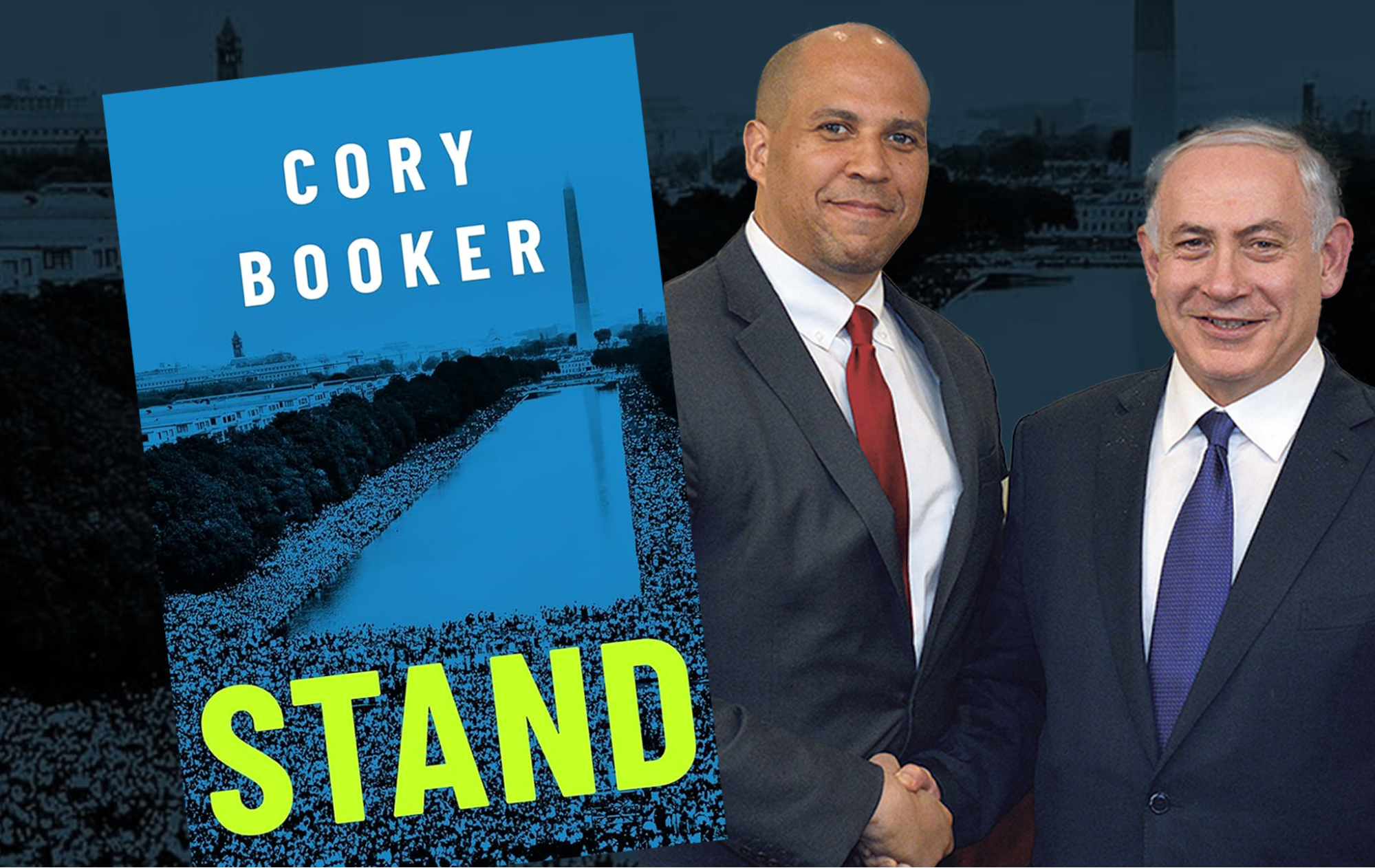
Well, that’s not what she asked, Cory, is it? Pressed on the same question by Pod Save America, the most Booker would say is that Netanyahu is a “horrible person,” who should be “held accountable” for “any crimes” that he has committed. As Netanyahu’s popularity has cratered, Booker has been more willing to criticize him, but every criticism he makes dances around the simple fact, which Booker will not say, that Netanyahu is responsible for war crimes and genocide. And in the second year of Israel's genocide, Booker was still happy to pose for a photo with Netanyahu!
Booker has also aggressively opposed the ICC’s effort at precisely the kind of “accountability” that he claims Netanyahu should face. He has joined with other pro-Israel Democrats and condemned the court for its “outrageous political targeting of Israel and its leaders,” calling its war crimes indictments an “affront to human conscience, deserving of both condemnation and severe consequences,” that must be “countered forcefully, including through sanctions on those at the ICC directly responsible.” It is hard to overstate how extreme this stance is. Instead of saying that the judicial process should be allowed to do its work, Booker says that there must be aggressive efforts taken, including sanctions, to ensure that the court responsible for prosecuting war crimes cannot prosecute Israel for its many war crimes.

“Our country needs each of us, every day, to stand,” Booker writes in Stand. But what kind of stand-taking is this? The man lacks the guts to even clearly acknowledge and defend his own position, which is that the U.S. should continue to help Israel annihilate Gaza and south Lebanon. Here we must at least give some comparative credit to Booker’s fellow Democratic senator John Fetterman, who is blunt in saying, to anyone who will listen, that he thinks Israel should kill as many Palestinians as it wants, and he will never criticize anything it does. Booker is more canny, criticizing West Bank settlers and Netanyahu’s moral character, but carefully avoiding confronting the fundamental question of why the U.S. should be offering ongoing financial support to a country that maintains an apartheid regime and is condemned by virtually the entirety of the human rights community for genocide. Booker doesn’t even have the courage to discuss the Israel-Palestine issue, avoiding any mention of it in the book. He piously quotes James Baldwin where it suits him, but declines to confront the James Baldwin who concluded that “the Palestinians have been paying for the British colonial policy of ‘divide and rule’ and for Europe’s guilty Christian conscience for more than thirty years” and said openly “I am anti-Zionist. I don’t believe they [Jews] have the right, after 3,000 years, to reclaim the land with western bombs and guns on biblical injunction.”
There is something grotesque, perhaps even evil, about a person who pays lofty tribute to Virtue and then takes hundreds of thousands of dollars from the lobby for a genocidal state and helps it continue to perpetrate some of the worst crimes against humanity being committed in our time. Booker has achieved a level of brazen hypocrisy that even Randy Fine and John Fetterman do not possess. Booker writes: “Leadership is not a title or position. It is action and example. It is sacrifice and service. It is—especially in a crisis, in the face of uncertainty, in a moral moment—standing up.” Stand is a call to protest, which is exactly what people of conscience are now doing against Booker’s book tour.
When the history of our time is written, nobody will have demonstrated a greater gap between their stated values and their actual actions than Senator Cory Booker (D-NJ), a man who rambled for days at a time about the importance of standing up and showing virtue, and then supported and funded some of the most horrifying violence of our time. Booker’s famous speech stopped 0 votes, halted 0 confirmations, and passed 0 bills. (It has led to one book tour.) His heinous failure on the most important moral issue in U.S. foreign policy tells us everything we need to know about Booker’s relationship to “virtue.”
Booker likes to quote Nelson Mandela (to whom he once compared IDF prisoner-of-war Gilad Shalit), once citing Mandela’s exhortation that “to be free is not merely to cast off one’s chains, but to live in a way that respects and enhances the freedom of others.” But when Mandela talked about fighting for the liberation of others and not just oneself, he was partly talking about Palestine. Mandela was explicit that anyone who admired his own work in the apartheid struggle had a moral obligation to show solidarity with Palestinians as well. In a 1997 speech at the International Day of Solidarity with Palestinian People, Mandela said:
The temptation in our situation is to speak in muffled tones about an issue such as the right of the people of Palestine to a state of their own. We can easily be enticed to read reconciliation and fairness as meaning parity between justice and injustice. Having achieved our own freedom, we can fall into the trap of washing our hands of difficulties that others faces. Yet we would be less than human if we did so. … All of us should be as vocal in condemning violence and the violation of human rights in this part of the world as we do with regard to other areas. ... All of us need to do more in supporting the struggle of the people of Palestine for self-determination.
In our time, there are some people who take Mandela’s words seriously, who do not just see them as platitudes to be emblazoned on mugs and shirts. There are Palestine Action protesters in Britain who risk arrest and imprisonment because their group has been “proscribed,” several of whom went on a hunger strike that lasted 73 days. There are those who have joined flotillas to Gaza trying to break Israel’s inhuman blockade and bring supplies, risking bombing and imprisonment. There are the tech workers who have been fired, the students who have been expelled, the immigrants who the Trump administration has aggressively tried to deport—all of whom took serious personal risks to stand up for Palestine. They are the ones who should be honored for standing on principle, and they are the ones who tell us the true meaning of virtue in our time.
Thank you to Nika Soon-Shiong for providing constructive comments on the first draft of this piece.