
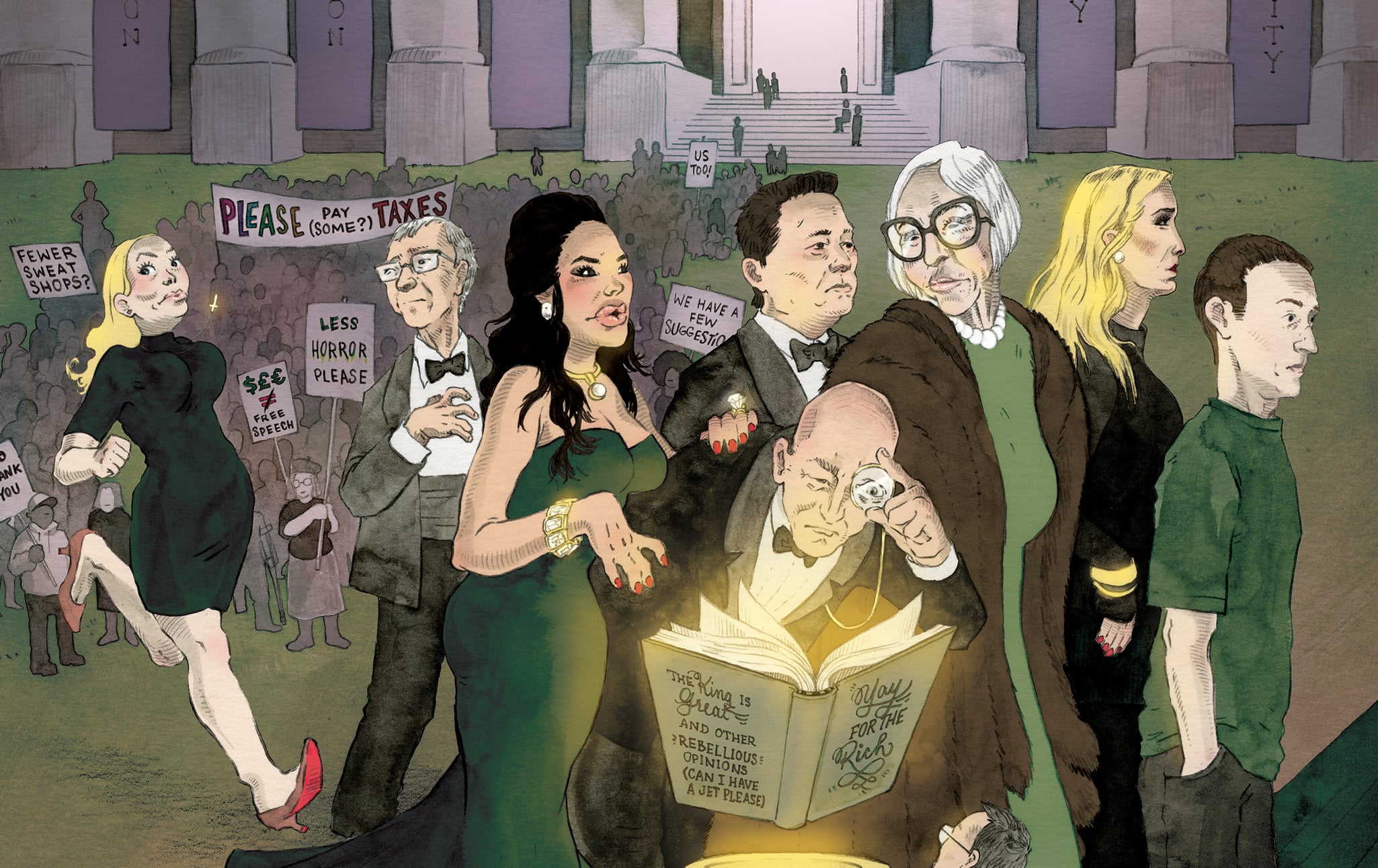
A new book argues that “Democracy Needs the Rich.” In fact, concentrated wealth destroys any semblance of a democratic society.
“What exactly is wrong with the wealthy?” law professor John O. McGinnis asks in Why Democracy Needs The Rich. McGinnis thinks the 1 percent have been unfairly maligned by leftists like Bernie Sanders, and are in need of a vigorous defense. The rich, he says, are productive and useful members of society. If we redistribute their wealth, we only impoverish ourselves. Even those of us who will never be rich ourselves benefit from the presence of oligarchs.
Is this true? Do we all benefit from the riches possessed by billionaires? In fact, the arguments here are thin, and the opposite is true: we would all be much, much better off if we lived in a more egalitarian society that didn’t concentrate wealth at the top.
Before evaluating McGinnis’s substantive case, we should refresh ourselves on what we’re talking about when we discuss “the rich” in the United States today. In 2025, the wealthiest one percent of Americans held about $55 trillion in assets, about the same as the bottom 90 percent of Americans put together. This year’s World Inequality Report found that the richest one percent globally owned 37 percent of the wealth of the planet, while the poorest 50 percent, over 3 billion people, owned two percent.
According to Oxfam, between 1989 and 2022, a household in the top 0.1 percent would have gained approximately $40 million in wealth, while a household in the bottom 20 percent would have gained less than $8,500, with the top one percent gaining over 100 times more wealth than the median household. When we’re talking about billionaires, we’re talking about sums of money that are almost impossible to grasp. Families at the top struggle with which sprawling luxury estate to spend the next season in, which exclusive restaurant to have your household manager get a reservation for you tonight, and whether to fire that personal sommelier your kid’s getting too close to. Meanwhile, at the bottom, families struggle with medical debt, college is unaffordable, entry-level jobs are scarce, wages don’t cover even basic housing, and there is widespread homelessness.
Curiously, though, McGinnis spends little time with these core facts. Instead, the scope of his book is narrow, and he prefers to largely focus on the influence that wealthy people have over political and economic decision-making. Most of his book is a response to the claim that wealthy people have a disproportionate influence over the political process, undermining democracy. Interestingly, rather than dispute the idea that the wealthy have outsized influence, McGinnis concedes the point. Yes, he says, the opinions of the rich matter more to policy outcomes. And that’s a good thing. “Sometimes greater influence results in better policy,” he says.
McGinnis says that the question is “whether the rich harm or help society.” He concludes that they help in three core ways: one is through “counterbalancing” the outsized influence of other groups, another is by contributing to “dynamism” and innovation through investing in or running businesses, and the third is through philanthropy.
One might begin by asking who, precisely, he means by “the rich.” McGinnis says that “it is not essential to have a precise cutoff for what constitutes ‘the rich,’” but says we might talk about the top 0.1 percent, whose wealth starts at around $60 million. But McGinnis says it ultimately doesn’t really matter what threshold we pick, because he will argue that the richer people are, the more socially valuable they are. “While the top 5 percent certainly make significant contributions, the top 1 percent do more, and the top 0.1 percent even more. Wealth, in this sense, acts like a lever: The more there is, the greater the impact.” So if you thought that perhaps McGinnis would say that it’s good to have a class of wealthy people, but perhaps not a tiny set of oligarchical near-trillionaires, you’d be wrong. In fact, the people at the very top are the most helpful of all, making Elon Musk our most socially beneficial wealthy person.
The argument McGinnis leans on the most is that the wealthy “counterbalance” the power of special interest groups. McGinnis argues that we do not live in a democracy where everyone has an equal say, with the power of the rich (to influence politicians, to buy media) corrupting that otherwise-pristine democratic process. Instead, he says, other groups like academics, journalists, nonprofits, and labor unions wield influence disproportionate to their size, getting their way despite holding minority viewpoints. The wealthy, McGinnis says, through their own power (which, again, he admits they hold) simply act as a counterweight, ensuring that the political process is something closer to fair.

Insubordination
McGinnis extends this argument about the rich “counterbalancing” special interests (like labor and reporters) to balancing the political debate itself. He leans heavily on the idea that academics and journalists, who he relentlessly claims are ideologically uniform leftists, are far more powerful than the rich since they control information. Journalists set the near-term agenda, he claims, while academics shape the long-term agenda. He says that these knowledge workers form a woke “clerisy” that is offended by the rich for allowing people out of their mind control, and he specifically claims they have more power than the rich.
McGinnis finesses this dubious equation of academic cache with billionaires’ cash by resorting to incredibly vague language, often using “clout” as something shared with the small number of households that own the country’s productive wealth and professors of English and Metro desk reporters. It is incredibly unserious, because “clout” is not a measurable or even clearly defined thing. McGinnis is guilty of obfuscating hierarchy, and not very convincingly. Frankly, we prefer it when conservatives outright celebrate real hierarchy, as many of the right’s leading philosophers have long done. It’s more honest.
Irritatingly, McGinnis also adopts the common right-wing pundit’s technique of never quoting or citing a leftist, ever. Instead, he cites vague unnamed “critics” who oppose his views, but who cannot apparently be afforded the room for even a few sentences of sincere debate. For someone so consumed with the rich as “counterbalancing” the left-wing uniformity of campuses by bringing “intellectual diversity,” McGinnis’s book will find literally no quoted leftists, except a two-word quotation from Bernie Sanders on page 1 (“policy failure,” used to describe billionaires). Don’t get used to it, because after that, ghostly “critics” imply there are opposing views, but McGinnis lacks the courage to let them have their day in court.
But do (often poorly paid) academics and journalists really wield more power than wealthy oligarchs? Certainly, the journalists at the Washington Post did not wield more power than their newspaper’s billionaire owner, Jeff Bezos. It was Bezos who fired hundreds of reporters at the Post recently, not the workers who organized a socialized workplace and voted to sack the boss. Bezos also directed that the paper should only publish op-eds that were consistent with his own ideological viewpoints, advocating for “personal liberties and free markets.”
What about academia? Here, too, we should remember that professors only have as much liberty as their board of trustees is willing to grant them. When the donors are unhappy, the professors’ careers come under threat. For instance, the public George Mason University in Virginia “granted the conservative Charles Koch Foundation a say in the hiring and firing of professors in exchange for millions of dollars in donations.” At the University of Illinois, Palestinian professor Steven Salaita was fired after a donor threatened to “reduce or withhold his monetary contributions to the University if Professor Salaita was allowed to teach there.”
In fact, McGinnis himself teaches at the Pritzker School of Law at Northwestern University. The private law school was renamed in 2015 after the wealthy Pritzker family, who had given it a $100 million gift. (Although McGinnis tells us the rich are in a “constant churn,” with new millionaires minted daily, the Pritzkers have been on the Forbes Top 10 Richest Families list since 1982.) The average American earns $1.7 million over their lifetimes, meaning this single gift came to the amount of money made in over 58.8 human lifetimes. Is it plausible that if the Pritzkers had a major problem with a faculty hire, that their call to the dean would have zero impact? Would the opinion of a student, or a school janitor, about hiring decisions be nearly as influential?
Diversity, from Hyper-Right to Wimpy Center-Right
McGinnis argues that the influence of the rich on politics does not pull the country in a particular ideological direction, because there is great political variety among them. This, he says, is proven by some billionaires supporting Trump in 2024 and some supporting Harris. But this in fact proves the point, because the backing of the two parties by America’s wealthiest tycoons is what has led them both to cohere around economic policies that decline to disrupt the status quo.
McGinnis’s constant claims that university and news elites have “ideological uniformity” relies entirely on the tendency of these groups to vote for the Democratic Party. The flimsiness of this can be seen in various ways, one being that the Democrats are mostly centrists and economic conservatives, opposed to popular left-wing demands like nationalizing health insurance, ending military aid to Israel, or far more liberal immigration policy. Harris’s corporate and oligarch backing led her to dial down economically populist policies, and after Barack Obama raked in money from Wall Street, he adopted Wall Street-friendly positions in office. Democrats are a fundamentally economically conservative political party. Democrats like Harris, Clinton, and Biden all support private property ownership and the great “innovations” of Big Tech. These kinds of Democrats passed or supported the working-class-killing NAFTA trade treaty, the TARP bank bailout program, and the use of “Obamacare” private insurance requirements rather than a left-wing proposal like Medicare for All. By claiming national Democratic politicians are “the Left,” McGinnis can slothfully claim that there is great ideological variety among the rich.
Still, even by this lazy definition, more of our richest oligarchs are full-on right-wingers than liberals or centrists, and 80 percent of campaign spending in 2024 by the top 100 richest Americans went to Republicans rather than Democrats. But how many of these elite families support the actual political Left in the U.S., such as it is, like endorsing Bernie Sanders or Zohran Mamdani or Rashida Tlaib? Few indeed! McGinnis claims that while academics and journalists are all leftists, the rich are, by contrast, richly different in their views. This is shown by reminding us of billionaires, like Mark Cuban or Tom Steyer, who supported the campaign of the famous left-wing figure of… Kamala Harris. And in reality, the New York Times has documented that the partisan tilt is clear enough: about 300 billionaires made 19 percent of all federal political contributions in 2024, with 5/6th of those millions going toward Republican candidates, 1/6th to Democrats. All these billionaires, for their alleged diversity, share a class preference for the leftmost option to be an Obamacare requirement to buy private insurance, rather than a leftist solution like national health insurance.
If we want to be serious in our analysis, we could conduct an institutional analysis, as Ed Herman and Noam Chomsky famously did in Manufacturing Consent, the definitive left-wing work of media criticism, which finds that there are compelling corporate and market incentives for media companies to maintain “filters” on news products that reflect the interests of media’s corporate ownership and reliance on an advertising-based media model. Or we could be serious by examining actual media output, as the progressive media monitoring group FAIR has reliably done for so many years, finding for example that while corporate CEOs are very commonly invited on as guests for commentary on commercial news, labor leaders are almost totally absent.
Similarly, rather than evaluating whether the rich are ideologically diverse by which pro-capitalism party they vote for, we could conduct a class analysis. Mark Cuban may prefer the “woke” stylings of a Kamala Harris while Elon Musk prefers the coarse Donald Trump, but they share an interest in limited regulation of their industries, opposition to tax increases on their income streams or wealth, and antagonism to worker organization in their empires. Both Cuban and Musk, for instance, called for antitrust crusader Lina Khan to be ousted from her post at the Federal Trade Commission in 2024. Are the billions upon billions of dollars at stake for these men possibly more compelling in understanding the rich compared to which anti-Medicare For All party they supported in the last cycle? Perhaps.
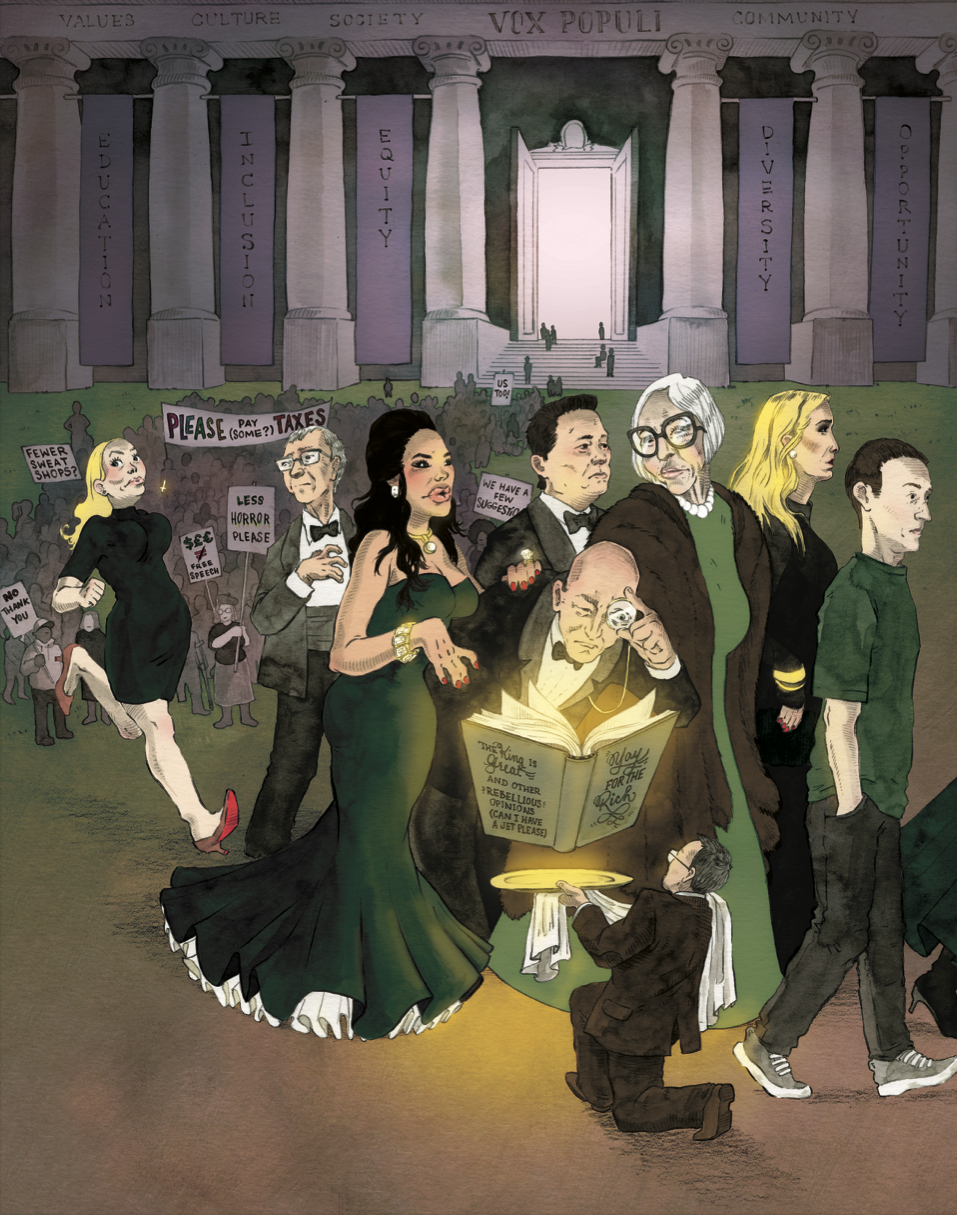
Art by Emily Altman from Current Affairs Magazine, Issue 59, May-June 2026
Cracked Foundations
What about McGinnis’s next argument, “economic dynamism”? The rich, he says, create all kinds of wonderful products and services for us. Well, first, how would we measure the contributions of the rich to “innovation” and “dynamism”? One way might be to look at whether innovation can occur in less grotesquely unequal countries to our own. In fact, it can. Plenty of social democratic countries, including Sanders’ favored Nordics, rank high on the Global Innovation Index, which “uses some 80 indicators, ranging from research and development (R&D) spending, venture capital (VC) deals, high-tech exports and intellectual property filings in evaluating nearly 140 world economies on their innovative performance.”
As Rob has written about for this magazine, inventing new technology is expensive and risky, with zero guarantee that your lab staff will come across a new discovery, let alone one that will generate a profit in the near-term. Largely for that reason, fundamental research and development has historically been done primarily by the public sector, including the military and university system. The history is clear—the radio broadcasting technology today’s cell signals and Wi-Fi descend from were developed by Marconi for the Italian Navy. The internet architecture, including its data protocols, interoperability, and technical network standards, were developed by the Pentagon’s research arm, DARPA, along with several U.S. research universities, over decades. Wi-Fi was developed for University of Hawaii researchers to access computing power. Google’s original web address was google.stanford.edu, reflecting its origin in a National Science Foundation-funded campus research lab.
The hyper-rich platform billionaires receive endless worship for innovating today’s online ecosystem, but their contribution was usually to recognize the commercial potential of the public-funded and -developed internet and rush to put companies in place to exploit the opportunity. That includes gigantic web-commerce entities like Amazon, search monopolist Google, and social network tyrants like Facebook and Twitter. Their innovation is real, but mostly in the field of getting your claws into a valuable new technology paid for by Cold War-era taxpayers.
What about philanthropy? McGinnis points to the work of foundations and charities funded by the rich. Would we want to do without their work? But here we must consider counterfactuals, the scenarios that would have unfolded if we lived in a more egalitarian society, not just if all of America’s nonprofits disappeared overnight. Mark Zuckerberg, for instance, donated $100 million to the Newark school system. We might look at that as a big plus in the “what rich people do for society” column. But even if we assume that that money was well spent (in fact, $20 million of it was spent on consultants), we can’t conclude that that’s $100 million worth of good contributed by the rich, because we have to consider an alternative world in which billionaires had their wealth taxed away to fund schools. In that alternative scenario, we would have a lot more than Zuckerberg’s $100 million to put towards underfunded schools.
You can come up with a long list, as McGinnis does, of helpful philanthropic endeavors funded by the rich. But the right question is: to what extent would we even need billionaire benevolence if we had a just system of taxation and spending to begin with? If public hospitals are starved of resources because the rich aren’t adequately taxed to pay for strong public services, but then a rich man funds a hospital for the poor, is that a benefit provided by the rich? Or is that a tiny suggestion of the world we could live in if we actually taxed appropriately?
McGinnis makes the point that many art museums are funded largely by wealthy philanthropists, suggesting that without the wealthy, we would lose access to important cultural treasures. “Walking through any major museum,” he writes, “one can trace not only the history of great art but also the legacy of the entrepreneurs and industrialists who were its early patrons.” Now, we should first note that even if we assume that only entrepreneurs and industrialists can endow and support museums, it may still be the case that we do not need billionaires, since art museums might well flourish in a society where nobody had more than $200 million. In fact, a policy that said “any income over $1 million per year must be donated to a nonprofit” would likely result in a vast increase in art museum budgets. But McGinnis also assumes that the public sector simply cannot care enough about culture to fund it adequately. Speaking of the Guggenheim Museum, he says, “Could a committee of bureaucrats, dispensing money that is not their own, have accomplished anything comparable?”
Well, as a matter of fact, yes. There’s a museum you may have heard of called the Louvre. (It’s in France.) In 1791, after the French Revolution, the National Constituent Assembly established the Louvre as "a place for bringing together monuments of all the sciences and arts,” and it opened to the public on the first anniversary of the end of the monarchy, making the king’s treasures accessible to all. The Louvre is operated by the French state to this day as a public cultural institution. There is no reason why art has to remain in the hands of the rich. The state can kill the king and give his art to the people, and the result is not bureaucratic disarray but the most acclaimed museum in the world.
McGinnis is also living in an idealized world of charitable billionaires, who believe in “giving back.” In fact, giving back has fallen out of fashion among today’s elites. Billionaires who signed Warren Buffett’s Giving Pledge have come to regret it. A New York Times profile of Lauren Sanchez Bezos says she embodies the moment when “American money stopped apologizing and decided it might as well enjoy itself.” In the age of Trump, the philosophy of the rich is: get as much as you can and keep it. The prevailing philosophy is now, according to Aaron Horvath, a sociologist who has studied the Giving Pledge: “I can keep my head down and keep making money. I don’t have to put up with this charity charade anymore.”

Because McGinnis doesn’t reckon with the actual public policy influence of the wealthy, or the counterfactual scenarios in which we had a more progressive system of taxation, let alone the moral horror of letting deprivation persist so that billionaires may sail around on climate-destroying jets and megayachts, his book’s argument is worthless and unconvincing. But this book does afford an opportunity to think through the world we could live in if we expropriated some of the vast wealth hoarded by our oligarchs.
The RAND Corporation has produced an important study that shows just what we are giving up by allowing extreme wealth concentration to persist. They note that over the last 40-plus years, “had the bottom 90 percent kept up with GDP growth, they'd have collectively taken home $2.5 trillion more in income in 2018.” They imagine a counterfactual situation in which the benefits of growth had been distributed equally rather than being clustered among the already-rich. If that had happened, then the annual income for a full-time worker in the 25th percentile would have been $61,000 in 2018, instead of the actual figure, $33,000. The median full-time salary would have been $92,000 instead of $50,000. In other words, you (yes, you!) would have been earning tens of thousands of dollars more every year. Think of what a difference that would have made. Think of how much suffering would have been avoided, how many sleepless nights over medical debt, how much hunger, how much homelessness. Illness or injury brings twin fears for Americans, not just death but bankruptcy for us and our family. Struggling to pay the bills colors every day with a desperation for many families, which is totally avoidable. We could have lived in a world in which even those in the low end of the income distribution earned more than enough to live what today seem like comfortable middle-class lives. That’s what inequality has robbed us of. It’s not just that we’re not getting our share of the money, it’s the life of unstable precarity and constant anxiety it burdens us with.
McGinnis does not mention this study, because he does not want us to think about the world we could actually have if we had a less absurd distribution of wealth. He doesn’t want you to realize that you are being robbed, and to realize just how much worse things are for the rest of us so that the world’s wealthiest people can amass even greater fortunes.
It would seem very difficult to defend this kind of inequality, which strikes many as grotesque. When kids are going to school hungry, how can Mark Zuckerberg justify having a $400 million, 387-foot megayacht, a yacht so elaborate that it travels with its own 220-foot support vessel? Interestingly, McGinnis does not even try to address the basic moral objection to extreme wealth inequality, namely that wasteful spending on luxuries cannot be justified when many people’s basic needs are not met. Perhaps that is because it is extremely difficult to make the case for why it is more important for Zuckerberg to have a 17th or 18th house than it is for a destitute child in Detroit to go to school well-fed. The allocation of resources that comes from such a lopsided wealth distribution cannot be squared with any defensible theory of the moral good.
From finessing numbers to inverting corporate org charts, McGinnis’s book badly bungles the facts and grossly fails to make its case. He claims that the rich are not that rich, that their wealth makes them more open-minded, that they are “out of favor” despite owning the economy, and that their practical experience and independence make them good for democracy. But despite this constant McGlibness, the ruling class helps democracy like smoking helps your lungs. McGinnis should return to his office, in his school named for billionaires, and start work on his book-length apology.


.png?width=352&name=Screenshot%202026-09-04%20at%204.00.52%20PM%20(1).png)
%20(1).jpg?width=352&name=miasma-1%20(1)%20(1).jpg)