_U.S._Marine_Corps_Sgt._Maj._Troy_E._Black_visits_the_War_in_the_Pacific_National_Historical_Park_in_Guam_on_March_24%2c_2025_-_6.jpg)
U.S. military power has poisoned Guam’s waters, controlled its politics, and prevented its people from determining their own future.
"Is this really America?"
As I marched through Agaña's humid suburbs in 2013—a dense, unfamiliar jungle pressing in on one side, cul-de-sacs with stilted houses and long roadways on the other—this question played over and over in my head. In the sky, American military helicopters passed. On the road, sun-bleached American cars. Every so often, a McDonald's. Yet none of it could shake the question until, over time, it curdled into something deeper: Should Guam be a part of America? Better yet, does America deserve to keep it?
Around the world, conversations around neo-colonialism are evolving—in Palestine, in the DRC, in dozens of places once written off as settled history. Welcome as that shift is, it far too often leaves out Guam's ongoing fight for self-determination, along with the rest of the Western Pacific Islands. I don't raise this as a criticism so much as an opening: this moment of decolonial reckoning is precisely the moment to bring Guam into the fold, and to ask what is hiding behind the opaque label of "territory."
I was once told that there is no difference between a colony and a territory. A colony, according to Merriam-Webster, is “an area over which a foreign nation or state extends or maintains control.” One could argue that Guam does not fit that definition—after all, the U.S. is not technically foreign to Guam, and vice versa.
But empires have always been fluent in the art of renaming what they claim as theirs. “Territory” is modern-day colonialism. It just has better PR.
Following centuries of Spanish colonization that devastated the native Chamoru population, Spain ceded Guam, along with the rest of the Mariana Islands, to the U.S. in 1898 after the Spanish-American War. The U.S. held the island until 1941, when Japan invaded and subjected Chamoru residents to three brutal years of occupation. American forces retook Guam in 1944, and in 1950, the island officially became a U.S. territory.
Yet, for many Chamoru families, including my own, that history is complicated.
My great-grandparents survived Japanese occupation, and I don’t take lightly what American forces did in liberating the island—nor the unspeakable trauma the Chamoru people endured along the way. At the hands of Japanese soldiers, Chamorus were tortured, raped, and subjected to forced labor. But it’s precisely that trauma that has justified the military’s ravaging of the island—the saviorist complex of the US has made way for a generational gratitude toward the military and its continued presence on the island. Researchers have actually given this phenomenon a name: “colonial debt”; Chamorus who report a stronger sense of debt to the U.S. for liberation are increasingly likely to support the military buildup today, and to trust pro-military news sources over critical ones.
The question, then, is not whether the Chamoru people were saved. It’s whether they were freed. Centuries earlier, Spain had already stripped Guam of its right to self-determination. When the island was signed over to the U.S. at the turn of the 20th century, it was treated as “spoils of war”—and that logic, I’d argue, quietly contributes to a justification for U.S. control today, even as the battle for Chamoru agency remains ongoing.
While the Organic Act of 1950 may have finally granted the Chamoru people American citizenship, it simultaneously gave Congress the power to annul any law Guam’s own legislature passed—without local consent. Seven decades later, that parasitic arrangement persists. Guam cannot vote for president, cannot have any senators, and can only send a single non-voting delegate to the House. Hell, they don’t even get a star on our flag.
What the American government advertised as an act of political equality and inclusion instead institutionalized a different kind of subordination, binding the Chamoru people to a system that granted the responsibilities of American citizenship without its full rights. The result was far from freedom or equality, but rather a permanent status somewhere between inclusion and exclusion. American enough to serve, but never quite American enough to decide.
As we know, the following decades brought about costly conflicts in Vietnam, Korea, and against the Soviet Union. Yet, even given their severe lack of political agency, the island of Guam remained not only faithful to U.S. efforts but also integral, harboring troops, munitions, and B-52 bombers to fight the, quote-unquote, “good fight” against our apparent Communist menace.
Today, over 21,000 U.S. service members reside on Guam, and three military bases take up roughly one third of the island—an island nearly five times smaller than Rhode Island. Despite the hundreds of American military bases worldwide, Guam is utterly indispensable to U.S. geopolitical interests, especially today given its proximity to Taiwan and the supposed “boogeyman” that is China—a designation that China itself has literalized, developing a ballistic missile officially nicknamed the “Guam killer.” When North Korea threatened to fire “a salvo of missiles" into Guam’s waters back in 2017, Trump’s own response—“let’s see what [Kim Jong Un] does with Guam”—perfectly encapsulated the view the U.S. military has long had regarding Guam: to us, your people will never be as valuable as your island.
None of this is new for Indigenous communities across the Pacific. American militarism has been razing land here for decades—one of the earliest cases being the nuclear testing campaign in the Marshall Islands. A 2025 study by the Institute for Energy and Environmental Research put the toll at roughly one Hiroshima-sized bomb every day for 20 years, with radiological, environmental, health, and economic damage that’s still being felt today.
Guam itself was not spared from this over decade-long barrage of nuclear testing, receiving measurable radioactive fallout, and with a 2012 congressional panel later concluding that the U.S. had “put the population of Guam in harm’s way knowingly and with total disregard for their well-being.” Nonetheless, despite being formally ruled eligible under the Radiation Exposure Compensation Act (RECA) in 2005, the Chamoru people have not received a cent to this day
For decades, the U.S. military has mercilessly bombed, polluted, and contaminated the Mariana Islands and Western Pacific land, waters, and ecosystems in pursuit of military expansion and weapons testing. When Washington needs Guam, the island is vital. When Guam needs Washington, the island becomes invisible.
Again and again, the pattern repeats.
As a result of this area’s decades-long designation as nothing more than critical military outposts and testing grounds, Guam has come to differ from its other post-colonial neighbors, such as the Hawaiian Islands, whose existence, to most, has been characterized by touristic, tropical fetishism. Guam, on the other hand, has been entirely consumed by this militaristic identity—and it has wrought catastrophic, long-term consequences for this small island and its just over 150,000 inhabitants.
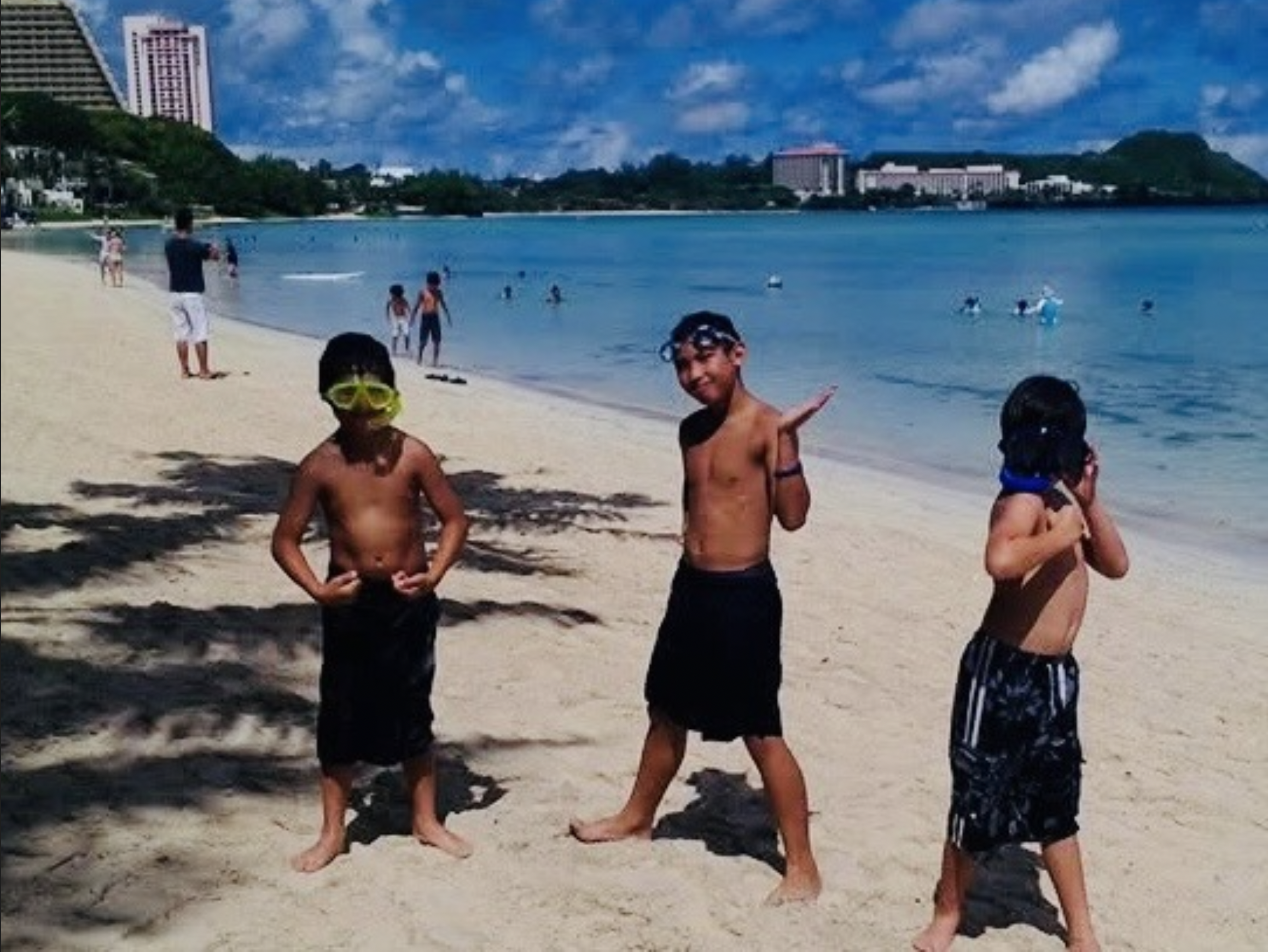 From right to left, the author, his cousin, and brother, play in the sand at one of Guam's many beaches in 2013. While the island is known for its stunning scenery, U.S. military activity has destroyed thousands of acres of Guam's forests and leaked "forever chemicals" into the water supply. (Photo courtesy of Nathan Sledjeski)
The island now has 19 federally designated Superfund sites—lands designated to have dangerously toxic levels of pollution—and at least 70 more contaminated locations, including one where the Navy discharged radioactive water into a public harbor without ever telling Guam’s own government. Decades of testing and militarization have also left massive traces of highly toxic pesticides like Dieldrin, PFAS, and PFOS across Guam’s northern waters, killing off fish and creating countless “no drinking” zones. Other hazardous substances, including Agent Orange, mustard agent, and a range of industrial carcinogens, have also been stored, used, or disposed of on the island over time—practices that the US government brazenly tried to deny in 2018, but that were confirmed true by the Veterans Legal Services Clinic at Yale Law School in 2020.
A similar pattern of wanton disregard extends to the land itself. Since World War II, the expansion of American military installations has leveled villages, displaced communities, and fenced families off from land their ancestors had lived on for generations. Even Guam's wildlife bears the imprint of that history. Native birds like the Guam kingfisher and Guam flycatcher once filled the island's jungles before the invasive brown tree snake—almost certainly introduced through U.S. military cargo after World War II—drove them to extinction in the wild or wiped out their populations.
The U.S. military’s abuse of Guam and its people without a doubt continues today at Tarague Beach, a site of immense archaeological significance that also provides clean drinking water to 80 percent of the island. The Air Force now wishes to continue open burning and open detonation of hazardous munitions, a practice not seen there for decades and one that would surely compound the already extensive list of environmental harms at the hands of the U.S. military. Yet this is part of a broader pattern in which military priorities repeatedly quite literally bulldoze over Indigenous history.
During the recent construction of Marine Corps Base Camp Blaz in Dededo, workers discovered human remains at multiple sites along with cultural artifacts. Despite local and community objection, with 13 of Guam’s 15 senators calling for a pause, the military continued.
In much of the U.S., federal protections would apply to sacred burial sites like these. But Guam exists in a second-class, legal gray area where many protections available to states do not fully extend to territories.
Prutehi Guåhan, a Guam-based environmental direct-action group, fiercely challenged the Air Force’s permitting process at Tarague Beach, suing them for violating the National Environmental Policy Act (NEPA). A Guam court initially dismissed the case, but Prutehi later prevailed on appeal before the Ninth Circuit. This was a milestone victory for Indigenous rights in the Pacific, with the ruling essentially forcing the military to conduct reviews to evaluate the potential impacts of its proposed actions.
But, as we know, the American military is quite the sore loser.
The U.S. Air Force has countersued Prutehi. The organization is now headed to the Supreme Court, represented by Earthjustice and supported by the Pacific-led international law firm Blue Ocean Law. The disgusting irony is obvious here, in that one of the world's largest military institutions is waging a legal battle against a small island community for insisting that it follow its own laws.
For Monaeka Flores, the Executive Director and founding member of Prutehi Guåhan, the issue here is not simply a lawsuit but about what it means for a community to have to fight exhaustively for protections that should already exist for them.
“It’s a delay in justice for our people,” they told me. “And it’s terrifying to go before SCOTUS.”
Flores’ frustration is rooted not in their odds of prevailing, but rather in what it says about the island’s position as a whole in the eyes of the federal government: “We have to ask why the people of Guam are not worthy of…the military just following the law.”
The U.S. military has left a legacy of long-term environmental devastation across Guam—one that continues to shape the health of the Chamoru people and the land they have called home for generations.
From radioactive fallout linked to nuclear testing and the open detonation of hazardous munitions to contaminated groundwater, toxic chemicals, and the expansion of military bases onto ancestral lands, the costs have been borne overwhelmingly by local communities. Drinking water has been polluted, sacred sites disturbed, and ecosystems permanently altered. Time and again, the well-being of the Chamoru people has been treated as secondary to the strategic ambitions of the United States, their health and homeland sacrificed in service of an ever-expanding military footprint across the Pacific.
If the Supreme Court were to side with Prutehi in their upcoming case, it could be, in Flores’ words, “major” as far as the federal government’s obligation to reevaluate social and environmental conditions through NEPA. This win could “affect every other community that needs NEPA to evaluate and participate, and provide feedback on any federal projects,” effectively enforcing compliance with environmental laws.

But in the midst of their legal battles, the typhoons came. In early 2026, Guam and the Northern Mariana Islands were hit by two storms of Category 4 and 5, Sinkalu and Bavi, within two months of each other.
“So many people in the northern islands lost their homes, their animals,” Monaeka told me. “We’re talking about several weeks of living with no power and water. People are severely food insecure. Hundreds of people in shelters.”
And, from the mainland, it seemed like almost nobody knew any of it was happening. One CNN headline in particular stood out to me, reading: “Super typhoon smacks into US Pacific island territories home to key military bases.” Not “island territories” home to communities or families, but “key military bases.”
This is what happens once an identity gets flattened into a “military asset.”
What makes resistance even harder is that the military isn’t just occupying the island—it’s embedded in it. Enlistment rates on Guam are among the highest in the country, and that same colonial debt runs through it. “We are stuck in cycles of dependency,” Monaeka said. “We are stuck in poverty because of our colonial status, and it makes resistance more challenging as a result.”
It should be known that this imbalance is not accidental but the result of a political system designed around the assumption that Guam, its people, its culture, and its history are close enough to the American empire to be governed, yet distant enough to be treated disparately.
The discourse around Chamoru political agency is often hindered by fear-mongering about an inevitable Chinese takeover. Consequently, Guam’s status options are reduced to a black-and-white binary: instantaneous foreign takeover and subjugation, or continued ownership by the US. This, however, is hardly the case.
Melvin Won Pat-Borja serves as the Executive Director for Guam’s Commission on Decolonization, a government office that educates the Chamoru public on political status options.
The office advocates for three distinct political statuses—U.S. statehood, independence, or free association—all of which would meet the commission’s standards for self-governance. These options would combat what Pat-Bojra describes as “legalized discrimination” in the political relationship between Guam and the United States, whereby Chamorus are afforded “statutory rights” rather than the “constitutional rights” enjoyed by U.S. citizens on the mainland.
This inequity is most evident in the 1901 Supreme Court Insular Cases, which established a two-tier system of rights for territories compared to states. Due to the perceived nature of the “alien races” inhabiting territories at the time, the cases ruled that the inhabitants of these islands were “belonging to, but not a part of” the US, and were therefore entitled to lesser rights.
But this doctrine itself doesn’t entirely respond to the earlier question of why Guam keeps falling out of the conversation about neo-colonialism. Palestine, Congo, Sudan, even Hawaii to an extent—all of them have found a place in that discourse. Guam hasn't. It would be foolish to presume that its absence is due in whole to a century-old court ruling.
The more well-rounded answer, in my view, resides in what that ruling has made possible.
To return to the initial point that there is no difference between a colony and a territory, we have to abandon the premise of a colony as an ancient relic of empire. If colonialism is to extract value from another’s land while denying them meaningful control over their political future, then the distinction begins to dissipate. Strip away the euphemisms, and the basic arrangement remains, laid bare. Colonialism has simply been modernized—its consent manufactured by the falsehood of American military necessity.
What recourse, then, is left to the Chamoru people? Guam’s political system seems designed to make resistance legible without making it consequential. Sure, its residents can testify, protest, sue, organize, vote locally—but the final authority over the island’s most consequential decisions resides outside the island itself. The federal government can hear Guam without having to heed it. It is a system that allows Chamoru voices to be duly noted—but how can one initiate change while being kept just far enough from power? Does being heard necessarily mean being able to decide? The answer to that question is no.
But this reality of what Melvin calls “consultation versus consent” has been, and always will be, a bitter pill to swallow. Guam’s particular predicament, I believe, says less about the failures of federalism than it does about the consequences of an insatiable and incessant knack for militarization in this country—and the political system that allows its colonial logic to persist largely out of sight. The US military, whether we are willing to call it one or not, operates with the logic of an empire: expanding its reach while treating the countless human and environmental tolls of that expansion as collateral.
And if the empire decides you're too indispensable, it doesn't let you go.
Decolonization movements have room for Palestine, Congo, and Sudan. They should have room for Guam too—not as a footnote, not as a punchline in a kids' movie, but as a live, ongoing fight for a people who never agreed to be a military asset in the first place. Guam deserves a seat at the table. The rest of us should be asking why it's taken this long to pull them up a chair.