
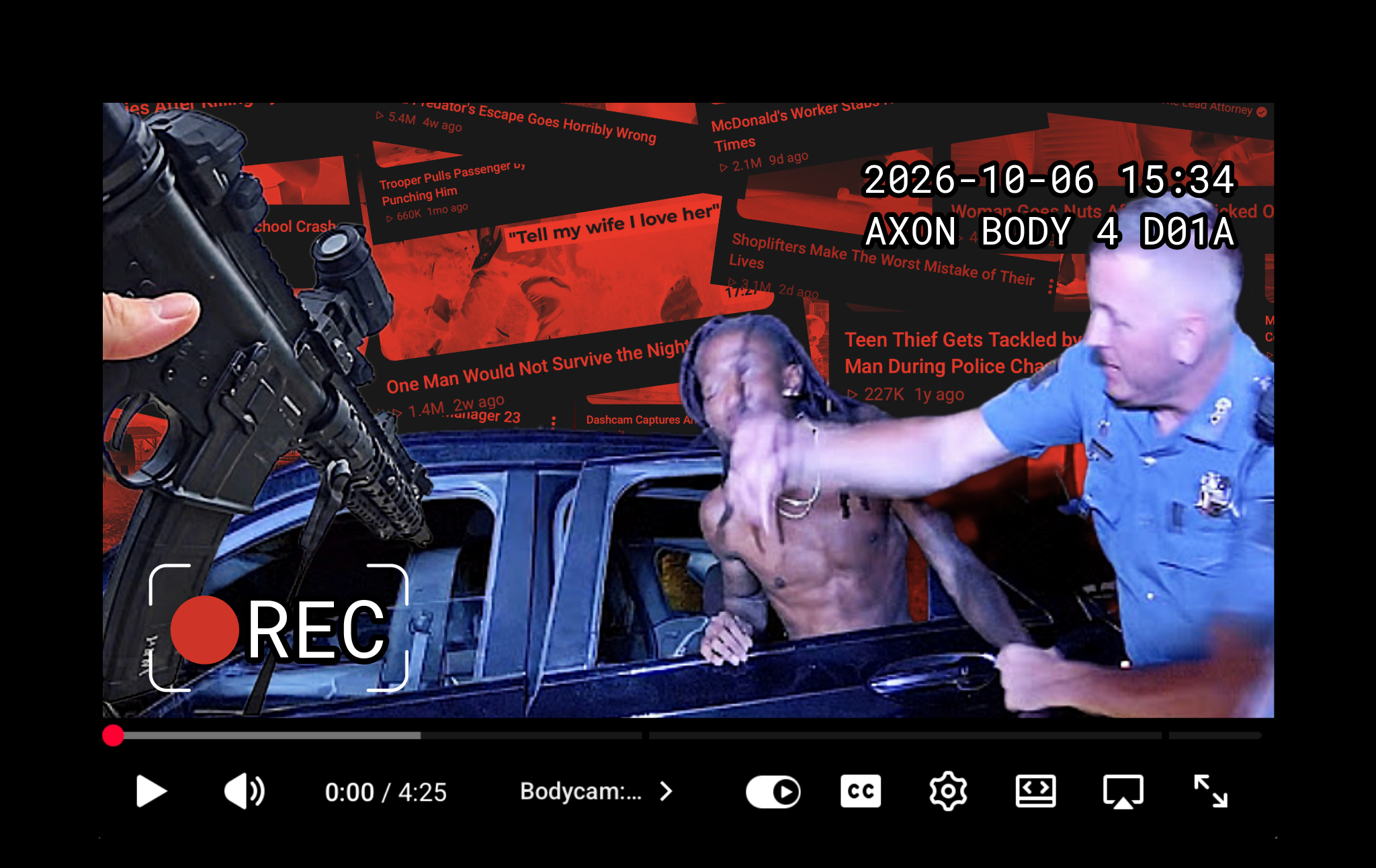
Police body cameras were meant to hold officers accountable. On YouTube and beyond, they’ve become a wildly profitable form of human misery as entertainment.
A video opens on a young man with dark hair and a beard, walking up a street on a sunny afternoon. He’s wearing dirty jeans, a red backpack, and a brown hoodie. He holds a metal baseball bat. As he walks past parked cars, he smashes their rear windshields. The video cuts to the interior of a car rolling to a halt beneath an underpass. “Hey!” yells the driver, as he opens the door and levels his firearm. “Put down the bat! Put it down! Put it down!” We’re watching from the perspective of a police officer. “Put it down!” he yells again. The officer steps to the left, revealing his target: the man with the baseball bat. He fires two shots. The man hunches over, as if about to vomit. He uses the bat to try and prop himself up. “Officer needs help, shots fired, shots fired,” says the policeman into his radio.
The man stumbles forward and collapses. His bat jangles as it hits the tarmac. He lies there with his eyes fixed on the officer who just shot him, hence on the camera, and the viewers. A group of police officers swarm him. “Don’t move, don’t move,” commands one. The man’s eyes are now closed and he doesn’t respond. Police take the bat from beneath his body, bring his hands together behind his back, lock handcuffs around his wrists, then roll him into a supine position. There’s a large pool of blood on the asphalt next to his head. Kneeling in it, an officer clamps her hands together, and starts performing chest compressions on the apparently lifeless man.
It is a disturbing scene, and its discomfort goes beyond the gruesome. Elements other than the shooting itself add to the sense of despair: the homeless people camped in the tunnel, the cars driving past as if nothing were out of the ordinary. The dirt on the dead man’s jeans, and their frayed cuffs. The fact that he’s not wearing socks. His raggedy rucksack. The look in his eyes after he’s shot. The closeup view of his body as police manipulate his hands into the cuffs, clinking them around one limp arm and then another. Although he was pronounced dead upon admission to hospital, it looks as if his soul left his body there beneath the underpass.
On YouTube, the video has been seen 640,000 times, and has 17,000 likes. It can be watched in English, or in twenty other languages from Arabic to Ukrainian.
To watch anyone killed ought to be distressing, but there’s no sense of that when reading the video’s top comments. “Human waste removed,” reads one. “Such a tragic loss. Those car windows ain’t cheap to replace,” reads a second. Together, they have thousands of likes. The xenophobic (“he’s been permanently deported,” “adios amigo”) sit alongside cruel jokes (“Amazing how just a small amount of lead helps with compliance”) and expressions of satisfaction: “One less dirtbag for the taxpayers to support.” One of the highest-ranked comments says, “I have zero capacity for empathy for people like him.”
The man was 33-year-old Alejandro Garcia, and his shooting made headlines in Los Angeles after the LAPD released the footage in August this year. Mayor Karen Bass released a statement in response, saying the video had been “incredibly difficult to watch. […] Mr. Garcia lost his life in an officer-involved shooting while he also appeared to be experiencing a mental health crisis.”
But there’s no room for compassion in the comment section. To ask who Garcia was, what might have caused him to pick up a baseball bat and start smashing car windows, or to express sorrow for his family, would be to break up the ghoulish online watch party.
The channel that elected to hold that party, where viewers have come together to watch a man die, and then to celebrate his death, is called PoliceActivity. It is the most popular body camera channel on YouTube, with nearly seven million subscribers.
For the enviably uninitiated, body camera channels show videos of real police encounters, recorded by the small body-worn cameras (BWCs) which officers mount on their uniforms. The big channels began on YouTube and still flourish there, though their content has spread to TikTok, to streaming services like Twitch and Kick, and to other social media platforms as well. Many channels supplement body camera footage with video from surveillance cameras, dashboard-mounted cameras, or cameras mounted on helicopters or drones, sometimes accompanied by voiceovers describing the action.
Body camera footage was introduced in part to make policing more transparent—but online, it’s become entertainment, a growing industry that takes people at their worst and presents them as villains to be mocked. Bodycam channels find arrest videos, then edit and package them to provoke judgmental reactions. Algorithms spread the videos across social media. The channels make huge profits, while the millions who watch come away seeing the world as more dangerous than it is.

The genre is an endless panoply of exploitation, condemnation, and distress. On YouTube a video titled “When a Mom Discovers Every Parent’s Worst Nightmare” is algorithmically bundled with another called “Daughters Lead Police to Mother’s Dead Body,” and one called “Woman Flees Crash with 2 Kids and Leaves Teen Dying.” There are disrespectful young women, spoiled brats, nightmare neighbors and women “going nuts.” There are drunk drivers, drunk people in airports, people fleeing, entitled moms, entitled teens, entitled students, and “Karens.” Lots of Karens, whose demands are answered with force, or some other form of ostensibly righteous comeuppance.
PoliceActivity has more total views than The Daily Show’s YouTube channel. The channel and its competitors—Donut Operator, Midwest Safety, EWU Bodycam, Code Blue Cam and Real World Police—sit outside YouTube’s top 100, which is dominated by entertainment conglomerates like MrBeast. But their multibillion view counts place them in the top 0.0005 percent of all channels, and they have incomes to match. VidIQ, a YouTube data-tracking company, estimates PoliceActivity’s current earnings at an average of $8,380 per video. By that metric, the video showing Alejandro Garcia’s fatal shooting earned it $55 per second.
The industry is relatively young, owing in part to the recent and massive expansion of police bodycam use in the United States. Before 2020, South Carolina was the only state that required widespread adoption of police body cameras. In the aftermath of George Floyd’s murder, seven more states enacted statewide mandates, while others expanded their use among particular agencies. In 2022, President Biden signed an executive order requiring all federal law enforcement agents to record arrests and searches, while calling for the expedited release of footage involving serious injuries or deaths. These measures were intended to increase police transparency, but soon produced something else: the bread and butter for a burgeoning new genre of online entertainment.
Many states consider these recordings to be public records, allowing channels to obtain them through state open-record requests. The specific rules and exemptions vary by jurisdiction; South and North Carolina, for example, are very restrictive and typically require a special court order to access footage. Other states, like Connecticut, make police records more readily accessible, allowing channels to comb through arrest logs for promising incidents and then request the corresponding bodycam footage.
By reviewing a log of public records requests made to the University of Connecticut Police Department, Current Affairs found that in June 2025, Midwest Safety asked for a list of every arrest made in the prior year. From there, the channel appeared to zero in on incidents likely to go viral, writing in each subsequent message, “If the individual was NOT arrested on camera, please let us know as we will likely cancel the request.” The exact same language appears in Midwest Safety’s requests to agencies in West Virginia and New Jersey, and in a request to the federal Bureau of Indian Affairs, which oversees law enforcement on some tribal lands.
Midwest Safety presents its work as public interest reporting, rather than just entertainment. In requests to police, they describe themselves as a “small team of Midwesterners” committed to using media to “highlight the everyday good works of first responders and to help promote public safety.” Unlike PoliceActivity, which mostly uploads short, often violent encounters, Midwest Safety has longer videos, with slower build-ups and more deliberate pacing. Its channel description on YouTube says, “The individuals presented in these videos may be suffering from the effects of alcohol, drug abuse, a mental health disorder,” or might simply be having a bad day. The videos, according to the disclaimer, do not show the “general behavior” of those within them: “Everyone deserves to be treated with respect.”
Alex Smith, Midwest Safety’s co-founder, says that his channel takes certain precautions to protect subjects’ identities. “We blur vulnerable victims,” he told Current Affairs, but said “if a victim later wants to reveal their face at a time and place of their choosing, we respect that.”
It is a rule that’s applied inconsistently. One of his channel’s most-viewed videos is called “Police Discover Kidnapped Woman Chained to Floor.” After cutting the chain from the woman’s neck, one of the officers orders his subordinates to stand in front of her, so she can’t be seen by passers-by on the street. Eighteen million people have watched it on YouTube. Midwest Safety blurs the woman’s face in the first part of the video, but not in the thumbnail (or in a local TV news interview included at the end). In “Man Attacks Blind Woman as His 44th Crime,” the blind woman’s face is blurred, but the bloodied face of another victim is not.
Another of Midwest Safety’s best-performing uploads is called “Immature Teens Get a Huge Reality Check.” Reality checks are as common in body camera videos as entitled women and Gen Z meltdowns. It shows a group of youngsters, lazing in chairs in a department store’s furniture section, then running from and tussling with police, until three are eventually arrested. “This video has a shocking lack of taser,” says one comment. It has 38,000 likes.
Unlike most body camera channels, Midwest Safety has a “Concerns and Complaints” form. The channel description notes, “if you were the suspect in a lower-level offense, you may email our board to request removal.” According to Smith, anyone in a video can make a request to have their images blurred or have the video taken down.
“Our rule of thumb for takedowns is, ‘Is society disappointed in you or scared of you?’ If it’s the former, we take it down,” he says. This, he adds, “is always done for free.” Smith doesn’t say whether society would be disappointed in or scared of the kids in “Immature Teens Get a Huge Reality Check.”
A recent video called “Six Juveniles Flee Police in Stolen Car” is a collaboration between Midwest Safety and Mark Lamb, a former sheriff and current Republican nominee for Arizona’s 5th Congressional District. Lamb runs his own body camera channel (and a family vlog, which uses “How We Got Our $2M TENNESSEE RANCH” as its featured video). His remarks in the Midwest Safety video serve as postscript, in which he says vehicular pursuits are especially dangerous when they involve adolescents because “their frontal lobes haven’t been fully formed.” The car chase happened in Wisconsin, a state whose citizens “are safer today with these juveniles off the streets,” he says.
Lamb’s opinion isn’t a court’s. Everyone in a body camera video is presumed innocent when it’s filmed, and many still legally are when it goes online. But the genre primes viewers to treat each encounter as a conviction, even when nobody is charged. In “Teen's Bridge Escape Ends in Sudden Tragedy,” uploaded by Midwest Safety last November, a black sedan speeds away from a police car, then crashes into the guardrail of a highway bridge. The driver, a 19-year-old, climbs out and jumps over the guardrail, falling ten stories to his death. His body is found on the street below. Police detain the passenger, who is not blurred, and tell him that his friend is dead. Later, they tell the driver’s mother. A postscript says no charges were filed. Appearing at the end, this vindication comes after more than 17 minutes of footage. By then, the video has done its damage: it has branded the passenger as a suspect, and has broadcast a young man’s death, and the grief of his mother and friend, to the world.
Still, by even acknowledging the issue of privacy—what the channel calls “the right to be forgotten”—and by giving people a chance to have themselves removed from videos, Midwest Safety seems the most accountable of all the channels in the genre.
Compare that approach with Real World Police. When a woman tried to prevent footage of her arrest from appearing online, the channel turned her efforts into a reason for publication and a way to attract viewers to a video titled “I requested footage of her DUI arrest, so she sued me.” Compared with most DUIs shown on body camera channels, it is unremarkable. There is no disorder, no chaos, and hardly any conflict. The woman is compliant and cooperative. It seems unlikely that the video would have been published at all, in fact, if the woman hadn’t sought a court order to try and stop it. If that’s true, the video serves as revenge. In it, the woman expresses her fears that the footage might destroy her future. An officer reassures her that low-tier DUI infractions don’t typically attract attention, “unless something out of the ordinary happens.” A yellow overlay appears, which acts as the channel’s response: “You know, like suing me.” Viewers know the woman is the enemy. She filed the lawsuit. As one commenter says, “I wasn’t going to watch until I saw she sued to stop the release. So now I’m [definitely] watching.” Another says, “She’s all over the Internet now,” and a third says, “I want her to know that we are all laughing at her.”
Body camera videos have an intrinsic authority. It’s a function of the medium. The camera shakes when the officer wearing it moves. It intermittently emits dual-tone bleeping sounds. There’s a logo, typically either Axon or Motorola (the two companies that provide most American law enforcement agencies with cameras) overlaid on the footage, and near that, metadata in white font. All of this combines to create, in the viewer’s mind, an aesthetic of authenticity. Watching it, it is easy to believe it is unedited. A legal record. Visual evidence.
That aesthetic is so recognizable, it has been counterfeited by channels that upload fictional encounters. Their videos are filmed with body-worn cameras, complete with radio chatter, actors wearing police uniforms, and cars painted to resemble non-existent police departments. What gives them away is their plots. In one, a judge drives to court, wearing her robes—so she can reveal her occupation to the villainous officer who’s pulled her over, accused her of stealing her car, and broken her taillight. There are certain giveaways that these videos are fake, such as the absence of backup units and dispatchers, but visually and audibly they’re completely convincing.

Body camera footage possesses all the qualities that make stories compelling. There’s conflict, uncertainty, danger, and an unusually intimate access to strangers in moments of crisis. Midwest Safety’s Alex Smith says his channel’s videos appeal to viewers because they’re “incredibly interesting but there’s frequently something to learn.” Among the lessons, he lists “the power of healthy coping skills, the tragic reality of drunk driving, how to be a helpful 911 caller or the pros and cons of various pursuit policies.” In “Bus Driver Caught Stabbing Passenger in 4K,” a petty dispute about a late bus turns into violence when a passenger attacks a bus driver. The bus driver pulls out a knife and stabs the passenger to death. The lesson might be that a bus driver shouldn’t stab a passenger. It might be that people shouldn’t carry knives. One wonders if these are lessons that need to be taught.
But Alex Smith says he’s convinced there are important lessons, and his videos are the right way to teach them. The video “5 People Shot After Boyfriend Caught Cheating,” he says, shows what can happen when people call 911 but are placed on hold. He calls that a “real nightmare scenario that happens far too often.” In “Cops Hunt Down Colorado Mass Killer,” officers delay entering a grocery store while a gunman shoots people inside. That video, says Smith, teaches “about the importance of police possessing breaching tools.” He says since its publication, police departments have equipped themselves with rapid forcible-entry devices, to respond to active shooting situations more quickly. Whatever their educational value, teaching these lessons is lucrative. As of October 2026, VidIQ estimates Midwest Safety earns $33,440 per video, four times as much as PoliceActivity.
In the video showing the bus driver stabbing a passenger, viewers are told the bus driver was arrested and charged with first-degree murder. There’s a sense of closure, as in nearly all body camera videos. Suspects very rarely escape. They’re almost always arrested, charged, or killed. And since the channels have access to effectively unlimited amounts of footage, and upload frequently, there’s always another video to watch, teed up by YouTube’s algorithm.
Before 2012, the algorithm relied mostly on view counts. Over the next several years it evolved, to emphasize metrics like click-through rates (how many people click a video) and retention time (how long people watch). Body camera videos offered something the new system valued. They were long enough to sustain the attention of viewers, and episodic and plentiful enough to keep them watching more. And creators learned to package them. Which is why today, the algorithm recommends videos with thumbnails showing people being handcuffed, or overturned cars and trucks, or cops pointing their firearms, or people on their knees with their hands in the air. Images of facial expressions signal turmoil: people screaming in anger, fear or pain, or in wide-eyed surprise. The titles are riddled with terms like “disaster,” “chaos,” “regret,” “insane,” “obnoxious,” “disturbing,” “bad grannies,” and “instant regret.” The permutations of that last theme—people getting what they deserve—are innumerable. So before the video has started, viewers know who they should condemn, and why.
A video called “Gen Z DUI “Confidence” COLLAPSES on Bodycam (Instant Regret)” is illustrative. The thumbnail shows a young woman in a police station, her eyes superimposed with cartoonish spectacles, and her hair and dress saturated red. The description condemns her as a “TikTok lawyer,” and promises “one of the worst DUI arrests caught on police body cam.” The message is clear: she deserves punishment, and will get it. But the video is different. The woman is polite. She hyperventilates and asks if she’ll die or be harmed in jail. It’s difficult to mock a frightened young woman sitting alone in a precinct, so the uploader turned her into a stereotype, using cues designed to provoke condemnation.
Body camera videos encourage what researchers call a “perspective bias.” Viewers judge suspects more harshly than they judge police officers, because the camera, as one paper says, invites the viewer to “take the wearer’s perspective.” When “video allows us to look through someone's eyes, we tend to adopt an interpretation that favors that person,” Seth Stoughton, a law professor and former police officer, told The New York Times. In a simulated encounter, included in a 2016 Times interactive, what looked like a violent struggle from an officer's perspective appeared far less dramatic when filmed from the side. Body cameras, the article says, “prioritize the officer’s point of view,” but don’t show everything that happens. The officer is rarely seen. So the viewer’s attention, and their censure, fall on the person being arrested.
On a Reddit thread posing the question “Why are bodycam videos so addictive?”, one user says they watch because the videos provide “the satisfaction of seeing justice.” But justice in these videos equates to punishment, and punishment to entertainment. There is no correct way for the person being filmed to behave. If they joke, they’re flirting. If they stay calm, they are callous. If they beg not to be separated from their children, they are neglectful. If they cry, they are manipulative. What they do becomes who they are. It is dehumanization.
By judging, categorizing, mocking and celebrating, viewers who aren’t physically involved in police work can still take part in it. Scholars call this “participatory policing.” Observation becomes involvement, and viewers become part of a “disciplinary apparatus.”
The person being arrested is punished, punished again by the video and the comments, and punished for as long as the video exists. Police stopped Mike McClelland in 2021 because his car looked like one used in a hit-and-run. It wasn’t. When it turned out his driver’s license was a state ID card, he was arrested. It was, as he later wrote in The Guardian, a misunderstanding. He spent a night in jail anyway. The footage was uploaded to a body camera channel; of the 1,100 comments, most mocked him for being gay, said his father was ashamed of him for his sexuality, or suggested that in jail he “would enjoy being r*ped by the police or other inmates.” He went through intensive therapy afterward. In his 2024 article, McClelland wondered, “What is it about my messiness that makes it OK for my bodycam video to be put up on a stranger’s website for entertainment?” The comments—which he knew not to read but did anyway—taught him that “1,100 strangers enjoyed kicking me while I was down.”
Outrage is valuable for body camera channels because it encourages engagement. Each viewer who is angry enough, shocked enough, disgusted enough, or delighted enough by a person’s punishment to leave a comment, signals to YouTube that the video is worth recommending to others. This creates a feedback loop. Channels edit raw footage to ensure encounters will produce strong reactions. Viewers respond, and the platform learns that body camera videos will keep those people watching. A person’s worst moments provide the emotional engagement that helps distribute those moments to still more spectators. It is algorithmic humiliation.
One video can urge a viewer to judge one person, but ten or a hundred videos later, the judgments accumulate. “The primary reason I watch and rewatch these videos,” writes a user named Murray on a Real World Police Patreon page, “is because they’re a great way to observe human behavior.” But Murray has only watched the behavior Real World Police chose to include. He hasn’t seen the mundane interactions that aren’t uploaded, but take up most of a uniformed officer’s time. Nor has he seen the suspects before they became suspects, or in the days or years after their arrests. But a succession of real events selected because they’re extraordinary can create a false impression of the ordinary, and of the world.
In 1976, communications professor George Gerbner measured how much violence appeared on American television, and how exposure to it affected viewers. Those who watched more violent television overestimated the likelihood that they would be attacked or robbed. They were less trusting of strangers. What they were left with is what he and his colleagues called “Mean World Syndrome.” Those who have it see the world as more hostile and frightening than it actually is.
In the 50 years since then, the idea has been tested and supported time and again. Recent research has found the pillars of Mean World Syndrome—fear, anxiety and pessimism—are all heightened by social media use, especially when the user is viewing unsettling content. Body camera videos are crime content delivered by social media, so they contain everything needed to make a hostile world feel like reality.
The FBI’s Crime Data Explorer shows that, in the US, robberies, murders, motor vehicle thefts and assaults are all declining. Says a Reddit user in the thread about body camera addiction, “you can imagine that [police work] is a dangerous job but seeing it POV style is a whole other story. It’s essentially a customer service job where you can lose your life at any moment.” That’s not true of American policing in general. Fewer police were killed on duty last year than at any time since 1943. The person who wrote the post formed their impression of officer safety by watching YouTube. Another Reddit poster, in a discussion called Trying to quit true crime (for my mental health), describes her obsessive consumption of body camera videos as a “weird sort of comfort, like if I understood danger, I could avoid it,” but says the viewing “made me super anxious and hyper-aware.”
So the harm goes beyond the people being filmed. Shocked viewers become indifferent. Compassion erodes. Which explains how a comment section can fill with people with no capacity for empathy for someone like Alejandro Garcia.
Cruelty isn’t what the cameras were supposed to deliver. Adam Schwartz of the Electronic Frontier Foundation has said body cameras were “sold to us as a police accountability tool,” not as a way to shame ordinary people. The ACLU told IPVM, a surveillance industry research publication, that “95+% of body camera video is of no public value,” and that viral body camera videos could discourage people from seeking police assistance.
As long as the footage is available, the channels will keep uploading it. Making it harder to obtain seems a useful way of mitigating harm, but public access is one of the reasons it exists. Body cameras can expose police misconduct, keep officers and the public safe, and provide evidence. Other proposed remedies, like restricting commercial distribution or charging fees to release the footage, have downsides too. Critics say that limiting the publication of these videos risks criminalizing journalism, while large YouTube channels can afford the fees, but local journalists can’t.
There may be no legal remedy, but it would help if YouTube enforced its own policies. According to its guidelines, content that “singles out someone for abuse or harassment,” or that “focuses on shaming or insulting,” is unsuitable for advertising. Its violent content policies say footage of people harmed in road accidents isn’t allowed in videos using titles like “Crazy accident” or “Warning: Lots of blood.” It is hard to see how those differ from “Insane Karen Goes Berserk” or “Top 6 Craziest Bodycam Encounters in Wisconsin.” Titles like these show what the videos are truly meant for: shocking and shaming. A channel that is actually committed to documenting newsworthy encounters would use titles like “Warren Police Department Arrest, March 16, 2024,” not “When You Realize You’re Totally Screwed.” If YouTube applied its own standards consistently, it’d allow less room for exploitation and more for accountability, which is what the footage was meant for.
Because the problem isn’t that the footage exists. It is that a man dying beneath a freeway has become something to watch for fun.