Forty years after my family fought for the right for me to hug my mother in prison, children are still being denied the same human connection.
When I was a year old, my parents were arrested. My mother came home 22 years later. My father came home after 40 years. I don’t remember the day they were taken from me, but I remember the visiting rooms, the metal detectors, the steel gates, the pat-downs I submitted to as a small child for the reward on the other side: the chance to sit in my mother’s lap, to hold my father’s hand, to be enveloped in a hug.
Sadly, my experience with parental incarceration is not an outlier in the country that leads the world in locking people up. Mass incarceration is so pervasive that nearly half of all adults in the United States have an immediate family member who is either formerly or currently incarcerated, while nearly half of imprisoned people in the country are parents of minor children. An estimated 2.7 million kids have a parent serving time in prison or jail on any given day, with millions more experiencing parental incarceration during their childhood.
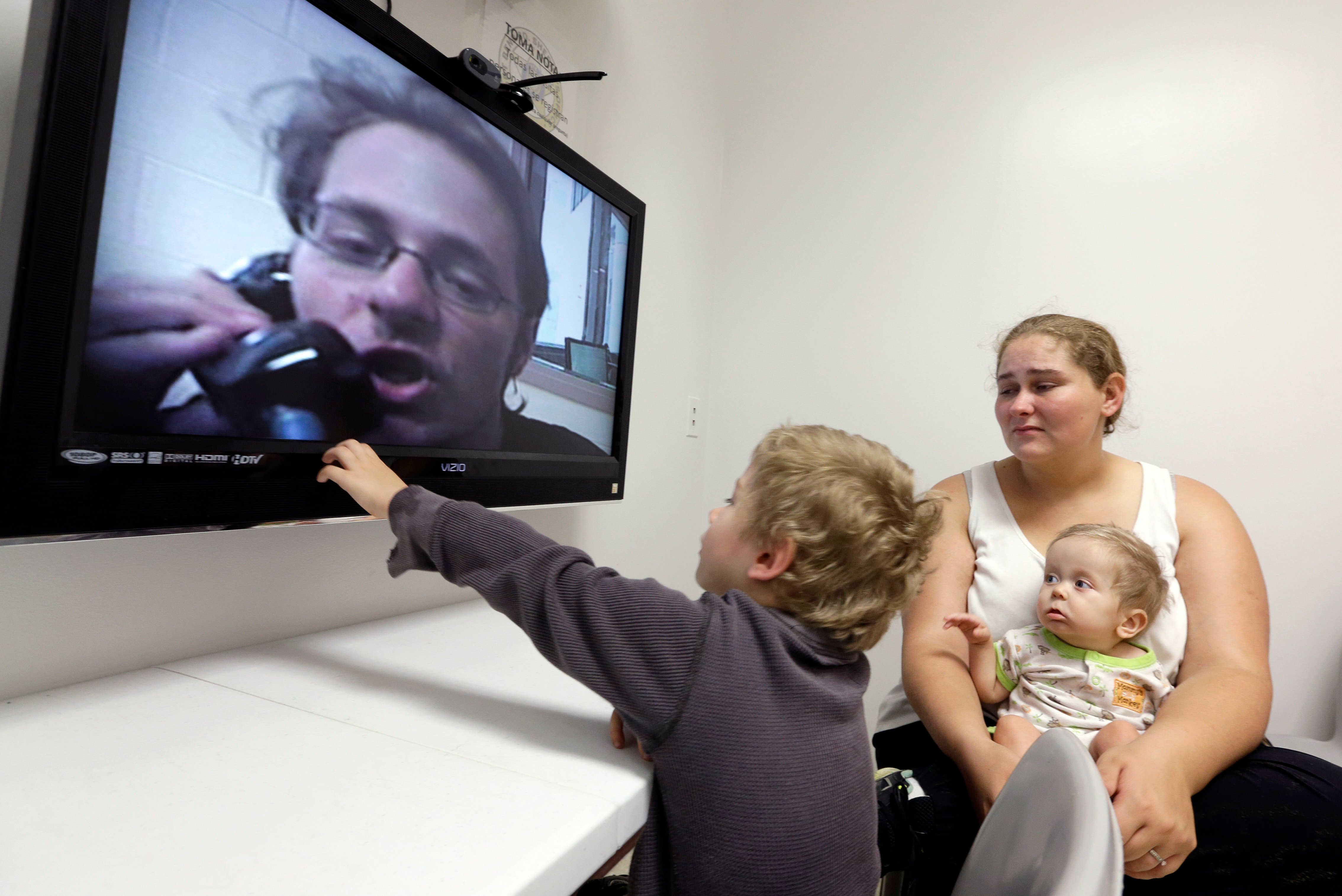
This past summer, my team at Berkeley Law’s Criminal Law & Justice Center—in partnership with Civil Rights Corps, Public Justice, and the firm BraunHagey & Borden—filed a class-action lawsuit on behalf of some of those children in Solano County, California. At the Solano County jails, families are not generally permitted to be in the same room as the people they love. The main option for a “visit” is a video call: glitchy, surveilled, and, for a child, no substitute for a parent’s embrace.
Contact visits are an essential part of how children survive parental incarceration. I know, because they are how I did. In 1982, when a jail tried to keep my mother and me apart behind Plexiglass, my family sued in federal court and won; the judge wrote that “[t]he importance of contact visits to the detainees, their family and to the institution cannot be understated.” I was too young to fully understand the implications of the victory or even to remember how I found out about the ruling. One day there was soundproof Plexiglass separating us, and on the next visit it had been removed: an early lesson in the power of litigation to effectuate policy change. I do have vivid memories of turning the phone we had used as the only way to communicate through glass into a toy to play with in the otherwise barren space.
Today, over four decades later, children in Solano County are still separated from their parents, communicating almost exclusively through phones and pixels on a screen.
BaKari Etter, one of our lead plaintiffs in the case, is fifteen. His father has been jailed for nearly two years, awaiting trial. “Ever since my dad went to jail, I haven’t been able to hug him, touch him, or be in the same room as him,” he says. “I feel our relationship changing.”
Why would a government do this to its own vulnerable residents? Not for safety. For money.
Since 2014, Solano County has contracted with a company called iWebVisit, replacing nearly all in-person visits and taking up to a 35 percent cut of every paid call. This amounts to real money from those who can least afford it: in one recent year the county’s cut of profits amounted to $147,000. The video feeds, our suit alleges, are recorded and stored. They are likely mined with artificial intelligence. To be sure, there are those who say contact visits are dangerous or impossible in overcrowded jails. But experts know that jail staff are more often a source of contraband and, as of April, the county held 486 people in jails built for 1,439.
Solano County is not an outlier; it reflects a growing, dangerous trend that back in 2013, I warned could emerge as a replacement rather than a supplement to contact visits. A 2024 investigation by the Investigative Reporting Lab at Yale identified more than 100 jails across 36 states that have done away with in-person visits entirely. National vendors like Securus and ViaPath, backed by private equity, take in hundreds of millions of dollars a year selling families access to their own loved ones. More than a third of families with an incarcerated relative go into debt trying to stay in touch. The poorest lose contact altogether.

I know from experience that incarceration doesn’t have to sever these bonds. I was lucky that my mother, once sentenced to state prison, was housed in New York’s Bedford Hills Correctional Facility, a model in facilitating mother-child bonding despite the distance incarceration creates. Other women entered prison pregnant and were able to keep their newborns with them for up to 18 months while breast feeding and establishing the critical foundation for a lifetime bond. A third of the visiting room was dedicated to a Children’s Center with carpeted floors, stuffed animals, a story corner, arts and crafts projects, all overseen by the effervescent nun Sister Elaine Roulet. She had arranged for a big rainbow to be painted on the wall and for all of us kids to put our handprints in bright colors underneath it. Above the rainbow, over the doors from the adult section of the visiting room, were the words: “Joy is unbreakable, so it is perfectly safe in the hands of children.”
The prison had a big outdoor patio attached to the visiting room. The patio was closed most of the year, but in the summers it was open for mothers and their children participating in Sister Elaine’s “Summer Program.” On hot summer days, groups of us would visit every day for a week or more. Those who lived too far to make the daily trip were paired with a local family that volunteered to house us after visits. During the day we played volleyball, made new friends, held talent shows, and worked on projects. Often, we got soaked with water fights on the patio before coming back into the chill of the air-conditioned visiting room to eat special donated lunches from places like McDonalds, instead of the usual vending machine fare.
The prisons my father served his decades in, by contrast, had no Sister Elaine. The visiting rooms were inhospitable places that a pack of cards or a raggedy old box of Monopoly did little to improve. But here, too, I was lucky. The prisons where I visited my father were among the few in the country that allow for overnight visitation. They had small trailers or modular homes inside the prison where immediate family members were allowed to visit for up to 44 hours at a time. A few times a year we spent the weekend cooking, playing catch, reading bedtime stories, and pretending to have a normal family life, albeit in the shadow of razor wire and guard towers. Those visits were the only time in 40 years my father had private showers, and for as long as he wanted. They were the only time he could cook for me, though over time his skills atrophied and the weekend menu became terribly repetitive: fruit and yogurt; salmon and broccoli; mushroom omelet. As I got older, and the decades passed, I taught myself to cook, practicing at home to master new recipes I thought he’d love. We both cherished every hour of those visits; they were the sinew holding together our family, solidifying a sense of identity, helping navigate the stigma and trauma of abandonment, separation, and collective punishment.
I’ve known, since I was a child, how fortunate I was to have meaningful visits with my incarcerated parents and how critical those quality visits were to their rehabilitation and to my own success in life. Thus, throughout my life, I’ve fought to expand opportunities for children to have meaningful relationships with their justice involved parents. It shouldn’t require good luck for children to get a chance to know their parents. As an activist in high school and college I traveled the country speaking about the impact of parental incarceration and supporting the roll out of the Bill of Rights for Children With Incarcerated Parents. In law school I researched and published articles on the rights of children with incarcerated parents. Later, as a public defender and as San Francisco’s elected district attorney, I volunteered to support contact visits in the county jail on weekends and launched a new diversion program for primary caregivers.

Now, with our suit against Solano County, my advocacy has come full circle, back to that 1982 lawsuit we filed to demand contact visits with my mom in pretrial detention.
Joseph Duran Jr., another lead plaintiff in our case, is a 60-year-old laborer with a local union. Decades ago, when he was the one incarcerated, he was allowed to hold his child in his arms. Now that his son is behind bars, the denial of contact visits is devastating. “There are things a father wants to do that you cannot do over a screen. I cannot put my hand on his shoulder. I cannot hug him. I cannot sit next to him in silence,” Duran explains. “When the video call ends, I feel a deep sense of loss that I cannot be with him in-person.” Joseph knows “that physical touch is essential to maintaining love, care, and human connection. Without it, people lose their connection.”
Tearing families apart makes us less safe, not more. Nearly everyone held in a county jail is coming home, often within weeks. Corrections departments’ own research—including a large study from Minnesota—finds that people who receive visits are meaningfully less likely to reoffend. Children who stay connected to a parent inside do better in school and in life. Researchers have warned, for decades, that parental incarceration increases the risk of child antisocial behavior, arrest, mental illness, substance abuse, school failure, and unemployment. When we sever the parent-child bond for profit, we manufacture the very harms we claim to be preventing.
The plaintiffs in Solano are not asking for anything extravagant. They are asking a court to recognize what every child already understands: a screen is not a visit, a paid video call is not a hug, and a family’s right to remain whole should not vanish at the jailhouse door. BaKari should be able to feel his father’s arms around him. Joseph should be able to hold his son. Four decades ago, a judge said a child like me deserved that much and it helped save my life. It should not take another forty years to realize this fundamental constitutional right for the children fighting for it today.


%20(crop).jpg?width=352&name=wile-e-coyote%20(resize)%20(crop).jpg)