
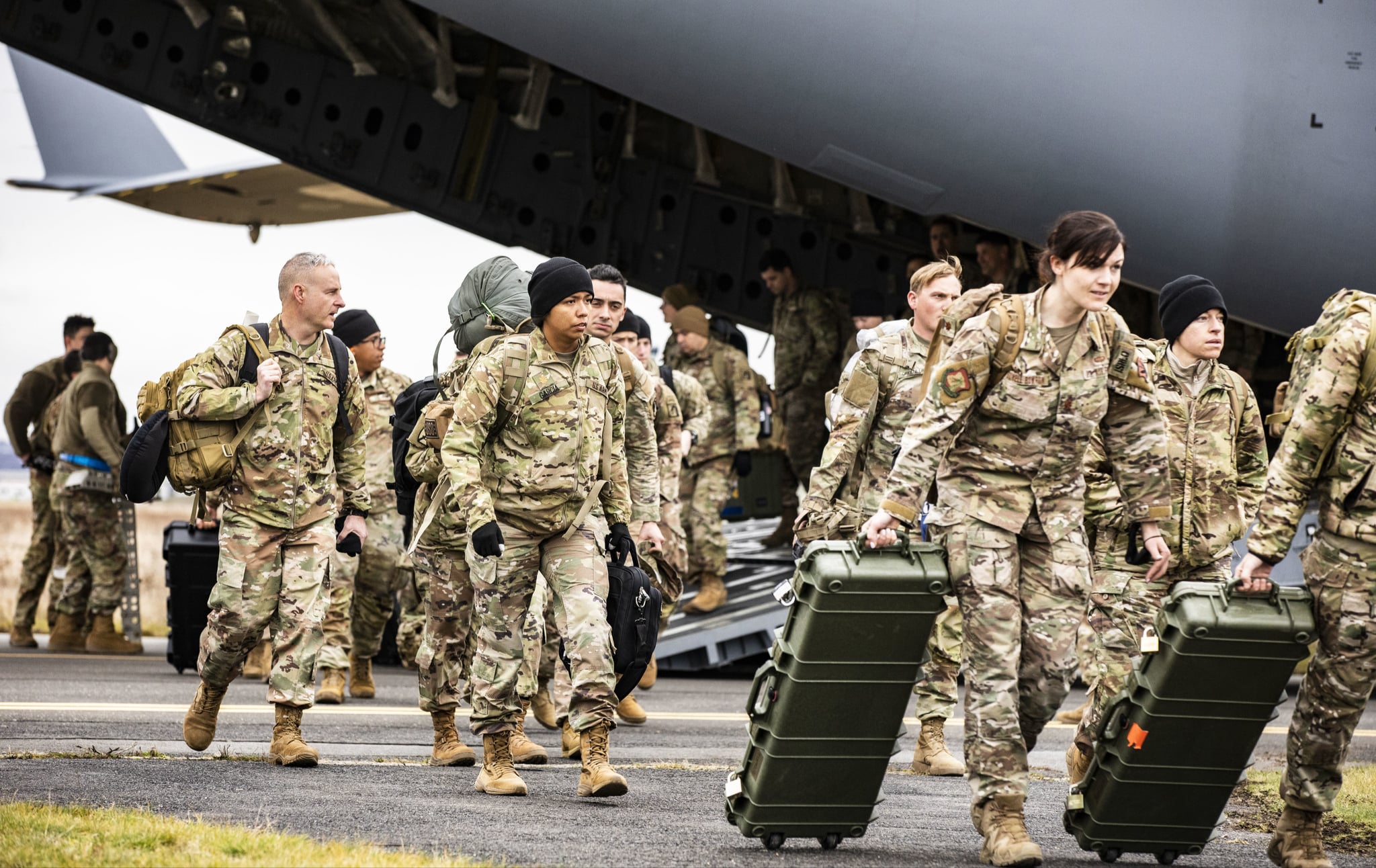
Attacking Iran serves America’s rulers, not its people. Are military leaders going to get away with sending you to another pointless war?
If you currently serve in the U.S. military, it is time to reconsider your service. If you have been assigned to duties in the Middle East, object or leak to the press. And if you are thinking of signing up, don’t.
Your time and health should not be sacrificed for an immoral and nonsensical conflict with Iran. The negative consequences will not affect the leaders sending you to war, but they will hurt you, your family, and the common American household you vowed to protect. Those households did not ask you to get hurt over this.
Military and government leaders have gotten away with playing with your life for too long. If you resist now, they will be forced to think twice before putting you in harm’s way. It is also better to act now, while there is a lull in fighting, than later, when escalation may run completely out of control.
During an unpopular and unjust war, common soldiers expressing their discontent can be an immensely powerful constituency. We saw this most clearly in the G.I. Movement of the 1970s, when American service members and veterans participated in the wave of protest that helped end the Vietnam War. But the dynamic can also be seen across the world. In Russia, disaffected Soviet-Afghan war veterans contributed to a political upheaval in the 1980s that prompted Vladimir Putin, decades later, to give Ukraine war veterans a bigger political voice. In 2022, dramatic pushback from would-be draftees forced the authoritarian leader to transition away from attempts at mass conscription. The same pattern holds across time: Alexander the Great conquered most of the world known to him, but even he had to stop when his soldiers mutinied in India. The bottom line is that wars can’t be fought if soldiers don’t fight.
Service members concerned they would be shirking their duty need only look to the commander in chief putting them on the front line. A young Donald Trump dodged the draft five times because he correctly understood the Vietnam War was not worth dying for.
Many will argue that service members cannot simply pick and choose which conflicts they participate in; that the nature of military service by definition requires unique sacrifices of personal freedoms. If service members can simply walk away from the job when they feel like it, the argument goes, there is little point to having a military.
There is some truth to this, but few consider the other side of the coin: those sacrifices cannot be taken lightly by the state either. When service members die or are wounded for a cause that doesn’t make sense, as is often the case, decision makers must face consequences—or they will repeat their mistakes.
This dynamic plays out legally too. President Truman was the first to enter a conflict without getting a formal declaration of war from Congress, as the Constitution requires, and that has set the precedent for every president since. But until now presidents at least sought congressional approval for major conflicts; this disastrous war began without even a consultation from lawmakers. It marks the nail in the coffin for the separation of powers and for the 1973 War Powers Resolution, which requires unauthorized troop commitments to be limited to 60 days. Absent resistance now, the law will be meaningless, and presidents will have no checks on their ability to start major wars.
Americans are being sent into harm’s way today for a stupid, immoral project because the Pentagon recently got away with it twice in a row, in Iraq and Afghanistan, with little consequence. And the tragic irony is that if more service members die in Iran today, their loss will only enable the decision makers to waste more lives in future pointless conflicts.

Those Who Order Deployments vs. the Deployed
The disconnect between those who send people to war and those who get sent to war is sobering. To use a recent example, last fall the Pentagon spent $15.1 million on rib-eye steak, $6.9 million on lobster tail, $2 million on Alaskan king crab, and $98,000 on a grand piano for the residence of the Air Force’s chief of staff. The justification: the Pentagon was trying to find ways to burn tens of billions of dollars in use-it-or-lose-it spending in the last month of the 2025 fiscal year.
Compare the eight figures dished out on rib-eye steak to the grub reportedly aboard the USS Abraham Lincoln and other Navy vessels in the region. Military planners who made this mess get steak, while sailors get dismal-looking food rations and moldy showers. The top brass get grand pianos. You get the longest carrier deployment since the Vietnam War.
The gross-looking food being fed to sailors grabs headlines for good reason, but here’s a longer-term one: at any given point, approximately a quarter of military families are food insecure.
In fact, that piano alone is worth much more than what most active-duty service members earn in a year. Over 71 percent of active-duty troops in 2024 were in the E1 through E6 pay grades; on the low end, a newly recruited soldier ranked E1 would earn a base pay of $25,297 a year, roughly a fourth of the value of the piano gifted to the Air Force’s chief of staff, while a soldier ranked E6 with eight years of service would earn $53,326 a year, just over half the piano.
That’s for those serving full-time. The first six American casualties of the conflict—who died when a drone hit a base in Kuwait—were Army reservists, meaning they were likely serving part-time and may have had other jobs. Based on publicly available information about their ranks, the six reservists killed in Kuwait would have likely been earning a base pay in the range of $5,800 to $16,400 a year.
One survivor of the attack in Kuwait, Sgt. First Class Cory Hicks, remarked to a local news outlet that deployments to the country used to be jokingly referred to as vacations, because “There hasn’t been war in Kuwait for over 30 years. You know, we thought we were safe.” He suffered nerve damage to his face that makes it difficult to smile.
When an airplane refueling tanker crashed in Iraq this March, killing six, three of the dead were in the Ohio Air National Guard—again, likely part-time. The plane likely lacked parachutes, as the Air Force pulled them from its fleet of refueling tankers to cut costs back in 2008. (After all, that $2 trillion F-35 program won’t pay for itself.)
This trend even shows in who’s being wounded. The latest stats put the number of American troops wounded as a result of “Operation Epic Fury” at nearly 800, and before the Pentagon changed how it lists casualties, nearly half of the number were from reserve or National Guard forces. The Pentagon has repeatedly said the vast majority of wounds have been minor, but both the total number of wounded and the number of injuries classified as minor have been credibly called into question. This is the same Pentagon that claimed damage to NSA Bahrain and other bases were minimal, and then quietly relocated everyone because the bases were rendered “virtually uninhabitable,” as a New York Times report put it. So how much do you believe them?
If the war escalates, American losses so far may come to look small. The Pentagon's underestimation of Iran means it has rapidly expended air defense munitions to the point defense officials are now intentionally letting some missiles and drones past defenses. They swear this rationing of air defenses doesn’t allow hits where troops may be at risk. But how well can that promise be kept, and as supplies run lower, how long can it remain the case? The president who made this gamble simply claims inventories aren’t low, and threatens to jail anyone who contradicts him, so you decide how much trust you can have in his word.
This War Hurts Your Family, and Everyone Else at Home
Now the administration is seeking a $1.5 trillion defense budget. Never mind that the Pentagon cannot be trusted to spend responsibly—if not evidenced by the lobster, then its failure to pass a single audit since 1990—the funds could come in part from cuts to or slowdowns in social spending. (“We’re fighting wars[...] It’s not possible for us to take care of day care, Medicaid, Medicare, all these individual things,” Trump recently said.)
It’s true the proposed budget calls for a substantial pay increase for the lower enlisted ranks. But the Pentagon hopes that giving troops the bare minimum in compensation will outweigh the economic pain brought to their families and other civilians at home.
As the administration spends money on defense and on tax breaks for the wealthiest Americans, it is asking the common household to shoulder the burden of curbing government spending. That includes the 42 million Americans receiving food stamps, including thousands of military households, and the millions struggling to afford health insurance. And while social services get cut, the supply chain shock the war started will drive up prices—not just at the gas pump, but everywhere.
The war’s economic effects have been muted in the U.S. so far, but this is unlikely to remain the case. Inflation has been tame because of an unusual mix of factors: an oversupply of oil, various countries’ buildup of energy supplies, and the economic behemoth that is China reducing its oil imports. Surplus supplies and stocks have already eroded considerably because of the strait’s closure, meaning China is one of the last lines of defense—and there are indications it will not want to continue relying on its reserves for long. In sum, the circumstances preventing massive price increases may fade soon.
Economic hardship will be the most immediate and common consequence Americans experience from the war. But there is now also an elevated risk of terrorism and cyberattacks. Some recent evidence for this: a spate of cyberattacks on dozens of U.S. water facilities that are believed to be linked to Iran.
Contrary to decades of fear-mongering, Iran had little incentive to sponsor terrorist attacks on U.S. soil prior to this conflict. But if it faces a war of survival—with not just regime leaders being targeted, but also threats to its critical infrastructure, and the deaths of thousands on the table—it has an incentive to use such asymmetrical tactics. Additionally, lone-wolf actors with little connection to Iran may find a new motivation to act on its behalf.
Terror attacks are not a certainty, and the prospect of them should not be invoked lightly, as the long assault on civil liberties shows. But it is a simple fact that there is a higher risk of them now than before the war. If the war resumes in full, the risk will increase. This is the opposite of keeping Americans safe.
This apathy for Americans’ safety has already been demonstrated by the callous disregard shown for military families in the Middle East at the start of the conflict.
Despite a months-long buildup of tensions and having full control over when it would start the war, the U.S. did not evacuate military families until after the first strikes started. This contrasts with the 12-day war in June 2025, which saw the military facilitate voluntary evacuations days before strikes commenced. The head of the 5th Fleet in March told families the displacement was expected to be brief; six months later, hundreds remained in temporary housing, and some report spending tens of thousands out of pocket to cover basic expenses.
Some may argue that military families agree to take some risk when they live abroad, or that the delayed evacuations were required for operational security and therefore part of the bargain. Even if one accepts this reasoning, the inverse would have to hold true: families agree to bear the risk with the understanding they will be protected. That deal was broken.
In short: if you signed up to protect your fellow Americans, aggression toward Iran does the opposite.

There’s a Better Way to Serve
If you joined mostly because you love your country, you can better serve it by resisting yet another disastrous war, which will leave both the United States and the Middle East worse off. The war is arguably illegal, and while soldiers rarely feel empowered to ask legal questions, there should be no guilt in refusing to wage an unlawful conflict.
If you joined to make the world a safer place, bombing Iran does the opposite. The immediate regional escalation aside, it’s a flagrant violation of the UN charter. With regional tensions rising and multipolarity increasing, international law has never been more necessary.
If you joined primarily because it was a good way of finding financial stability and/or advancing your career, consider if those benefits outweigh the risk of losing an arm, leg, or more commonly, losing cognitive ability from concussions and blast exposures.
The clearest signal to Pentagon planners is conscientious objection. Realistically, only a small number of troops will go this route, but even a small uptick will catch the eye of military planners.
A successful conscientious objection requires clearing a high bar. An objector must prove that they have a deep personal conviction against war—not simply a specific war, but war in general. This is traditionally a religious conviction, but does not have to be, as long as the ethical belief holds the same weight as a religious one. For more information on or assistance with the process, contact the Center on Conscience and War.
There is no hiding that conscientious objection has consequences, and as someone writing under a pseudonym, I cannot urge you to take risks. Those who do so may be ostracized and risk finding the years they already put into their military careers are not properly rewarded, if promotions and opportunities are denied. Loved ones back home may not understand, and even if they do, emotional support doesn’t replace paychecks or career stability. Consider too that this administration seems particularly hostile to dissent. Negative consequences are not inevitable, but they are a very real possibility.
If becoming a conscientious objector yourself is not a realistic option, you can try changing the culture around it. If your peers are interested, encourage them; if no one is talking about it but discontent is obvious, float the idea. A more permissive culture will enable more objectors.
Another option is to let your service contract expire without renewing it. It is subtle, but military planners will notice if there is an uptick in the number of troops exiting service. And if the uptick happens during or shortly after conflict with Iran, the signal will be undeniable.
You can also reach out to journalists—just do so securely. Americans at home have little idea what troops are going through in combat deployments, and media reports are the primary way they find out.
Whatever your precise motivations for joining the military were, belief in service was almost certainly a factor. And right now, the most heroic act of service is refusing to fight.


%20(crop).jpg?width=352&name=wile-e-coyote%20(resize)%20(crop).jpg)